
Soy Flour Market Size, Trend, Growth, Industry Analysis 2034

Soy Flour Market By Application (Nutraceuticals, Food Industry, Cosmetics, Animal Feed, and Others), By Type (Defatted Soy Flour, Regular Soy Flour, Organic Soy Flour, and Instant Soy Flour), By End-use (Residential and Commercial), By Sales Channel (Specialty Stores, Direct Sales, Supermarkets/Hypermarkets, and Online Retail), and By Region - Global and Regional Industry Overview, Market Intelligence, Comprehensive Analysis, Historical Data, and Forecasts 2025 - 2034
| Market Size in 2024 | Market Forecast in 2034 | CAGR (in %) | Base Year |
|---|---|---|---|
| USD 4.05 Billion | USD 6.78 Billion | 5.90% | 2024 |
Soy Flour Industry Perspective:
What is the anticipated size of the soy flour market during the projection period?
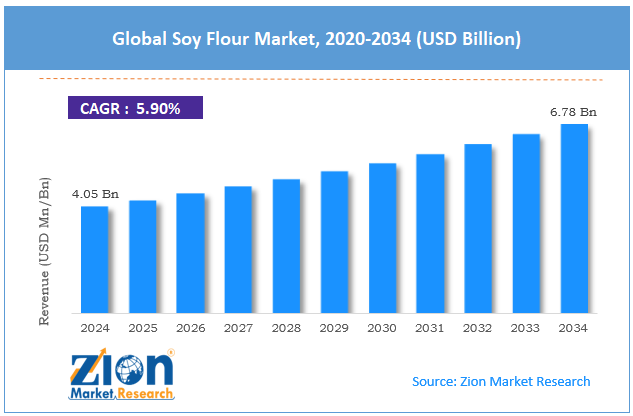
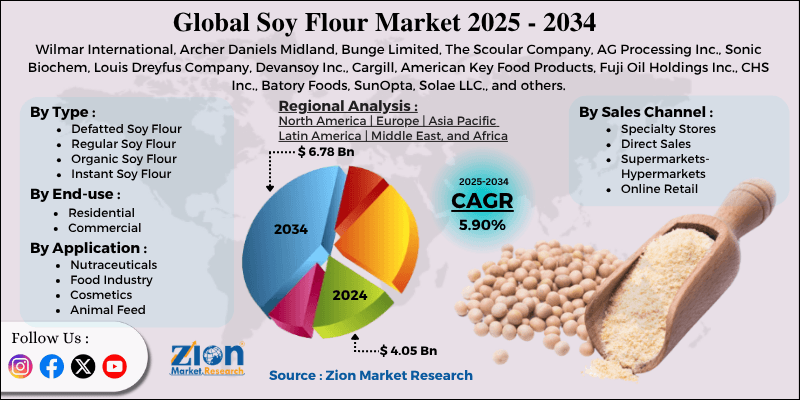
The global soy flour market size was worth around USD 4.05 billion in 2024 and is predicted to grow to around USD 6.78 billion by 2034, with a compound annual growth rate (CAGR) of roughly 5.90% between 2025 and 2034.
Key Insights:
- As per the analysis shared by our research analyst, the global soy flour market is estimated to grow annually at a CAGR of around 5.90% over the forecast period (2025-2034)
- In terms of revenue, the global soy flour market size was valued at around USD 4.05 billion in 2024 and is projected to reach USD 6.78 billion by 2034.
- The soy flour market is projected to grow at a significant rate due to the rising health awareness among the general population.
- Based on the application, the food industry segment is growing at a high rate and will continue to dominate the global market, as per industry projections
- Based on the type, the defatted soy flour segment is anticipated to command the largest market share
- Based on the end-use, the commercial segment is expected to lead the market growth trends
- Based on the sales channel, the supermarkets/hypermarkets segment is projected to influence revenue in the market
- Based on region, the Asia-Pacific is projected to dominate the global market during the forecast period
Soy Flour Market: Overview
Soy flour is produced by finely grinding soybeans, also known as Glycine max. Soy flour or grits have extensive industrial and food applications. It is a source of gluten-free, high-protein foods due to its lysine content, compared to other cereal proteins. The soy flour industry is led by different types, including defatted and enzyme-activated versions. Leading applications of soy flour include baking procedures and as dairy alternatives. Additionally, soy flour is also applied in textile sizing, adhesive production, and animal feed formulations. Global demand for soy flour is expected to continue to grow due to rising health consciousness among the general population, increasing preference for gluten-free food items, and growing demand for healthy animal feed.
Moreover, government policies boosting soybean production will further help the industry thrive. However, rising geopolitical tensions and a changing global trade landscape may affect overall market revenue by the end of the projection duration.
Soy Flour Market: Dynamics
Growth Drivers
How will growing health awareness among the population influence soy flour market growth?
The global soy flour market is expected to be led by the rising health awareness among the general population. Soy flour is a protein-rich ingredient. Additionally, it is considered an excellent source of fiber and contains essential vitamins. Soy flour is gluten-free, further elevating the ingredient’s overall nutritional value. These factors make soy flour highly popular among health-conscious individuals. Factors such as the growing prevalence of chronic illnesses, rising awareness of the immune system, and increasing geriatric population are propelling demand for healthy, clean food items, thus creating revenue for soy flour distributors.
Rising vegan food trends to accelerate industry growth trends during the forecast period
Soy flour is a popular food choice among vegans. Soy flour is plant-based and does not contain meat-based protein. The last few years have witnessed an increase in the population relying solely on plant-based foods. Veganism is influenced by factors such as rising awareness around animal cruelty, growing zoonotic diseases, and the environmental impact of excess dependence on animal meat. As per official estimates, more than 75 million people worldwide follow a vegan diet. The number is expected to increase in the coming years, creating growth opportunities for players in the global soy flour market.
Restraints
How will evolving geopolitics limit soy flour market growth trends?
The global soy flour industry is expected to be limited due to evolving geopolitics worldwide. The US has imposed heavy tariffs on a range of agricultural products imports, resulting in several trade disputes with critical economies such as China and India. Additionally, ongoing wars affect the raw material supply chain, further creating growth barriers for the industry players. The rising geopolitical uncertainty will continue to affect the demand and supply of soy flour in the coming years.
Opportunities
Organic and clean-label soy flour-based products to create market growth opportunities
The global soy flour market is anticipated to experience new growth opportunities due to rising demand for specialty products. For instance, organic soy flour and clean-label products are gaining global popularity due to their health benefits. In February 2022, Benson Hill, a US-based food technology company, announced the launch of the TruVail line of non- Genetically Modified Organism (GMO) soy protein ingredients. The range offers less processed soy protein concentrate along with texturized proteins. According to official reports, TruVail emits 50% less carbon dioxide and uses 70% less water for production.
What expansion opportunities can soy flour market players expect from the rising demand for animal feed?
Soy flour is a prominent ingredient in high-performance animal feed. It is used in the production of pet food, livestock feed, and aquaculture. Soy flour has the right amino acid balance for animals. Additionally, the abundant availability of flour makes it a cost-effective ingredient. The rising use of animal feed worldwide will continue driving demand for soy flour. The global animal feed industry reached over USD 500 billion in 2025 and is projected to deliver a significant CAGR in the coming years. Rising pet adoption rates, growing animal health awareness, and surging demand for animal meat will work in favor of the industry players.
Challenges
Allergen concerns and competition from alternatives will challenge market growth in the future
The global soy flour industry will face challenges, as soy is a prominent allergen for a large portion of the world's population. Around 0.51% of the global population is allergic to soy products, thus affecting demand for soy flour. Additionally, competition from safer alternatives such as rice flour and pea protein may fragment market revenue in the long run.
Soy Flour Market: Report Scope
| Report Attributes | Report Details |
|---|---|
| Report Name | Soy Flour Market |
| Market Size in 2024 | USD 4.05 Billion |
| Market Forecast in 2034 | USD 6.78 Bllion |
| Growth Rate | CAGR of 5.90 |
| Number of Pages | 227 |
| Key Companies Covered | Wilmar International, Archer Daniels Midland, Bunge Limited, The Scoular Company, AG Processing Inc., Sonic Biochem, Louis Dreyfus Company, Devansoy Inc., Cargill, American Key Food Products, Fuji Oil Holdings Inc., CHS Inc., Batory Foods, SunOpta, Solae LLC., and others. |
| Segments Covered | By Application, By Type, By End-use, By Sales Channel, and By Region |
| Regions Covered | North America, Europe, Asia Pacific (APAC), Latin America, Middle East, and Africa (MEA) |
| Base Year | 2024 |
| Historical Year | 2019 to 2023 |
| Forecast Year | 2025 - 2034 |
| Customization Scope | Avail customized purchase options to meet your exact research needs. Request For Customization |
Soy Flour Market: Segmentation
The global soy flour market is segmented based on application, type, end-use, sales channel, and region.
Why will the food industry emerge as the leading application in the flour market during the forecast period?
Based on application, the global market segments are nutraceuticals, the food industry, cosmetics, animal feed, and others. In 2024, the highest growth was listed in the food industry segment, accounting for 38.05% of the global revenue. It is projected to grow at a CAGR of 7.7% during the forecast period and will continue to dominate the market as demand for plant-based food ingredients continues to rise. The animal feed segment is expected to emerge as the fastest-growing segment with a CAGR of 10.09% due to rising demand for clean-label animal feed and pet food.
What is the projected CAGR for defatted soy flour in the soy flour market during the forecast period?
Based on type, the global soy flour industry is divided into defatted soy flour, regular soy flour, organic soy flour, and instant soy flour. The defatted soy flour segment accounted for 61% of the global market share in 2024 and will continue to lead the industry, with a CAGR of 7.57%. Rising demand for plant-based protein, health consciousness among the general population, and surging bakery applications of the ingredient will aid segmental expansion.
Which factors will help the commercial segment lead the soy flour market during the forecast period?
Based on end-use, the global market divisions are residential and commercial. In 2024, the highest revenue was listed in the commercial segment. It accounted for 65% of global revenue and is projected to deliver a CAGR of 8.01% during the forecast period. Rising demand in the food service industry, bakery applications, and growing consumer demand for plant-based nutraceuticals will aid segmental expansion in the future.
How is the supermarket/hypermarkets segment expected to perform in the soy flour market over the projection period?
Based on the sales channel, the global market fragments are specialty stores, direct sales, supermarkets/hypermarkets, and online retail. 2024 was dominated by the supermarkets/hypermarkets, accounting for 43% of the global revenue. It is expected to show a CAGR of 6.9% during the projection period due to rising sales of consumer goods through supermarkets. Additionally, these facilities offer a wider range of options for end consumers while remaining cost-effective.
Soy Flour Market: Regional Analysis
Why will Asia-Pacific emerge as the leading region in the soy flour market during the forecast period?
The global soy flour market will be led by Asia-Pacific during the forecast period. In 2024, the region accounted for nearly 50% of the global trade, with China and India leading the regional revenue. Asia-Pacific is projected to deliver a CAGR of 7.57% during the forecast period due to higher regional demand for soy flour. It is a common ingredient in regional cuisines. Furthermore, China and India are among the leading soybean producers, ensuring an abundant supply of raw materials. Rising health consciousness among the general population and the growing demand for plant-based food items will help accelerate growth in the Asia-Pacific.
How is North America expected to perform during the forecast period in the soy flour market?
North America is expected to emerge as the second-highest revenue generator during the forecast period with a CAGR of 7.02%. It accounted for 27% of the global revenue in 2024. Growth in North America is driven by high demand for protein-rich foods and a growing nutraceutical market. Furthermore, the region is heavily influenced by rising consumption of organic and specialty soy flour, along with greater demand for superior-quality animal feed.
Soy Flour Market: Competitive Analysis
The global soy flour market is led by players like:
- Wilmar International
- Archer Daniels Midland
- Bunge Limited
- The Scoular Company
- AG Processing Inc.
- Sonic Biochem
- Louis Dreyfus Company
- Devansoy Inc.
- Cargill
- American Key Food Products
- Fuji Oil Holdings Inc.
- CHS Inc.
- Batory Foods
- SunOpta
- Solae LLC.
What are the latest key trends in the soy flour market?
Expansion through e-commerce channels
A promising trend in the soy flavor industry has emerged in the form of growing sales of soy flour through e-commerce channels, especially grocery delivery applications. Quick commerce proliferations will create new growth avenues for industry players.
Product innovation
Product innovation is a promising soy flour market trend. It includes the sale of soy flavor in different forms and packaging. For instance, soy flour with high digestibility and pre-functionalized formats are novel offerings in the industry.
The global soy flour market is segmented as follows:
By Application
- Nutraceuticals
- Food Industry
- Cosmetics
- Animal Feed
- Others
By Type
- Defatted Soy Flour
- Regular Soy Flour
- Organic Soy Flour
- Instant Soy Flour
By End-use
- Residential
- Commercial
By Sales Channel
- Specialty Stores
- Direct Sales
- Supermarkets/Hypermarkets
- Online Retail
By Region
- North America
- The U.S.
- Canada
- Mexico
- Europe
- France
- The UK
- Spain
- Germany
- Italy
- Rest of Europe
- Asia Pacific
- China
- Japan
- India
- Australia
- South Korea
- Rest of Asia Pacific
- The Middle East & Africa
- Saudi Arabia
- UAE
- Egypt
- Kuwait
- South Africa
- Rest of the Middle East & Africa
- Latin America
- Brazil
- Argentina
- Rest of Latin America
Table Of Content
Methodology
FrequentlyAsked Questions
Soy flour is produced by finely grinding soybeans, also known as Glycine max. Soy flour or grits have extensive industrial and food applications.
The global soy flour market is expected to be led by the rising health awareness among the general population.
According to study, the global soy flour market size was worth around USD 4.05 billion in 2024 and is predicted to grow to around USD 6.78 billion by 2034.
The CAGR value of the soy flour market is expected to be around 5.90% during 2025-2034.
Allergic reactions and competition from safer alternatives are the major challenges restraining the growth of the soy flour market.
The global soy flour market has performed well so far and will offer similar trends in the coming years.
The various stages in the value chain of the global soy flour industry include seed development, soybean cultivation, primary processing, quality control and certification, packaging and branding, and distribution.
The global soy flour market will be led by Asia-Pacific during the forecast period.
The global soy flour market is led by players like Wilmar International, Archer Daniels Midland, Bunge Limited, The Scoular Company, AG Processing Inc., Sonic Biochem, Louis Dreyfus Company, Devansoy Inc., Cargill, American Key Food Products, Fuji Oil Holdings Inc., CHS Inc., Batory Foods, SunOpta, and Solae LLC.
The report explores crucial aspects of the soy flour market, including a detailed discussion of existing growth factors and restraints, while also browsing future growth opportunities and challenges that impact the market.

HappyClients

