
Printed Circuit Board (PCB) Market Size, Share, Value and Forecast 2034

Printed Circuit Board (PCB) Market By Product Type (Single-Sided PCB, Double-Sided PCB, Multilayer PCB, Flexible PCB, Rigid-Flex PCB, High-Density Interconnect PCB), By Application (Consumer Electronics, Automotive Electronics, Telecommunications and Networking, Industrial Machinery and Automation, Medical Devices, Aerospace and Defense), By End-User (Electronics Manufacturers, Automotive Companies, Telecommunications Providers, Medical Device Makers, Industrial Equipment Producers, Defense and Aerospace Organizations), By Distribution Channel (Direct Supply to Original Equipment Manufacturers, Electronic Component Distributors, Online Procurement Platforms, Contract Electronics Manufacturers), and By Region - Global and Regional Industry Overview, Market Intelligence, Comprehensive Analysis, Historical Data, and Forecasts 2025 - 2034
| Market Size in 2024 | Market Forecast in 2034 | CAGR (in %) | Base Year |
|---|---|---|---|
| USD 74.14 Billion | USD 129.68 Billion | 6.38% | 2024 |
Printed Circuit Board (PCB) Industry Perspective:
What will be the size of the printed circuit board (PCB) market during the forecast period?
The global printed circuit board (PCB) market size was worth approximately USD 74.14 billion in 2024 and is projected to grow to around USD 129.68 billion by 2034, with a compound annual growth rate (CAGR) of roughly 6.38% between 2025 and 2034.
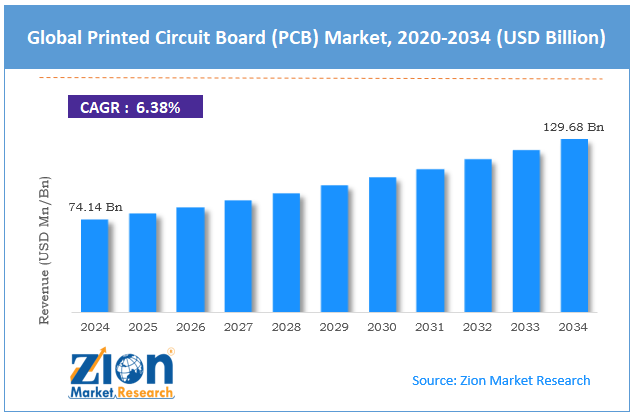
Printed Circuit Board (PCB) Market: Overview
A printed circuit board (PCB) is a flat board that mechanically supports and electrically connects electronic components using conductive pathways etched onto an insulating surface. It is made from an insulating material, such as fiberglass, with thin copper wires on its surface. These copper lines act like roads, carrying electrical signals between components such as microchips, resistors, capacitors, and transistors. Each connection is carefully designed so that signals move in the correct path without interference. A PCB replaces the need for messy wires and helps keep devices compact, organized, and reliable. It allows manufacturers to produce electronic products in large volumes while maintaining consistent quality. Strong materials and precise design also make PCBs durable enough to handle heat, vibration, and regular use. PCBs are found in a wide range of everyday and advanced products. Common examples include smartphones, laptops, televisions, washing machines, and cars. Growing digital adoption, smart technologies, and connected devices are increasing the importance of PCBs. Efficient design and continuous innovation in PCB technology play a key role in improving performance, reducing size, and supporting the development of modern electronics across industries.
The printed circuit board market is expected to grow steadily, driven by consumer electronics, EVs, 5G rollout, medical devices, industrial automation, and advanced PCB technologies.
Key Insights
- As per the analysis shared by our research analyst, the global printed circuit board (PCB) market is estimated to grow annually at a CAGR of around 6.38% over the forecast period (2025–2034).
- In terms of revenue, the global printed circuit board market size was valued at approximately USD 74.14 billion in 2024 and is projected to reach USD 129.68 billion by 2034.
- The printed circuit board market is set for strong growth driven by rising demand for consumer electronics, 5G expansion, increasing use in EVs and autonomous systems, growth in medical and wearable devices, expanding industrial automation, and ongoing PCB miniaturization and performance advancements.
- Based on product type, the multilayer PCB segment is expected to lead the printed circuit board market, while the flexible PCB segment is anticipated to grow at the fastest rate.
- Based on application, the consumer electronics segment is expected to lead the printed circuit board market, while the automotive electronics segment is anticipated to grow rapidly.
- Based on end-user, the electronics manufacturers segment is the largest current end-user group, while the automotive companies segment is anticipated to grow most rapidly during the forecast period.
- Based on distribution channel, the direct supply to the original equipment manufacturers segment is expected to lead the printed circuit board market, while the online procurement platforms segment is anticipated to grow steadily.
- Based on region, Asia Pacific is projected to dominate the global printed circuit board market during the estimated period, followed by North America.
Impact of the USA-Israel war on Iran on the Printed Circuit Board (PCB) Market
The ongoing USA-Israel war on Iran is expected to have a direct short-term and long-term impact on electronics manufacturing and PCB supply chains. The current rise in energy and material costs due to supply disruptions will increase PCB production costs in the short term. However, as countries focus on domestic electronics production and defense technologies, the printed circuit board (PCB) market may achieve long-term growth.
Printed Circuit Board (PCB) Market: Technology Roadmap 2025–2034
What is the projected development roadmap of the printed circuit board market over the forecast period?
The printed circuit board market is evolving through advances in high-density interconnect design, flexible and stretchable board technologies, embedded component integration, improved thermal management materials, and AI-assisted design and fabrication processes. The market is expected to grow at a CAGR of around 6.38% over the forecast period, driven by strong demand from the consumer electronics, automotive, telecommunications, medical, and industrial sectors.
The following roadmap outlines key development phases expected through 2034.
2025–2027: 5G Expansion and Advanced PCB Technology Growth Phase
- PCB manufacturers are expected to increase production of high-density interconnect boards and advanced packaging substrates to meet rising demand from 5G equipment, data centers, and high-performance computing.
- Flexible and rigid-flex PCBs are likely to grow, driven by wearable devices, foldable phones, and modern car interiors where space and flexibility matter.
- Embedded component technology, where parts are built directly into PCB layers, is projected to gain wider use, helping reduce size and improve performance.
2028–2031: Electric Vehicle Electronics with Smart Manufacturing Phase
- Automotive-grade PCB production is expected to grow as electric vehicles require reliable, heat-resistant boards for batteries, power systems, and driver-assistance features.
- Smart factories using AI and machine vision for inspection and quality checks are likely to become common in advanced PCB manufacturing.
- Eco-friendly PCB production, including the use of halogen-free materials and improved recycling, is expected to grow as sustainability standards become stricter.
2032–2034: Next-Generation PCB Materials and Ultra-High-Density Innovation Phase
- Next-generation PCBs using advanced materials and very dense designs are expected to support AI systems, quantum technologies, and future telecom hardware.
- Stretchable, biodegradable PCBs may see early use in wearable medical devices and disposable electronics, supporting both flexibility and sustainability.
- Digital twins of PCB manufacturing are projected to be widely adopted, helping improve quality, accelerate design changes, and optimize production efficiency.
Printed Circuit Board (PCB) Market: Dynamics
Growth Drivers
What factors are accelerating growth in the printed circuit board market as electronics and digital infrastructure expand?
The printed circuit board industry is growing steadily as the world depends more on electronics, digital connectivity, and smart systems in everyday life. Every electronic device and network system needs a PCB to work properly, which keeps demand consistently high. Rising consumer electronics usage, supported by higher incomes and constant product upgrades, continues to drive strong demand. Smartphones alone account for a major share, with billions of units shipped every year, while laptops, tablets, wearables, and smart home devices add to the overall volume.
At the same time, the rapid expansion of 5G networks is driving strong growth in the printed circuit board market. Building 5G infrastructure requires a large number of base stations, antennas, and routers, all of which depend on advanced PCBs designed for high speed and heat resistance. Strong investments in telecom infrastructure across Asia, North America, and Europe are further driving demand for specialized, high-performance circuit boards.
The electric vehicles and industrial automation are driving high-growth opportunities in the printed circuit board market.
The printed circuit board market is growing strongly due to the rapid rise of electric vehicles and the increasing adoption of industrial automation worldwide. Electric vehicles use far more electronic systems than traditional cars, thereby increasing demand for high-quality PCBs. Key systems such as battery management, power control, motor operation, advanced driver assistance, infotainment, and connectivity all depend on reliable circuit boards. As electric vehicle sales continue to increase globally, demand for automotive PCBs is rising at the same pace, along with the need for better performance, heat resistance, and durability.
At the same time, industrial automation is becoming a major growth driver for the printed circuit board market. Smart factories, robotics, machine vision, and industrial IoT systems all rely on PCBs to function efficiently. These boards must operate in harsh conditions, such as high temperatures and constant vibration, which underscores the need for durable designs. As industries continue upgrading to automated and intelligent systems, PCB demand in the industrial sector is steadily expanding, supporting long-term market growth.
Restraints
How are supply chain risks and complex manufacturing processes challenging growth in the printed circuit board market?
The printed circuit board market faces key challenges due to its heavy reliance on complex supply chains and highly precise manufacturing processes. PCB production depends on materials such as copper laminates, resins, specialty chemicals, and precious metals, many of which are sourced from limited global suppliers. Any disruption caused by trade issues, natural events, or logistics delays can quickly increase costs and slow down production. At the same time, manufacturing advanced PCBs is highly complex and requires strict control over temperature, chemicals, and equipment settings.
Even small errors can lead to defects and production losses. Producing high-end boards also requires expensive machinery, clean facilities, and skilled workers, thereby increasing overall costs. These factors create entry barriers for new players and can lead to supply shortages when demand rises suddenly, making it difficult for the printed circuit board market to maintain stable growth.
Opportunities
What opportunities are emerging from medical electronics and wearables in the printed circuit board market?
The printed circuit board industry is gaining strong opportunities from the rapid growth of medical electronics and wearable health devices. Healthcare systems are increasingly using electronic equipment to improve diagnosis, monitoring, and treatment, which is driving demand for reliable PCBs. Devices such as MRI machines, patient monitors, glucose meters, hearing aids, and portable diagnostic tools all depend on high-quality circuit boards to function safely and accurately. The need for long-lasting and highly reliable PCBs is especially important in healthcare, where device performance is critical. At the same time, the rise of wearable health technology is opening new growth areas for the printed circuit board market.
Products like smartwatches, fitness trackers, continuous glucose monitors, and smart medical patches require very small, lightweight, and flexible PCBs. These requirements are pushing innovation in PCB design and creating demand for advanced solutions beyond traditional boards. Companies that focus on medical-grade and flexible PCB technologies can benefit from steady demand, higher margins, and long-term partnerships in this fast-growing segment.
Challenges
Geopolitical supply chain risks and environmental concerns from PCB manufacturing waste remain key challenges for the industry.
The printed circuit board market faces ongoing challenges due to global supply chain risks and environmental concerns. PCB production is heavily concentrated in Asia, especially in China, Taiwan, South Korea, and Japan, making the industry sensitive to trade tensions, export controls, and political uncertainties. Efforts by North America and Europe to build local supply chains are increasing, but the process is slow, costly, and complex, keeping short-term risks high.
At the same time, PCB manufacturing involves the use of chemicals such as acids and solvents, which require careful handling to avoid environmental damage. The industry also produces waste materials, such as chemical sludge and discarded boards, which may contain harmful substances. Governments worldwide are tightening regulations on hazardous materials and waste management, forcing manufacturers to invest in cleaner processes and safer materials. These changes increase production costs and add operational challenges, making it harder for the printed circuit board market to balance growth with sustainability.
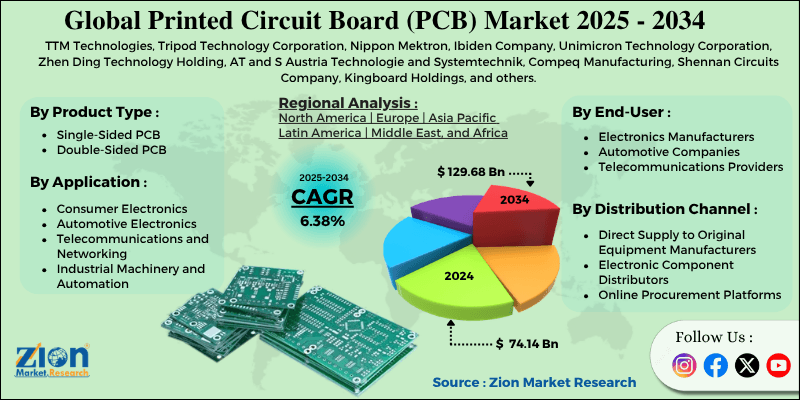
Printed Circuit Board (PCB) Market: Report Scope
| Report Attributes | Report Details |
|---|---|
| Report Name | Printed Circuit Board (PCB) Market |
| Market Size in 2024 | USD 74.14 Billion |
| Market Forecast in 2034 | USD 129.68 Billion |
| Growth Rate | CAGR of 6.38% |
| Number of Pages | 225 |
| Key Companies Covered | TTM Technologies, Tripod Technology Corporation, Nippon Mektron, Ibiden Company, Unimicron Technology Corporation, Zhen Ding Technology Holding, AT and S Austria Technologie and Systemtechnik, Compeq Manufacturing, Shennan Circuits Company, Kingboard Holdings, and others. |
| Segments Covered | By Product Type, By Application, By End-User, By Distribution Channel, and By Region |
| Regions Covered | North America, Europe, Asia Pacific (APAC), Latin America, Middle East, and Africa (MEA) |
| Base Year | 2024 |
| Historical Year | 2019 - 2023 |
| Forecast Year | 2025 - 2034 |
| Customization Scope | Avail customized purchase options to meet your exact research needs. Request For Customization |
Printed Circuit Board (PCB) Market: Segmentation
The global printed circuit board market is segmented by product type, application, end-user, distribution channel, and region.
What helps the multilayer PCB segment lead the printed circuit board market?
Based on product type, the global printed circuit board market is divided into single-sided PCBs, double-sided PCBs, multilayer PCBs, flexible PCBs, rigid-flex PCBs, and high-density interconnect PCBs. The multilayer PCB segment holds about 46% of the global market and remains dominant due to its ability to support complex circuits and high component density in modern electronics. The flexible PCB segment holds around 18% of the market share. It is growing rapidly, driven by rising demand for compact, lightweight, and bendable designs in wearables and advanced devices.
How does the consumer electronics application segment maintain its leading position in the printed circuit board market?
Based on application, the printed circuit board market is segregated into consumer electronics, automotive electronics, telecommunications and networking, industrial machinery, medical devices, and aerospace and defense. The consumer electronics segment accounts for about 38% of the global market and leads it due to high production of smartphones, laptops, and other smart devices. The automotive electronics segment holds around 20% share. It is growing quickly, driven by the increasing use of electronic content in electric and connected vehicles.
What makes the electronics manufacturers segment lead the printed circuit board market?
Based on end user, the printed circuit board market is categorized into electronics manufacturers, automotive companies, telecommunications providers, medical device makers, industrial equipment producers, and defense organizations. The electronics manufacturers segment accounts for about 37% of the global market and leads due to large-scale, consistent PCB demand across consumer electronics production. The automotive companies segment holds around 19% of the market share. It is growing as electronic systems become increasingly prevalent in modern vehicles.
What drives the dominance of direct supply to OEMs in the printed circuit board market?
Based on distribution channel, the printed circuit board market is classified into direct supply to original equipment manufacturers, electronic component distributors, online procurement platforms, and contract electronics manufacturers. The direct supply segment accounts for around 42% of the global market and remains dominant due to long-term supply agreements and quality control benefits. The online procurement platforms segment holds about 14% share. It is growing steadily, driven by demand for prototypes and small-volume orders.
Printed Circuit Board (PCB) Market: Regional Analysis
What makes the Asia Pacific the leading region in the printed circuit board market?
The printed circuit board market is led by Asia Pacific, which is expected to grow at a CAGR of around 7.5% during the forecast period. The region accounts for the largest share of global PCB production due to strong manufacturing infrastructure, a skilled workforce, and well-developed supply chains. China leads global production, contributing more than half of total output and supporting both domestic demand and exports across major regions. A large network of manufacturers in China, ranging from major companies to small specialized units, strengthens production capacity and flexibility. Taiwan plays a key role in advanced PCB technologies, especially in high-density boards, semiconductor packaging, and telecom applications. South Korea also contributes significantly, supported by strong electronics and semiconductor industries. Japan adds value through high-quality, specialty PCBs used in the automotive, industrial, and aerospace sectors.
Other countries such as Vietnam, Thailand, Malaysia, and the Philippines are emerging as additional manufacturing hubs as companies expand production beyond China. Government support and rising demand for electronics in these countries are further boosting regional growth. Strong production capacity, continuous technological development, and rising local consumption ensure that the Asia Pacific region remains the dominant region in the printed circuit board market. High investment in research and development is accelerating innovation in advanced PCB designs and materials. Cost advantages in large-scale production and efficient labor availability further strengthen competitiveness. Close integration with global electronics supply chains ensures faster production cycles and reliable delivery of high-volume orders.
What factors support North America's strong and growing position in the global printed circuit board market?
The printed circuit board market ranks North America as the second-largest region, with an expected CAGR of around 6.2% during the forecast period. The United States drives most of the demand, supported by a strong technology-focused economy that uses advanced PCBs in consumer electronics, defense systems, medical devices, telecom networks, and automotive applications.
Even though many consumer electronics PCBs are produced in Asia, the United States still maintains a strong domestic production base, especially for defense, aerospace, and medical applications, where local manufacturing and secure supply chains are critical. Government support in the United States is also playing a major role in shaping the printed circuit board market. Concerns about depending on foreign suppliers for critical electronic parts have led to policies that encourage local manufacturing, including incentives to build new PCB production facilities.
At the same time, the growing electric vehicle industry in North America is increasing demand for high-quality automotive PCBs that meet strict performance standards. Canada and Mexico are also supporting regional growth through expanding electronics assembly activities and rising investments in telecom infrastructure, making North America an important and evolving region in the global printed circuit board market.
Recent Market Developments
- In March 2026, India approved electronics manufacturing projects worth over $750 million involving companies such as Dixon Technologies and Lohum Cleantech to strengthen domestic supply chains for components, including PCBs, supporting telecom, automotive, and consumer electronics sectors.
- In February 2026, Broadcom highlighted ongoing supply constraints affecting PCB availability, noting extended lead times for optical transceiver PCBs due to capacity limitations in key Asian manufacturing hubs.
Printed Circuit Board (PCB) Market: Competitive Analysis
The leading players in the global printed circuit board market are:
- TTM Technologies
- Tripod Technology Corporation
- Nippon Mektron
- Ibiden Company
- Unimicron Technology Corporation
- Zhen Ding Technology Holding
- AT and S Austria Technologie and Systemtechnik
- Compeq Manufacturing
- Shennan Circuits Company
- Kingboard Holdings
The global printed circuit board (PCB) market is segmented as follows:
By Product Type
- Single-Sided PCB
- Double-Sided PCB
- Multilayer PCB
- Flexible PCB
- Rigid-Flex PCB
- High-Density Interconnect PCB
By Application
- Consumer Electronics
- Automotive Electronics
- Telecommunications and Networking
- Industrial Machinery and Automation
- Medical Devices
- Aerospace and Defense
By End-User
- Electronics Manufacturers
- Automotive Companies
- Telecommunications Providers
- Medical Device Makers
- Industrial Equipment Producers
- Defense and Aerospace Organizations
By Distribution Channel
- Direct Supply to Original Equipment Manufacturers
- Electronic Component Distributors
- Online Procurement Platforms
- Contract Electronics Manufacturers
By Region
- North America
- The U.S.
- Canada
- Mexico
- Europe
- France
- The UK
- Spain
- Germany
- Italy
- Rest of Europe
- Asia Pacific
- China
- Japan
- India
- Australia
- South Korea
- Rest of Asia Pacific
- The Middle East & Africa
- Saudi Arabia
- UAE
- Egypt
- Kuwait
- South Africa
- Rest of the Middle East & Africa
- Latin America
- Brazil
- Argentina
- Rest of Latin America
Table Of Content
Methodology
FrequentlyAsked Questions
A printed circuit board (PCB) is a flat board that mechanically supports and electrically connects electronic components using conductive pathways etched onto an insulating surface.
The global printed circuit board market is expected to grow, driven by demand for consumer electronics, 5G rollout, EVs, medical devices, automation, and ongoing PCB miniaturization and performance improvements.
According to a study, the global printed circuit board market size was worth around USD 74.14 billion in 2024 and is predicted to grow to around USD 129.68 billion by 2034.
The CAGR value of the printed circuit board market is expected to be around 6.38% during 2025–2034.
Asia Pacific is expected to lead the global printed circuit board market during the forecast period, driven by China's dominant PCB manufacturing base, Taiwan's advanced board technology capabilities, and the region's massive electronics production and consumption ecosystem.
The major players in the global printed circuit board market include TTM Technologies, Tripod Technology Corporation, Nippon Mektron, Ibiden Company, Unimicron Technology Corporation, Zhen Ding Technology Holding, AT and S Austria Technologie and Systemtechnik, Compeq Manufacturing, and Kingboard Holdings.
The report analyzes the printed circuit board market, covering drivers, restraints, opportunities, challenges, competitive landscape, regional insights, and future outlook across key segments.
The printed circuit board market faces challenges from supply chain disruptions, dependence on limited raw material sources, and rising costs of advanced materials. Complex manufacturing processes, strict quality requirements, environmental regulations, and high capital investment also limit scalability and create barriers for new entrants.
The printed circuit board market is highly competitive, with large global manufacturers and numerous regional players. Companies compete on technology, quality, pricing, and production scale, while advanced PCB segments remain dominated by specialized, high-capability manufacturers.
The printed circuit board market is shifting toward miniaturized, high-performance, and flexible boards, driven by demand from advanced electronics, electric vehicles, and wearable devices, as well as an increasing preference for reliable, energy-efficient designs.

HappyClients

