
Handmade Soap Market Size, Share, Trends, Growth, Forecast 2034

Handmade Soap Market By Product Type (Organic Soap, Natural Soap, Specialty Soap), By Ingredient Type (Essential Oils, Plant Extracts, Fragrance Oils), By End-User (Individual Consumers, Retailers, Spa and Wellness Centers), and By Region - Global and Regional Industry Overview, Market Intelligence, Comprehensive Analysis, Historical Data, and Forecasts 2025 - 2034
| Market Size in 2024 | Market Forecast in 2034 | CAGR (in %) | Base Year |
|---|---|---|---|
| USD 8,326.79 Million | USD 12,491.18 Million | 5.20% | 2024 |
Handmade Soap Industry Perspective:
What will be the size of the global handmade soap market during the forecast period?
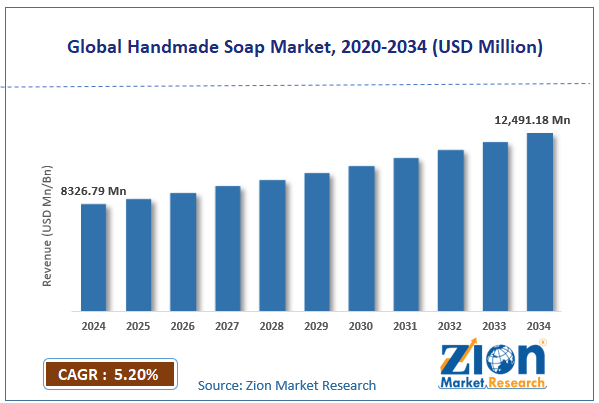
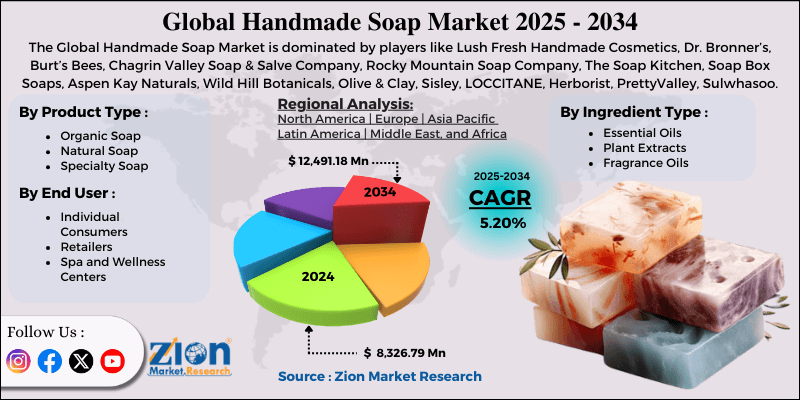
The global handmade soap market size was around USD 8326.79 million in 2024 and is projected to reach USD 12491.18 million by 2034, with a compound annual growth rate (CAGR) of roughly 5.20% between 2025 and 2034.
Key Insights:
- As per the analysis shared by our research analyst, the global handmade soap market is estimated to grow annually at a CAGR of around 5.20% over the forecast period (2025-2034)
- In terms of revenue, the global handmade soap market size was valued at around USD 8326.79 million in 2024 and is projected to reach USD 12491.18 million by 2034.
- The handmade soap market is projected to grow significantly owing to rising awareness of the harmful chemicals in commercial soaps, the expansion of e-commerce platforms, and the premiumization trend in personal care.
- Based on product type, the organic soap segment is expected to lead the market, with a higher share than the natural soap segment, which is anticipated to grow considerably but remain second.
- Based on ingredient type, the essential oils segment has the largest market share, while the plant extracts segment is expected to drive significant revenue growth over the forecast period.
- Based on end-user, the individual consumers segment is expected to lead the market, followed by the ‘retailers’ segment.
- By region, North America is projected to dominate the global market during the forecast period, followed by Europe.
Handmade Soap Market: Overview
Handmade soap is crafted in small batches using traditional techniques, such as hot or cold process, and blends natural oils, lye, and butters to create a gentle cleansing bar rich in glycerin. Unlike most commercial soaps, it contains nourishing ingredients like coconut oil, essential oils, shea butter, and botanical additives that protect and moisturize the skin. The global handmade soap market is projected to grow substantially, driven by rising demand for natural ingredients, heightened skin sensitivity and allergy concerns, and heightened environmental awareness. Growing consumer concern about parabens and other synthetic chemicals is accelerating demand for plant-based skincare alternatives. Handmade soaps formulated with herbs, natural oils, and essential oils support clean beauty preferences. This move towards ingredient transparency strongly supports industry growth.
Moreover, rising dermatology issues have compelled consumers to seek cleansing products. Handmade soaps retain natural glycerin and avoid harmful detergents that may cause skin issues. This perceived safety benefit motivates repeat purchases and brand loyalty. Furthermore, environmentally-conscious users prefer biodegradable products with minimal packaging waste. Handmade soaps usually feature sustainably sourced and plastic-free wrapping ingredients. This environmentally responsible positioning improves brand differentiation and demand.
Although drivers exist, the global market is challenged by factors such as higher raw material and production costs and limited shelf life. Natural oils and essential oils are more expensive than synthetic alternatives. Small-batch manufacturing further raises operational and labor expenses. These factors lead to higher retail prices and low price competitiveness. Likewise, handmade soaps usually avoid chemical preservatives that extend product lifespan. Exposure to heat and moisture can affect scent, texture, and performance, creating logistical, storage, and export challenges.
Even so, the global handmade soap industry is well-positioned due to the development of functional variants and its association with the hospitality and wellness industries. Soaps targeting anti-aging, acne control, baby care, or moisturizing address specific consumer needs. Functional differentiation improves product value beyond basic cleansing. This widens the industry's appeal across diverse age groups. Additionally, luxury hotels, spas, and resorts seek artisanal toiletries for enhanced guest experiences. Supplying customized handmade soaps and secure bulk extracts. These collaborations raise brand credibility and visibility.
Handmade Soap Market: Dynamics
Growth Drivers
How are sustainability & eco‑conscious consumption driving the growth of the handmade soap market?
Sustainability drives growth, with buyers seeking biodegradable, plastic-free soaps. Brands are reducing packaging, offering naked bars, or using compostable materials. Ethical sourcing and transparent eco practices add brand value. Eco-conscious consumers, mainly young, prefer sustainable products. This trend fuels loyalty and higher spending. Sustainability is now central to competing in the handmade soap market.
How does the handmade soap market benefit from premiumization & rising disposable incomes?
Rising disposable incomes are driving demand for premium handmade soaps with unique formulations and luxury ingredients. Buyers associate artisanal soaps with complex scents, superior textures, and ethical practices. Specialized options—such as organic, vegan, or dermatologist-friendly bars—are increasingly popular. Premium pricing is more accepted among aspirational and affluent buyers, while growing middle-class spending reinforces these trends globally. As a result, premiumization boosts market value and differentiation.
Restraints
Fragmented market with small producers negatively impacts the market progress
The worldwide market is fragmented, with many small artisanal producers and limited brand consolidation, resulting in inconsistent quality, brand confusion, and limited recognition. Large players struggle to scale while keeping authenticity. Users struggle to distinguish quality, and distribution partners hesitate to add multiple small brands. This fragmentation hinders institutional retail adoption.
Opportunities
How are sustainability certifications and ethical branding offering advantageous for the growth of the handmade soap market?
Obtaining recognized eco-certifications, such as fair trade, organic, and cruelty-free, may elevate brand credibility and command higher prices. Clear ethical and environmental messaging resonates with conscious consumers. Certifications help differentiate brands in a crowded industry. Transparent supply chains and sustainable sourcing enhance trust. Certified products can access niche marketplaces and premium retail channels. Ethical branding supports shifts in consumer values and long-term trends in the handmade soap industry.
Challenges
Scaling production without quality loss limits the market growth
As demand grows, handmade soap makers must scale production while preserving authenticity and quality. Larger batches risk uneven texture, scent, and performance. Hiring skilled craftsmen and standardizing processes, while upholding brand ethos, is complex. Facility expansion requires capital that many small brands lack. Cost pressures may compromise ingredients. Balancing craftsmanship and growth remains the core challenge.
Handmade Soap Market: Report Scope
| Report Attributes | Report Details |
|---|---|
| Report Name | Handmade Soap Market |
| Market Size in 2024 | USD 8,326.79 Million |
| Market Forecast in 2034 | USD 12,491.18 Mllion |
| Growth Rate | CAGR of 5.20% |
| Number of Pages | 225 |
| Key Companies Covered | Lush Fresh Handmade Cosmetics, Dr. Bronner’s, Burt’s Bees, Chagrin Valley Soap & Salve Company, Rocky Mountain Soap Company, The Soap Kitchen, Soap Box Soaps, Aspen Kay Naturals, Wild Hill Botanicals, Olive & Clay, Sisley, LOCCITANE, Herborist, PrettyValley, Sulwhasoo, and others. |
| Segments Covered | By Product Type, By Ingredient Type, By End User, and By Region |
| Regions Covered | North America, Europe, Asia Pacific (APAC), Latin America, Middle East, and Africa (MEA) |
| Base Year | 2024 |
| Historical Year | 2019 to 2023 |
| Forecast Year | 2025 - 2034 |
| Customization Scope | Avail customized purchase options to meet your exact research needs. Request For Customization |
Handmade Soap Market: Segmentation
The global handmade soap market is segmented based on product type, ingredient type, end user, and region.
Why is the Organic Soap segment projected to dominate the handmade soap market?
Based on product type, the global handmade soap industry is divided into organic soap, natural soap, and specialty soap. The organic soap segment dominates the market, accounting for 40% share, driven by high demand for certified, chemical-free, and sustainable products. It appeals strongly to eco- and health-conscious users. Premium positioning and organic certifications drive its worldwide leadership.
Conversely, the natural soap segment ranks second in the market with 35% share. Its prominence is attributed to its mild, plant-based alternative, without formal organic certification. It appeals to ingredient- and cost- conscious buyers seeking eco-friendly cleansing bars. Widespread acceptance in the artisan and retail industries supports its growth.
What factors help the Essential Oils segment lead the handmade soap market?
Based on ingredient type, the global handmade soap market is segmented into essential oils, plant extracts, and fragrance oils. The essential oils segment leads with nearly 45% of the total market share, as they offer added therapeutic benefits and natural fragrance. Consumers favor essential oil blends for perceived skin benefits and aromatherapy effects. Their natural appeal and multifunctional use make them the most prevalent choice among artisanal soap producers.
However, the plant extracts segment holds a second-leading position, accounting for approximately 35% of the overall market share, valued for their botanical properties, including moisturizing, soothing, and antioxidant effects. These ingredients improve functional benefits without synthetic additives. Their strong presence signals escalating demand for performance-oriented, natural soap formulations.
What are the key reasons for the leadership of the Individual Consumers segment in the handmade soap market?
Based on end user, the global market is segmented into individual consumers, retailers, and spa and wellness centers. The individual consumer segment captures a leading 60%+ market share, as most purchases are for daily use. This is backed by surging demand for chemical-free, natural soaps. The leadership reflects e-commerce and direct retail sales, as consumers seek eco-friendly, gentle cleansing options for their households. This wide consumer base remains the primary source of revenue worldwide.
Nonetheless, the retail segment ranks second, accounting for 35% of the total market, as specialty stores, supermarkets, and boutiques stock handmade soaps to make them more accessible. These channel purchases connect artisan brands to mass audiences while supporting curated and impulse purchases in physical stores. Retailers play a vital role in distribution growth, mainly in urban and emerging markets.
Handmade Soap Market: Regional Analysis
What enables North America strong foothold in the global Handmade Soap Market?
North America is likely to sustain its leadership in the handmade soap market, with a 3.4% CAGR, driven by high consumer awareness of health and wellness, strong e-commerce and retail infrastructure, and growing demand for ethical and sustainable products. North American consumers are well-aware of allergies, skincare, and chemical-free personal care. This fuels the demand for organic and natural handmade soaps. Rising preference for safe, gentle, and eco-friendly products continues to maintain industry dominance.
Moreover, broader online marketplaces and specialty retail shops offer easy access to artisan soaps. Users can conveniently explore a diverse range of brands and premium offerings. This retail and digital reach drives sales and industry penetration. Furthermore, eco-conscious buyers prioritize cruelty-free, biodegradable, and responsibly sourced products. Handmade soaps with natural ingredients support these values. Sustainability trends boost brand preference and industry growth.
Why does Europe rank second in the global Handmade Soap Market?
Europe continues to hold the second-highest share, with a 3.7% CAGR in the handmade soap industry, driven by high demand for organic, natural, and sustainable products, stringent regulations that favor quality over safety, and cultural heritage and artisan craftsmanship. European users show a strong preference for handmade soap made with eco-friendly, organic, and natural ingredients instead of conventional chemical-based soaps. This trend towards sustainability and clean beauty fuels demand across most Western European nations.
Moreover, the EU’s stringent cosmetic and ingredient regulations focus on ingredient transparency, safety, and environmental standards. These standards favor high-quality, traceable ingredients, which are common in handmade soap products, driving market acceptance and consumer trust. Additionally, Europe has a long-standing culture of artisanal soap-making, which adds prestige and value to handmade soaps. Users associate these products with craftsmanship, authenticity, and premium quality.
Handmade Soap Market: Competitive Analysis
The leading players in the global handmade soap market are:
- Lush Fresh Handmade Cosmetics
- Dr. Bronner’s
- Burt’s Bees
- Chagrin Valley Soap & Salve Company
- Rocky Mountain Soap Company
- The Soap Kitchen
- Soap Box Soaps
- Aspen Kay Naturals
- Wild Hill Botanicals
- Olive & Clay
- Sisley
- LOCCITANE
- Herborist
- PrettyValley
- Sulwhasoo
What are the key trends in the global Handmade Soap Market?
Personalization and custom blends:
Customized soap formulations tailored to certain skin types, therapeutic benefits, or scents are gaining prominence. Consumers seek unique blends with botanicals, essential oils, and specialty additives that reflect personal preferences. This trend backs high price points and strong brand differentiation.
Sustainable packaging and zero‑waste initiatives:
Eco-friendly packaging solutions such as compostable wraps, recyclable boxes, and minimalist plastic designs are becoming mainstream. Handmade soap makers focus on sustainability to attract environmentally conscious buyers. This move boosts brand image and resonates with global green purchasing behaviors.
The global handmade soap market is segmented as follows:
By Product Type
- Organic Soap
- Natural Soap
- Specialty Soap
By Ingredient Type
- Essential Oils
- Plant Extracts
- Fragrance Oils
By End User
- Individual Consumers
- Retailers
- Spa and Wellness Centers
By Region
- North America
- The U.S.
- Canada
- Europe
- France
- The UK
- Spain
- Germany
- Italy
- Rest of Europe
- Asia Pacific
- China
- Japan
- India
- South Korea
- Southeast Asia
- Rest of Asia Pacific
- Latin America
- Brazil
- Mexico
- Rest of Latin America
- Middle East & Africa
- GCC
- South Africa
- Rest of Middle East & Africa
Table Of Content
Methodology
FrequentlyAsked Questions

HappyClients

