
Compostable Coffee Capsule Market Size, Growth, Global Trends, Forecast 2034

Compostable Coffee Capsule Market By Material Type (Plant-Based Plastics, Paper-Based Materials, Biodegradable Polymers, Aluminum with Compostable Components, Cellulose-Based Materials, Bamboo Fiber), By Compatibility (Nespresso-Compatible, Keurig-Compatible, Dolce Gusto-Compatible, Universal Systems, Proprietary Systems), By Distribution Channel (Supermarkets and Grocery Stores, Online Retail, Specialty Coffee Shops, Convenience Stores, Direct-to-Consumer, Subscription Services), By End-User (Household Consumers, Office and Workplace, Hotels and Hospitality, Cafes and Restaurants, Educational Institutions, Healthcare Facilities), and By Region - Global and Regional Industry Overview, Market Intelligence, Comprehensive Analysis, Historical Data, and Forecasts 2025 - 2034
| Market Size in 2024 | Market Forecast in 2034 | CAGR (in %) | Base Year |
|---|---|---|---|
| USD 7.79 Billion | USD 14.09 Billion | 7.70% | 2024 |
Compostable Coffee Capsule Industry Perspective:
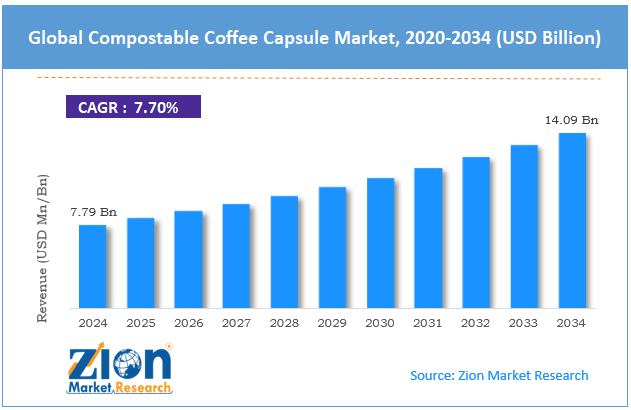
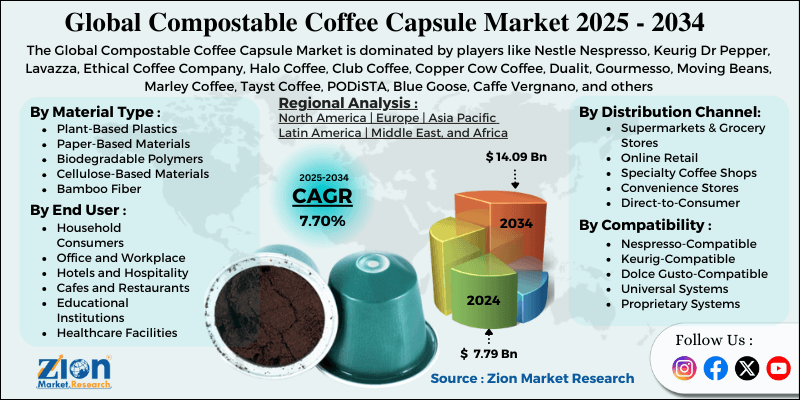
The global compostable coffee capsule market size was valued at approximately USD 7.79 billion in 2024 and is expected to grow to around USD 14.09 billion by 2034, with a compound annual growth rate of roughly 7.70% between 2025 and 2034.
Key Insights:
- According to analysis shared by industry research experts, the global compostable coffee capsule market is estimated to grow annually at a rate of around 7.70% over the forecast period from 2025 to 2034.
- In terms of revenue, the global compostable coffee capsule market size was valued at approximately USD 7.79 billion in 2024 and is projected to reach USD 14.09 billion by 2034.
- The compostable coffee capsule market is projected to grow significantly due to increasing environmental awareness, strengthening plastic packaging regulations, and expanding composting infrastructure availability.
- Based on material type, the plant-based plastics segment is expected to lead the market, while the bamboo fiber segment is anticipated to experience notable growth.
- Based on compatibility, the Nespresso-compatible segment is expected to dominate the market, while the universal systems segment is anticipated to witness substantial expansion.
- Based on distribution channel, the supermarkets and grocery stores segment is the dominating segment, while the online retail segment is projected to witness considerable revenue growth over the forecast period.
- Based on end-user, the household consumers segment is expected to lead the market compared to other segments.
- Based on region, Europe is projected to dominate the global compostable coffee capsule market during the estimated period, followed by North America.
Compostable Coffee Capsule Market: Overview
Compostable coffee capsules are single-serve coffee containers made from eco-friendly materials that naturally break down in composting environments without releasing harmful chemicals, microplastics, or toxic residues. These capsules provide the same convenience, consistency, and variety as regular coffee pods while addressing growing concerns about plastic waste, limited landfill space, and long-term environmental harm caused by traditional plastic and aluminum capsules. They are produced using renewable plant-based materials, certified biodegradable polymers, sustainably sourced paper, and natural fibers that decompose fully within specific timeframes in industrial composting facilities or suitable home composting setups. The capsules are designed to protect coffee freshness, preserve flavor, prevent moisture exposure, and comply with strict food safety standards for materials that come into contact with consumable products. Manufacturers develop these capsules to work smoothly with popular coffee machines, allowing consumers to switch from traditional pods without changing their equipment or daily brewing habits. Coffee brands, specialty roasters, advocacy groups, and sustainability-focused retailers are promoting compostable capsules as an important step toward reducing the environmental impact of global coffee consumption.
The rising consumer consciousness about environmental sustainability issues and increasing regulatory pressure on single-use plastic packaging are expected to drive growth in the compostable coffee capsule market throughout the forecast period.
Compostable Coffee Capsule Market Dynamics
Growth Drivers
Environmental regulations and sustainability initiatives
The compostable coffee capsule market is growing rapidly as governments worldwide introduce strict rules on single-use plastic packaging and consumers become increasingly aware of the environmental impacts of daily purchasing choices. Many European countries have passed strong laws that ban or limit several types of disposable plastic packaging, creating strong pressure no coffee brands to offer sustainable options instead of traditional plastic capsules. Environmental groups have released studies showing the huge volume of waste generated each year, as billions of non-recyclable capsules end up in landfills, incinerators, or the natural environment, increasing public demand for responsible corporate behavior. Producer responsibility programs in multiple regions require companies to manage the full end-of-life impact of their packaging materials, encouraging investment in safer solutions. Several cities are expanding organic waste systems and composting facilities, making disposal of compostable capsules easier for regular users through organized pickup services.
Large coffee companies and retailers are investing in greener packaging to meet sustainability goals and reduce overall environmental footprints. Market studies show strong consumer interest in paying small premiums for products aligned with personal environmental values and proven sustainable practices. Media coverage of plastic pollution has increased public awareness of the need for safer alternatives, and younger consumers are showing consistent preference for brands committed to environmental responsibility.
How are specialty coffee culture growth and convenience-focused preferences driving the compostable coffee capsule market expansion?
The global compostable coffee capsule market is growing steadily as single-serve coffee systems remain popular for offering convenience, consistent brewing, wide flavor choices, and simple preparation across homes, offices, and hospitality spaces. Faster daily routines make quick and mess-free coffee appealing to professionals, parents, young adults, and anyone who prefers quality coffee without learning complex brewing methods or spending time on cleanup tasks. Single-serve systems allow users to try many coffee varieties, explore different flavor profiles, and enjoy beans from various regions without buying large bags that may lose freshness over time. Modern workplaces value capsule systems because they reduce cleanup, eliminate reliance on employees' brewing skills, and prevent disputes over shared coffee duties in busy office kitchens.
Specialty coffee culture is expanding into homes as people seek premium flavors, single-origin options, and artisanal roasts delivered through simple at-home methods that match their quality expectations. Compostable capsules offer brewing performance and flavor quality comparable to traditional options, removing earlier concerns about choosing between sustainability and good coffee. Rising coffee consumption in emerging regions across Asia, Latin America, and Africa creates new opportunities for sustainable products to build a strong market presence early.
Restraints
How do premium prices slow consumer adoption in the compostable coffee capsule market?
The compostable coffee capsule market faces major challenges because production costs are much higher than those of conventional plastic or aluminum capsules, putting pressure on pricing and consumer adoption. Compostable materials require specialized sourcing, newer technologies, and limited suppliers, which increases expenses and reduces flexibility for manufacturers seeking competitive pricing. Certification processes, laboratory testing requirements, and compliance documentation add further costs, leading to higher retail prices for environmentally friendly capsules.
Many budget-focused consumers still prefer cheaper traditional options during periods of economic uncertainty, inflation, or reduced household spending power. Retailers with limited shelf space often prioritize products with stronger margins and faster sales, making it harder for higher-priced compostable capsules to gain visibility. Premium pricing also restricts adoption in developing regions where affordability strongly influences purchase decisions among lower-income consumers. Smaller sustainable packaging companies struggle to reach large production volumes, making cost reductions difficult and creating additional challenges when material prices fluctuate.
Opportunities
How are material science innovations creating opportunities for the compostable coffee capsule market?
The compostable coffee capsule industry is seeing strong growth as new research develops biodegradable materials with greater strength, heat resistance, and barrier protection comparable to traditional plastics. Research groups and companies are developing bio-based polymers from agricultural waste, algae, food byproducts, and other renewable resources to reduce environmental impact and lessen reliance on petroleum plastics. Improved multilayer coatings protect coffee from oxygen, moisture, and light while remaining fully compostable, helping maintain freshness and flavor. Collaboration between engineers, scientists, roasters, and machine makers supports better capsule designs with consistent extraction and reliable composting performance.
Government funding and corporate research investments are speeding up the development of affordable biodegradable materials that may eventually match traditional packaging costs. New material formulas offer competitive advantages, while updated home composting standards and stronger certification programs are boosting consumer trust and encouraging wider adoption.
Challenges
Infrastructure limitations and disposal complexity
The compostable coffee capsule industry continues to face major challenges because many regions lack adequate composting facilities, and consumers often remain unsure about proper disposal. Industrial composting systems with controlled heat, moisture, and processing time are unavailable in many cities, making it harder for compostable materials to break down fully. Home compost bins usually cannot reach the high temperatures needed for complete decomposition, leading to slow results and lower user satisfaction.
Limited consumer education leads to confusion about whether capsules should go into organic waste, recycling bins, or general trash, often resulting in incorrect disposal. Recycling facilities also face contamination when compostable capsules are mixed with recyclable materials, creating equipment issues and lowering material quality. Inconsistent labeling across brands makes disposal instructions difficult to understand.
Compostable Coffee Capsule Market: Report Scope
| Report Attributes | Report Details |
|---|---|
| Report Name | Compostable Coffee Capsule Market |
| Market Size in 2024 | USD 7.79 Billion |
| Market Forecast in 2034 | USD 14.09 Billion |
| Growth Rate | CAGR of 7.70% |
| Number of Pages | 216 |
| Key Companies Covered | Nestle Nespresso, Keurig Dr Pepper, Lavazza, Ethical Coffee Company, Halo Coffee, Club Coffee, Copper Cow Coffee, Dualit, Gourmesso, Moving Beans, Marley Coffee, Tayst Coffee, PODiSTA, Blue Goose, Caffe Vergnano, and others. |
| Segments Covered | By Material Type, By Compatibility, By Distribution Channel, By End User, and By Region |
| Regions Covered | North America, Europe, Asia Pacific (APAC), Latin America, Middle East, and Africa (MEA) |
| Base Year | 2024 |
| Historical Year | 2019 to 2023 |
| Forecast Year | 2025 - 2034 |
| Customization Scope | Avail customized purchase options to meet your exact research needs. Request For Customization |
Compostable Coffee Capsule Market: Segmentation
The global compostable coffee capsule market is segmented based on material type, compatibility, distribution channel, end-user, and region.
Based on material type, the compostable coffee capsule industry is segregated into plant-based plastics, paper-based materials, biodegradable polymers, aluminum with compostable components, cellulose-based materials, and bamboo fiber. Plant-based plastics lead the market due to their excellent moisture barrier properties, compatibility with existing capsule manufacturing equipment, and growing commercial availability.
Based on compatibility, the market is classified into Nespresso-compatible, Keurig-compatible, Dolce Gusto-compatible, universal systems, and proprietary systems. Nespresso-compatible capsules dominate the market due to the extensive global installed base of Nespresso brewing machines and a large consumer population actively seeking sustainable alternatives.
Based on distribution channel, the global market is segmented into supermarkets and grocery stores, online retail, specialty coffee shops, convenience stores, direct-to-consumer, and subscription services. Supermarkets and grocery stores are expected to lead during the forecast period due to their high consumer foot traffic and shopping preferences for physically inspecting packaging and products.
Based on end-user, the global market is divided into household consumers, office and workplace, hotels and hospitality, cafes and restaurants, educational institutions, and healthcare facilities. Household consumers hold the largest market share due to the substantial volume of residential coffee consumption and the increasing availability of compostable options through mainstream retail channels.
Compostable Coffee Capsule Market: Regional Analysis
Europe leads the global market
Europe leads the compostable coffee capsule market because strict environmental rules, well-developed composting systems, high consumer awareness, and active government policies create ideal conditions for sustainable packaging adoption across the region. The European Union has set strict, legally binding goals to reduce single-use plastic and cut overall packaging waste, increasing pressure on companies to shift toward compostable options in the food and beverage industry.
Many European countries also use extended producer responsibility programs that require coffee brands and retailers to manage and fund the full environmental impact of their packaging, encouraging faster adoption of eco-friendly materials. Consumer awareness is especially strong in Germany, the Netherlands, Scandinavia, and Switzerland, where sustainability plays an important role in everyday buying decisions. European cities already operate reliable organic waste collection systems, making it easy for consumers to dispose of compostable capsules through curbside pickup programs built into existing waste services.
Europe’s long-standing coffee culture creates a large market of regular coffee drinkers who are open to sustainable alternatives that fit their daily routines. Leading brands such as Nespresso, Lavazza, and many specialty roasters are pushing the market forward by launching innovative compostable products that meet both consumer expectations and regulatory requirements. Government incentives, tax benefits, and supportive policies also help make sustainable packaging more affordable and appealing, encouraging widespread adoption across different consumer groups.
How is North America growing as the second-largest region in the compostable coffee capsule market?
North America is the second-largest region in the compostable coffee capsule market, driven by strong sustainability commitments, expanding composting infrastructure, rising consumer awareness, and active corporate investment, which are supporting rapid adoption of eco-friendly packaging solutions. The United States and Canada are seeing increasing regulatory focus on reducing single-use plastic waste, with several states and provinces introducing restrictions, landfill diversion targets, and packaging waste reduction policies that encourage companies to adopt compostable alternatives. Many municipalities are slowly expanding organic waste collection programs, and industrial composting facilities are becoming more common in urban and suburban areas, making proper disposal of compostable capsules more practical for households and workplaces.
Consumer interest in environmentally responsible products continues to grow across the region because of concerns about plastic pollution, landfill overflows, and long-term ecological impacts linked to conventional plastic and aluminum capsules. Coffee consumption remains very high in North America, and the widespread use of single-serve coffee machines in homes, offices, and hospitality settings creates a strong demand for sustainable capsule options.
Major coffee brands, specialty roasters, and private-label manufacturers are investing heavily in compostable materials and third-party certifications to meet expectations for quality and verified sustainability. Retailers and subscription services are promoting compostable products through sustainability-focused displays, educational labeling, and premium placement. As composting infrastructure grows and regulatory support strengthens, North America is expected to see continued expansion in compostable capsule adoption across mainstream consumer groups.
Recent Market Developments:
- In March 2025, FLO Group and NatureWorks introduced the “KEYGEA” compostable coffee pod using Ingeo PLA for the North American market, designed to deliver high performance and full industrial compostability.
- In November 2025, NEXE Innovations Inc. received a purchase order of 1.2 million compostable coffee pods from Bridgehead Coffee for a launch in Costco stores in Canada.
Compostable Coffee Capsule Market: Competitive Analysis
The leading players in the global compostable coffee capsule market include:
- Nestle Nespresso
- Keurig Dr Pepper
- Lavazza
- Ethical Coffee Company
- Halo Coffee
- Club Coffee
- Copper Cow Coffee
- Dualit
- Gourmesso
- Moving Beans
- Marley Coffee
- Tayst Coffee
- PODiSTA
- Blue Goose
- Caffe Vergnano
The global compostable coffee capsule market is segmented as follows:
By Material Type
- Plant-Based Plastics
- Paper-Based Materials
- Biodegradable Polymers
- Aluminum with Compostable Components
- Cellulose-Based Materials
- Bamboo Fiber
By Compatibility
- Nespresso-Compatible
- Keurig-Compatible
- Dolce Gusto-Compatible
- Universal Systems
- Proprietary Systems
By Distribution Channel
- Supermarkets and Grocery Stores
- Online Retail
- Specialty Coffee Shops
- Convenience Stores
- Direct-to-Consumer
- Subscription Services
By End User
- Household Consumers
- Office and Workplace
- Hotels and Hospitality
- Cafes and Restaurants
- Educational Institutions
- Healthcare Facilities
By Region
- North America
- The U.S.
- Canada
- Europe
- France
- The UK
- Spain
- Germany
- Italy
- Rest of Europe
- Asia Pacific
- China
- Japan
- India
- South Korea
- Southeast Asia
- Rest of Asia Pacific
- Latin America
- Brazil
- Mexico
- Rest of Latin America
- Middle East & Africa
- GCC
- South Africa
- Rest of Middle East & Africa
Table Of Content
Methodology
FrequentlyAsked Questions
What regulatory or environmental factors are affecting the compostable coffee capsule market growth?

HappyClients

