
Christmas Decoration Market Size, Share, Value and Forecast 2034

Christmas Decoration Market By Type (Christmas Trees, Lighting and Illumination Products, Ornaments and Baubles, Wreaths and Garlands), By Material (Plastic-based Decorations, Glass-based Decorations, Fabric and Textile Decorations, Metal- and Wood-based Decorations), By Distribution Channel (Online Retail Stores, Supermarkets and Hypermarkets, Specialty Christmas Stores, Departmental Stores), By End-User (Residential Households, Commercial Spaces, Hospitality Sector, Retail and Corporate Offices), and By Region - Global and Regional Industry Overview, Market Intelligence, Comprehensive Analysis, Historical Data, and Forecasts 2026 - 2034
| Market Size in 2025 | Market Forecast in 2034 | CAGR (in %) | Base Year |
|---|---|---|---|
| USD 8.75 Billion | USD 13.42 Billion | 4.87% | 2025 |
Christmas Decoration Industry Perspective:
What will be the size of the Christmas decoration market during the forecast period?
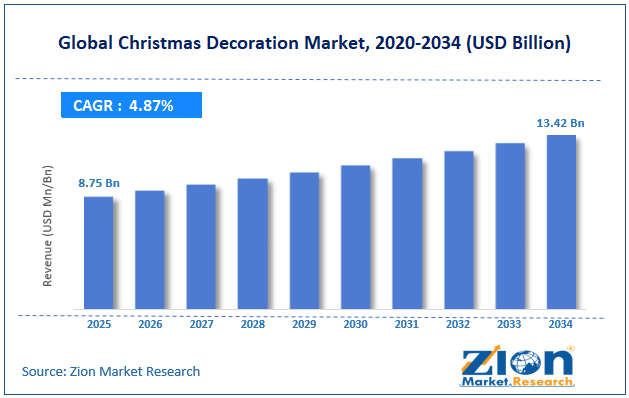
The global Christmas decoration market size was valued at approximately USD 8.75 billion in 2025 and is projected to reach around USD 13.42 billion by 2034, growing at a compound annual growth rate of approximately 4.87% between 2026 and 2034.
Key Insights
- As per the analysis shared by our research team, the global Christmas decoration market is estimated to grow at a compound annual growth rate of approximately 4.87% during the forecast period from 2026 to 2034.
- In terms of revenue, the global Christmas decoration market was valued at approximately USD 8.75 billion in 2025 and is projected to reach USD 13.42 billion by 2034.
- The Christmas decoration market is expected to grow steadily due to rising festive spending, the growing popularity of home décor trends, increased hospitality sector investment in holiday displays, and expanding online retail reach.
- Based on type, Christmas trees lead the market because of their central role in holiday celebrations, while lighting and illumination products are gaining strong momentum as one of the fastest-growing types due to demand for energy-efficient LED options.
- Based on material, plastic-based decorations lead the market due to affordability and durability. In contrast, metal- and wood-based decorations are the fastest-growing segment as shoppers move toward premium, eco-friendly, and reusable options.
- Based on distribution channel, online retail stores lead the market due to convenience and wide product variety, while specialty Christmas stores are steadily growing as customers look for unique, handcrafted, and personalized items.
- Based on end-user, residential households lead the market due to widespread home-decorating traditions, while the hospitality sector is growing rapidly as hotels and resorts compete to offer memorable festive experiences.
- Based on region, North America leads the global Christmas decoration market, while Asia Pacific is the fastest-growing region due to rising festive celebrations and expanding retail infrastructure.
Christmas Decoration Market: Overview
Christmas decorations are festive items used to decorate homes, offices, shops, hotels, and public spaces during the Christmas season. They include traditional products such as Christmas trees, lights, ornaments, wreaths, stockings, and garlands, as well as modern options like inflatable figures, projection lights, and smart LED displays controlled through mobile applications. The Christmas decoration market is growing as families and businesses spend more to create attractive, memorable festive spaces. Many shoppers now prefer decorations that combine traditional styles with modern designs, including pastel shades, simple patterns, and minimalist themes. Online shopping is also making Christmas décor easier to buy, with customers exploring seasonal collections weeks or months before December. Hotels, malls, restaurants, and offices are investing in large decorations to attract visitors and create a festive atmosphere. Growing demand for reusable and eco-friendly decorations is reducing interest in single-use plastic products. Rising incomes in developing countries are also encouraging consumers to spend more on seasonal décor, supporting continued growth in the Christmas decorations market. Social media trends and influencer content are inspiring customers to refresh their décor annually.
The Christmas decoration industry continues to expand as manufacturers, retailers, and designers work together to create festive products that suit changing tastes, budgets, and lifestyles worldwide.
Christmas Decoration Market: Strategic Perspective
Where is the Christmas decoration market heading?
The Christmas decoration market is expected to move toward smarter, more sustainable, and more personalized festive products. Growing interest in application-controlled lighting, reusable ornaments, and decorations made from recycled materials could reshape how households and businesses celebrate the season while reducing environmental impact.
Where should businesses invest in the Christmas decoration market?
The Christmas decoration market offers promising investment opportunities in energy-efficient LED lighting, biodegradable ornament materials, customizable décor kits, and premium artificial trees that closely resemble real ones. Companies that offer easy assembly, storage-friendly designs, and appealing packaging may benefit as more shoppers seek convenience alongside style.
What will reshape competition in the Christmas decoration market?
Competition in the Christmas decoration market is likely to be shaped by product design, pricing strategy, sustainability credentials, and the strength of seasonal marketing campaigns. Brands that can offer trendy designs, reliable quality, and flexible online and offline shopping experiences are likely to gain an advantage.
Christmas Decoration Market: Technology Roadmap 2026–2034
What is the projected development roadmap of the Christmas decoration market over the forecast period?
The Christmas decoration market is advancing through improved LED lighting efficiency, smarter application-connected décor, expanded use of recyclable materials, and growing demand for personalized festive products, making holiday decorating more convenient and environmentally responsible for households and businesses. The market is expected to grow at a compound annual growth rate of approximately 4.87% over the forecast period, driven by rising festive spending, evolving design trends, and continuous innovation in decoration materials.
The following roadmap outlines key development phases expected through 2034.
2026–2028: Design Innovation and Sustainability Phase
- Better material quality: Manufacturers are expected to make artificial trees, ornaments, and lights that last longer, helping people avoid replacing them every year.
- Eco-friendly product development: Companies are likely to use recyclable packaging, plant-based materials, and reusable decoration sets as people become aware of environmental impact.
- Wider retail availability: Online stores and local shops are expected to offer Christmas decorations across regions and price ranges, making festive products easier to buy.
2029–2031: Smart Décor and Retail Expansion Phase
- Smart lighting adoption: Application-controlled and voice-controlled lights are expected to become common as people seek easy ways to change colors, brightness, and festive designs.
- Personalized décor growth: Brands are expected to offer custom ornaments, name-based stockings, and specially made decorations for people seeking a personal Christmas setup.
- Commercial space expansion: Christmas decoration demand is expected to rise in malls, hotels, restaurants, and offices as businesses use festive displays to attract customers and create a welcoming atmosphere.
2032–2034: Experience-Driven and Sustainable Holiday Phase
- Interactive festive displays: Businesses are expected to use lights, projections, and interactive displays to create exciting Christmas experiences in stores and public places.
- Reuse and rental services: Decoration rental and product return programs are likely to grow as people seek ways to enjoy festive décor without buying, storing, or discarding large amounts of decorations.
- Community event integration: Christmas decorations may become closely linked with local festivals, tourism events, and public celebrations, leading to larger festive displays across cities and towns.
Christmas Decoration Market: Dynamics
Growth Drivers
What is driving the expansion of the Christmas decoration market across residential and commercial spaces?
The Christmas decoration market is growing as households and businesses spend on attractive festive displays during the holiday season. Rising consumer spending on home décor is increasing demand for Christmas trees, lights, ornaments, and other decorative products. Hotels, restaurants, shopping malls, and offices are also investing in festive displays to create welcoming spaces and attract visitors. Growing popularity of Christmas markets, public celebrations, and seasonal tourism is increasing demand for large outdoor decorations. Advances in LED technology are supporting market growth by providing bright, colorful lighting with lower electricity use. Realistic artificial trees are gaining popularity as reusable alternatives to fresh trees, while social media encourages consumers to create stylish, shareable festive setups. Affordable decoration sets available through online stores are also making Christmas décor accessible to a wider consumer base. These factors are expanding the use of Christmas decorations across homes, retail stores, hospitality venues, offices, events, and public spaces, supporting steady global market growth.
Online retail expansion is creating fresh opportunities in the Christmas decoration market.
The Christmas decoration market is benefiting from the growing use of e-commerce, smart lighting, and sustainable products. Online shopping lets consumers easily compare Christmas trees, lights, ornaments, and other décor by price, design, and features. Early holiday promotions encourage shoppers to plan and buy decorations ahead of the festive season. Smart lighting is also supporting market growth, with application-controlled products allowing users to change colors, brightness, and lighting patterns to suit their preferences. Growing environmental awareness is increasing demand for recyclable, reusable, and biodegradable decorations. Themed decoration sets are attracting consumers by offering coordinated products that simplify home decorating. Faster delivery services are also improving access to seasonal décor, particularly during the busy weeks before Christmas. These changing shopping habits and product preferences are increasing consumer access, convenience, and choice, encouraging wider adoption of Christmas decorations across different customer groups and supporting continued market growth during the forecast period.
Restraints
How are seasonal demand patterns and cost pressures affecting the Christmas decoration market?
The Christmas decoration market is restrained by its highly seasonal sales cycle, rising production costs, and limited purchasing periods. Most Christmas décor purchases happen in the weeks before the holiday, pressuring manufacturers and retailers to manage inventory carefully. Unsold seasonal stock can lead to markdowns and financial losses, while sudden demand can cause shortages. Rising prices of plastic, metal, glass, packaging, and energy can also increase manufacturing and retail costs, making products expensive for consumers. Inflation and weaker household budgets may further encourage shoppers to delay purchases or choose low-cost decorations. Strong competition from large brands can place additional pressure on smaller manufacturers, which may struggle to match lower prices and production volumes. These factors can reduce profit margins and limit market expansion, particularly for businesses that depend heavily on Christmas sales. Better demand forecasting, efficient production, and flexible pricing can help companies manage these restraints.
Opportunities
Will rising festive spending create new opportunities for the Christmas decoration market?
The Christmas decoration market is gaining opportunities as people spend more on home décor, festive events, and holiday experiences. Families continue to buy trees, lights, and ornaments to create a warm Christmas atmosphere, while retailers and shopping centers use attractive decorations to bring in shoppers during the festive season. Hotels and restaurants are also adopting themed décor to improve customer experiences and encourage repeat visits. Manufacturers offering high-quality, realistic artificial trees can attract consumers seeking durable products they can reuse each year. Smart, application-controlled lighting is creating opportunities for brands that combine technology with festive décor. Christmas markets, public celebrations, and outdoor events are also driving demand for large display decorations. Companies offering eco-friendly materials, compact designs, and easy-to-install products can meet changing customer needs. Holiday gifting is creating another opportunity, with brands offering decoration sets as ready-to-buy gifts. Retailers are also investing in creative window displays to attract customers. Rising demand for attractive, photo-friendly festive spaces is supporting growth across homes, stores, hotels, restaurants, offices, and public venues during the Christmas season. Social media further encourages creative decorating and helps brands reach new customers.
Challenges
How are quality and changing preferences challenging the Christmas decoration market?
The Christmas decoration market faces challenges from changing consumer preferences, product quality concerns, environmental expectations, and the need for creative designs. Customers increasingly expect durable, safe, attractive, and reusable decorations, pressuring companies to improve product quality. Faulty lights, weak materials, or damaged ornaments can lead to poor reviews and reduce customer trust. Growing concerns about plastic waste and non-recyclable packaging are also pushing manufacturers to develop environmentally responsible products without significantly increasing prices. Consumers are also seeking fresh designs and personalized décor, requiring brands to update collections regularly and respond quickly to changing trends. International companies face additional challenges from different product standards, labeling requirements, and safety regulations across countries. The growing use of smart lighting also requires manufacturers to manage technology, application compatibility, and product support. Meeting these changing expectations while maintaining affordability, quality, and sustainability remains a key market challenge.
Christmas Decoration Market: Report Scope
| Report Attributes | Report Details |
|---|---|
| Report Name | Christmas Decoration Market |
| Market Size in 2025 | USD 8.75 Billion |
| Market Forecast in 2034 | USD 13.42 Billion |
| Growth Rate | CAGR of 4.87% |
| Number of Pages | 227 |
| Key Companies Covered | National Tree Company, Balsam Hill, Department 56, Kurt S. Adler Inc., Santa's Best, Holiday Time, Sterling Inc., Christmas Central, Barcana Inc., Gemmy Industries, and others. |
| Segments Covered | By Type, By Material, By Distribution Channel, By End-User, and By Region |
| Regions Covered | North America, Europe, Asia Pacific (APAC), Latin America, Middle East, and Africa (MEA) |
| Base Year | 2025 |
| Historical Year | 2020 - 2024 |
| Forecast Year | 2026 - 2034 |
| Customization Scope | Avail customized purchase options to meet your exact research needs. Request For Customization |
Christmas Decoration Market: Segmentation
The global Christmas decoration market is segmented by type, material, distribution channel, end-user, and region.
What makes Christmas trees the dominant type in the Christmas decoration market?
Based on type, the global Christmas decoration market is divided into Christmas trees, lighting and illumination products, ornaments and baubles, and wreaths and garlands. Christmas trees hold about 35% of the market share, leading because they are the centerpiece of holiday home décor. Lighting and illumination products hold around 27% market share. It is the fastest-growing segment because demand for energy-efficient and smart LED lighting solutions is rising.
How does the plastic-based decoration material maintain its leading position in the Christmas decoration market?
By material, the Christmas decoration industry is divided into plastic-based, glass-based, fabric and textile, and metal- and wood-based decorations. Plastic-based decorations account for approximately 40% of the global market share, driven by affordability, durability, and ease of mass production. Metal and wood-based decorations hold around 18% market share. This segment is the fastest-growing due to rising demand for premium, natural-looking, and eco-friendly décor items.
What makes online retail stores the dominant distribution channel in the Christmas decoration market?
By distribution channel, the market is categorized into online retail stores, supermarkets and hypermarkets, specialty Christmas stores, and department stores. Online retail stores lead with about a 33% share because of convenience, wider product selection, and increasing comfort with digital shopping. Specialty Christmas stores hold around 19% market share. They are growing steadily as shoppers look for unique, handcrafted, and premium decoration pieces.
How does the residential household end user shape the demand landscape of the Christmas decoration market?
Based on end-user, the Christmas decoration market is classified into residential households, commercial spaces, the hospitality sector, and retail and corporate offices. Residential households account for about 44% of the market, leading because of long-standing family traditions of home decorating during the holiday season. The hospitality sector holds around 20% market share. This segment is expanding quickly as hotels and resorts compete to create memorable festive guest experiences.
Christmas Decoration Market: Regional Analysis
Why is North America leading the global Christmas decoration market?
North America holds a 34.68% share of the global Christmas decoration market and is expected to remain the leading region during the forecast period. The region has a strong tradition of decorating homes, stores, offices, and public spaces during Christmas. Rising consumer interest in stylish home décor and creative outdoor displays is also supporting demand across residential and commercial spaces. The United States is a major contributor, with families, retailers, cities, and businesses spending heavily on Christmas trees, lights, ornaments, and outdoor displays each year. Shopping malls use large light installations and festive displays to attract visitors during the busy holiday shopping season. Cities also host public tree-lighting events and Christmas celebrations, creating demand for large-scale decorations. Hotels and restaurants are investing in festive décor to attract holiday travelers and local customers. Social media is also influencing decoration trends by giving consumers easy access to home décor ideas and styling inspiration. North America's strong retail network supports efficient product distribution, storage, and seasonal sales.
Demand for premium, personalized, and reusable decorations is encouraging brands to offer products for different budgets and preferences. Strong holiday spending, growing interest in home décor, and investment in festive experiences are expected to help North America maintain its leading position in the global Christmas decoration market throughout the forecast period.
What makes Asia Pacific the fastest-growing region in the Christmas decoration market?
The Asia Pacific Christmas decoration market is the fastest-growing regional market and is expected to expand at a CAGR of 8.71% during the forecast period. Rising incomes, growing Western cultural influence, urbanization, and expanding retail networks are supporting market growth. China and India are key contributors, with large manufacturing industries producing Christmas decorations for domestic and international markets. Christmas celebrations are becoming popular in major cities, where shopping malls, hotels, restaurants, and stores use festive displays to attract customers during the year-end shopping season. Growing social media use is also encouraging consumers to explore creative festive decoration ideas and trends. Countries such as the Philippines and South Korea have strong Christmas traditions, creating steady demand for trees, lights, ornaments, and other décor.
In Japan, Christmas is widely celebrated as a commercial and social event, encouraging retailers to launch new decoration collections each year. E-commerce is also helping consumers across Asia Pacific access a wide range of products at competitive prices. Local manufacturers provide affordable decorations, making festive products accessible to different income groups. Rising tourism and hospitality investment are also increasing demand for large festive displays. Continued urban growth, retail development, cultural exchange, and online shopping are expected to support strong growth in the Christmas decoration market across Asia Pacific throughout the forecast period.
Recent Market Developments
- In August 2026, Marks & Spencer launched its 2026 Christmas bauble collection, featuring 48 designs including character and food-inspired ornaments such as Percy Pig, Connie the Caterpillar, and pistachio-themed decorations.
Christmas Decoration Market: Competitive Analysis
The leading players in the global Christmas decoration market are:
- National Tree Company
- Balsam Hill
- Department 56
- Kurt S. Adler Inc.
- Santa's Best
- Holiday Time
- Sterling Inc.
- Christmas Central
- Barcana Inc.
- Gemmy Industries
The global Christmas decoration market is segmented as follows:
By Type
- Christmas Trees
- Lighting and Illumination Products
- Ornaments and Baubles
- Wreaths and Garlands
By Material
- Plastic-Based Decorations
- Glass-Based Decorations
- Fabric and Textile Decorations
- Metal- and Wood-Based Decorations
By Distribution Channel
- Online Retail Stores
- Supermarkets and Hypermarkets
- Specialty Christmas Stores
- Departmental Stores
By End-User
- Residential Households
- Commercial Spaces
- Hospitality Sector
- Retail and Corporate Offices
By Region
- North America
- The U.S.
- Canada
- Mexico
- Europe
- France
- The UK
- Spain
- Germany
- Italy
- Rest of Europe
- Asia Pacific
- China
- Japan
- India
- Australia
- South Korea
- Rest of Asia Pacific
- The Middle East & Africa
- Saudi Arabia
- UAE
- Egypt
- Kuwait
- South Africa
- Rest of the Middle East & Africa
- Latin America
- Brazil
- Argentina
- Rest of Latin America
Table Of Content
Methodology
FrequentlyAsked Questions
Christmas decorations are festive items used to decorate homes, offices, shops, hotels, and public spaces during the Christmas season. They include traditional products such as Christmas trees, lights, ornaments, wreaths, stockings, and garlands, as well as modern options such as inflatable figures, projection lights, and smart LED displays controlled through mobile applications.
The global Christmas decoration market is expected to grow due to rising festive spending, the growing popularity of home décor trends, increasing hospitality investment in holiday displays, and expanding online retail reach worldwide.
According to research, the global Christmas decoration market was valued at approximately USD 8.75 billion in 2025 and is projected to reach approximately USD 13.42 billion by 2034.
The compound annual growth rate of the Christmas decoration market is expected to be approximately 4.87% from 2026 to 2034.
North America is expected to lead the global Christmas decoration market throughout the forecast period, driven by strong cultural traditions, well-developed retail infrastructure, and high holiday-season consumer spending.
The major players in the global Christmas decoration market include National Tree Company, Balsam Hill, Department 56, Kurt S. Adler Inc., Santa's Best, Holiday Time, Sterling Inc., Christmas Central, Barcana Inc, and Gemmy Industries.
The report examines key aspects of the Christmas decoration market, including growth drivers, adoption barriers, application opportunities, competitive landscape dynamics, detailed regional market performance analysis, and a comprehensive forward-looking outlook across all major types, materials, distribution channels, end-user segments, and geographic regions through 2034.
Macroeconomic factors such as rising incomes, inflation, consumer spending, and interest rates will influence the Christmas decoration market by affecting household budgets and festive purchases. Economic growth can increase demand for premium décor, while inflation and weaker consumer confidence may shift spending toward affordable and reusable decorations.
Home décor, retail store displays, hospitality venues, corporate offices, and public holiday events will offer strong opportunities in the Christmas decoration market. Growing demand for creative, sustainable, and photogenic festive setups is driving adoption across these sectors.
Smart application-controlled lighting, eco-friendly materials, personalized ornaments, and realistic artificial trees are key trends shaping the Christmas decoration market. Integration with online retail platforms and social media-driven décor inspiration is also expanding its everyday appeal.

HappyClients

