
Herbal Beauty Products Market Size, Share, Trends, Growth and Forecast 2034

Herbal Beauty Products Market By Product Type (Herbal Skincare Products, Herbal Hair Care Products, Herbal Makeup and Color Cosmetics, Herbal Fragrances and Body Care), By Application (Daily Skincare and Moisturization, Anti-Aging and Skin Repair, Hair Growth and Scalp Health, Color Cosmetics and Personal Grooming), By End-User (Individual Retail Consumers, Professional Salons and Spas, Dermatology and Wellness Clinics, Hospitality and Luxury Hotels), By Distribution Channel (Specialty Health and Beauty Stores, E-Commerce and Direct-to-Consumer Platforms, Pharmacy and Drug Store Chains, Supermarkets and Hypermarkets), and By Region - Global and Regional Industry Overview, Market Intelligence, Comprehensive Analysis, Historical Data, and Forecasts 2026 - 2034
| Market Size in 2025 | Market Forecast in 2034 | CAGR (in %) | Base Year |
|---|---|---|---|
| USD 90.86 Billion | USD 173.47 Billion | 7.45% | 2025 |
Herbal Beauty Products Industry Perspective:
What will be the size of the herbal beauty products market during the forecast period?
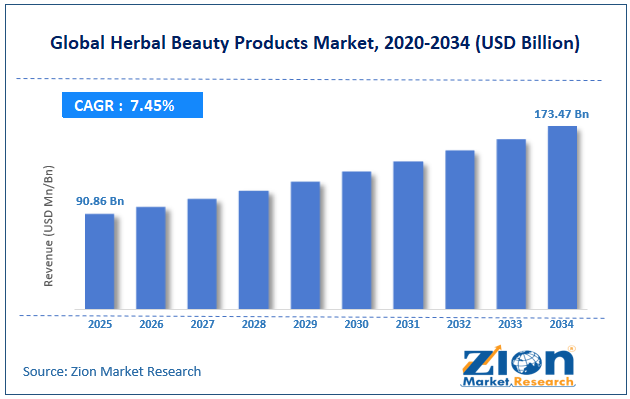
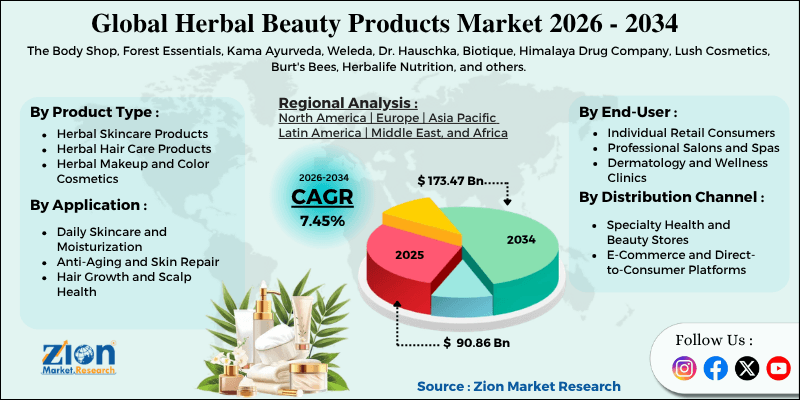
The global herbal beauty products market size was worth approximately USD 90.86 billion in 2025 and is projected to grow to around USD 173.47 billion by 2034, with a compound annual growth rate of roughly 7.45% between 2026 and 2034.
 Request Free SampleRequest Free SampleRequest Free Sample
Herbal Beauty Products Market: Overview
Herbal beauty products are skincare, haircare, and cosmetic products made primarily from natural ingredients, such as plants, herbs, flowers, roots, seeds, and botanical extracts, rather than synthetic chemicals. These products include face washes, moisturizers, shampoos, hair oils, serums, lip balms, perfumes, and many other personal care items designed to improve beauty and overall skin and hair health. People are increasingly choosing herbal beauty products because they are often viewed as safer, gentler, and more natural than conventional products. Many herbal ingredients, such as aloe vera, turmeric, neem, chamomile, rosehip, and ashwagandha, have been used for centuries in traditional beauty and wellness practices across different cultures. In recent times, manufacturers combine this traditional knowledge with modern science to create products that are effective, consistent, and safe to use. Growing consumer awareness about product ingredients, along with concerns about chemicals such as parabens, sulfates, and artificial fragrances, is increasing demand for herbal alternatives.
In addition, ongoing product innovation and the growing availability of herbal beauty products through retail stores and online platforms are further expanding consumer access and market reach worldwide.The herbal beauty products market is growing as more consumers choose natural, plant-based personal care products, encouraging companies to develop safer, more effective, and more innovative beauty solutions.
Key Insights
- As per the analysis shared by our research analyst, the global herbal beauty products market is estimated to grow annually at a compound annual growth rate of around 7.45% over the forecast period from 2026 to 2034.
- In terms of revenue, the global herbal beauty products market size was valued at approximately USD 90.86 billion in 2025 and is projected to reach USD 173.47 billion by 2034.
- The herbal beauty products market is expected to grow steadily due to rising demand for natural personal care products, increasing awareness of synthetic chemical concerns, expanding e-commerce access, growing popularity of Ayurveda and Traditional Chinese Medicine, and stricter regulations on cosmetic ingredients.
- Based on product type, herbal skincare products are expected to lead the overall market, while herbal hair care products are anticipated to grow rapidly, driven by strong consumer demand for plant-based solutions addressing hair thinning, scalp health, and damage repair.
- Based on application, the daily skincare and moisturization segment is expected to lead the herbal beauty products market, while the anti-aging and skin repair segment is anticipated to grow at the fastest pace, driven by aging global demographics and rising demand for effective, gentle alternatives to clinical anti-aging treatments.
- Based on end-user, individual retail consumers represent the largest segment, while professional salons and spas are anticipated to grow steadily as more establishments incorporate herbal and Ayurvedic treatments into their service menus.
- Based on distribution channel, e-commerce and direct-to-consumer platforms are expected to lead market growth, while specialty health and beauty stores are anticipated to remain important destinations for discovery and trial of new herbal beauty brands.
- Based on region, Asia Pacific is projected to dominate the global herbal beauty products market during the forecast period, followed by Europe, which has a strong tradition of botanical cosmetics and strict ingredient-safety regulations that favor natural formulations.
Impact of the USA-Israel War on Iran on the Herbal Beauty Products Market
Geopolitical tensions involving the United States, Israel, and Iran may create temporary challenges for the herbal beauty products market by affecting the supply and transportation of certain botanical ingredients. However, the market benefits from a diverse global sourcing network, allowing manufacturers to manage regional disruptions effectively. Strong consumer demand for natural and plant-based beauty products continues to support long-term market growth worldwide.
Herbal Beauty Products Market: Technology Roadmap 2025–2034
What is the projected development roadmap of the herbal beauty products market over the forecast period?
The herbal beauty products market is growing through improved extraction of plant ingredients, advanced natural formulations, and digital tools that help consumers choose products suited to their skin and hair needs. The market is expected to grow at a compound annual growth rate of around 7.45% over the forecast period, driven by sustained consumer demand for natural beauty solutions and accelerating innovation in botanical science.
The following roadmap outlines key development phases expected through 2034.
2025–2027: Formulation Science and Clinical Validation Phase
- Herbal beauty companies are increasing clinical testing and dermatological studies to support product effectiveness and build consumer confidence.
- Advanced extraction technologies are improving the purity, quality, and performance of plant-based ingredients used in beauty products.
- Digital skin analysis and artificial intelligence-powered beauty tools are helping consumers select herbal products that match their individual skin needs.
2028–2031: Biotechnology and Sustainable Sourcing Phase
- Biotechnology-produced botanical ingredients are becoming more widely available, supporting consistent quality and sustainable production.
- Sustainable sourcing and supply chain transparency are becoming key priorities as demand for responsibly sourced herbal ingredients grows.
- Waterless and solid-form herbal beauty products are expected to gain popularity as demand grows for environmentally friendly products that generate less packaging waste.
2032–2034: Microbiome Intelligence and Personalized Botanical Wellness Phase
- Herbal beauty products designed to support the skin microbiome are becoming more important as awareness of skin health continues to increase.
- Personalized herbal beauty solutions tailored to factors such as skin condition, lifestyle, and environmental exposure are expected to become increasingly available across premium product categories.
- Partnerships with regenerative farming communities are supporting sustainable ingredient sourcing while strengthening environmental and supply chain initiatives.
Herbal Beauty Products Market: Dynamics
Growth Drivers
What is driving growth in the herbal beauty products market as consumers increasingly prioritize ingredient safety and natural wellness?
The herbal beauty products market is growing as consumers increasingly seek natural, plant-based, and chemical-free personal care products. People are becoming more aware of the ingredients used in skincare and haircare products and are paying closer attention to product labels before making purchasing decisions. Concerns about the long-term effects of synthetic chemicals, such as parabens, sulfates, and artificial fragrances, are prompting consumers to choose herbal alternatives. Younger consumers, particularly millennials and Generation Z, are driving demand as they actively seek safe, transparent, and environmentally friendly beauty products. The growing influence of social media, beauty influencers, and online skincare education is also increasing awareness of herbal ingredients and their benefits.
In addition, the rising popularity of traditional wellness systems such as Ayurveda and Traditional Chinese Medicine is supporting demand for products made with trusted botanical ingredients. Expanding product availability through supermarkets, specialty beauty stores, pharmacies, and e-commerce platforms is making herbal beauty products more accessible. Continuous product innovation and the introduction of new natural formulations are further supporting market growth worldwide.
Rising skin-sensitivity concerns and a growing preference for gentler formulations are further supporting the expansion of the herbal beauty market.
The herbal beauty products market is also growing because many consumers experience sensitive skin and irritation from synthetic ingredients commonly found in conventional beauty products. As a result, many people are turning to herbal products made with natural ingredients such as aloe vera, chamomile, calendula, and green tea, known for their gentle, soothing properties. Increasing awareness of skin health and demand for safer personal care solutions are encouraging more consumers to choose herbal alternatives.
Another important growth factor is the introduction of stricter cosmetic regulations in many countries. Governments and regulatory bodies are placing greater focus on ingredient safety and restricting the use of certain chemicals in beauty products. This is encouraging manufacturers to develop products with naturally derived, plant-based ingredients. As consumer trust in herbal formulations grows and regulations support cleaner products, demand for herbal beauty products is expected to increase globally.
Restraints
Premium pricing and challenges with ingredient standardization are key restraints in the herbal beauty products market.
The herbal beauty products market faces several challenges that can limit growth. One major restraint is the higher cost of natural and plant-based ingredients compared to synthetic alternatives. These higher production costs often result in more expensive products, making them less affordable for price-sensitive consumers. Another challenge is maintaining consistent product quality. The effectiveness of botanical ingredients can vary depending on factors such as climate, soil conditions, harvesting methods, and processing techniques. This makes it more difficult for manufacturers to ensure the same performance across different product batches. Shelf life is also a concern for many herbal beauty products. Since they often contain fewer synthetic preservatives, they may have a shorter storage life than conventional cosmetics. This can create challenges in product distribution, inventory management, and long-term storage. These factors can affect product availability, pricing, and consumer confidence, creating hurdles for manufacturers operating in the herbal beauty products market.
Opportunities
How are wellness tourism, male grooming, and emerging market demand creating opportunities in the herbal beauty products market?
The herbal beauty products industry has several exciting growth opportunities that could support future expansion. One major opportunity comes from the growing wellness tourism industry, where consumers are increasingly seeking natural spa treatments, herbal skincare therapies, aromatherapy products, and wellness experiences at hotels, resorts, and health retreats. This trend is creating new demand for premium herbal beauty products. Another promising opportunity is the rapidly growing male grooming market. More men are becoming interested in skincare, haircare, and personal grooming, increasing demand for herbal face washes, beard oils, moisturizers, shampoos, and shaving products made with natural ingredients.
In addition, the rapid growth of e-commerce is helping herbal beauty brands reach millions of new consumers. Social media marketing, beauty influencers, and direct-to-consumer platforms are further increasing product visibility. These trends are creating new opportunities for companies to expand their customer base and strengthen their presence in global herbal beauty markets.
Challenges
What challenges does the herbal beauty products market face in maintaining trust and navigating regulatory complexity?
The herbal beauty products market faces several challenges that can affect consumer trust and business growth. One of the biggest issues is greenwashing, where some companies market products as natural or herbal even though they contain only small amounts of plant-based ingredients. This can confuse consumers and make it harder for truly herbal brands to stand out. Another challenge is the difference in regulations across countries. An ingredient approved for use in one market may face restrictions in another, making it difficult and costly for companies to sell products globally. Consumer education is also important. While interest in natural beauty products is increasing, some people believe that herbal products are always safe for everyone or assume they are less effective than conventional alternatives.
As a result, companies need to provide clear, accurate information about ingredients, benefits, and proper product use. Addressing these challenges will be important for maintaining consumer confidence and supporting long-term market development.
 Request Free SampleRequest Free SampleRequest Free Sample
Herbal Beauty Products Market: Report Scope
| Report Attributes | Report Details |
|---|---|
| Report Name | Herbal Beauty Products Market |
| Market Size in 2025 | USD 90.86 Billion |
| Market Forecast in 2034 | USD 173.47 Billion |
| Growth Rate | CAGR of 7.45% |
| Number of Pages | 227 |
| Key Companies Covered | The Body Shop, Forest Essentials, Kama Ayurveda, Weleda, Dr. Hauschka, Biotique, Himalaya Drug Company, Lush Cosmetics, Burt's Bees, Herbalife Nutrition, and others. |
| Segments Covered | By Product Type, By Application, By End-User, By Distribution Channel, and By Region |
| Regions Covered | North America, Europe, Asia Pacific (APAC), Latin America, Middle East, and Africa (MEA) |
| Base Year | 2024 |
| Historical Year | 2020 - 2024 |
| Forecast Year | 2026 - 2034 |
| Customization Scope | Avail customized purchase options to meet your exact research needs. Request For Customization |
Herbal Beauty Products Market: Segmentation
The global herbal beauty products market is segmented by product type, application, end-user, distribution channel, and region.
What makes herbal skincare products the leading segment in the herbal beauty products market?
Based on product type, the global herbal beauty products industry is divided into herbal skincare products, herbal hair care products, herbal makeup and color cosmetics, and herbal fragrances and body care. Herbal skincare products hold approximately 46% of the market share, leading the category due to strong, consistent daily consumer demand for cleansers, moisturizers, serums, and masks formulated with botanical actives. Herbal hair care products hold around 28% share. They are growing rapidly due to concerns about hair thinning and chemical damage, as well as increasing interest in Ayurvedic hair care.
How does the daily skincare and moisturization application segment maintain its leading position in the herbal beauty products market?
Based on application, the herbal beauty products market is categorized into daily skincare and moisturization, anti-aging and skin repair, hair growth and scalp health, and color cosmetics and personal grooming. The daily skincare and moisturization segment accounts for around 40% of the global herbal beauty products market, driven by regular skincare routines and strong demand for natural moisturizers and cleansers. The anti-aging and skin repair segment holds around 22% share. It is the fastest-growing segment, driven by rising demand for gentle anti-aging products such as plant-based retinol alternatives and herbal serums.
What makes individual retail consumers the dominant end-user group in the herbal beauty products market?
Based on end-user, the market is classified into individual retail consumers, professional salons and spas, dermatology and wellness clinics, and hospitality and luxury hotels. Individual retail consumers lead with about 65% share, driven by personal skincare routines, growing ingredient awareness, and convenient access to herbal beauty products across both online and physical retail channels. Professional salons and spas hold around 18% share. They are growing steadily as more spas and salons offer herbal treatments, Ayurvedic therapies, and botanical beauty services to attract consumers seeking natural beauty care.
How do e-commerce and direct-to-consumer platforms lead the distribution landscape of the herbal beauty products market?
Based on distribution channel, the herbal beauty products market is segregated into specialty health and beauty stores, e-commerce and direct-to-consumer platforms, pharmacy and drugstore chains, and supermarkets and hypermarkets. E-commerce and direct-to-consumer platforms account for about 36% of the market, leading due to wider product availability, detailed ingredient information, and customer reviews. Specialty health and beauty stores hold around 24% share. They remain important for product testing and expert guidance when trying new herbal beauty products.
Herbal Beauty Products Market: Regional Analysis
How is Asia Pacific shaping global demand for herbal beauty products?
The herbal beauty products market is led by Asia Pacific and is expected to grow steadily at a compound annual growth rate of around 7.3% during the forecast period. The region has a strong history of using natural and plant-based ingredients in beauty and personal care products, which has led to the widespread acceptance of herbal formulations among consumers. India is one of the fastest-growing markets, supported by the popularity of Ayurveda and increasing demand for natural skincare, haircare, and wellness products. Indian herbal beauty brands are expanding rapidly in both domestic and international markets. China is another major market, driven by the use of Traditional Chinese Medicine ingredients and a large consumer base seeking natural beauty solutions.
Strong e-commerce networks further support product sales and accessibility. Japan and South Korea contribute significantly through their advanced skincare industries, where botanical ingredients are combined with modern beauty science to create innovative products. Southeast Asian countries such as Indonesia, Thailand, Malaysia, Vietnam, and the Philippines are also experiencing strong growth driven by rising incomes, greater beauty awareness, and growing interest in natural personal care products.
Expanding online retail channels, continuous product innovation, and the growing popularity of traditional wellness practices continue to support market growth across the region. Increasing demand for organic and clean-label beauty products is further encouraging manufacturers to expand their herbal product portfolios. In addition, rising investments in product development and digital marketing are helping herbal beauty brands reach a wider customer base across the region.
How does Europe maintain its strong position in the herbal beauty products market?
The herbal beauty products market sees Europe as the second-largest region and is expected to grow at a compound annual growth rate of around 6.1% during the forecast period. Europe has a long history of using plant-based ingredients in skincare, haircare, and personal care products, making herbal beauty a well-established part of the regional beauty industry. Consumers across the region are highly aware of product ingredients and increasingly prefer natural, organic, and clean-label beauty products. Germany leads the European market due to its strong health and wellness culture, extensive pharmacy network, and growing demand for herbal personal care products. France is another major market, supported by its globally recognized cosmetics industry and the popularity of botanical ingredients such as lavender, rose, and other plant extracts. The United Kingdom is witnessing increasing demand for natural beauty products as consumers become more conscious of sustainability and ingredient safety. Nordic countries, including Sweden, Denmark, and Norway, are also driving market growth due to strong interest in environmentally friendly, naturally derived beauty solutions.
In addition, strict regulations on cosmetic ingredients across Europe are encouraging manufacturers to develop safer and more natural formulations. Strong consumer preference for sustainable and plant-based personal care products continues to strengthen Europe's position in the global herbal beauty products market.
Recent Market Developments
- In January 2026, Kapiva launched a ₹50 crore research and development fund to support innovation, clinical validation, and new product development in Ayurveda, strengthening the scientific foundation of herbal and natural beauty products.
- In May 2026, Naturals Salon continued expanding its D2C skincare brand NXTFACE, featuring AI-powered skincare recommendations and products designed for ingredient-conscious consumers seeking modern beauty solutions.
Herbal Beauty Products Market: Competitive Analysis
The leading players in the global herbal beauty products market are;
- The Body Shop
- Forest Essentials
- Kama Ayurveda
- Weleda
- Dr. Hauschka
- Biotique
- Himalaya Drug Company
- Lush Cosmetics
- Burt's Bees
- Herbalife Nutrition
The global herbal beauty products market is segmented as follows:
By Product Type
- Herbal Skincare Products
- Herbal Hair Care Products
- Herbal Makeup and Color Cosmetics
- Herbal Fragrances and Body Care
By Application
- Daily Skincare and Moisturization
- Anti-Aging and Skin Repair
- Hair Growth and Scalp Health
- Color Cosmetics and Personal Grooming
By End-User
- Individual Retail Consumers
- Professional Salons and Spas
- Dermatology and Wellness Clinics
- Hospitality and Luxury Hotels
By Distribution Channel
- Specialty Health and Beauty Stores
- E-Commerce and Direct-to-Consumer Platforms
- Pharmacy and Drug Store Chains
- Supermarkets and Hypermarkets
By Region
- North America
- The U.S.
- Canada
- Mexico
- Europe
- France
- The UK
- Spain
- Germany
- Italy
- Rest of Europe
- Asia Pacific
- China
- Japan
- India
- Australia
- South Korea
- Rest of Asia Pacific
- The Middle East & Africa
- Saudi Arabia
- UAE
- Egypt
- Kuwait
- South Africa
- Rest of the Middle East & Africa
- Latin America
- Brazil
- Argentina
- Rest of Latin America
Table Of Content
Methodology
FrequentlyAsked Questions
Herbal beauty products are skincare, haircare, and cosmetic products made primarily from natural ingredients, such as plants, herbs, flowers, roots, seeds, and botanical extracts, rather than synthetic chemicals. These products include face washes, moisturizers, shampoos, hair oils, serums, lip balms, perfumes, and many other personal care items designed to improve beauty and overall skin and hair health.
The global herbal beauty products market is expected to grow due to rising awareness of the risks of synthetic ingredients, the increasing popularity of Ayurveda and Traditional Chinese Medicine, expanding e-commerce access, stricter cosmetic regulations, and growing demand for sustainable personal care products.
According to research, the global herbal beauty products market size was worth around USD 90.86 billion in 2025 and is predicted to grow to around USD 173.47 billion by 2034.
The compound annual growth rate value of the herbal beauty products market is expected to be around 7.45% during 2026 to 2034.
Asia Pacific is expected to lead the global herbal beauty products market, driven by strong beauty traditions in India and China, growing middle-class populations, expanding e-commerce, and the rising popularity of Ayurveda and Traditional Chinese Medicine.
The major players in the global herbal beauty products market include The Body Shop, Forest Essentials, Kama Ayurveda, Weleda, Dr. Hauschka, Biotique, Himalaya Drug Company, Lush Cosmetics, Burt's Bees, and Herbalife Nutrition
The report examines key aspects of the herbal beauty products market, including growth drivers, restraints, emerging opportunities, challenges, a competitive landscape analysis, regional breakdowns, and a detailed future outlook across all major product types, applications, end users, and geographies.
The herbal beauty products market is evolving toward greater formulation transparency, clinical validation of botanical actives, sustainable and regenerative ingredient sourcing, and personalized herbal beauty solutions that match specific skin types, concerns, and environmental conditions rather than offering one-size-fits-all natural formulations.
The herbal beauty products market will see strong growth in anti-aging skincare, plant-based hair restoration, herbal men's grooming, wellness spa treatments, and microbiome-friendly formulations, driven by aging populations, expanding male beauty demand, and growing interest in plant-based ingredients.
Biotechnology-derived botanical actives, microbiome-compatible formulations, waterless beauty formats, artificial intelligence-powered skin analysis and personalization, regenerative agriculture sourcing models, and the growing integration of ancient botanical wellness traditions with modern clinical dermatology research are shaping the herbal beauty products market.

HappyClients

