
Disposable Hygiene Products Market Size, Share, Value and Forecast 2034

Disposable Hygiene Products Market By Product Type (Sanitary Napkins, Diapers, Tampons, Tissue Paper, Toilet Paper, Wipes, and Others), By Sales Channel (Online, Drug Stores/Pharmacies, and Supermarkets/Hypermarkets), and By Region - Global and Regional Industry Overview, Market Intelligence, Comprehensive Analysis, Historical Data, and Forecasts 2026 - 2034
| Market Size in 2025 | Market Forecast in 2034 | CAGR (in %) | Base Year |
|---|---|---|---|
| USD 256.48 Billion | USD 389.27 Billion | 4.67% | 2025 |
Disposable Hygiene Products Industry Perspective:
What is the anticipated size of the disposable hygiene products market during the projection period?
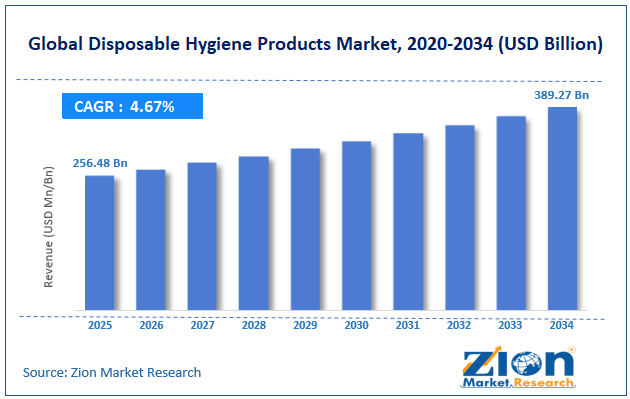
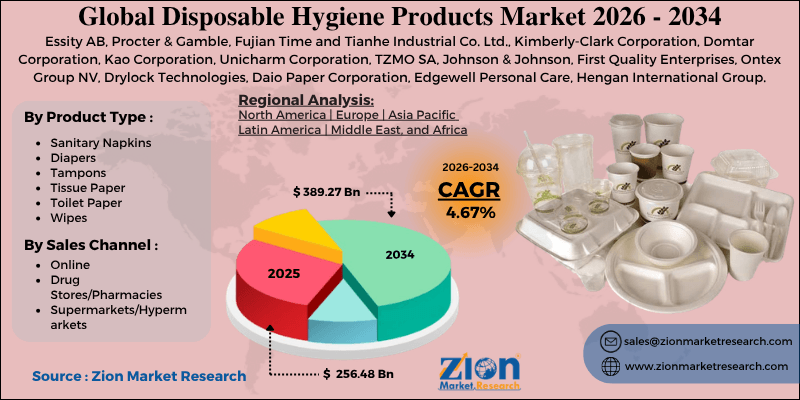
The global disposable hygiene products market size was worth around USD 256.48 billion in 2025 and is predicted to grow to around USD 389.27 billion by 2034, with a compound annual growth rate (CAGR) of roughly 4.67% between 2025 and 2034.
 Request Free SampleRequest Free SampleRequest Free Sample
Key Insights:
- As per the analysis shared by our research analyst, the global disposable hygiene products market is estimated to grow annually at a CAGR of around 4.67% over the forecast period (2026-2034)
- In terms of revenue, the global disposable hygiene products market size was valued at around USD 256.48 billion in 2025 and is projected to reach USD 256.48 billion by 2034.
- The disposable hygiene products market is projected to grow at a significant rate due to the rising population and subsequent consumerism worldwide.
- Based on the product type, the diapers segment is growing at a high rate and will continue to dominate the global market as per industry projections.
- Based on the sales channel, the supermarkets/hypermarkets segment is anticipated to command the largest market share.
- Based on region, North America is projected to dominate the global market during the forecast period.
Disposable Hygiene Products Market: Overview
Disposable hygiene products are single-use consumer goods designed to prevent contamination, promote cleanliness, and ensure personal protection across domestic, hospitality, industrial, and medical environments. Disposable hygiene products are lightweight, cost-effective, and easy to use. However, modern-day disposable hygiene items are often associated with growing concerns over environmental pollution. In recent times, demand for eco-friendly single-use hygiene goods has increased considerably. During the forecast period, the global disposable hygiene products market is expected to grow due to the rising world population and growing consumerism. In addition, environmentally-friendly products are likely to open new channels for market growth. Online marketplaces such as e-commerce and quick commerce channels will further accelerate growth trends. However, excessive competition, negative environmental impact, and a surge in demand for reusable hygiene items will act as major market challenges in the coming years.
Disposable Hygiene Products Market: Dynamics
Growth Drivers
How will rising population and consumerism influence the disposable hygiene products market growth?
The global disposable hygiene products market is expected to grow due to the rising population and subsequent consumerism worldwide. According to the United Nations, the global population is expected to continue growing for the next 50 to 60 years, peaking at 10.3 billion by the 2080s. The increase in world population is a sharp indicator of growing consumerism. As per official forecasts, global consumer spending is expected to reach over USD 70 trillion by the end of 2026. Disposable hygiene products have become a crucial cleanliness-related good for the general population. An average woman uses around 11,400 pads throughout her lifetime, according to estimates by PubMed Central.
Surge in patient population to influence market revenue during the forecast period
Disposable hygiene products such as wipes and tissue paper are frequently used by patients, especially those with contagious diseases. Sales of single-use hygiene products increased drastically during COVID-19 and have maintained momentum since then. Surge in the number of respiratory infection cases, such as influenza, has accelerated market growth trends. In addition, heightened public awareness about the importance of maintaining personal hygiene and easier access to products work in favor of market players.
Restraints
Which environmental concerns will limit the growth of the disposable hygiene products market?
The global demand for disposable hygiene products is expected to be restricted due to environmental concerns. Single-use products are disposed of after one use, thus contributing to rising global waste and pollution levels. European countries such as Northern Ireland and Great Britain register 200,000 metric tons of period product waste every year. Disposable products made of non-biodegradable materials can last in the ecosystem for centuries, contributing to land and soil pollution.
Opportunities
Eco-friendly hygiene products to generate growth opportunities during the projection period
The global disposable hygiene products industry is anticipated to generate growth opportunities in the form of eco-friendly alternatives. These products are environmentally friendly as they are made of biodegradable raw materials. For instance, in June 2026, Anabio Tech, an Indian startup, announced the launch of a 100% flushable, disposable range of sanitary pads made from plant-based materials. In January 2026, researchers at the University of Waterloo announced the introduction of a new hydrogel designed to make personal hygiene products greener. According to official news, the innovation absorbs like plastic but breaks down in a few years.
What will be the impact of online sales platforms on the disposable hygiene products market?
Online sales platforms, such as e-commerce and quick commerce websites, have emerged as crucial growth propellers for the global disposable hygiene products market players. These channels ease the buying process and provide a wider range of options to end consumers. The quick commerce industry, for instance, is characterized by deliveries within 10 to 30 minutes of placing the order. The E-commerce industry is rapidly expanding across markets. As the industry reaches a wider population in remote areas, single-use hygiene product companies can expect improved market revenue.
Challenges
Tough competition and evolving trends to challenge industry growth in the coming years
The global disposable hygiene products industry is expected to be challenged by tough competition. Excessive options in the market can be overwhelming for consumers and lead to diluted profit margins. Furthermore, it also affects brand loyalty. In addition, disposable hygiene goods are facing competition from reusable alternatives. The latter are cost-effective and environmentally friendly. Market analysis suggests that around 1.02% of the global menstruating population currently uses menstrual cups, thus replacing single-use sanitary napkins. Moreover, evolving consumer buying patterns and preferences may create growth barriers in the long run.
 Request Free SampleRequest Free SampleRequest Free Sample
Disposable Hygiene Products Market: Report Scope
| Report Attributes | Report Details |
|---|---|
| Report Name | Disposable Hygiene Products Market |
| Market Size in 2025 | USD 256.48 Billion |
| Market Forecast in 2034 | USD 389.27 Billion |
| Growth Rate | CAGR of 4.67% |
| Number of Pages | 230 |
| Key Companies Covered | Essity AB, Procter & Gamble, Fujian Time and Tianhe Industrial Co. Ltd., Kimberly-Clark Corporation, Domtar Corporation, Kao Corporation, Unicharm Corporation, TZMO SA, Johnson & Johnson, First Quality Enterprises, Ontex Group NV, Drylock Technologies, Daio Paper Corporation, Edgewell Personal Care, Hengan International Group, and others. |
| Segments Covered | By Product Type, By Sales Channel, and By Region |
| Regions Covered | North America, Europe, Asia Pacific (APAC), Latin America, Middle East, and Africa (MEA) |
| Base Year | 2025 |
| Historical Year | 2020 - 2024 |
| Forecast Year | 2026 - 2034 |
| Customization Scope | Avail customized purchase options to meet your exact research needs. Request For Customization |
Disposable Hygiene Products Market: Segmentation
The global disposable hygiene products market is segmented based on product type, sales channel, and region.
Why will the diapers segment lead the disposable hygiene products industry revenue during the forecast period?
Based on product type, the global market segments are sanitary napkins, diapers, tampons, tissue paper, toilet paper, wipes, and others. In 2025, the highest growth was listed in the diapers segment. It controlled over 40.01% of global revenue and is expected to continue leading the market with a CAGR of 6.23% in the coming years. Growing birth rate, changing consumer lifestyles, heightened awareness, and rising disposable income among the general population will drive segmental growth in the future.
Which will be the fastest-growing sales channel during the forecast period in the disposable hygiene products market?
Based on the sales channel, the global industry is fragmented into online, drug stores/pharmacies, and supermarkets/hypermarkets. In 2025, the industry was led by supermarkets/hypermarkets, accounting for 39.15%. During the projection period, the same segment will continue dominating total revenue with a CAGR of 4%. Supermarkets & hypermarkets are preferred for shopping for bulk items as they offer several discounts and a wider range of options.
Disposable Hygiene Products Market: Regional Analysis
Which factors will influence the expansion of the disposable hygiene products market in North America during the forecast period?
The global disposable hygiene products market is anticipated to be led by North America during the forecast period. In 2025, it accounted for 34% of global revenue and will grow at a CAGR of 4.67% during the forecast period. Strong consumer awareness of safety measures and high levels of consumerism across the US and Canada are key drivers of regional market growth. In addition, robust product innovation, a rising geriatric population, and growing revenue contribution from the women workforce will aid regional growth during the forecast period.
Why will Asia-Pacific generate the fastest CAGR in the disposable hygiene products market during the forecast period?
Asia-Pacific is expected to emerge as the fastest-growing region in the global disposable hygiene products market with a CAGR of 5.62% during the forecast period. In 2025, it accounted for 30% of the global revenue. Regional growth will be supported by a rising population, changing lifestyles, and increasing disposable income of buyers. Additionally, a shift toward eco-friendly disposable hygiene products and strong demand across the hospitality and healthcare sectors will prove to be essential growth accelerators for regional players.
Disposable Hygiene Products Market: Competitive Analysis
The global disposable hygiene products market is led by players like:
- Essity AB
- Procter & Gamble
- Fujian Time and Tianhe Industrial Co. Ltd.
- Kimberly-Clark Corporation
- Domtar Corporation
- Kao Corporation
- Unicharm Corporation
- TZMO SA
- Johnson & Johnson
- First Quality Enterprises
- Ontex Group NV
- Drylock Technologies
- Daio Paper Corporation
- Edgewell Personal Care
- Hengan International Group
What are the latest key trends in the disposable hygiene products market?
Product premiumization
Consumers are actively seeking premium or high-end disposable hygiene products. For instance, skin-friendly and environmentally conscious wipes have gained popularity in the last few years. Product innovation will deliver exceptional results for the market players.
User-friendly products
Improved buyer awareness has aided higher consumption of user-friendly products. This includes dermatologically-tested, allergen-free, fragrance-free, and hygiene-tested items. Safer formulations and transparent labeling are preferred over low-quality products.
The global disposable hygiene products market is segmented as follows:
By Product Type
- Sanitary Napkins
- Diapers
- Tampons
- Tissue Paper
- Toilet Paper
- Wipes
- Others
By Sales Channel
- Online
- Drug Stores/Pharmacies
- Supermarkets/Hypermarkets
By Region
- North America
- The U.S.
- Canada
- Mexico
- Europe
- France
- The UK
- Spain
- Germany
- Italy
- Rest of Europe
- Asia Pacific
- China
- Japan
- India
- Australia
- South Korea
- Rest of Asia Pacific
- The Middle East & Africa
- Saudi Arabia
- UAE
- Egypt
- Kuwait
- South Africa
- Rest of the Middle East & Africa
- Latin America
- Brazil
- Argentina
- Rest of Latin America
Table Of Content
Methodology
FrequentlyAsked Questions
Disposable hygiene products are single-use consumer goods designed to prevent contamination, promote cleanliness, and ensure personal protection across domestic, hospitality, industrial, and medical environments.
The global disposable hygiene products market is expected to grow due to the rising population and subsequent consumerism worldwide.
According to study, the global disposable hygiene products market size was worth around USD 256.48 billion in 2025 and is predicted to grow to around USD 389.27 billion by 2034.
The CAGR value of the disposable hygiene products market is expected to be around 4.67% during 2026-2034.
The global disposable hygiene products industry is expected to be challenged by tough competition.
Market trends and consumer preferences are evolving toward eco-friendly and skin-friendly disposable hygiene products.
Product innovation, extensive research & development, and geographic expansion are the leading strategic initiatives adopted by the market players to expand their presence.
The global disposable hygiene products market is anticipated to be led by North America during the forecast period.
The global disposable hygiene products market is led by players like Essity AB, Procter & Gamble, Fujian Time and Tianhe Industrial Co., Ltd., Kimberly-Clark Corporation, Domtar Corporation, Kao Corporation, Unicharm Corporation, TZMO SA, Johnson & Johnson, First Quality Enterprises, Ontex Group NV, Drylock Technologies, Daio Paper Corporation, Edgewell Personal Care, and Hengan International Group.
The report explores crucial aspects of the disposable hygiene products market, including a detailed discussion of existing growth factors and restraints, while also browsing future growth opportunities and challenges that impact the market.

HappyClients

