
Retail E-commerce Market Size, Share, Trends, Growth and Forecast 2034

Retail E-commerce Market By Product (Groceries, Personal and Beauty Care, Apparels and Accessories, Footwear, Furniture and Home Decor, Electronic Goods, and Others), By Model (Business to Business (B2B), Consumer to Consumer (C2C), and Business to Consumer (B2C)), By Type (Pure Marketplace and Hybrid Marketplace), and By Region - Global and Regional Industry Overview, Market Intelligence, Comprehensive Analysis, Historical Data, and Forecasts 2026 - 2034
| Market Size in 2025 | Market Forecast in 2034 | CAGR (in %) | Base Year |
|---|---|---|---|
| USD 3,578 Billion | USD 9,530 Billion | 11.5% | 2025 |
Retail E-commerce Industry Perspective:
What will be the size of the global retail e-commerce market during the forecast period?
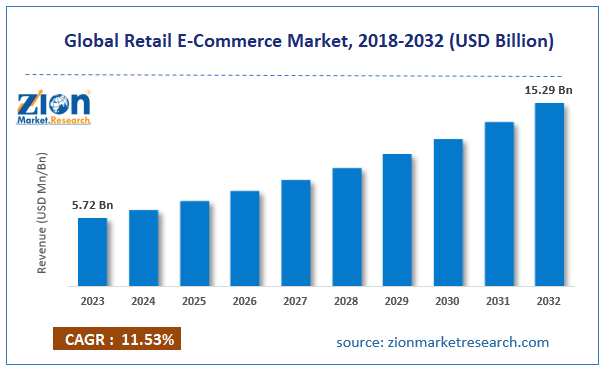
The global retail e-commerce market size was worth around USD 3,578 billion in 2025 and is predicted to grow to around USD 9,530 billion by 2034, with a compound annual growth rate (CAGR) of roughly 11.5% between 2026 and 2034.
Key Insights
- As per the analysis shared by our research analyst, the global retail e-commerce market is estimated to grow annually at a CAGR of around 11.5% over the forecast period (2026-2034).
- In terms of revenue, the global retail e-commerce market size was valued at around USD 3,578 billion in 2025 and is projected to reach USD 9,530 billion by 2034.
- Growth of digital payment ecosystems is expected to propel the retail e-commerce market over the projected period.
- Based on the product, the apparels and accessories segment holds a significant market share in 2025 of 42%.
- Based on the model, the Business to Business (B2B) segment held the largest revenue share in 2025.
- Based on the type, the pure marketplace segment held the prominent market share in 2025.
- Based on region, the Asia Pacific dominates the market with a major revenue share of 40% in 2025.
Retail E-commerce Market: Overview
Retail e-commerce is the buying and selling of consumer goods through digital interfaces such as websites, mobile apps, online marketplaces, and social commerce platforms. This enables the marketing and delivery of a variety of products, including clothing, electronics, groceries, beauty products, home appliances, and consumer packaged goods, directly to consumers via secure digital transactions and doorstep delivery. This market includes B2C (Business to Consumer), C2C (Consumer to Consumer), and D2C (Direct to Consumer) forms of retail, along with digital payment systems, cloud-based commerce software, AI technologies, data analytics tools, and logistic networks. Growth drivers in this market include smartphone adoption rates, internet connectivity rates, omnichannel retailing, personalization, and fast fulfillment. Moreover, social commerce, live-stream shopping, cross-border e-commerce, and AI-driven product recommendations are bringing about revolutionary changes to the retail industry.
Impact of the USA-Israel War on Iran on the Retail E-commerce Market
Conflict between the USA and Israel concerning Iran has affected the global retail e-commerce market to some extent, but mostly indirectly. Escalating tensions have disrupted international shipping channels, leading to higher transportation, insurance, and fuel costs and causing uncertainty about supplies, especially products from the Middle East. This situation has increased business costs and sometimes resulted in delays in product deliveries for online retailers.
Nevertheless, the retail e-commerce market demonstrated resilience under such conditions, owing to diversified sourcing from other regions, regional fulfillment facilities, advanced inventory management systems, and strong demand for online purchasing. Consequently, even though the market experienced some problems with efficiency and profit margins, its growth prospects were not affected, as they were based on continued digitalization, omnichannel retailing, and the global development of e-commerce.
Retail E-commerce Market: Dynamics
Growth Drivers
Why does the increasing internet and smartphone penetration drive the retail e-commerce market?
Rapid internet connectivity and rising smartphone penetration are among the major factors driving growth in the global retail e-commerce market. In this regard, individuals can view products, compare prices, make secure digital transactions, and shop anywhere, anytime. According to the International Telecommunication Union (ITU), there are 6.0 billion internet users or 74% of the total global population by 2025, compared to 60% in 2020, an increase of 1.3 billion users within just five years. Furthermore, according to the ITU, 5G networks now cover more than 50% of the world's population, thereby improving the mobile experience for customers.
Moreover, according to the GSMA report, 4.7 billion people, or 58% of the global population, were using mobile internet at the end of 2024, while mobile broadband covered 96% of the global population. The above trend indicates the acceleration of mobile-commerce (m-commerce), through which retailers can reach consumers via mobile applications, mobile websites, digital wallets, and social commerce. As governments and telecommunications companies continue to invest in broadband and internet expansion at affordable costs, this will remain a major catalyst for the global retail e-commerce market.
Restraints
Cybersecurity threats and data privacy concerns hamper the growth of the retail e-commerce industry
There are several issues that still pose roadblocks to the retail e-commerce sector. The online stores store large amounts of their customers' personal data, such as financial, identity, and transactional information. Ransomware, phishing, credential theft, and data breaches impact the industry through financial losses and operational disruptions, and erode consumers' trust in the online medium.
For instance, in the Verizon DBIR 2025 analysis, 22,000 cybersecurity events and 12,195 data breaches were studied in 139 countries. As Verizon states, 44% of data breaches worldwide involved ransomware; 22% of first attack vectors involved credential abuse; there was a 34% rise in vulnerability exploitation compared to the previous year; and there were twice as many cases of third-party involvement in data breaches (30%). Verizon also includes the retail sector among those that constantly face cyber threats.
The costs of such attacks rise yearly. For instance, according to the IBM Cost of a Data Breach Report 2025, the average cost of a data breach in India reached a record high of INR 220 million (USD 2.6 million), up 13% from 2024. The most widespread types of attack vectors were phishing, third-party compromises, and vulnerability exploits.
Opportunities
How do the advancements in artificial intelligence and data analytics offer a lucrative opportunity for the retail e-commerce market?
The growing use of artificial intelligence (AI) and data analytics is generating considerable opportunities for the retail e-commerce market by providing retailers with the capability to personalize the customer experience, optimize inventory management, automate customer service, enhance demand forecasting, and improve pricing strategies. AI recommendation engines, predictive analytics, intelligent search, and generative AI technologies help retailers increase customer engagement, improve conversion rates, lower costs, and create greater customer loyalty. As more retailers use real-time consumer data to inform their decisions, AI-driven commerce becomes a crucial competitive advantage.
An instance of a significant innovation in May 2025 is the launch of Shopify's AI Store Builder, which enables merchants to build a full e-commerce store by simply inputting prompts. The platform generates the full store design, product pages, images, and content. In addition to introducing the AI Store Builder, Shopify also improved its Sidekick AI assistant, adding to it voice interaction, screen sharing, AI-powered analytics, image generation, customer segmentation, and inventory management, thus allowing merchants to automate operations and make data-driven decisions.
Also, Adobe Analytics noted in March 2025 that traffic to US retail websites from generative AI sources grew 1,200% year over year, based on analysis of more than 1 trillion visits to US retail websites. Such significant growth indicates that shopping assistants and AI-powered personalized recommendations have become important tools for acquiring customers and selling products, creating huge opportunities for the retail e-commerce market.
Challenges
How does reliance on third-party logistics and marketplace platforms pose a significant challenge to the retail e-commerce market?
Reliance on third-party logistics (3PL) companies and online marketplace systems poses a significant threat to the retail e-commerce market, as many retailers rely on third parties for activities such as storing goods, fulfilling orders, delivering products, handling payments, and attracting customers. Delays in transport, labor shortages, fuel price hikes, cyberattacks, and other capacity issues may directly impact order fulfillment, delivery times, and customer satisfaction.
Moreover, policy changes in terms of higher commissions, tougher requirements for sellers, algorithms, and account closures may decrease the visibility of retailers, raise their expenses, and reduce sales. Dependence on 3PL companies and marketplaces also means that retailers lose the ability to maintain customer relationships, set prices for their goods and services, and build their brands, which is why they cannot establish loyal clients. Cross-border logistics challenges, delays in customs clearance, and changes in international shipping costs can reduce profitability, especially among small and medium-sized businesses. Consequently, overdependence on 3PL companies and marketplace systems poses numerous threats to the sustainable development of the retail e-commerce market.
Retail E-commerce Market: Report Scope
| Report Attributes | Report Details |
|---|---|
| Report Name | Retail E-commerce Market |
| Market Size in 2025 | USD 3,578 Billion |
| Market Forecast in 2034 | USD 9,530 Billion |
| Growth Rate | CAGR of 11.5% |
| Number of Pages | 228 |
| Key Companies Covered | Amazon, Alibaba Group (Taobao, Tmall), JD.com, Walmart eCommerce, PDD Holdings (Pinduoduo & Temu), eBay, Mercado Libre, Shopify, Rakuten Group, Coupang, Sea Limited (Shopee), Zalando, Flipkart Group, Etsy, Otto Group, Wayfair, Shein, Target eCommerce, Tesco Online, Carrefour eCommerce, and others. |
| Segments Covered | By Product, By Model, By Type, and By Region |
| Regions Covered | North America, Europe, Asia Pacific (APAC), Latin America, Middle East, and Africa (MEA) |
| Base Year | 2025 |
| Historical Year | 2020 to 2024 |
| Forecast Year | 2026 - 2034 |
| Customization Scope | Avail customized purchase options to meet your exact research needs. Request For Customization |
Retail E-commerce Market: Segmentation
Product Insights
Why does the apparels and accessories segment hold a prominent position in the retail e-commerce market?
The apparels and accessories segment holds a significant share of the e-commerce industry in 2025, of 42%. The factors that help increase a sector's revenue include the growing habit of people to purchase garments online, increased use of cell phones, and the wide selection of products available on various global and regional e-commerce sites. Customers appreciate the ease of browsing, low prices, product recommendations that suit their needs, virtual trials, easy returns, and fast delivery.
Model Insights
Why does the Business to Business (B2B) segment capture the largest share in the Retail E-commerce market?
The Business to Business (B2B) segment held the largest revenue share of the retail e-commerce market in 2025. The expansion is being fueled by the accelerated transformation of procurement into a digital mode and the increased use of online procurement channels by wholesalers, manufacturers, distributors, and business buyers. More and more companies are moving from conventional procurement practices to e-procurement to increase efficiency in purchasing transactions, reduce costs, and make operations more visible. E-procurement sites provide features such as bulk purchasing, contract pricing, customized catalogs, invoicing, and inventory management.
Type Insights
Does the pure marketplace segment capture the largest share in the retail e-commerce market?
The pure marketplace segment held a prominent share of the retail e-commerce industry in 2025. The growth is fueled by the rising trend towards adopting an asset-light approach, which enables marketplaces to facilitate direct connections between third-party sellers and consumers. In contrast to inventory-based companies, pure marketplaces do not own most of the goods sold on their platform. It allows them to quickly and efficiently add many products to their offerings without spending much on expansion. Therefore, marketplaces attract many sellers and offer customers a wide range of options.
Regional Insights
Why does Asia-Pacific lead the retail e-commerce market?
The Asia-Pacific region dominates the retail e-commerce market, accounting for 40% of revenue in 2025. The growth in the regional market is driven by a large base of online consumers, the ongoing digital revolution, and the penetration of internet and smartphone technologies. Online retailing is experiencing significant growth in countries such as China, India, Japan, South Korea, Indonesia, and other Southeast Asian countries due to high levels of disposable income, advanced digital payment solutions, and government support for the digital economy. This region is home to the top e-commerce websites in the world, including Alibaba, JD.com, PDD Holdings (Temu), Rakuten, Flipkart, Shopee, Lazada, and Coupang. These companies are making large investments in technologies such as AI and omnichannel retailing.
The growing popularity of mobile commerce (m-commerce), social commerce, live shopping, and cross-border e-commerce is also helping in the growth of the regional market. Fulfillment centers, last-mile delivery, cloud commerce, and AI-driven personalization are among the major ways the customer experience is being enhanced in this region; therefore, Asia Pacific will dominate the global retail e-commerce market during the forecast period.
Retail E-commerce Market: Competitive Analysis
The global retail e-commerce market is dominated by players like:
- Amazon
- Alibaba Group (Taobao
- Tmall)
- JD.com
- Walmart eCommerce
- PDD Holdings (Pinduoduo & Temu)
- eBay
- Mercado Libre
- Shopify
- Rakuten Group
- Coupang
- Sea Limited (Shopee)
- Zalando
- Flipkart Group
- Etsy
- Otto Group
- Wayfair
- Shein
- Target eCommerce
- Tesco Online
- Carrefour eCommerce
The global retail e-commerce market is segmented as follows:
By Product
- Groceries
- Personal and Beauty Care
- Apparels and Accessories
- Footwear
- Furniture and Home Décor
- Electronic Goods
- Others
By Model
- Business to Business (B2B)
- Consumer to Consumer (C2C)
- Business to Consumer (B2C)
By Type
- Pure Marketplace
- Hybrid Marketplace
By Region
- North America
- The U.S.
- Canada
- Mexico
- Europe
- France
- The UK
- Spain
- Germany
- Italy
- Rest of Europe
- Asia Pacific
- China
- Japan
- India
- Australia
- South Korea
- Rest of Asia Pacific
- The Middle East & Africa
- Saudi Arabia
- UAE
- Egypt
- Kuwait
- South Africa
- Rest of the Middle East & Africa
- Latin America
- Brazil
- Argentina
- Rest of Latin America
Table Of Content
Methodology
FrequentlyAsked Questions
Retail e-commerce is the buying and selling of consumer goods through digital interfaces such as websites, mobile apps, online marketplaces, and social commerce platforms. This enables the marketing and delivery of a variety of products, including clothing, electronics, groceries, beauty products, home appliances, and consumer packaged goods, directly to consumers via secure digital transactions and doorstep delivery.
The growth of the retail e-commerce market is primarily driven by increasing internet and smartphone penetration, rising consumer preference for convenient online shopping, and the rapid adoption of digital payment solutions. Advancements in artificial intelligence (AI), data analytics, and cloud-based commerce platforms are enabling personalized shopping experiences, efficient inventory management, and improved customer engagement.
The retail e-commerce market faces several challenges, including rising cybersecurity threats and data privacy concerns, increasing logistics and last-mile delivery costs, and high product return rates that reduce profit margins. Intense competition among online retailers, dependence on third-party logistics and marketplace platforms, and supply chain disruptions further constrain market growth.
Based on the product, the apparels and accessories segment is expected to dominate the retail e-commerce market growth during the projected period.
The retail e-commerce market is being shaped by emerging trends such as AI-powered personalization, generative AI shopping assistants, social and live-stream commerce, and the rapid growth of mobile-commerce (m-commerce). Retailers are increasingly adopting omnichannel strategies, cloud-based commerce platforms, and advanced data analytics to enhance customer experiences and optimize operations. Innovations in automated fulfillment centers, robotics, drone and autonomous delivery, augmented reality (AR) virtual try-ons, voice commerce, and sustainable packaging are further transforming the market. At the same time, the expansion of cross-border e-commerce and Buy Now, Pay Later (BNPL) solutions continues to drive consumer adoption and market growth.
According to the report, the global retail e-commerce market size was worth around USD 3,578 billion in 2025 and is predicted to grow to around USD 9,530 billion by 2034.
The global retail e-commerce market is expected to grow at a CAGR of 11.5% during the forecast period.
The global retail e-commerce industry growth is expected to be led by the Asia Pacific over the forecast period.
The global retail e-commerce market is dominated by players like Amazon, Alibaba Group (Taobao, Tmall), JD.com, Walmart eCommerce, PDD Holdings (Pinduoduo & Temu), eBay, Mercado Libre, Shopify, Rakuten Group, Coupang, Sea Limited (Shopee), Zalando, Flipkart Group, Etsy, Otto Group, Wayfair, Shein, Target eCommerce, Tesco Online, and Carrefour eCommerce, among others.
The retail e-commerce market report covers the geographical market along with a comprehensive competitive landscape analysis. It also includes cash flow analysis, profit ratio analysis, market basket analysis, market attractiveness analysis, sentiment analysis, PESTLE analysis, trend analysis, SWOT analysis, trade area analysis, demand & supply analysis, Porter’s five forces analysis, and value chain analysis.

HappyClients

