
Pharma 4.0 Market Size, Share, Growth, Opportunities 2034

Pharma 4.0 Market By Technology (Artificial Intelligence and Machine Learning, Internet of Things, Big Data Analytics, Cloud Computing, Robotics and Automation), By Application (Drug Discovery and Development, Clinical Trials, Manufacturing and Quality Control, Supply Chain Management, Pharmacovigilance), By End-User (Pharmaceutical Companies, Contract Research Organizations, Academic and Research Institutions, Regulatory Authorities), By Deployment Mode (On-Premise, Cloud-Based, Hybrid), and By Region - Global and Regional Industry Overview, Market Intelligence, Comprehensive Analysis, Historical Data, and Forecasts 2026 - 2034
| Market Size in 2025 | Market Forecast in 2034 | CAGR (in %) | Base Year |
|---|---|---|---|
| USD 17.85 Billion | USD 90.71 Billion | 19.80% | 2025 |
Pharma 4.0 Industry Perspective:
What will be the size of the Pharma 4.0 market during the forecast period?
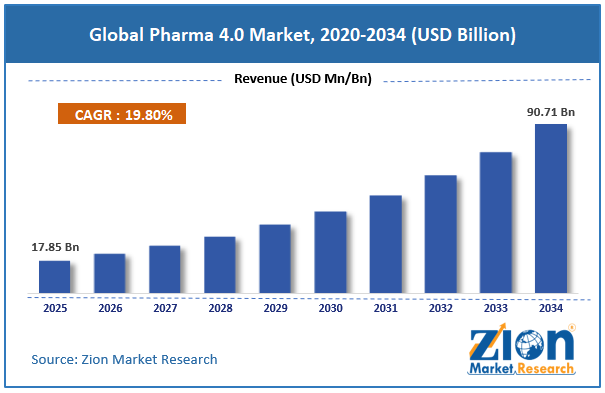
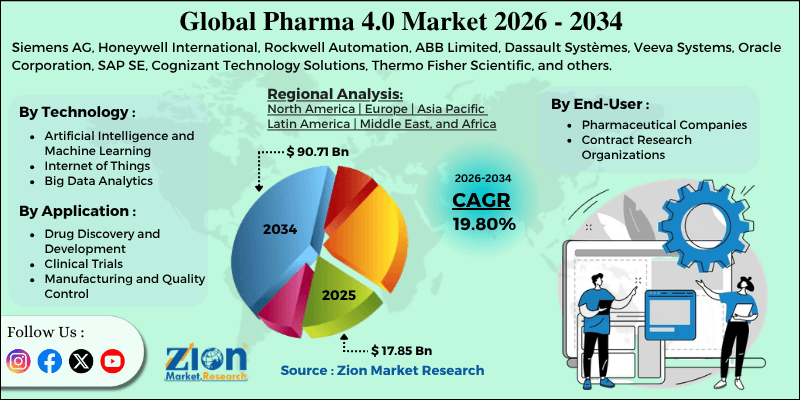
The global Pharma 4.0 market size was worth approximately USD 17.85 billion in 2025 and is projected to grow to around USD 90.71 billion by 2034, with a compound annual growth rate of roughly 19.80% between 2026 and 2034.
Pharma 4.0 Market: Overview
Pharma 4.0 is the integration of advanced digital technologies, including artificial intelligence, the Internet of Things (IoT), robotics, big data analytics, cloud computing, and automation, into pharmaceutical research, manufacturing, quality management, and supply chain operations. Instead of depending on manual workflows and paper-based documentation, pharmaceutical companies are adopting connected digital systems to improve efficiency, accuracy, and process control. Pharma 4.0 enables seamless data flow across the entire drug lifecycle, from molecule discovery and clinical development to manufacturing and patient delivery. In modern production facilities, smart sensors and automated systems continuously monitor equipment performance, product quality, and process parameters in real time, helping reduce errors and production risks. Artificial intelligence and advanced analytics are also supporting faster identification of potential drug candidates by processing large scientific datasets. Increasing regulatory expectations for data integrity, traceability, product quality, and supply chain visibility are accelerating digital adoption across the industry.
At the same time, the growing demand for personalized medicines, biologics, and advanced therapies is creating a need for flexible, intelligent manufacturing platforms. As digital transformation advances throughout healthcare, Pharma 4.0 is becoming a key strategy for improving operational performance, product quality, compliance, and pharmaceutical innovation worldwide.
The Pharma 4.0 market is growing as pharmaceutical companies increasingly rely on intelligent, connected, and data-driven operations to improve competitiveness, compliance, and efficiency.
Key Insights
- As per the analysis shared by our research analyst, the global Pharma 4.0 market is estimated to grow annually at a compound annual growth rate of around 19.80% over the forecast period from 2026 to 2034.
- In terms of revenue, the global Pharma 4.0 market size was valued at approximately USD 17.85 billion in 2025 and is projected to reach USD 90.71 billion by 2034.
- The Pharma 4.0 market is expected to grow steadily, driven by increasing regulatory requirements for digital data integrity, the growing adoption of artificial intelligence in drug discovery, rising demand for smart pharmaceutical manufacturing, expanding investment in clinical trial digitization, and the urgent need for resilient, transparent pharmaceutical supply chains.
- Based on technology, artificial intelligence and machine learning are expected to grow the fastest, while robotics and automation continue to lead overall market share due to their widespread deployment across packaging, dispensing, and quality inspection operations.
- Based on application, manufacturing, and quality control is expected to lead the Pharma 4.0 market, while drug discovery and development are anticipated to grow rapidly, driven by high drug development costs and the ability of artificial intelligence to accelerate candidate identification.
- Based on end-user, pharmaceutical companies represent the largest segment, while contract research organizations are anticipated to grow as they increasingly adopt digital platforms to serve multiple clients efficiently and competitively.
- Based on deployment mode, cloud-based solutions are expected to drive market growth, while hybrid deployment models are anticipated to remain strong as regulated industries balance data control requirements with the scalability advantages of cloud infrastructure.
- Based on region, North America is projected to dominate the global Pharma 4.0 market during the forecast period, followed by Europe, which is growing steadily due to strong regulatory frameworks and significant investment in pharmaceutical innovation and modernized manufacturing.
Impact of the USA-Israel War on Iran on the Pharma 4.0 Market
Geopolitical tensions involving the United States, Israel, and Iran may create temporary challenges for the Pharma 4.0 market by affecting the supply of semiconductor components, electronic hardware, and technology equipment. Higher shipping and energy costs could slightly impact system deployment timelines and operational expenses in some regions. However, the market outlook remains positive, supported by growing demand for digital transformation, smart manufacturing, and advanced pharmaceutical production systems worldwide.
Pharma 4.0 Market: Technology Roadmap 2025–2034
What is the projected development roadmap of the Pharma 4.0 market over the forecast period?
The Pharma 4.0 market is advancing through artificial intelligence-powered process optimization, real-time release testing, digital twin manufacturing environments, autonomous laboratory platforms, and fully connected end-to-end pharmaceutical value chains. The market is expected to grow at a compound annual growth rate of around 19.80% over the forecast period, driven by accelerating regulatory alignment with digital manufacturing standards and growing industry confidence in the return on investment that intelligent pharmaceutical technologies deliver.
The following roadmap outlines key development phases expected through 2034.
2025–2027: Foundation and Integration Phase
- Pharmaceutical manufacturers are increasingly integrating manufacturing, laboratory, and business management systems to improve data visibility, process coordination, and operational efficiency across facilities.
- Artificial intelligence-powered process-monitoring tools are being adopted to provide real-time quality insights and enable faster production decisions.
- Internet of Things sensor networks are helping companies improve predictive maintenance, reduce equipment failures, and increase overall manufacturing productivity.
2028–2031: Intelligent Autonomy and Regulatory Convergence Phase
- Digital twin technology is expected to gain wider adoption, allowing pharmaceutical companies to simulate manufacturing processes and equipment changes before physical implementation.
- Regulatory agencies are expected to introduce clearer frameworks for continuous manufacturing, real-time testing, and digital data management, encouraging further investment in Pharma 4.0 technologies.
- Autonomous laboratory robots are expected to support drug discovery and research activities by automating sample preparation, testing, and routine laboratory operations
2032–2034: End-to-End Autonomous Pharmaceutical Operations Phase
- End-to-end connected pharmaceutical ecosystems linking suppliers, manufacturing facilities, clinical trial centers, and distribution networks are expected to become increasingly common.
- Artificial intelligence systems are expected to play a larger role in predicting drug safety trends, patient response patterns, and fluctuations in supply chain demand.
- Sustainable and energy-efficient manufacturing technologies supported by intelligent process controls are expected to become standard features in new pharmaceutical production facilities.
Pharma 4.0 Market: Dynamics
Growth Drivers
What is driving growth in the Pharma 4.0 market as digital transformation reshapes pharmaceutical research and manufacturing?
The Pharma 4.0 market is growing as pharmaceutical companies focus on improving manufacturing efficiency, reducing production costs, and accelerating the development of new medicines. The increasing demand for high-quality drugs, along with the need for faster product launches, is driving the adoption of digital technologies across pharmaceutical operations. Advanced tools such as artificial intelligence, automation, cloud computing, and connected manufacturing systems are helping companies improve productivity, reduce errors, and strengthen quality control. Rising cases of cancer, diabetes, cardiovascular diseases, and rare disorders are creating greater demand for faster drug research and development, supporting investment in intelligent digital solutions. Regulatory authorities are also encouraging the use of real-time data monitoring, electronic records, and improved process control to enhance product quality and compliance.
In addition, growing demand for biologics, biosimilars, cell therapies, and gene therapies is increasing the need for advanced manufacturing platforms capable of handling complex production processes. Expanding digital transformation initiatives, greater emphasis on operational efficiency, and increasing adoption of smart manufacturing technologies are further supporting the growth of the Pharma 4.0 market across the global pharmaceutical industry.
Growing investment in clinical trial digitization and decentralized research models is further accelerating the Pharma 4.0 market.
The Pharma 4.0 industry is growing as pharmaceutical companies seek faster, cost-effective, and data-driven approaches to clinical research and drug development. Clinical trials are often lengthy and expensive, creating strong demand for digital technologies that improve efficiency and reduce delays. Solutions such as electronic data capture, remote patient monitoring, wearable health devices, artificial intelligence, and advanced analytics are helping companies collect accurate data and improve trial management. The increasing adoption of decentralized clinical trials is another major growth driver, enabling patients to participate from home via connected healthcare technologies rather than making frequent visits to research centers. The growing acceptance of virtual trials by regulators, pharmaceutical companies, and healthcare organizations is driving demand for digital platforms, patient engagement tools, and integrated data management systems. In addition, the growing use of real-world patient data to support regulatory submissions, safety monitoring, and treatment evaluation is driving demand for advanced analytics and pharmacovigilance solutions.
Restraints
High costs, legacy systems, and a shortage of skilled talent remain key challenges in the Pharma 4.0 market.
The Pharma 4.0 industry faces several challenges that may slow adoption. Many pharmaceutical companies continue to operate older manufacturing facilities and legacy systems that are difficult to connect with modern digital technologies. Upgrading production sites with smart sensors, automation platforms, cloud-based systems, and connected software requires significant investment and careful planning. High implementation costs for manufacturing execution systems, data management platforms, cybersecurity solutions, and system validation can be difficult for small and medium-sized pharmaceutical companies to manage. Another major restraint is the shortage of skilled professionals with expertise in pharmaceutical operations, digital technologies, data analytics, and regulatory compliance.
Finding and retaining qualified talent remains a challenge for many organizations. In addition, varying regulatory requirements across different countries can create uncertainty regarding the adoption of advanced digital technologies and automated processes. Concerns related to data security, system integration, and maintaining uninterrupted production during digital upgrades further complicate matters.
Opportunities
How are personalized medicine, emerging market expansion, and supply chain resilience creating new growth opportunities in the Pharma 4.0 market?
The Pharma 4.0 market offers significant growth opportunities as pharmaceutical companies increasingly focus on personalized medicine and advanced therapies. The growing use of genetic testing, biomarker analysis, and patient-specific treatment approaches is driving demand for flexible, intelligent manufacturing systems capable of producing highly customized medicines. Digital technologies such as artificial intelligence, automation, and advanced data analytics are helping pharmaceutical companies improve production accuracy and support personalized healthcare. Another important opportunity comes from the increasing use of real-world patient data to evaluate treatment effectiveness and support regulatory requirements. Pharmaceutical companies are investing in digital platforms that collect and analyze data from electronic health records, healthcare systems, and connected medical devices to improve decision-making and patient outcomes. Emerging pharmaceutical manufacturing markets, such as India, China, South Korea, and Brazil, also offer strong growth potential.
In addition, growing demand for operational efficiency, regulatory compliance, and data-driven pharmaceutical operations is creating new opportunities for technology providers offering scalable Pharma 4.0 solutions across global pharmaceutical markets.
Challenges
What challenges does the Pharma 4.0 market face in managing data security, regulatory alignment, and organizational change at scale?
The Pharma 4.0 market faces several challenges that can slow adoption across the pharmaceutical industry. One of the biggest concerns is data security, as connected manufacturing systems, laboratory platforms, clinical databases, and supply chain networks increase the risk of cyberattacks and unauthorized access to sensitive information. Protecting patient records, production data, and intellectual property requires significant investment in cybersecurity solutions. Another challenge is the variation in regulatory requirements across different countries, making it difficult for pharmaceutical companies to implement standardized digital systems across global operations. Compliance with multiple regulatory frameworks often increases costs and complexity. Resistance to organizational change is also a major barrier, as many companies continue to rely on traditional processes and established workflows. Adopting advanced digital technologies often requires employee training, operational adjustments, and long-term investment. These challenges can slow the pace of digital transformation and limit the wider adoption of Pharma 4.0 technologies across pharmaceutical manufacturing and research environments.
Pharma 4.0 Market: Report Scope
| Report Attributes | Report Details |
|---|---|
| Report Name | Pharma 4.0 Market |
| Market Size in 2025 | USD 17.85 Billion |
| Market Forecast in 2034 | USD 90.71 Billion |
| Growth Rate | CAGR of 19.80% |
| Number of Pages | 226 |
| Key Companies Covered | Siemens AG, Honeywell International, Rockwell Automation, ABB Limited, Dassault Systèmes, Veeva Systems, Oracle Corporation, SAP SE, Cognizant Technology Solutions, Thermo Fisher Scientific, and others. |
| Segments Covered | By Technology, By Application, By End-User, By Deployment Mode, and By Region |
| Regions Covered | North America, Europe, Asia Pacific (APAC), Latin America, Middle East, and Africa (MEA) |
| Base Year | 2024 |
| Historical Year | 2020 - 2024 |
| Forecast Year | 2026 - 2034 |
| Customization Scope | Avail customized purchase options to meet your exact research needs. Request For Customization |
Pharma 4.0 Market: Segmentation
The global Pharma 4.0 market is segmented by technology, application, end-user, deployment mode, and region.
What makes artificial intelligence and machine learning the fastest-growing technology segment in the Pharma 4.0 market?
Based on technology, the global Pharma 4.0 market is divided into artificial intelligence and machine learning, the Internet of Things, big data analytics, cloud computing, and robotics and automation. Robotics and automation hold approximately 35% of the market share, leading due to its established presence across high-speed packaging lines, sterile filling operations, and automated quality inspection systems. Artificial intelligence and machine learning hold around 22% of the market share. They are the fastest-growing technology segment, driven by expanding use in drug discovery, process optimization, clinical data analysis, and drug safety monitoring.
How does manufacturing and quality control maintain its leading position in the Pharma 4.0 application landscape?
Based on application, the Pharma 4.0 industry is categorized into drug discovery and development, clinical trials, manufacturing and quality control, supply chain management, and pharmacovigilance. The manufacturing and quality control segment accounts for about 38% of the market, driven by the direct financial impact of batch failures, regulatory citations, and product recalls that smart manufacturing technologies help prevent. The drug discovery and development segment holds around 20% share. It is growing rapidly as artificial intelligence speeds up drug discovery and development.
What makes pharmaceutical companies the dominant end-user group in the Pharma 4.0 market?
Based on end-user, the market is classified into pharmaceutical companies, contract research organizations, academic and research institutions, and regulatory authorities. Pharmaceutical companies lead with about 58% share, driven by the scale of their manufacturing operations, the volume of their regulatory obligations, and the strategic imperative to reduce costs and accelerate innovation pipelines through digital transformation. Contract research organizations hold around 19% share. They are growing as pharmaceutical and biotechnology companies require stronger digital integration and real-time data access from outsourcing partners.
How do cloud-based solutions lead the deployment landscape of the Pharma 4.0 market?
Based on deployment mode, the Pharma 4.0 market is segregated into on-premise, cloud-based, and hybrid solutions. Cloud-based solutions account for about 41% of the market and lead, as they allow pharmaceutical companies to scale data storage and computing capacity rapidly without large upfront hardware investments, while also enabling easier collaboration across geographically distributed research, manufacturing, and regulatory teams. Hybrid deployment models hold around 28% share. They are growing as pharmaceutical companies use on-premise systems for critical data and cloud platforms for analytics and collaboration.
Pharma 4.0 Market: Regional Analysis
How is North America shaping global demand for Pharma 4.0 technologies?
The Pharma 4.0 market is led by North America and is expected to grow steadily at a compound annual growth rate of around 6.4% during the forecast period. North America leads due to its highly advanced pharmaceutical industry, strong digital infrastructure, and early adoption of innovative technologies across drug development and manufacturing. The United States is the region's largest market, supported by the presence of many of the world's leading pharmaceutical and biotechnology companies. Growing investments in artificial intelligence, automation, cloud computing, advanced analytics, and smart manufacturing systems are helping pharmaceutical companies improve productivity, product quality, and regulatory compliance. Supportive initiatives from regulatory authorities are also encouraging the adoption of digital technologies that improve manufacturing efficiency and data management. Canada contributes significantly to regional growth through its expanding biotechnology sector, strong research capabilities, and increasing focus on strengthening pharmaceutical manufacturing capacity. Collaboration between universities, research institutions, healthcare organizations, and pharmaceutical companies continues to drive innovation across the industry.
In addition, North America benefits from a well-developed ecosystem of technology providers, software companies, automation specialists, and consulting firms that support Pharma 4.0 implementation. Rising demand for biologics, personalized medicines, advanced therapies, and efficient supply chain management is further accelerating digital adoption across the region. Strong research and development activity, favorable investment conditions, and continued technological innovation are strengthening North America's leadership in the global Pharma 4.0 market.
How does Europe maintain strong momentum in the Pharma 4.0 market?
The Pharma 4.0 market in Europe holds a strong second position globally and is expected to grow at a compound annual growth rate of around 6.9% during the forecast period. Europe is a major hub for pharmaceutical innovation, advanced manufacturing, and healthcare research, making it an important market for digital transformation technologies. Germany leads the regional market due to its strong industrial base, advanced engineering capabilities, and large pharmaceutical manufacturing sector.
Many pharmaceutical companies in Germany are investing in automation, artificial intelligence, connected manufacturing systems, and data-driven production processes to improve efficiency and product quality. Switzerland is another key contributor, supported by the presence of globally recognized pharmaceutical companies and significant investments in research and development. The United Kingdom continues to strengthen its position through the growing adoption of digital technologies across drug development, manufacturing, and supply chain operations.
Support from European regulatory agencies is encouraging greater use of advanced manufacturing technologies, digital quality management systems, and real-time data monitoring. Collaborative research programs, strong partnerships between industry and academic institutions, and increasing investments in biologics and personalized medicine are further supporting market growth. Growing focus on operational efficiency, product quality, sustainability, and regulatory compliance continues to drive Pharma 4.0 adoption across Europe, strengthening the region's position in the global pharmaceutical technology landscape.
Recent Market Developments
- In January 2026, PHARMAP 2026 identified smart pharmaceutical facilities, digital manufacturing, and Pharma 4.0 technologies among the key themes shaping future pharmaceutical production and operational modernization.
Pharma 4.0 Market: Competitive Analysis
The leading players in the global Pharma 4.0 market are:
- Siemens AG
- Honeywell International
- Rockwell Automation
- ABB Limited
- Dassault Systèmes
- Veeva Systems
- Oracle Corporation
- SAP SE
- Cognizant Technology Solutions
- Thermo Fisher Scientific
The global Pharma 4.0 market is segmented as follows:
By Technology
- Artificial Intelligence and Machine Learning
- Internet of Things
- Big Data Analytics
- Cloud Computing
- Robotics and Automation
By Application
- Drug Discovery and Development
- Clinical Trials
- Manufacturing and Quality Control
- Supply Chain Management
- Pharmacovigilance
By End-User
- Pharmaceutical Companies
- Contract Research Organizations
- Academic and Research Institutions
- Regulatory Authorities
By Deployment Mode
- On-Premise
- Cloud-Based
- Hybrid
By Region
- North America
- The U.S.
- Canada
- Mexico
- Europe
- France
- The UK
- Spain
- Germany
- Italy
- Rest of Europe
- Asia Pacific
- China
- Japan
- India
- Australia
- South Korea
- Rest of Asia Pacific
- The Middle East & Africa
- Saudi Arabia
- UAE
- Egypt
- Kuwait
- South Africa
- Rest of the Middle East & Africa
- Latin America
- Brazil
- Argentina
- Rest of Latin America
Table Of Content
Methodology
FrequentlyAsked Questions
Pharma 4.0 is the integration of advanced digital technologies, including artificial intelligence, the Internet of Things (IoT), robotics, big data analytics, cloud computing, and automation, into pharmaceutical research, manufacturing, quality management, and supply chain operations.
The global Pharma 4.0 market is expected to grow due to rising regulatory requirements, increasing demand for personalized and biologic medicines, expanding clinical trials, and growing pharmaceutical manufacturing investments across Asia Pacific and Latin America.
According to research, the global Pharma 4.0 market size was worth around USD 17.85 billion in 2025 and is predicted to grow to around USD 90.71 billion by 2034.
The compound annual growth rate value of the Pharma 4.0 market is expected to be around 19.80% during 2026 to 2034.
North America is expected to lead the global Pharma 4.0 market during the forecast period, driven by the concentration of innovative pharmaceutical companies, progressive regulatory engagement, and high levels of digital transformation investment. Europe is anticipated to be a strong second, driven by robust regulatory frameworks, significant pharmaceutical manufacturing capacity, and active public and private investment in pharmaceutical innovation and digitalization.
The major players in the global Pharma 4.0 market include Siemens AG, Honeywell International, Rockwell Automation, ABB Limited, Dassault Systèmes, Veeva Systems, Oracle Corporation, SAP SE, Cognizant Technology Solutions, and Thermo Fisher Scientific.
The report examines key aspects of the Pharma 4.0 market, including growth drivers, restraints, emerging opportunities, challenges, a competitive landscape analysis, regional breakdowns, and a detailed future outlook across all major technology segments, application areas, end-user categories, deployment modes, and geographies.
The Pharma 4.0 market is shifting toward cloud-native platforms, artificial intelligence-powered process optimization, and real-time data ecosystems that connect manufacturing, quality, clinical, and commercial operations under a single digital framework. Pharmaceutical companies are increasingly focusing on interoperability, data standardization, and cybersecurity as digital transformation expands across global operations.
The Pharma 4.0 market will see strong growth in artificial intelligence-assisted drug discovery, continuous pharmaceutical manufacturing, decentralized clinical trial management, intelligent pharmacovigilance signal detection, and end-to-end supply chain digitization, driven by cost pressures, and regulatory mandates.
The Pharma 4.0 market is being shaped by digital twin manufacturing environments, autonomous laboratory systems, generative artificial intelligence for molecular design, decentralized clinical trial platforms, predictive pharmacovigilance analytics, and sustainable closed-loop manufacturing systems that combine intelligent process controls with environmental efficiency goals to meet both regulatory expectations and corporate sustainability commitments.

HappyClients

