
Supply Chain Network Design Market Size, Share, Trends, Growth and Forecast 2034

Supply Chain Network Design Market By Component (Software/Platform and Services), By Deployment Mode (On-Premise, Hybrid Deployment and Cloud-Based (SaaS)), By Organization Size (Large Enterprises and Small & Medium Enterprises (SMEs)), By Application (Supply Chain Optimization & Planning, Transportation & Distribution Modelling, Inventory & Warehouse Location Planning, Risk & Resilience Management, Sourcing & Procurement Strategy Design, Demand Forecasting & Scenario Simulation and Sustainability & Carbon Footprint Optimization), By Industry Vertical (Manufacturing, Consumer Goods & FMCG, Healthcare & Pharmaceuticals, Logistics & Transportation, Retail & E-Commerce, Energy & Utilities and Automotive) and By Region - Global and Regional Industry Overview, Market Intelligence, Comprehensive Analysis, Historical Data, and Forecasts 2026 - 2034
| Market Size in 2025 | Market Forecast in 2034 | CAGR (in %) | Base Year |
|---|---|---|---|
| USD 16.5 Billion | USD 46.5 Billion | 12.2% | 2025 |
Supply Chain Network Design Industry Perspective:
What will be the size of the global supply chain network design market during the forecast period?
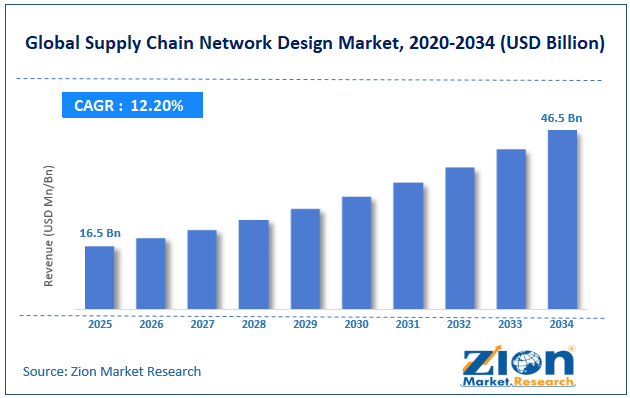
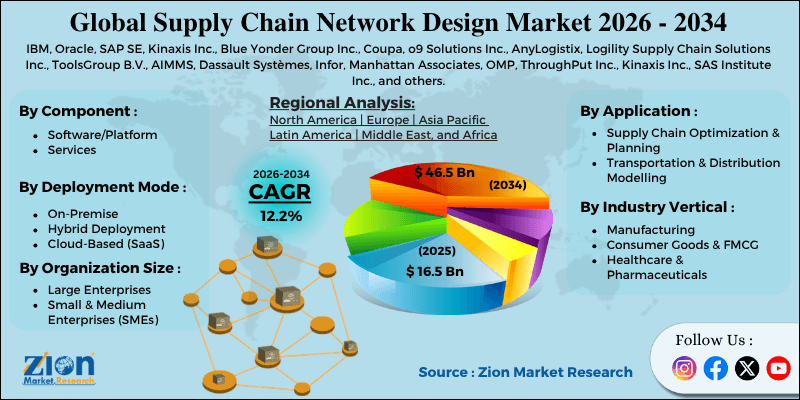
The global supply chain network design market size was worth around USD 16.5 billion in 2025 and is predicted to grow to around USD 46.5 billion by 2034 with a compound annual growth rate (CAGR) of roughly 12.2% between 2026 and 2034.
Supply Chain Network Design Market: Overview
Supply chain network design is the strategic activity that plans, analyzes, and optimizes a company's supply chain architecture to facilitate the efficient flow of products, information, and other resources from the point of origin to the point of consumption. In addition, it encompasses determining how many, where, and how much to produce, in terms of capacity for manufacturing plants, distribution facilities, warehouses, and transport routes. Supply chain network design uses powerful analysis, modeling, simulation, and optimization capabilities to analyze various scenarios. Companies leverage supply chain network design solutions to make their supply chains more resilient, reduce transport and inventory costs, improve customer satisfaction, adapt to market changes, and advance sustainability goals. In light of the increasing complexity of today's global supply chains, supply chain network design has become an essential part of strategic supply chain management across all industries.
Key Insights
- As per the analysis shared by our research analyst, the global supply chain network design market is estimated to grow annually at a CAGR of around 12.2% over the forecast period (2026-2034).
- In terms of revenue, the global supply chain network design market size was valued at around USD 16.5 billion in 2025 and is projected to reach USD 46.5 billion by 2034.
- Demand for end-to-end supply chain visibility is expected to propel the supply chain network design market over the projected period.
- Based on the component, the software/platform category would drive substantial revenue growth in the supply chain network design market.
- Based on the deployment mode, the Cloud-based (SaaS) category is likely to experience robust revenue growth in the supply chain network design market.
- Based on the organization size, it is anticipated that the large enterprises category will be responsible for much of the growth in the supply chain network design market.
- Based on the application, the supply chain optimization and planning segment is likely to drive substantial revenue growth in the supply chain network design market.
- Based on the industry vertical, retail & e-commerce is among the largest revenue-generating segments in the supply chain network design market.
- Based on region, the North American region dominates the global market for supply chain network design.
Impact of the USA-Israel War on Iran on the Supply Chain Network Design Market
Due to the conflict between the United States and Israel over Iran, there has been an increasing need to develop supply chain network designs to address growing risks such as geopolitical instability, high fuel prices, disruptions in the movement of goods, and logistics challenges, among others. The conflict, which includes fears for the Strait of Hormuz, one of the most important maritime channels in the world, will push organizations to develop alternative supply chain network designs, seek new suppliers, set up local distribution centers, and increase resilience through simulation and digital twin technology.
Supply Chain Network Design Market: Dynamics
Growth Drivers
Why does the rising complexity of global supply chains drive the supply chain network design market?
Complexity in global supply chains is a primary factor driving the growth of the supply chain network design market. Companies are dealing with an increasing number of supply chain members spanning a range of countries and geographical locations. As companies become more global in their operations, they often face issues related to changing demand patterns, regulatory and trade issues, logistical expenses, and other challenges. With the help of such solutions, companies can analyze these factors and optimize their logistics planning decisions, including facility location, inventory positioning, and transportation management.
For instance, according to the global supply chain pressure Index published by the New York federal reserve, global supply chain pressures have not eased, driven by geopolitical tensions and shipping delays.
Restraints
High implementation and deployment costs hamper the growth of the supply chain network design industry
One of the major constraints on the growth of the supply chain network design market is the high deployment and implementation costs. This is because modern network design tools generally entail high costs for software licensing, cloud computing, data integration, consulting services, and staff training. Companies have to allocate funds for collecting large amounts of supply chain data, integrating with ERP and logistics platforms, and supporting regular software upgrades, among other costs. In addition, the cost burden associated with modern network design solutions is particularly heavy for small and medium-sized businesses, thereby preventing their widespread adoption. High expenses over a relatively long period required to recover one's money can be another reason for restraining market growth.
Opportunities
Why does the increasing expansion of company services offer a lucrative opportunity for the supply chain network design market?
The increasing expansion of company services are expected to offer a lucrative opportunity to the supply chain network design market over the projected period. in May 2026, Amazon is announcing Amazon Supply Chain Services (ASCS), opening its full portfolio of freight, distribution, fulfillment, and parcel shipping capabilities to businesses of all sizes, not just Amazon sellers. With this launch, Amazon is expanding its third-party logistics capacity to support businesses in industries such as healthcare, automotive, manufacturing, and retail.
Challenges
Do the data security and privacy concerns pose a significant challenge to the supply chain network design market?
Issues related to data security and privacy represent an important restraint on the supply chain network design market. Supply chain network design systems rely heavily on data, including information on suppliers, inventories, transport paths, production processes, demand forecasting, and accounting data. As more enterprises adopt cloud and AI services, the risks of cyberattacks, data breaches, and other data-related issues become increasingly relevant.
Moreover, many businesses find it difficult to share data about their operations with various partners using digital technologies due to the risks of intellectual property infringement and disruption of business activities. Such issues can also increase the complexity and costs of complying with regulatory requirements. Thus, they might negatively affect the market growth.
Supply Chain Network Design Market: Report Scope
| Report Attributes | Report Details |
|---|---|
| Report Name | Supply Chain Network Design Market |
| Market Size in 2025 | USD 16.5 Billion |
| Market Forecast in 2034 | USD 46.5 Billion |
| Growth Rate | CAGR of 12.2% |
| Number of Pages | 226 |
| Key Companies Covered | IBM, Oracle, SAP SE, Kinaxis Inc., Blue Yonder Group Inc., Coupa, o9 Solutions Inc., AnyLogistix, Logility Supply Chain Solutions Inc., ToolsGroup B.V., AIMMS, Dassault Systèmes, Infor, Manhattan Associates, OMP, ThroughPut Inc., Kinaxis Inc., SAS Institute Inc., and others. |
| Segments Covered | By Component, By Deployment Mode, By Organization Size, By Application, By Industry Vertical, and By Region |
| Regions Covered | North America, Europe, Asia Pacific (APAC), Latin America, Middle East, and Africa (MEA) |
| Base Year | 2025 |
| Historical Year | 2020 - 2024 |
| Forecast Year | 2026 - 2034 |
| Customization Scope | Avail customized purchase options to meet your exact research needs. Request For Customization |
Supply Chain Network Design Market: Segmentation
Component Insights
Why does the software/platform the supply chain network design market?
The software/platform category would drive substantial revenue growth in the supply chain network design market by leveraging advanced analytics, AI, machine learning, and digital twins to enhance supply chain optimization processes. Companies are leveraging software applications for scenario modeling, network simulation, demand forecasting, inventory optimization, and risk assessment to boost their performance and resilience. The ever-growing complexities of global supply chains, increased online sales volumes, and the need for real-time monitoring and analysis in supply networks are driving demand for cloud network design platforms.
Deployment Mode Insights
How does the cloud-based (SaaS) segment capture the largest market share in the supply chain network design market?
The Cloud-based (SaaS) category is likely to experience robust revenue growth in the supply chain network design market, owing to the benefits of cloud-based solutions, including greater scalability and flexibility, as well as lower costs compared with on-premises applications. With cloud-based solutions, companies can leverage supply chain information in real time, develop network models, and collaborate seamlessly with colleagues and supply chain partners spread across different geographic locations.
Organization Size Insights
Does the large enterprises segment capture the largest market share in the supply chain network design market?
It is anticipated that the large enterprises category will be responsible for much of the growth in the supply chain network design market due to the complex nature of the global supply chains that operate within these enterprises. Such enterprises operate large networks of suppliers, manufacturers, distribution centers, and transport channels spanning multiple geographies, necessitating effective supply chain network design systems. Large enterprises possess the capital and technology needed to implement sophisticated systems capable of modeling scenarios and providing an accurate digital twin of supply chains.
Application Insights
How does the supply chain optimization & planning segment capture the largest market share in the supply chain network design market?
The supply chain optimization and planning segment is likely to drive substantial revenue growth in the supply chain network design market. This growth can be attributed to companies' growing demand for more efficient, cost-effective, and resilient supply chains. These companies are investing in highly sophisticated optimization and planning techniques to analyze complex supply networks, identify optimal facility locations, optimize logistics, and improve inventory management systems. Increased volatility in international business, customer demand for fast product delivery, and supply chain disruptions further fuel demand for these services.
Industry Vertical Insights
Does the retail & e-commerce segment capture the largest market share in the supply chain network design market?
Retail & e-commerce is among the largest revenue-generating segments in the supply chain network design market. The reason for this success is its widespread network of distribution centers, large orders, and the need for quick, effective delivery systems. To provide customers with same-day and/or next-day delivery, retailers and e-commerce businesses need to be efficient with their warehouse locations and transportation strategies.
Regional Insights
Why does North America lead the supply chain network design market?
The North American region dominates the global market for supply chain network design due to its advanced technology, presence of top-notch software companies, and well-developed logistics and transportation infrastructure. In fact, some of the prominent organizations in the region include IBM, Oracle Corporation, Coupa Software, and Blue Yonder, which are consistently making strides in developing supply chain management systems through the application of artificial intelligence, machine learning, cloud computing, and digital twins.
Moreover, there are many multinational manufacturers, retailers, e-commerce firms, and third-party logistics companies in the region, hence contributing significantly to the demand for the design of supply chain networks. Other factors promoting market growth include the complexities of supply chains, increased emphasis on risk management, and investments in digital transformation projects.
Furthermore, the proliferation of e-commerce and high customer demand for speedy deliveries, together with disruptions related to geopolitical shifts, new trade policies, and supply chain volatility, have boosted the adoption of advanced network design platforms in North America
Supply Chain Network Design Market: Competitive Analysis
The global supply chain network design market is dominated by players like;
- IBM
- Oracle
- SAP SE
- Kinaxis Inc.
- Blue Yonder Group Inc.
- Coupa
- o9 Solutions Inc.
- AnyLogistix
- Logility Supply Chain Solutions Inc.
- ToolsGroup B.V.
- AIMMS
- Dassault Systèmes
- Infor
- Manhattan Associates
- OMP
- ThroughPut Inc.
- Kinaxis Inc.
- SAS Institute Inc.
The global supply chain network design market is segmented as follows:
By Component
- Software/Platform
- Services
By Deployment Mode
- On-Premise
- Hybrid Deployment
- Cloud-Based (SaaS)
By Organization Size
- Large Enterprises
- Small & Medium Enterprises (SMEs)
By Application
- Supply Chain Optimization & Planning
- Transportation & Distribution Modelling
- Inventory & Warehouse Location Planning
- Risk & Resilience Management
- Sourcing & Procurement Strategy Design
- Demand Forecasting & Scenario Simulation
- Sustainability & Carbon Footprint Optimization
By Industry Vertical
- Manufacturing
- Consumer Goods & FMCG
- Healthcare & Pharmaceuticals
- Logistics & Transportation
- Retail & E-Commerce
- Energy & Utilities
- Automotive
By Region
- North America
- The U.S.
- Canada
- Mexico
- Europe
- France
- The UK
- Spain
- Germany
- Italy
- Rest of Europe
- Asia Pacific
- China
- Japan
- India
- Australia
- South Korea
- Rest of Asia Pacific
- The Middle East & Africa
- Saudi Arabia
- UAE
- Egypt
- Kuwait
- South Africa
- Rest of the Middle East & Africa
- Latin America
- Brazil
- Argentina
- Rest of Latin America
Table Of Content
Methodology
FrequentlyAsked Questions
Supply chain network design is the strategic activity that plans, analyzes, and optimizes a company's supply chain architecture to facilitate the efficient flow of products, information, and other resources from the point of origin to the point of consumption.
The supply chain network design market is primarily driven by the increasing complexity of global supply chains, growing demand for supply chain resilience, rising adoption of AI-powered analytics, and the need to optimize logistics, inventory, and distribution networks while reducing operational costs.
The growth of the supply chain network design market is restrained by high implementation and deployment costs, data security and privacy concerns, integration complexities with legacy systems, and the shortage of skilled professionals capable of managing advanced supply chain analytics and optimization platforms.
Based on the deployment mode, the cloud based segment is expected to dominate the supply chain network design market growth during the projected period.
Key trends shaping the supply chain network design market include the adoption of AI and machine learning for predictive analytics, the use of digital twins for real-time scenario modeling, growing deployment of cloud-based (SaaS) platforms, integration of IoT-enabled supply chain visibility solutions, and increasing focus on sustainability-driven network optimization to reduce costs, emissions, and supply chain risks.
According to the report, the global supply chain network design market size was worth around USD 16.5 billion in 2025 and is predicted to grow to around USD 46.5 billion by 2034.
The global supply chain network design market is expected to grow at a CAGR of 12.2% during the forecast period.
The global supply chain network design industry growth is expected to be led by North America over the forecast period.
The global supply chain network design market is dominated by players like IBM, Oracle, SAP SE, Kinaxis Inc., Blue Yonder Group, Inc., Coupa, o9 Solutions, Inc., AnyLogistix, Logility Supply Chain Solutions, Inc., ToolsGroup B.V., AIMMS, Dassault Systèmes, Infor, Manhattan Associates, OMP, ThroughPut Inc., Kinaxis Inc. and SAS Institute Inc. among others.
The market report covers the geographical market along with a comprehensive competitive landscape analysis. It also includes cash flow analysis, profit ratio analysis, market basket analysis, market attractiveness analysis, sentiment analysis, PESTLE analysis, trend analysis, SWOT analysis, trade area analysis, demand & supply analysis, Porter’s five forces analysis, and value chain analysis.

HappyClients

