
Supply Chain Management (SCM) Market Size, Growth, Global Trends, Forecast 2034

Supply Chain Management (SCM) Market By Component (Services and Solutions), By Deployment (Cloud-Based and On-Premises), By Organization (Large Enterprises and Small & Medium Sized Enterprises), By Vertical (Transportation & Logistics, Retail & E-commerce, Healthcare, Food & Beverages, Industrial, and Others), and By Region - Global and Regional Industry Overview, Market Intelligence, Comprehensive Analysis, Historical Data, and Forecasts 2025 - 2034
| Market Size in 2024 | Market Forecast in 2034 | CAGR (in %) | Base Year |
|---|---|---|---|
| USD 31.84 Billion | USD 91.83 Billion | 12.48% | 2024 |
Supply Chain Management (SCM) Industry Perspective:
What is the anticipated size of the global supply chain management (SCM) market during the projection period?
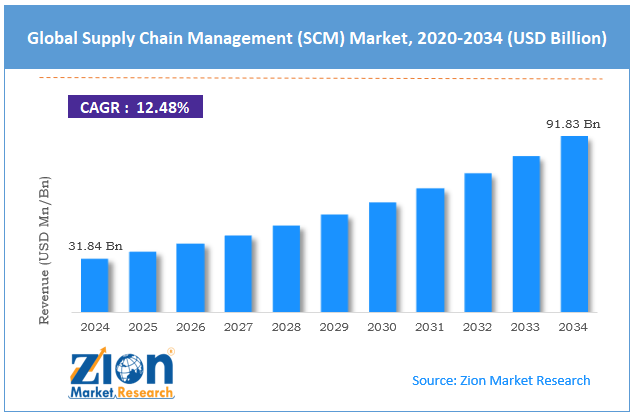
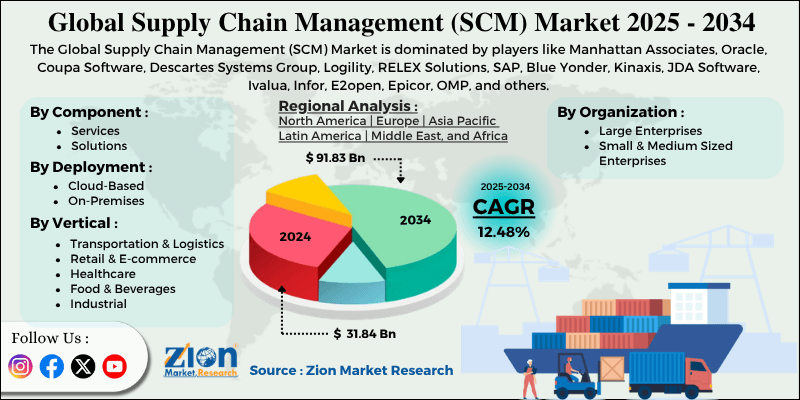
The global supply chain management (SCM) market size was worth around USD 31.84 billion in 2024 and is predicted to grow to around USD 91.83 billion by 2034, with a compound annual growth rate (CAGR) of roughly 12.48% between 2025 and 2034.
Key Insights:
- As per the analysis shared by our research analyst, the global supply chain management (SCM) market is estimated to grow annually at a CAGR of around 12.48% over the forecast period (2025-2034)
- In terms of revenue, the global supply chain management (SCM) market size was valued at approximately USD 31.84 billion in 2024 and is projected to reach USD 91.83 billion by 2034.
- The supply chain management market is projected to grow at a significant rate due to e-commerce expansion.
- Based on the component, the solutions segment is growing at a high rate and will continue to dominate the global market, as per industry projections
- Based on the deployment, the cloud-based segment is anticipated to command the largest market share
- Based on the organization, the Large enterprises segment is expected to lead the market growth trends
- Based on the vertical, the transportation & logistics segment is projected to influence revenue in the market
- Based on region, North America is projected to dominate the global market during the forecast period
Supply Chain Management (SCM) Market: Overview
Supply chain management (SCM) is the end-to-end coordination of an organization’s production process. It involves managing raw materials from delivery to the production of final goods. Supply chain management is a complex process that deals with multiple stakeholders, including suppliers, producers, distributors, retailers, and customers. Supply chain effectiveness is improved by optimizing the network, ensuring each process is carried out at the right time without any hurdles. Prominent benefits of an effective SCM include both monetary and non-monetary advantages such as minimized costs, reduced waste, and improved brand reputation. Supply chain management has several strategic approaches, including agile SCM, lean SCM, Six Sigma, resilient SCM, and digital SCM. During the forecast period, demand for SCM is expected to grow due to the rising expansion of the e-commerce and quick commerce industries.
Additionally, the growing integration of digital solutions, such as Artificial Intelligence (AI) and Machine Learning (ML), is expected to shape the industry’s future growth trends. However, high implementation costs, data security risk, and supply chain disruptions can impact business growth prospects during the forecast period.
Supply Chain Management (SCM) Market: Dynamics
Growth Drivers
How will e-commerce expansion influence growth in the supply chain management (SCM) market?
The global supply chain management (SCM) market is expected to be driven by e-commerce expansion. According to industry analysis, the e-commerce industry is one of the largest contributors to SCM demand worldwide. Effective supply chain management in the e-commerce industry allows companies to reach remote customers on time. Additionally, the emergence and rapid proliferation of quick commerce have further intensified demand for SCM optimization. It can create a need for ultra-fast delivery channels with minimal scope for error. Quick commerce also demands real-time inventory visibility to ensure performance accuracy of the channel. These factors have encouraged quick commerce and e-commerce companies to adopt agile, digital supply chain management solutions.
Trade globalization is expected to accelerate revenue in the SCM industry during the forecast period
Companies are increasingly expanding their presence across the globe. Global trade allows organizations to tap into new and unexplored markets. It also helps companies avoid financial and operational difficulties during uncertain times, such as wars and economic downturns, through strategic risk diversification. As more companies seek trading opportunities in new markets, the global supply chain management (SCM) market will continue to benefit during the forecast period. Operating at a global scale requires companies to efficiently manage multiple stakeholders, including suppliers and manufacturers. Advanced SCM facilitates seamless coordination among these stakeholders.
Restraints
What will be the impact of high investment cost on the supply chain management (SCM) market?
The global supply chain management (SCM) industry is expected to be restricted due to the high cost of investment. Modern supply chain management technologies, including infrastructure and software, require extensive capital expenditure. The average cost of SCM deployment for a large company can range between USD 2.2 million and USD 4.1 million or more. Growing economic volatility worldwide may create growth barriers against SCM adoption, especially among small & medium sized companies.
Opportunities
AI and ML integration in supply chain management to create growth opportunities for the industry players
The integration of Artificial Intelligence and Machine Learning in the global supply chain management (SCM) market is expected to generate growth opportunities for the market players in the coming years. These technologies are designed to help improve SCM performance across complex infrastructure. In February 2026, FourKites, a leading supply chain technology company, announced the launch of Loft. It is an AI orchestration platform developed to integrate external network intelligence and internal enterprise data. With this move, the company has managed to offer broader enterprise system orchestration, moving away from traditional supply chain tracking solutions.
In March 2026, Descartes Systems Group, a global leader in logistics solutions, announced the expansion of AI capabilities within its Global Logistics Network (GLN). The brand has introduced Descartes MacroPoint™ OpsForce. It consists of AI agent suites designed to maintain tracking continuity and automate freight visibility workflows. AI in the logistics market is expected to reach more than USD 570 billion by the end of the forecast period. The introduction of AI-led customer service agents, predictive analytics, and route optimization are among the leading applications of Artificial Intelligence in supply chain management.
Challenges
Why will privacy concerns challenge supply chain management (SCM) market growth?
The global supply chain management (SCM) industry is expected to be challenged by privacy and data security concerns. Digital SCM solutions are prone to cyber-attacks and data breaches. The average cost of an SCM cyberattack can range between USD 4 million and USD 5 million per incident. It also compromised brand perception and customer loyalty, thus creating complex growth limitations for industry players.
Supply Chain Management (SCM) Market: Report Scope
| Report Attributes | Report Details |
|---|---|
| Report Name | Supply Chain Management (SCM) Market |
| Market Size in 2024 | USD 31.84 Billion |
| Market Forecast in 2034 | USD 91.83 Billion |
| Growth Rate | CAGR of 12.48% |
| Number of Pages | 226 |
| Key Companies Covered | Manhattan Associates, Oracle, Coupa Software, Descartes Systems Group, Logility, RELEX Solutions, SAP, Blue Yonder, Kinaxis, JDA Software, Ivalua, Infor, E2open, Epicor, OMP, and others. |
| Segments Covered | By Component, By Deployment, By Organization, By Vertical, and By Region |
| Regions Covered | North America, Europe, Asia Pacific (APAC), Latin America, Middle East, and Africa (MEA) |
| Base Year | 2024 |
| Historical Year | 2019 to 2023 |
| Forecast Year | 2025 - 2034 |
| Customization Scope | Avail customized purchase options to meet your exact research needs. Request For Customization |
Supply Chain Management (SCM) Market: Segmentation
The global supply chain management (SCM) market is segmented based on component, deployment, organization, vertical, and region.
Which is the leading component type in the supply chain management (SCM) market?
Based on the component, the global market is divided into services and solutions. In 2024, around 62% of global revenue was listed in the solutions segment due to the rising adoption of advanced SCM tools, such as software and analytics solutions. It is expected to continue leading the market with a CAGR of over 13.01% during the forecast period. The services segment is projected to deliver improved CAGR driven by growing demand for software-as-a-service (SaaS) solutions.
What is the projected CAGR for the cloud-based segment in the supply chain management (SCM) market during the projection period?
Based on deployment, the global supply chain management (SCM) industry is divided into cloud-based and on-premises. The highest growth rate in 2024 was listed in the cloud-based segment, accounting for 61.05% of the global revenue. Cloud-based systems offer higher flexibility, scalability, and remote access. The segment is projected to grow at a CAGR of 12.09% during the forecast period.
Which factors will allow dominance of large enterprises in the supply chain management (SCM) market in the coming years?
Based on organization, the global market divisions are large enterprises and small & medium sized enterprises. The large enterprises segment led the SCM industry in 2024, contributing more than 69% of total revenue. Large enterprises will continue to lead the industry, with a projected CAGR of 13.07%, driven by growing investments in AI-driven SCM systems to manage their complex supply chains.
Why will transportation & logistics lead the supply chain management (SCM) market during the projection period?
Based on verticals, the global market is fragmented into transportation & logistics, retail & e-commerce, healthcare, food & beverages, industrial, and others. In 2024, the transportation & logistics sector led market revenue, accounting for over 31% of global revenue. It will continue to lead the market with a CAGR of 15.01% during the forecast period. Trade globalization, evolving consumer expectations, and rising demand for route optimization in the logistics industry will aid segmental dominance in the future.
Supply Chain Management (SCM) Market: Regional Analysis
Why will North America continue to lead the supply chain management (SCM) market during the forecast period?
The global supply chain management (SCM) market is expected to be led by North America during the forecast period. The region accounted for 40% of global revenue in 2024 and is projected to grow at a CAGR of 11.02% over the projection period. Growth in North America will be driven by the increasing integration of AI- and ML-powered SCM solutions across large- and medium-scale enterprises.
Moreover, growing demand for data analytics across businesses and the presence of influential players will further aid regional prominence.
Which factors will promote growth in Europe’s supply chain management (SCM) market during the projection period?
Europe is the second-highest market, accounting for 31% of the global revenue in 2024. It is expected to offer a CAGR of 11.07% during the projection period, aided by the growing adoption of sustainable practices across the region’s SCM infrastructure.
Moreover, the expansion of the regional e-commerce and logistics industry, along with increased demand for automated solutions across the healthcare and food & beverage industries, will drive revenue growth across Europe.
Supply Chain Management (SCM) Market: Competitive Analysis
The global supply chain management (SCM) market is led by players like:
- Manhattan Associates
- Oracle
- Coupa Software
- Descartes Systems Group
- Logility
- RELEX Solutions
- SAP
- Blue Yonder
- Kinaxis
- JDA Software
- Ivalua
- Infor
- E2open
- Epicor
- OMP
What are the latest key trends in the supply chain management (SCM) market?
Sustainability initiatives
Sustainable initiatives such as reduced carbon emissions during transportation, green logistics, and eco-friendly packaging are gaining momentum in the modern SCM industry. This trend is influenced by favorable government initiatives and evolving consumer preferences.
Blockchain integration
Blockchain integration in supply chain management tools can help companies reduce fraud risk. The technology promotes transparency and traceability across the supply chain.
The global supply chain management (SCM) market is segmented as follows:
By Component
- Services
- Solutions
By Deployment
- Cloud-Based
- On-Premises
By Organization
- Large Enterprises
- Small & Medium Sized Enterprises
By Vertical
- Transportation & Logistics
- Retail & E-commerce
- Healthcare
- Food & Beverages
- Industrial
- Others
By Region
- North America
- The U.S.
- Canada
- Mexico
- Europe
- France
- The UK
- Spain
- Germany
- Italy
- Rest of Europe
- Asia Pacific
- China
- Japan
- India
- Australia
- South Korea
- Rest of Asia Pacific
- The Middle East & Africa
- Saudi Arabia
- UAE
- Egypt
- Kuwait
- South Africa
- Rest of the Middle East & Africa
- Latin America
- Brazil
- Argentina
- Rest of Latin America
Table Of Content
Methodology
FrequentlyAsked Questions
Supply chain management (SCM) is the end-to-end coordination of an organization’s production process.
The global supply chain management (SCM) market is expected to be driven by e-commerce expansion.
According to study, the global supply chain management (SCM) market size was worth around USD 31.84 billion in 2024 and is predicted to grow to around USD 91.83 billion by 2034.
The CAGR value of the supply chain management (SCM) market is expected to be around 12.48% during 2025-2034.
The global supply chain management (SCM) industry is expected to be challenged by privacy and data security concerns.
Sustainability initiatives and blockchain integration are the emerging trends and innovations impacting the supply chain management (SCM) market.
The global supply chain management (SCM) market has performed well so far and will offer similar trends in the coming years.
The global supply chain management (SCM) market is expected to be led by North America during the forecast period.
The global supply chain management (SCM) market is led by players like Manhattan Associates, Oracle, Coupa Software, Descartes Systems Group, Logility, RELEX Solutions, SAP, Blue Yonder, Kinaxis, JDA Software, Ivalua, Infor, E2open, Epicor, and OMP.
The report explores crucial aspects of the supply chain management (SCM) market, including a detailed discussion of existing growth factors and restraints, while also browsing future growth opportunities and challenges that impact the market.

List of Contents
Supply Chain Management (SCM)Industry Perspective:Key Insights:OverviewDynamicsReport ScopeSegmentationRegional AnalysisCompetitive AnalysisWhat are the latest key trends in the supply chain management (SCM) market?The global supply chain management (SCM) market is segmented as follows:HappyClients

