
Global Business-to-Business E-commerce Market Size, Share, Value and Forecast 2032

Business-to-Business E-commerce Market By Type (Buyer Oriented E-commerce, Supplier Oriented E-commerce, Intermediary Oriented E-commerce), By Size (Small and Medium Enterprise, Large Enterprise), By Application (Home and Kitchen Application, Consumer Electronics, Industrial and Science, Healthcare, Clothing, Beauty and Personal Care, Sports Apparel, Books and Stationery, Automotive, Others), and By Region - Global and Regional Industry Overview, Market Intelligence, Comprehensive Analysis, Historical Data, and Forecasts 2024 - 2032
| Market Size in 2023 | Market Forecast in 2032 | CAGR (in %) | Base Year |
|---|---|---|---|
| USD 18.50 Billion | USD 89.90 Billion | 19.2% | 2023 |
Business-to-Business E-commerce Industry Perspective
What will be the global business-to-business e-commerce market size during the forecast period?
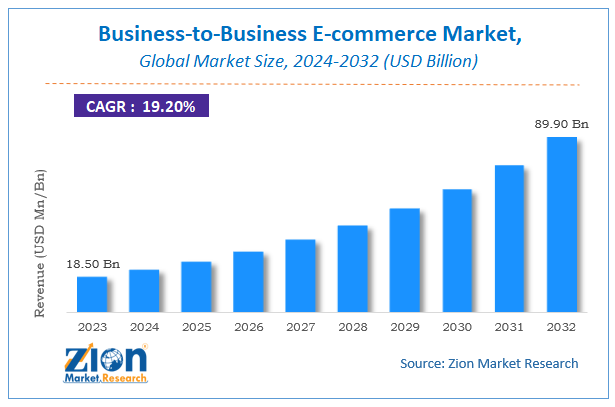
The global business-to-business e-commerce market size was worth around USD 18.50 billion in 2023 and is predicted to reach around USD 89.90 billion by 2032, with a compound annual growth rate (CAGR) of roughly 19.2% between 2024 and 2032.
This report provides a comprehensive analysis of the growth drivers, restraints, and challenges shaping demand across the global business-to-business e-commerce market throughout the forecast period, while highlighting high-potential emerging opportunities within the industry.
 Request Free Sample
Key Insights
- As per the analysis shared by our research analyst, the global business-to-business e-commerce market is estimated to grow annually at a CAGR of around 19.2% over the forecast period (2024-2032).
- In terms of revenue, the global business-to-business e-commerce market size was valued at around USD 18.50 billion in 2023 and is projected to reach USD 89.90 billion by 2032.
- The business-to-business e-commerce market is driven by rapid digitization, the shift from conventional business methods to online platforms, and the addition of advanced digital features by platform providers.
- By type, supplier-oriented e-commerce is projected to grow strongly, driven by numerous suppliers on online platforms that generate transaction-based revenue.
- By size, large enterprises hold a leading position, supported by greater resources for digital transformation and higher transaction volumes on B2B platforms.
- By application segment, consumer electronics is expected to dominate, driven by rising demand for smartphones, televisions, and continuously evolving technology that increases consumption.
- Asia Pacific is projected to grow at a significant rate and contribute notably, driven by rising numbers of customers and mobile phone users along with the tapping of untapped rural markets in developing economies such as India and China.
Business-to-Business E-commerce Market: Overview
B2B e-commerce is a platform where buyers and sellers meet virtually to view products, place orders, and manage them from mobile devices at their convenience. It includes a wide range of transactions, including wholesale and purchases of parts and components. E-commerce platforms offer numerous advantages, such as unlocking new markets, broadening offerings, improving efficiency and management between suppliers and customers, reaching new customers, and improving data and analytics.
Business-to-Business E-commerce Market: Growth Factors
What factors are primarily accelerating demand in the business-to-business e-commerce market?
Rapid changes in how businesses operate, along with the ongoing trend of digitization, are projected to drive growth in the B2B e-commerce market during the projected period. Numerous companies across all regions are opting for online platforms to conduct business and reach customers. Thus, changing business trends and the shift from conventional to online platforms are boosting market growth. B2B e-commerce platform players such as Alibaba recently added digital features such as freight features and trade financing to enhance their customers' digital experience.
Business-to-Business E-commerce Market: Restraints
What factors are limiting the expansion of the business-to-business e-commerce market?
Certain operational and trust-related hurdles can slow adoption in specific segments or regions. Complex logistics, payment security concerns, and the need for reliable verification of suppliers and buyers remain important considerations for participants.
Varying levels of digital infrastructure and readiness, particularly among smaller businesses or in less developed markets, can constrain the speed at which organizations fully transition to online B2B platforms.
Business-to-Business E-commerce Market: Opportunities
Where do significant growth opportunities lie for the business-to-business e-commerce market?
The expansion of mobile internet access and smartphone usage opens substantial opportunities, especially in emerging economies. Tapping previously underserved rural and semi-urban markets creates new transaction volumes and customer bases.
Continuous innovation in platform features, data analytics, and value-added services such as financing and logistics integration allows operators to attract more participants and deepen engagement, supporting long-term market development.
Business-to-Business E-commerce Market: Challenges
What key challenges confront participants in the business-to-business e-commerce market?
Building and maintaining trust between buyers and suppliers on digital platforms requires ongoing investment in verification, quality controls, and dispute resolution mechanisms. Logistics coordination across borders or complex supply chains can also present operational difficulties.
Ensuring seamless integration with existing enterprise systems and delivering consistent user experiences across diverse industries remain important challenges that platform providers and participants must address to sustain growth.

Business-to-Business E-commerce Market: Report Scope
| Report Attributes | Report Details |
|---|---|
| Report Name | Business-to-Business E-commerce Market |
| Market Size in 2023 | USD 18.50 Billion |
| Market Forecast in 2032 | USD 89.90 Billion |
| Growth Rate | CAGR of 19.2% |
| Number of Pages | 230 |
| Key Companies Covered | ChinaAseanTrade.com, Amazon Inc., eBay Inc., DIYTrade.com, eworldtrade.com, Flipkart.com, Flexfire LEDs, KellySearch.com, KOMPASS, and IndiaMART Intermesh Ltd., among others |
| Segments Covered | By Type, By Size, By Application, and By Region |
| Regions Covered | North America, Europe, Asia Pacific (APAC), Latin America, Middle East, and Africa (MEA) |
| Base Year | 2023 |
| Historical Year | 2018 to 2022 |
| Forecast Year | 2024 - 2032 |
| Customization Scope | Avail customized purchase options to meet your exact research needs. Request For Customization |
Business-to-Business E-commerce Market: Segmentation
The business-to-business e-commerce market is segmented by type, size, application, and region. All the segments of the business-to-business e-commerce market have been analyzed based on present and future trends and the market is estimated from 2024 to 2032.
By type segment, the business-to-business e-commerce market is divided into buyer-oriented e-commerce, supplier-oriented e-commerce, and intermediary-oriented e-commerce. Supplier-oriented e-commerce is projected to grow notably because many suppliers are active on online platforms. These platforms generate revenue from successful transactions between buyers and sellers, and the increasing presence of suppliers online strengthens this category’s contribution to overall market expansion. Buyer-oriented and intermediary-oriented models also support market development by facilitating efficient matching and transaction management across different participant preferences.
By size segment, the business-to-business e-commerce market is divided into small and medium enterprises and large enterprises. Large enterprises currently lead due to greater financial and technological resources that enable comprehensive digital transformation and higher-volume online procurement and sales activities. Their scale drives significant transaction values and encourages platform innovation. Small and medium enterprises form the second major category and contribute to market growth by increasingly adopting online channels to eliminate intermediaries, expand reach, and improve operational efficiency.
By application segment, the business-to-business e-commerce market is divided into home and kitchen applications, consumer electronics, industrial and science, healthcare, clothing, beauty and personal care, sports apparel, books and stationery, automotive, and others. Consumer electronics is expected to dominate the application landscape because rising demand for smartphones, televisions, and rapidly evolving technology continues to increase consumption and procurement volumes through B2B channels. This leadership supports overall market growth by generating high transaction frequency and encouraging platforms to refine category-specific tools and logistics. Other categories such as industrial and science, healthcare, and automotive also contribute meaningfully through specialized wholesale requirements.
Business-to-Business E-commerce Market: Regional Analysis
Why will Asia Pacific continue to dominate the global market during the projection period?
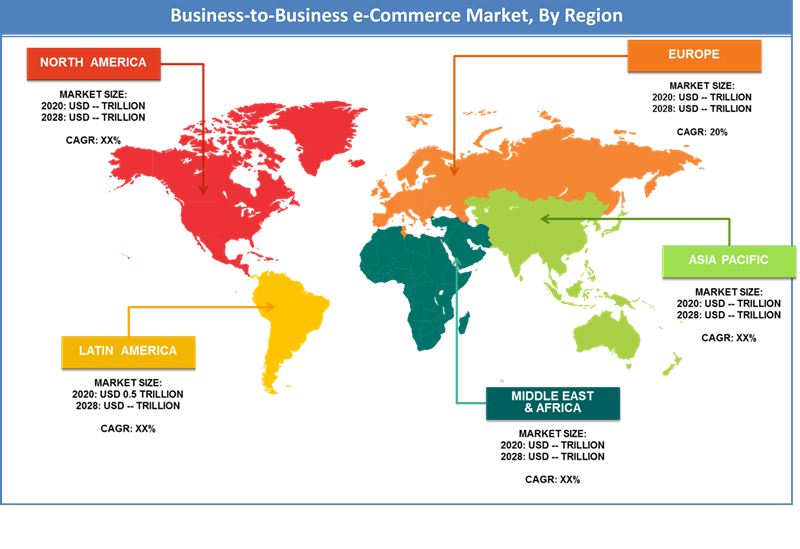
Asia Pacific is projected to grow at a significant rate and contribute meaningfully to the global business-to-business e-commerce market. The region benefits from a rapidly expanding base of customers and mobile phone users, which facilitates broader participation in online B2B platforms. Developing economies such as India and China offer substantial untapped potential, particularly in rural and semi-urban sectors that are progressively coming online. Countries including China, Japan, and South Korea rank among the top global merchandise exporters and already account for a large share of e-commerce activity, reinforcing regional leadership. This combination of demographic momentum, digital adoption, and export strength drives overall market growth by generating high transaction volumes, stimulating platform innovation tailored to local needs, and encouraging further investment in logistics and digital infrastructure across the region.
North America maintains a strong presence supported by advanced digital infrastructure, high incomes, and the activities of major platform operators. Europe benefits from mature e-commerce ecosystems and cross-border trade within the region. Latin America and the Middle East and Africa are advancing as internet penetration rises and businesses increasingly explore online wholesale channels, creating additional opportunities for platform expansion.
Business-to-Business E-commerce Market: Competitive Landscape
The Business-to-Business E-commerce Market profiles key players such as
- ChinaAseanTrade.com
- Amazon Inc.
- eBay Inc.
- DIYTrade.com
- eworldtrade.com
- Flipkart.com
- Flexfire LEDs
- KellySearch.com KOMPASS and
- IndiaMART Intermesh Ltd.
Business-to-Business E-commerce Market: Key Trends
What are the key trends in the business-to-business e-commerce market?
Accelerated shift from conventional to digital platforms
Businesses across industries are increasingly adopting online channels for procurement and sales to improve efficiency, expand reach, and gain better data insights. This structural transition continues to reshape how wholesale transactions are conducted and supports sustained platform growth.
Enhancement of platform capabilities with value-added services
Operators are integrating features such as trade financing, freight solutions, and advanced analytics to deliver a more complete digital experience. These additions increase platform stickiness and help attract a broader range of buyers and suppliers.
Segments Covered
The global Business-to-Business E-commerce market is segmented as follows:
By Type
- Buyer Oriented E-commerce
- Supplier Oriented E-commerce
- Intermediary Oriented E-commerce
By Size
- Small and Medium Enterprise
- Large Enterprise
By Application
- Home and Kitchen Application
- Consumer Electronics
- Industrial and Science
- Healthcare
- Clothing
- Beauty and Personal Care
- Sports Apparel
- Books and Stationery
- Automotive
- Others
By Region
- North America
- The U.S.
- Canada
- Mexico
- Europe
- France
- The UK
- Spain
- Germany
- Italy
- Rest of Europe
- Asia Pacific
- China
- Japan
- India
- Australia
- South Korea
- Rest of Asia Pacific
- The Middle East & Africa
- Saudi Arabia
- UAE
- Egypt
- Kuwait
- South Africa
- Rest of the Middle East & Africa
- Latin America
- Brazil
- Argentina
- Rest of Latin America
Table Of Content
Methodology
FrequentlyAsked Questions
The business-to-business e-commerce market consists of digital platforms that enable buyers and sellers to conduct wholesale and component transactions online, including product viewing, order placement, and management through web or mobile devices, offering advantages such as market expansion, efficiency gains, and improved data insights.
Key growth drivers include the rapid digitization of business processes, the shift from conventional to online platforms, rising smartphone usage, demand for technologically advanced devices, interest in cross-border products, and increasing per capita incomes.
The global business-to-business e-commerce market was valued at approximately USD 18.50 billion in 2023 and is projected to reach around USD 89.90 billion by 2032.
The global business-to-business e-commerce market is expected to expand at a compound annual growth rate of approximately 19.2% between 2024 and 2032.
Asia Pacific is projected to grow at a significant rate and contribute notably, supported by rising customer and mobile user numbers and the development of previously untapped markets in economies such as India and China.
Major players include ChinaAseanTrade.com, Amazon Inc., eBay Inc., DIYTrade.com, eworldtrade.com, Flipkart.com, Flexfire LEDs, KellySearch.com, KOMPASS, and IndiaMART Intermesh Ltd.
The report offers comprehensive analysis of market size, growth drivers, restraints, opportunities, segmentation by type, size and application, regional dynamics, competitive landscape, recent developments, and future outlook for the period 2024-2032, enabling informed strategic decision-making.

HappyClients

