
Paraffin Wax Market Size, Share, Trends, Growth and Forecast 2034

Paraffin Wax Market By Product Type (Fully Refined, Semi Refined and Others), By Application (Candles, Cosmetics, Packaging, Hot melts, Board Sizing, Rubber and Other Applications) and By Region - Global and Regional Industry Overview, Market Intelligence, Comprehensive Analysis, Historical Data, and Forecasts 2025 - 2034
| Market Size in 2024 | Market Forecast in 2034 | CAGR (in %) | Base Year |
|---|---|---|---|
| USD 5.9 Billion | USD 11.4 Billion | 6.8% | 2024 |
Paraffin Wax Industry Perspective:
What will be the size of the global paraffin wax market during the forecast period?
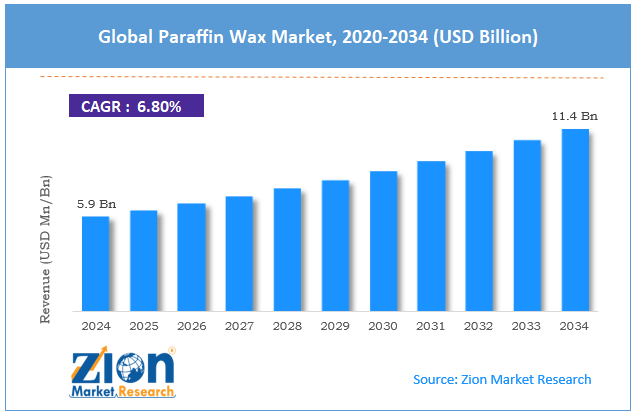
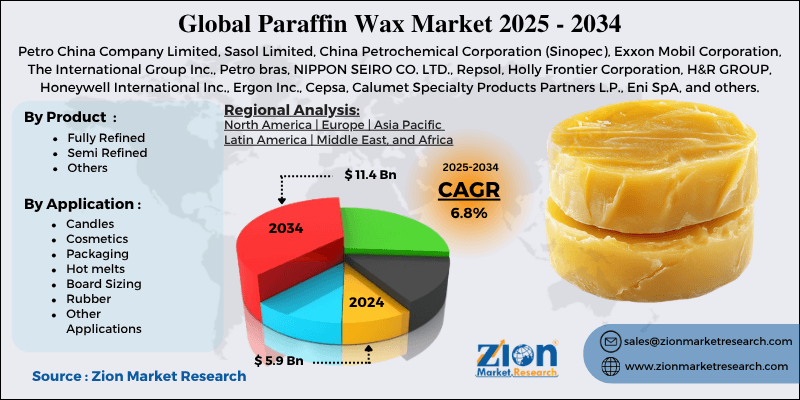
The global paraffin wax market size was worth around USD 5.9 billion in 2024 and is predicted to grow to around USD 11.4 billion by 2034 with a compound annual growth rate (CAGR) of roughly 6.8% between 2025 and 2034.
Key Insights
- As per the analysis shared by our research analyst, the global paraffin wax market is estimated to grow annually at a CAGR of around 6.8% over the forecast period (2025-2034).
- In terms of revenue, the global paraffin wax market size was valued at around USD 5.9 billion in 2024 and is projected to reach USD 11.4 billion by 2034.
- Expansion of packaging industry is expected to propel the paraffin wax market over the projected period.
- Based on the product type, the fully refined segment captures the largest market share in 2024.
- Based on the application, the packaging application captures the largest revenue share in 2024 of over 32%.
- Based on region, the Asia Pacific accounted for the highest market share in the paraffin wax market in 2024 of 55%.
Paraffin Wax Market: Overview
Paraffin wax is described as a white or colorless odorless and tasteless soft solid that is made mainly from petroleum, through the process of distillation of crude oil. The material is composed of hydrocarbons, saturated chemicals with carbon atoms between C20 and C40. This means that the material has a stable chemical nature and therefore reacts very little with other substances. Paraffin wax is recognized for its low melting point, water resistance, and excellent insulation properties. Therefore, the material is extremely versatile and is used across different sectors and processes.
However, paraffin wax is predominantly used in candle making because it burns cleanly and produces bright flames. In addition, the material is used in other industries, such as packaging, cosmetics, and rubber, due to its moisture-repelling properties.
Impact of the USA-Israel War on Iran on the Paraffin Wax Market
The current war between the USA and Israel against Iran (2026) has had a considerable impact on the international market of paraffin wax because of its close relationship with the oil industry. The disruption in crude oil production caused by the closure of the Strait of Hormuz one of the routes through which 20% of the world's oil exports pass has led to a steep increase in oil prices. As paraffin wax is a petroleum-derived substance produced from the refining of crude oil, an increase in oil prices has significantly increased production costs and market prices for paraffin wax. Additionally, the U.S. naval blockade of Iran and the decrease in its oil exports to several million barrels per day have constrained the global supply of the raw material used to produce paraffin wax (slack wax).
Attacks against oil infrastructure in the Middle East and less refining capacity also add to the list of constraints affecting paraffin wax. These impacts are driving scarcity and volatility in paraffin wax imports to key regions, particularly Asia, including India.
Paraffin Wax Market: Dynamics
Growth Drivers
How does the strong demand from the candle industry drive the paraffin wax market?
A high level of demand in the candle industry represents a key reason behind the increasing demand for paraffin wax in the market, because paraffin wax happens to be the most extensively utilized raw material in the manufacturing process of candles, owing to the low cost, easy availability, and desirable burning characteristics of paraffin wax. The consistent melting point, strong scent retention, and ability to burn and produce a clear flame make paraffin wax an ideal choice for candle production in various forms, such as scented, decorative, religious, or utility candles.
Increasing consumer preference for home décor and aromatic goods has led to widespread use of candles worldwide during both festive seasons and regular periods by urban residents, while other uses for paraffin wax candles include worship rituals and power shortages. The growing practice of gift-giving and consumer demand for fragrant, decorative candles are expected to fuel production.
Restraints
Why do environmental concerns & sustainability pressure act as a major restraint to the paraffin wax market?
The environmental and sustainability issues that have recently gained prominence pose a considerable threat to the paraffin wax market, as it is derived from petroleum extraction and use, which causes environmental harm and releases CO2 into the atmosphere. With growing awareness of the problems posed by climate change and increased regulation of the environmental impacts of petrochemicals, it has become difficult to produce paraffin without complying with certain regulations. These require limiting the emissions and waste generated in production, as well as establishing safety requirements for the product itself. This not only increases the cost of paraffin wax manufacturing but also restricts production capacity due to limited resources.
In addition, consumer behavior is increasingly concerned with the environmental and health consequences of using certain products, and people are starting to prefer items from renewable sources that do not cause additional damage when used. For example, paraffin wax candles are believed to emit soot upon combustion, and their alternatives made of plant-based waxes, such as soy or beeswax, are gaining popularity. They are biodegradable and safe for the environment and consumer health; therefore, many companies have begun using these waxes for candles and cosmetics.
Finally, there are ongoing sustainability efforts to replace conventional materials across industries, such as packaging. Thus, many producers opt for environmentally friendly coating options, such as recyclable and compostable coatings, which decrease demand for paraffin wax in the industry. All these factors constitute significant restraints on the growth potential of the paraffin wax market.
Opportunities
How does the rising product launch offer a lucrative opportunity for the paraffin wax market?
The opportunities for innovation and specialization in wax production represent one of the best ways to promote sales and increase revenue by providing new solutions for paraffin wax market players. By refining and enhancing the processing technology for raw materials and implementing new blending methods, manufacturers can produce high-quality, customized paraffin wax with increased purity, odor control, greater flexibility, and optimal melting points. The resulting products can be used in such sectors as cosmetics, pharmaceuticals, food packaging, and high-end candles, where high quality is required.
Moreover, the producers actively develop new, value-added paraffin-based blend formulas that provide increased adhesion, durability, and desired textures in materials such as glues, coatings, and rubbers. In addition, manufacturers strive to produce low-oil, fully refined paraffin that meets the most rigorous requirements of developed countries. Finally, some producers even explore the potential of ecologically friendly paraffin hybrids with other components. By making innovative changes to the wax production process, companies can provide consumers with unique products and enter a market niche, thereby increasing their revenue.
Challenges
Competition from bio-based alternatives pose a significant challenge to the paraffin wax market
The competition that arises from bio-based alternatives poses a major threat to the paraffin wax market. In today's world, there is an increasing trend toward using bio-based alternatives that provide renewable resources. Soy wax, palm wax, and beeswax are examples of bio-based alternatives that provide paraffin wax competition. Bio-based alternatives have an advantage over paraffin wax because of their sustainability and renewability. Paraffin wax is not considered sustainable because it relies on crude oil, a non-renewable resource. In addition, paraffin wax is not considered biodegradable. The increasing number of consumers and industries aware of environmental issues makes paraffin wax less desirable than bio-based alternatives.
Products made from paraffin wax may be used in various applications; however, paraffin wax may face competition in applications such as candles, cosmetics, and packaging. For instance, most consumers purchase natural wax candles because they are considered better than paraffin-based candles. Paraffin wax is not biodegradable and can emit pollutants when burned. Furthermore, paraffin wax is more expensive than bio-based alternatives; however, environmentally conscious consumers would rather pay the extra cost of bio-based alternatives than buy products made with paraffin wax.
Paraffin Wax Market: Report Scope
| Report Attributes | Report Details |
|---|---|
| Report Name | Paraffin Wax Market |
| Market Size in 2024 | USD 5.9 Billion |
| Market Forecast in 2034 | USD 11.4 Bllion |
| Growth Rate | CAGR of 6.8% |
| Number of Pages | 228 |
| Key Companies Covered | Petro China Company Limited, Sasol Limited, China Petrochemical Corporation (Sinopec), Exxon Mobil Corporation, The International Group Inc., Petro bras, NIPPON SEIRO CO. LTD., Repsol, Holly Frontier Corporation, H&R GROUP, Honeywell International Inc., Ergon Inc., Cepsa, Calumet Specialty Products Partners L.P., Eni SpA, and others. |
| Segments Covered | By Product Type, By Application, and By Region |
| Regions Covered | North America, Europe, Asia Pacific (APAC), Latin America, Middle East, and Africa (MEA) |
| Base Year | 2024 |
| Historical Year | 2019 to 2023 |
| Forecast Year | 2025 - 2034 |
| Customization Scope | Avail customized purchase options to meet your exact research needs. Request For Customization |
Paraffin Wax Market: Segmentation
Product Type Insights
Why does the fully refined dominate the paraffin wax market?
The fully refined segment captures the largest market share in 2024. Segment growth is based on high purity, performance, and compliance with regulatory norms. Completely purified paraffin wax has relatively low levels of oil and contaminants; it is well-suited for applications where purity, safety, and high quality are required – cosmetics, pharmaceuticals, food packaging, and top-grade candles. With increased consumer awareness of product safety and hygiene, there is also a growing tendency to use completely purified grades, which ensure more efficient odor control, stable operation, and good burning qualities.
Also, as the regulatory framework related to food-contact materials and cosmetics becomes stricter, the use of more purified forms of wax is encouraged. Increasing consumption of scented and premium candles, as well as the rapid development of the personal care industry (especially in developing countries such as India and China), is adding to the above effect.
Application Insights
Does the packaging capture the largest market share in the paraffin wax market?
The packaging application captures the largest revenue share in 2024 of over 32%. The growth can be attributed to the widespread use of paraffin wax as a moisture-resistant and protective coating material. It is used in paperboard, corrugated boxes, and food wrap to protect articles made of paper and board and to prolong shelf life. It acts as a barrier, preventing the penetration of air and water, and is thus required to maintain the product's quality during storage and transportation. Great demand for packaged goods and economic coating methods is expected to sustain growth in consumption, ensuring dominance of this segment.
Regional Insights
Why does the Asia Pacific lead the paraffin wax market?
The Asia Pacific accounted for the highest market share in the paraffin wax market in 2024 of 55%. Market expansion will arise from years of strong demand from the packaging, candle, and industrial sectors. This region is well established in terms of production facilities, manufacturing a broad range of paraffin wax for coating, board sizing, and finishing products. The area benefits from high consumption of packaged goods, which require moisture-resistant products, resulting in constant wax consumption.
Additionally, having large-scale refining facilities throughout the region will guarantee a regular supply of raw materials for continued production and distribution, which in turn will strengthen its position in the region.
Paraffin Wax Market: Competitive Analysis
The global paraffin wax market is dominated by players like:
- Petro China Company Limited
- Sasol Limited
- China Petrochemical Corporation (Sinopec)
- Exxon Mobil Corporation
- The International Group Inc.
- Petro bras
- NIPPON SEIRO CO. LTD.
- Repsol
- Holly Frontier Corporation
- H&R GROUP
- Honeywell International Inc.
- Ergon Inc.
- Cepsa
- Calumet Specialty Products Partners L.P.
- Eni SpA
The global Paraffin Wax market is segmented as follows:
By Product Type
- Fully Refined
- Semi Refined
- Others
By Application
- Candles
- Cosmetics
- Packaging
- Hot melts
- Board Sizing
- Rubber
- Other Applications
By Region
- North America
- The U.S.
- Canada
- Mexico
- Europe
- France
- The UK
- Spain
- Germany
- Italy
- Rest of Europe
- Asia Pacific
- China
- Japan
- India
- Australia
- South Korea
- Rest of Asia Pacific
- The Middle East & Africa
- Saudi Arabia
- UAE
- Egypt
- Kuwait
- South Africa
- Rest of the Middle East & Africa
- Latin America
- Brazil
- Argentina
- Rest of Latin America
Table Of Content
Methodology
FrequentlyAsked Questions
Paraffin wax is described as a white or colorless odorless and tasteless soft solid that is made mainly from petroleum, through the process of distillation of crude oil. The material is composed of hydrocarbons, saturated chemicals with carbon atoms between C20 and C40.
The key growth drivers for the paraffin wax market include strong demand from the candle industry due to its cost-effectiveness and clean-burning properties, along with rapid expansion of the packaging sector where paraffin wax is widely used for moisture-resistant coatings. Increasing consumption in cosmetics and personal care products is further supporting market growth, as the wax provides texture, stability, and protection.
The major challenges restraining the growth of the paraffin wax market include increasing environmental concerns and sustainability pressure due to its petroleum-based origin, which has led to stricter regulations and a shift toward eco-friendly alternatives. Rising competition from bio-based waxes such as soy, palm, and beeswax is also limiting market expansion, as these options are renewable and increasingly preferred in applications like candles and cosmetics.
Based on the product type, the fully refined segment is expected to dominate the paraffin wax market growth during the projected period.
One of the key trends is the shift toward high-purity and fully refined waxes, particularly for use in cosmetics, pharmaceuticals, and food packaging, as industries increasingly demand safer and more compliant materials. Advances in refining technologies are enabling manufacturers to produce wax with improved odor control, consistency, and performance characteristics, thereby enhancing its suitability for premium applications.
According to the report, the global paraffin wax market size was worth around USD 5.9 billion in 2024 and is predicted to grow to around USD 11.4 billion by 2034.
The global paraffin wax market is expected to grow at a CAGR of 6.8% during the forecast period.
The global paraffin wax industry growth is expected to be led by the Asia Pacific over the forecast period.
The global paraffin wax market is dominated by players like Petro China Company Limited, Sasol Limited, China Petrochemical Corporation (Sinopec), Exxon Mobil Corporation, The International Group, Inc., Petro bras, NIPPON SEIRO CO., LTD., Repsol, Holly Frontier Corporation, H&R GROUP, Honeywell International Inc., Ergon, Inc., Cepsa, Calumet Specialty Products Partners, L.P. and Eni SpA among others.
The market report covers the geographical market along with a comprehensive competitive landscape analysis. It also includes cash flow analysis, profit ratio analysis, market basket analysis, market attractiveness analysis, sentiment analysis, PESTLE analysis, trend analysis, SWOT analysis, trade area analysis, demand & supply analysis, Porter’s five forces analysis, and value chain analysis.

HappyClients

