
Motorcycle Chain Sprocket Market Size, Share, Value and Forecast 2034

Motorcycle Chain Sprocket Market By Motorcycle (Standard, Sports, Cruiser, Off-road Bikes, Mopeds, and Others), By Chain (Standard Rolling Chain, X Ring Chain, O Ring Chain), By Engine Capacity (Up to 150 CC, 151-300 CC, 301-500 CC, Above 500 CC), and By Region - Global and Regional Industry Overview, Market Intelligence, Comprehensive Analysis, Historical Data, and Forecasts 2025 - 2034
| Market Size in 2024 | Market Forecast in 2034 | CAGR (in %) | Base Year |
|---|---|---|---|
| USD 1.95 Billion | USD 3.27 Billion | 6.71% | 2024 |
Motorcycle Chain Sprocket Industry Perspective:
What will be the size of the global motorcycle chain sprocket market during the forecast period?
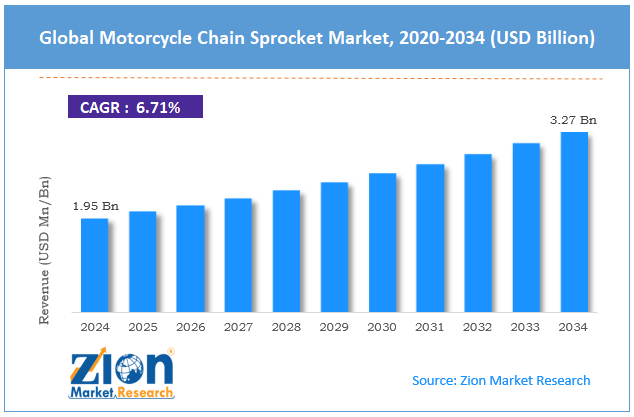
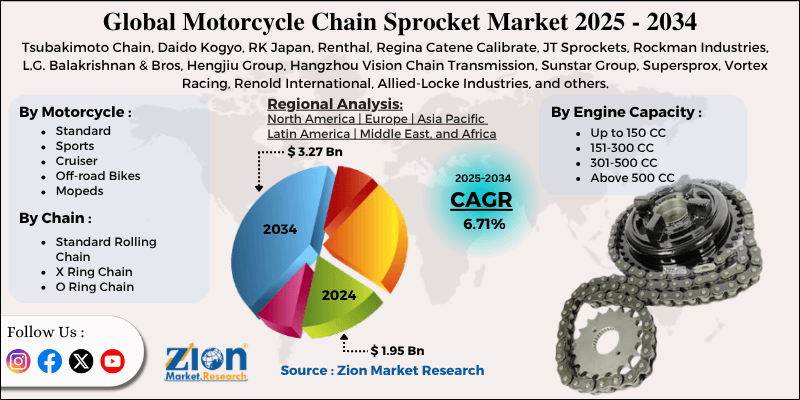
The global motorcycle chain sprocket market size was around USD 1.95 billion in 2024 and is projected to reach USD 3.27 billion by 2034, with a compound annual growth rate (CAGR) of roughly 6.71% between 2025 and 2034.
Key Insights:
- As per the analysis shared by our research analyst, the global motorcycle chain sprocket market is estimated to grow annually at a CAGR of around 6.71% over the forecast period (2025-2034)
- In terms of revenue, the global motorcycle chain sprocket market size was valued at around USD 1.95 billion in 2024 and is projected to reach USD 3.27 billion by 2034.
- The motorcycle chain sprocket market is projected to grow significantly, driven by urbanization, the expansion of e-commerce for aftermarket parts, and the rising demand for electric motorcycles.
- Based on motorcycles, the standard segment is expected to lead the market, while the sports segment is expected to grow considerably.
- Based on the chain, the standard rolling chain segment is the dominating segment, while the O ring chain segment is projected to witness sizeable revenue over the forecast period.
- Based on engine capacity, the up to 150 CC segment is expected to lead the market, followed by the 151-300 CC segment.
- Based on region, the Asia Pacific is projected to dominate the global market during the estimated period, followed by North America.
Motorcycle Chain Sprocket Market: Overview
A motorcycle chain sprocket system includes a front drive sprocket and a rear-driven sprocket, linked by a chain to transfer power. Sprocket size impacts acceleration and speed, while proper lubrication and alignment guarantee smooth operation. Regular maintenance prevents wear and maintains the reliability and safety of the drivetrain. The global motorcycle chain sprocket market is projected to witness substantial growth, driven by urbanization and traffic congestion, the growth of sports and performance motorcycles, and growing customization trends. Urbanization expansion and rising congestion are encouraging the shift towards motorcycles for efficiency and convenience. High daily city mileage leads to faster deterioration of drivetrain components. This results in elevated demand for sprocket replacement and maintenance.
Moreover, the growing prominence of high-performance motorcycles is driving demand for durable, advanced sprockets. Performance bikes need precision-engineered components capable of handling high speed and stress. This segment backs premium product development and technical advancements. Furthermore, motorcycle enthusiasts are actively investing in customization to enhance performance and aesthetics. Sprocket modifications are commonly used to alter speed-to-torque ratios and riding dynamics. This trend fuels demand for high-class, specialized, and performance-oriented sprocket products.
Although drivers exist, the global market faces challenges, including the prevalence of counterfeit products and the shift towards alternative drivetrain systems. The broader availability of low-cost counterfeit sprockets impacts safety standards and brand reputation. These products often fail prematurely, compromising vehicle performance and putting pressure on genuine manufacturers. Likewise, the adoption of shaft and belt drive systems is reducing dependency on traditional chain sprockets in some motorcycles, offering low maintenance and smooth operation. This shift presents a structural challenge to long-term market growth.
Even so, the global motorcycle chain sprocket industry is well-positioned due to engineering advancements, improved materials, and the growth of e-commerce platforms. Innovations like coatings, advanced alloys, and precision techniques enhance sprocket performance, reduce maintenance needs, improve durability, and increase efficiency. Companies can use these to create premium offerings. Rapidly expanding digital sales channels allow manufacturers to reach a global customer base, providing consumers with variety, convenience, and competitive pricing, thereby reducing reliance on traditional distribution networks.
Motorcycle Chain Sprocket Market: Dynamics
Growth Drivers
How is the uptick in performance, custom, and sports motorcycle segments fueling the motorcycle chain sprocket market?
Consumers' demand is shifting towards custom and high-performance motorcycles, increasing the need for specialized sprockets. Sports bikes usually use lightweight materials, such as hybrid or aluminum composites, to enhance handling and acceleration. Enthusiast communities in Japan, Europe, and the U.S. prefer CNC-machined, performance-tuned sprockets more often, usually every 10,000-15,000 km, thereby fueling aftermarket sales. This trend encourages manufacturers to develop niche product lines focused on aesthetics and performance, thus fueling the global motorcycle chain sprocket market.
How are technological advancements in manufacturing and materials driving growth in the worldwide motorcycle chain sprocket market?
Advanced in manufacturing and materials are producing stronger, lighter, and longer-lasting sprockets, driving industry growth. High-strength alloy steels, aluminum alloys, and hybrid composites reduce weight and enhance durability, improving motorcycle performance. Precision machining and advanced coatings lower wear and friction, extending sprocket life and rider satisfaction. Ongoing R&D integrates these solutions into both aftermarket and OEM products to drive differentiation. Predictive analytics and AI-enabled design further enhance product quality and manufacturing efficiency.
Restraints
The influx of counterfeit and low‑quality products adversely impacts the market progress
The widespread availability of fake sprockets in informal markets undermines reputable brands and erodes customer trust. Several counterfeit parts fail basic tensile or wear tests and wear out much faster than the genuine components. Poor quality products may lead to safety issues and dissatisfaction. This phenomenon weakens brand equity and total market value. It also complicates efforts to standardize quality benchmarks worldwide.
Opportunities
How do performance and custom motorcycle growth offer advantages for the motorcycle chain sprocket market?
Growing interest in racing, performance, and custom bikes creates a niche, high-margin market for specialty sprockets. Enthusiasts increasingly seek CNC-machined, anodized, or lightweight components. These products command higher prices and are replaced more often than standard units. The aftermarket for performance upgrades is expanding significantly in Europe and North America. This offers growth beyond traditional commuter segments in the motorcycle chain sprocket industry.
Challenges
Regulatory and standardization challenges limit the market growth
Complying with varying environmental, safety, and quality standards in multiple jurisdictions adds cost and complexity. The lack of harmonized global standards for sprocket and chain specifications complicates inventory and design management. This creates barriers for companies targeting multiple international markets. Small players may struggle with compliance overheads. Continuous regulatory updates demand ongoing investment.
Motorcycle Chain Sprocket Market: Report Scope
| Report Attributes | Report Details |
|---|---|
| Report Name | Motorcycle Chain Sprocket Market |
| Market Size in 2024 | USD 1.95 Billion |
| Market Forecast in 2034 | USD 3.27 Bllion |
| Growth Rate | CAGR of 6.71% |
| Number of Pages | 229 |
| Key Companies Covered | Tsubakimoto Chain, Daido Kogyo, RK Japan, Renthal, Regina Catene Calibrate, JT Sprockets, Rockman Industries, L.G. Balakrishnan & Bros, Hengjiu Group, Hangzhou Vision Chain Transmission, Sunstar Group, Supersprox, Vortex Racing, Renold International, Allied-Locke Industries, and others. |
| Segments Covered | By Motorcycle, By Chain, By Engine Capacity, and By Region |
| Regions Covered | North America, Europe, Asia Pacific (APAC), Latin America, Middle East, and Africa (MEA) |
| Base Year | 2024 |
| Historical Year | 2019 to 2023 |
| Forecast Year | 2025 - 2034 |
| Customization Scope | Avail customized purchase options to meet your exact research needs. Request For Customization |
Motorcycle Chain Sprocket Market: Segmentation
The global motorcycle chain sprocket market is segmented based on motorcycle, chain, engine capacity, and region.
Why is the Standard Motorcycle segment projected to dominate the motorcycle chain sprocket market?
Based on motorcycle, the global motorcycle chain sprocket industry is divided into standard, sports, cruiser, off-road bikes, mopeds, and others. The standard segment holds a dominant share, accounting for nearly 51% of the market due to broader use for daily commuting and mass adoption in emerging economies. Their high volume fuels steady demand for affordable and basic sprocket systems suited to commuter-oriented drivetrains. This dominance reflects the strong presence of mid-range and budget motorcycles worldwide.
Nonetheless, the sports motorcycle segment ranks second with a 31% market share, driven by rising demand for performance and high-precision sprockets. Riders' sprockets that tolerate higher speeds, frequent maintenance cycles, and torque, supporting aftermarket and OEM demand.
What factors help the Standard Rolling Chain segment lead the motorcycle chain sprocket market?
Based on chain, the global motorcycle chain sprocket market is segmented into standard rolling chain, X ring chain, and O ring chain. The standard rolling chain segment captures 52% of the total market share from 2024 26. They are commonly used on low-engine and commuter motorcycles because of their low cost, simplicity, and widespread adoption in high-volume markets like APAC. Their dominance reflects the large installed base of basic motorcycles needing cost-effective drivetrain solutions.
However, the O ring chains segment holds a second-leading position with 46% of the market share. The O ring design retains lubricant within the chain, reducing maintenance and enhancing durability over non-sealed chains. Their longevity, performance, and balanced cost make them popular in mid-range and daily-use motorcycles, backing strong aftermarket and OEM adoption.
What are the key reasons for the leadership of the Up to 150 CC segment in the motorcycle chain sprocket market?
Based on engine capacity, the global market is segmented into up to 150 CC, 151-300 CC, 301-500 CC, and above 500 CC. The ‘up to 150 CC’ segment accounts for nearly 42% of the total market, driven by its dominance in emerging economies. These low-displacement bikes are extensively used for cost-efficient commuting and experience high replacement demand for sprockets and chains. Their prominence promises the segmental dominance among others.
Conversely, the 151-300 CC segment holds 28% of the market share, balancing performance and affordability. Riders seek greater power and usability while keeping running costs manageable, fueling demand for aftermarket and OEM sprockets. The segmental dominance in semi-urban and urban areas sustains its major industry share.
Motorcycle Chain Sprocket Market: Regional Analysis
What enables Asia Pacific's strong foothold in the global Motorcycle Chain Sprocket Market?
Asia Pacific is likely to sustain its leadership in the motorcycle chain sprocket market, with a 6-13% CAGR, driven by rapid urbanization and traffic congestion, growing disposable income, and a strong aftermarket and service ecosystem. The region is experiencing speedy urban growth, leading to denser traffic conditions in major cities. Motorcycles are used broadly for daily commuting, which accelerates wear on sprockets and chains. This results in a steady replacement cycle, sustaining continuous market growth.
Moreover, rising incomes and an expanding middle class enable more consumers to buy motorcycles. With higher purchasing power, people are willing to invest in maintenance, performance enhancements, and upgrades. This trend increases demand for high-class sprocket systems in the aftermarket and OEM segments. Furthermore, a well-developed network of repair shops, service centers, and dealerships exists throughout the region. These facilities effectively facilitate routine maintenance and sprocket replacements. The strong aftermarket infrastructure promises consistent consumption and industry stability for the manufacturers.
Why does North America rank second in the global Motorcycle Chain Sprocket Market?
North America continues to hold the second-highest share, with a 4-5% CAGR in the motorcycle chain sprocket industry, owing to a strong aftermarket and service network, high disposable income, premium motorcycle ownership, technological awareness, and demand for premium components. The region holds a well-established network of motorcycle dealerships, repair shops, and service centers.
Regular maintenance and replacement of sprockets and chains are extensively practiced. This strong aftermarket promises steady demand and industry stability. Consumers in the region generally have higher disposable incomes, enabling them to purchase premium motorcycles. Owners are willing to invest in durable sprockets, performance upgrades, and regular maintenance. This supports growth in aftermarket sprocket and high-end OEM segments.
Additionally, riders in North America tend to prioritize durability, quality, and advanced materials in their components. This fuels demand for high-performance sprockets, such as X-ring and O-ring chains. Manufacturers can cater to a market that values long-lasting and premium products.
Motorcycle Chain Sprocket Market: Competitive Analysis
The leading players in the global motorcycle chain sprocket market are:
- Tsubakimoto Chain
- Daido Kogyo
- RK Japan
- Renthal
- Regina Catene Calibrate
- JT Sprockets
- Rockman Industries
- L.G. Balakrishnan & Bros
- Hengjiu Group
- Hangzhou Vision Chain Transmission
- Sunstar Group
- Supersprox
- Vortex Racing
- Renold International
- Allied-Locke Industries
What are the key trends in the global Motorcycle Chain Sprocket Market?
Growth of aftermarket customization and upgrades:
Motorcycle enthusiasts modify sprockets to enhance torque, speed, or aesthetics. Aftermarket sales of specialized and premium sprockets are growing as a result. This trend drives advancement in materials and design to meet rider-specific preferences.
Shift toward high-performance and lightweight sprockets:
Manufacturers are increasingly producing sprockets from advanced materials and lightweight alloys to enhance performance. These sprockets reduce rotational mass, extend component lifespan, and enhance acceleration. This trend is fueled by demand from premium motorcycle and sports segments seeking improved handling and greater efficiency.
The global motorcycle chain sprocket market is segmented as follows:
By Motorcycle
- Standard
- Sports
- Cruiser
- Off-road Bikes
- Mopeds
- Others
By Chain
- Standard Rolling Chain
- X Ring Chain
- O Ring Chain
By Engine Capacity
- Up to 150 CC
- 151-300 CC
- 301-500 CC
- Above 500 CC
By Region
- North America
- The U.S.
- Canada
- Mexico
- Europe
- France
- The UK
- Spain
- Germany
- Italy
- Rest of Europe
- Asia Pacific
- China
- Japan
- India
- Australia
- South Korea
- Rest of Asia Pacific
- The Middle East & Africa
- Saudi Arabia
- UAE
- Egypt
- Kuwait
- South Africa
- Rest of the Middle East & Africa
- Latin America
- Brazil
- Argentina
- Rest of Latin America
Table Of Content
Methodology
FrequentlyAsked Questions

HappyClients

