
Global High-Speed Camera Market Size, Share, Sales Growth Trends 2032

High-Speed Camera Market - By Frame Rate (>100,000, >20,000-100,000, >5,000-20,000, And 1,000-5,000), By Usage (Used, Rental, And New), By Throughput (>10,000 MPPS, >5,000 - 10,000 MPPS, >2,000 - 5,000 MPPS, And 0 - 2,000 MPPS), By Resolution (>5 MP, >2-5 MP, And <2 MP), By Spectrum (Visible RGB, X-Ray, And Infrared), By Component (Lens, Image Sensors, Batteries, Memory Systems, Fans & Cooling Systems, Image Processors, And Other Semiconductor Components), By Connectivity Technology (Wireless And Wired), By Application (Industrial Manufacturing, Automotive & Transportation, Consumer Electronics, Food & Beverages, Sports, Media & Entertainment, Military, Aerospace, Defense, Paper & Printing, Healthcare, Research, Design & Testing, And Others), By Functionality (Traditional Camera And AI-Based Ca mera), And By Region - Global Industry Perspective, Comprehensive Analysis, and Forecast, 2024 - 2032
| Market Size in 2023 | Market Forecast in 2032 | CAGR (in %) | Base Year |
|---|---|---|---|
| USD 563.7 Million | USD 1660.3 Million | 11.4% | 2023 |
What is the Market size of the high-speed camera market?
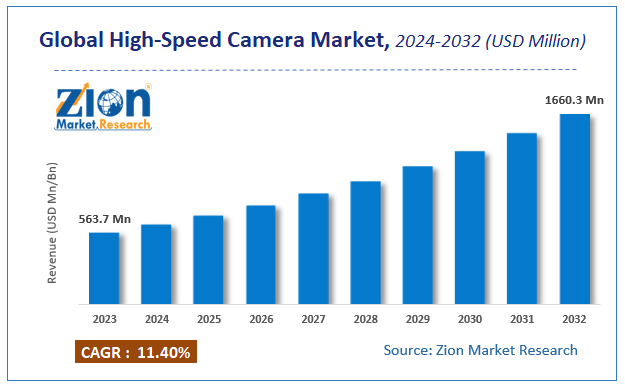
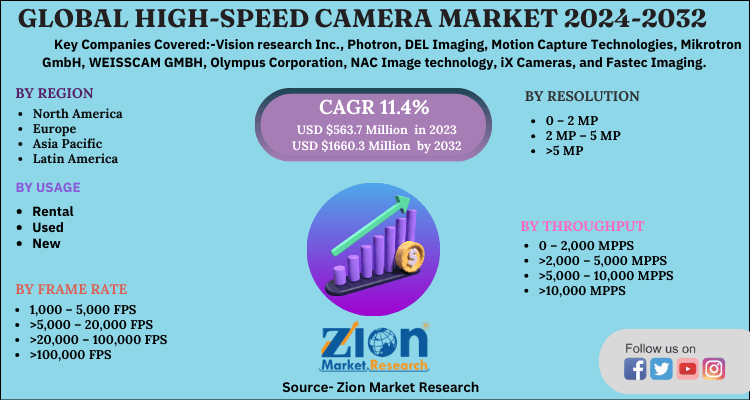
Zion Market Research has published a report on the global High-Speed Camera Market, estimating its value at USD 563.7 Million in 2023, with projections indicating that it will reach USD 1660.3 Million by 2032. The market is expected to expand at a compound annual growth rate (CAGR) of 11.4% over the forecast period 2024-2032. The report explores the factors fueling market growth, the hitches that could hamper this expansion, and the opportunities that may arise in the High-Speed Camera Market industry. Additionally, it offers a detailed analysis of how these elements will affect market demand dynamics and market performance throughout the forecast period.
High-speed Camera Industry Introduction
High-speed camera is equipment that has the ability to capture moving pictures that have an exposure of nearly lesser than a one-thousandth second. In addition to this, high speed cameras that are used today possess CMOS active pixel sensor or CCD that captures nearly 1,000 frames each second. Generally, high-speed cameras are divided into four divisions including high-speed video cameras, high – speed film cameras, high-speed framing cameras, and high-speed streak cameras. Precisely, high-speed cameras are an upgraded kind of conventional digitized cameras having high resolution and higher frame rate along with capability of capturing events at very high speed. Additionally, the product quality is based on myriad attributes including sensor size, frame rate, image processor, cooling system, resolution, and memory size.
Market Growth Drivers
The expansion of high speed camera industry over the projected timeframe is due to its massive utilization in automotive, food & beverages, pharmaceuticals & healthcare, paper & printing, plastic & rubber industry, media & entertainment, aerospace, military & defense, and household & textile sectors. Additionally, high speed cameras offer myriad benefits including high speed real-time recording, setting of speed display, real-time display, direct write data recording, image stability, and proficient interface with software tools. All these aspects are anticipated to steer the growth of high speed camera industry over the projected timespan.
Furthermore, large-scale acceptance of the product in industrial manufacturing and media & entertainment sectors will propel the expansion of high speed camera market over the forecast timeframe. Nonetheless, elongated product life cycle, high equipment costs, light sensitivity, and heat generation & sensor noise are likely to create obstacles in the growth path of high speed camera industry over the assessment timeline.
High-Speed Camera Market: Report Scope
| Report Attributes | Report Details |
|---|---|
| Report Name | High-Speed Camera Market |
| Market Size in 2023 | USD 563.7 Million |
| Market Forecast in 2032 | USD 1660.3 Million |
| Growth Rate | CAGR of 11.4% |
| Number of Pages | 215 |
| Key Companies Covered | Vision research Inc., Photron, DEL Imaging, Motion Capture Technologies, Mikrotron GmbH, WEISSCAM GMBH, Olympus Corporation, NAC Image technology, iX Cameras, and Fastec Imaging |
| Segments Covered | By Usage, By Frame Rate, By Resolution, By Throughput, By Component, By Spectrum, By Connectivity Technology, By Functionality, By Application, and By Region |
| Regions Covered | North America, Europe, Asia Pacific (APAC), Latin America, Middle East, and Africa (MEA) |
| Base Year | 2023 |
| Historical Year | 2018 - 2022 |
| Forecast Year | 2024 - 2032 |
| Customization Scope | Avail customized purchase options to meet your exact research needs. Request For Customization |
Asia Pacific Market To Garner Huge Gains Over 2024-2032
The growth of the high speed camera industry in Asia Pacific over the assessment timeline is due to swift industrialization along with presence of large number of firms producing high speed cameras in the region. In addition to this, use of the product in consumer electronics goods, healthcare, food & beverages, and automotive sectors will further pave a way for the growth of high speed camera market in Asia Pacific over the forecast timeline. Countries such as India, China, and Japan are projected to be the major regional revenue drivers in the foreseeable future.
Key players profiled in the study include:
- Vision Research Inc.
- Photron
- DEL Imaging
- Motion Capture Technologies
- Mikrotron GmbH
- WEISSCAM GMBH
- Olympus Corporation
- NAC Image technology
- iX Cameras
- Fastec Imaging.
The global high-speed camera market is segmented as follows:
By Usage:
- Rental
- Used
- New
By Frame Rate:
- 1,000 – 5,000 FPS
- >5,000 – 20,000 FPS
- >20,000 – 100,000 FPS
- >100,000 FPS
By Resolution:
- 0 – 2 MP
- 2 MP – 5 MP
- >5 MP
By Throughput:
- 0 – 2,000 MPPS
- >2,000 – 5,000 MPPS
- >5,000 – 10,000 MPPS
- >10,000 MPPS
By Component:
- Image sensors
- Lens
- Memory Systems
- Batteries
- Image Processors
- Fans and Cooling systems
- Other semiconductor components (photodiodes, microprocessor chips, color filters, and others)
By Spectrum:
- Visible RGB
- Infrared
- X-Ray
By Connectivity Technology:
- Wired
- Wireless
By Functionality:
- AI-based camera
- Traditional Camera
By Application:
- Automotive & Transportation
- Industrial Manufacturing
- Food & Beverages
- Consumer Electronics
- Media & Entertainment
- Sports
- Paper & Printing
- Military, Aerospace, & Defense
- Research, Design, & Testing
- Healthcare
- Others (building materials, tobacco, and non-woven)
By Region
- North America
- The U.S.
- Canada
- Mexico
- Europe
- France
- The UK
- Spain
- Germany
- Italy
- Rest of Europe
- Asia Pacific
- China
- Japan
- India
- Australia
- South Korea
- Rest of Asia Pacific
- The Middle East & Africa
- Saudi Arabia
- UAE
- Egypt
- Kuwait
- South Africa
- Rest of the Middle East & Africa
- Latin America
- Brazil
- Argentina
- Rest of Latin America
Table Of Content
Methodology
FrequentlyAsked Questions
A high-speed camera captures images at very high frame rates. It is used to analyze fast-moving events
The global High-Speed Camera market is expected to be driven by the demand for motion analysis in industrial testing, research, and sports. Applications in automotive, aerospace, and defense support expansion.
According to study, the global High-Speed Camera market size was worth around USD 563.7 Million in 2023 and is predicted to grow to around USD 1660.3 Million By 2032.
The global High-Speed Camera market is expected to grow at a Compound Annual Growth Rate (CAGR) of around CAGR 11.4% during the forecast period from 2024-2032.
The global High-Speed Camera industry is projected to be challenged by Challenges include high equipment costs, data storage requirements, and niche application scope.
Which application areas will offer significant growth opportunities in the High-Speed Camera market?
The Opportunities include industrial inspection, sports broadcasting, scientific research, and defense and aerospace testing will offer significant growth opportunities in the High-Speed Camera market.
Ultra-high frame rates and resolution; compact and rugged designs; applications in industrial testing and scientific research are the emerging trends and innovations impacting the High-Speed Camera market.
The global High-Speed Camera market is expected to be led by North America during the forecast period.
Some of the prominent players operating in the global High-Speed Camera market are; Vision research Inc., Photron, DEL Imaging, Motion Capture Technologies, Mikrotron GmbH, WEISSCAM GMBH, Olympus Corporation, NAC Image technology, iX Cameras, and Fastec Imaging and others.
The report explores crucial aspects of the High-Speed Camera market, including a detailed discussion of existing growth factors and restraints, while also browsing future growth opportunities and challenges that impact the market.

List of Contents
What is the Market size of the high-speed camera market?High-speed Camera Industry IntroductionMarket Growth DriversReport ScopeAsia Pacific Market To Garner Huge Gains Over 2024-2032Key players profiled in the study include:The global high-speed camera market is segmented as follows:HappyClients

