
Insulated Lunch Box Market Size, Share, Trends, Growth and Forecast 2034

Insulated Lunch Box Market By Type (Vacuum Insulated Lunch Boxes, Foam Insulated Lunch Boxes, Gel Pack Insulated Lunch Boxes, Thermal Fabric Lunch Boxes), By Application (Office Use, School and College Use, Outdoor and Travel Use, Industrial and Worksite Use), By Material (Stainless Steel Lunch Boxes, Plastic Lunch Boxes, Silicone Lunch Boxes, Fabric and Canvas Lunch Boxes), By End-User (Adults, Children, Working Professionals, Athletes and Outdoor Enthusiasts), and By Region - Global and Regional Industry Overview, Market Intelligence, Comprehensive Analysis, Historical Data, and Forecasts 2026 - 2034
| Market Size in 2025 | Market Forecast in 2034 | CAGR (in %) | Base Year |
|---|---|---|---|
| USD 1.75 Billion | USD 2.98 Billion | 6.21% | 2025 |
Insulated Lunch Box Industry Perspective:
What will be the size of the insulated lunch box market during the forecast period?
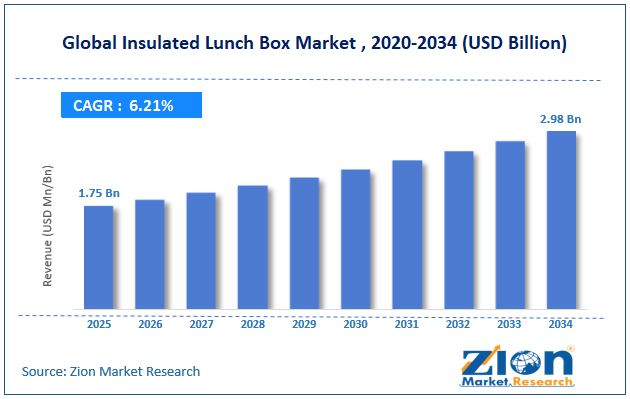
The global insulated lunch box market size was valued at approximately USD 1.75 billion in 2025 and is projected to reach around USD 2.98 billion by 2034, growing at a compound annual growth rate of approximately 6.21% between 2026 and 2034.
Key Insights
- As per the analysis shared by our research team, the global insulated lunch box market is estimated to grow at a compound annual growth rate of approximately 6.21% during the forecast period from 2026 to 2034.
- In terms of revenue, the global insulated lunch box market was valued at approximately USD 1.75 billion in 2025 and is projected to reach USD 2.98 billion by 2034.
- The insulated lunch box market is expected to grow strongly due to rising preference for home-cooked meals, growing awareness of plastic waste reduction, increasing participation in outdoor activities, and expanding demand from working professionals and students.
- Based on type, vacuum insulated lunch boxes lead the market because of their superior temperature-holding ability, while gel pack insulated lunch boxes are gaining strong momentum as one of the fastest-growing types because of their affordability and ease of use.
- Based on application, office use leads the market due to the steady rise in packed-meal culture among working adults, while outdoor and travel use is the fastest-growing segment as more people take part in hiking, camping, and road trips.
- Based on material, stainless steel lunch boxes lead the market because of their durability and better temperature retention, while silicone lunch boxes are seeing rapid adoption because of their flexibility, lightweight nature, and easy cleaning.
- Based on end-user, working professionals lead the market due to daily meal-carrying habits, while athletes and outdoor enthusiasts are steadily growing as fitness culture and active lifestyles continue to expand.
- Based on region, North America leads the global insulated lunch box market, while Asia Pacific is the fastest-growing region due to rising urban working populations and changing food habits.
Insulated Lunch Box Market: Overview
An insulated lunch box is a reusable food container designed to keep meals warm or cold for several hours. It uses insulated layers, thermal fabric, foam, gel packs, or special materials to slow temperature changes and help food stay fresh while being carried outside the home. The insulated lunch box market is growing as people increasingly prefer homemade meals for better health, lower costs, and personal choice. Office workers, students, gym-goers, travelers, construction workers, and outdoor enthusiasts use these lunch boxes widely. Parents look for leak-proof and easy-to-clean options for children, while professionals prefer stylish designs that fit easily into work bags. Manufacturers are improving products with stronger zippers, durable stitching, washable interiors, secure seals, and lightweight materials. Some designs can also fold flat for easy storage when not in use.
Growing awareness of food safety and concern about single-use plastic packaging are encouraging consumers to choose reusable insulated lunch boxes. Demand is also rising for compact designs, multiple compartments, and convenient carrying handles for everyday use. Better designs, improved insulation, attractive styles, and convenient features are making these products suitable for everyday meals, travel, picnics, and outdoor activities.
The insulated lunch box industry continues to grow as consumers, retailers, and manufacturers work together toward smarter, more sustainable, and better-looking food carrying solutions worldwide.
Insulated Lunch Box Market: Strategic Perspective
Where is the insulated lunch box market heading?
The insulated lunch box market is likely to shift toward more personalized and multi-purpose designs that suit different lifestyles, from busy office workers to students and outdoor travelers. Future products may emphasize better insulation technology, eco-friendly materials, compact folding designs, and features that make cleaning and carrying much easier than before.
Where should businesses invest in the insulated lunch box market?
Investment opportunities in the insulated lunch box market are likely to emerge in premium vacuum insulated designs, kid-friendly leak-proof boxes, eco-conscious fabric options, and compact models built for travel and commuting. Manufacturers that combine good looks with strong functionality and offer wider size and color choices can access a much broader customer base.
What will reshape competition in the insulated lunch box market?
Competition in the insulated lunch box market will increasingly depend on insulation performance, design appeal, ease of cleaning, and durability rather than price alone. Companies offering better warranties, thoughtful packaging, sustainable materials, and strong online presence are likely to strengthen their position among today's shoppers.
Insulated Lunch Box Market: Technology Roadmap 2026–2034
What is the projected development roadmap of the insulated lunch box market over the forecast period?
The insulated lunch box market is advancing through better insulation layers, more durable zippers and seals, expanded use of eco-friendly and recyclable materials, and growing attention to compact, stylish designs that suit modern lifestyles. The market is expected to grow at a compound annual growth rate of approximately 6.21% over the forecast period, driven by rising health consciousness, changing food habits, and continuous innovation in lunch box technology.
The following roadmap outlines key development phases expected through 2034.
2026–2028: Comfort and Practical Design Phase
- Better insulation materials: Manufacturers are expected to use improved foam and gel layers that keep food warm or cold for longer without making lunch boxes heavy.
- Better leak protection: Brands are likely to add stronger seals and spill-proof compartments, especially for children and people carrying meals to work.
- Wider size options: Companies are expected to offer small single-meal boxes and larger family-size options to suit different daily meal needs.
2029–2031: Sustainability and Lifestyle Expansion Phase
- Eco-friendly materials: Recyclable fabrics and plant-based linings are expected to become common as consumers look for lunch boxes with less plastic.
- Travel-friendly designs: Lunch boxes made for hiking, commuting, road trips, and outdoor activities are likely to gain popularity as these activities grow.
- Workplace-friendly styles: Demand is expected to rise for stylish and professional lunch boxes that working adults can easily carry to offices and meetings.
2032–2034: Smart Food Storage Phase
- Temperature tracking features: Future lunch boxes may use simple indicators or sensors to show whether food is still at a safe temperature.
- Application-connected storage: Smart lunch boxes could connect to mobile apps that remind users when to eat food or when the box needs cleaning.
- Personalized designs: Manufacturers are expected to offer customizable lunch boxes, letting customers choose the size, color, compartments, and other features they need.
Insulated Lunch Box Market: Dynamics
Growth Drivers
Growing demand for healthier eating habits is strengthening the insulated lunch box market.
The insulated lunch box market is growing as consumers increasingly choose homemade meals over takeout and canteen food. Growing health awareness is encouraging office workers and families to prepare balanced meals at home and carry them safely during the day. Parents are also choosing insulated lunch boxes to pack fresh meals for children. Rising awareness of food safety and portion control is further supporting demand for containers that protect food during transport. Fitness enthusiasts are using insulated boxes to carry prepared meals, snacks, and drinks to the gym and during workouts.
Remote and hybrid work are also supporting demand as people carry meals between home, offices, and shared workspaces. Concern about single-use packaging is encouraging consumers to switch to reusable lunch boxes. These changing food habits are increasing the use of insulated lunch boxes across workplaces, schools, fitness routines, and everyday meal preparation. Together, healthier eating, food safety, meal planning, and reduced use of disposable packaging are key factors supporting market growth.
How are product innovations opening new opportunities in the insulated lunch box market?
Product innovation is strengthening the insulated lunch box industry by improving convenience, performance, and everyday usability. Manufacturers are developing better insulation that keeps food warm or cold longer, making lunch boxes suitable for long workdays and travel. Stronger zippers, improved seals, durable fabrics, comfortable straps, and easy-clean linings are increasing product reliability. Multi-compartment designs help users keep different foods separate, while foldable and collapsible models save space when not in use. Vacuum-insulated products are also gaining attention for keeping food warm or cold for extended periods.
Manufacturers are using recyclable, washable, and reusable materials to reduce product waste and meet environmental concerns. These improvements are making insulated lunch boxes more practical for daily use and expanding their appeal across offices, schools, gyms, travel, and outdoor activities. Continued improvements in product design and functionality are expected to support adoption during the forecast period.
Restraints
Price sensitivity and durability concerns limit growth in the insulated lunch box market.
Higher prices for advanced products restrain the insulated lunch box market compared with basic lunch bags and containers. Premium vacuum-insulated models can be expensive, making them less attractive to budget-conscious consumers. Specialized materials, insulation layers, and added features can further increase retail prices. Regular maintenance is another concern, as some products require careful cleaning to maintain their insulation and appearance. Repeated washing may also affect certain fabrics, coatings, or seals over time. These factors can increase total cost of ownership and discourage consumers looking for simple, low-cost meal-carrying solutions.
Manufacturers need to balance product features with affordable pricing while using materials that can withstand regular cleaning and daily use. Addressing these cost-related concerns can help reduce resistance among price-sensitive consumers and support wider adoption of insulated lunch boxes.
Opportunities
Will changing food and lifestyle habits create growth opportunities for the insulated lunch box market?
Changing lifestyles are creating opportunities in the insulated lunch box market, allowing manufacturers to serve specific consumer groups and new use cases. Brands can develop child-friendly products with attractive designs, larger models for athletes, and durable options for hiking, road trips, and outdoor activities. Rising disposable incomes in developing countries are allowing consumers to spend on premium kitchen and lifestyle products. Online retail and direct-to-consumer platforms are also helping brands reach customers who prefer convenient home shopping.
Stylish designs can position insulated lunch boxes as lifestyle accessories rather than basic food containers, appealing to younger and design-conscious consumers. Gift-ready packaging and product bundles with water bottles, cutlery, or meal accessories can attract seasonal and occasional buyers. Wellness brands and fitness businesses can also use insulated lunch boxes to support meal-preparation trends among health-focused consumers. These trends create opportunities to expand the customer base, develop targeted product ranges, and increase sales across residential, workplace, fitness, travel, and outdoor markets.
Challenges
What challenges are affecting product choice in the insulated lunch box market?
The insulated lunch box industry faces challenges related to product selection, availability, and changing user requirements. Consumers may struggle to choose the right product because lunch boxes differ in size, capacity, insulation time, compartment layout, and intended use. A model suitable for a school child may not meet the needs of an office worker, athlete, or traveler. Limited availability of trusted brands in smaller cities and developing regions can also restrict consumer choice and increase reliance on low-quality alternatives. Small retailers may struggle to stock products for every user group because of limited shelf space and demand uncertainty. Households with several family members may also need different designs for different needs, creating additional storage requirements. Manufacturers can address these challenges through clearer product information, wider distribution, standardized sizing guidance, and stronger online availability. These steps can simplify purchasing decisions and improve access to suitable insulated lunch boxes across different consumer groups.
Insulated Lunch Box Market: Report Scope
| Report Attributes | Report Details |
|---|---|
| Report Name | Insulated Lunch Box Market |
| Market Size in 2025 | USD 1.75 Billion |
| Market Forecast in 2034 | USD 2.98 Billion |
| Growth Rate | CAGR of 6.21% |
| Number of Pages | 228 |
| Key Companies Covered | Thermos LLC, Stanley, Zojirushi Corporation, Bentgo, PackIt LLC, Hydro Flask, Yeti Holdings, Contigo, Lock&Lock, Igloo Products Corp., and others. |
| Segments Covered | By Type, By Application, By Material, By End User, and By Region |
| Regions Covered | North America, Europe, Asia Pacific (APAC), Latin America, Middle East, and Africa (MEA) |
| Base Year | 2025 |
| Historical Year | 2020 - 2024 |
| Forecast Year | 2026 - 2034 |
| Customization Scope | Avail customized purchase options to meet your exact research needs. Request For Customization |
Insulated Lunch Box Market: Segmentation
The global insulated lunch box market is segmented by type, application, material, end-user, and region.
What makes vacuum insulated lunch boxes the dominant type in the insulated lunch box market?
Based on type, the global insulated lunch box industry is categorized into vacuum insulated, foam insulated, gel pack insulated, and thermal fabric lunch boxes. Vacuum insulated lunch boxes hold about 38% of the market share, leading because they keep food warm or cold for extended hours compared to other types. Gel pack insulated lunch boxes hold around 27% market share. They are the fastest-growing segment because demand is increasing for affordable options that still deliver reliable temperature control.
How does office use maintain its leading position in the insulated lunch box market?
Based on application, the insulated lunch box market is divided into office use, school and college use, outdoor and travel use, and industrial and worksite use. Office use accounts for about 36% of the global market share, driven by the steady rise of working adults choosing to bring home-cooked meals instead of eating out. Outdoor and travel use accounts for around 21% of the market share. It is the fastest-growing segment due to increasing participation in hiking, camping, and long-distance travel.
Where do stainless steel lunch boxes stand out in the insulated lunch box market?
Based on material, the market is segregated into stainless steel, plastic, silicone, and fabric and canvas lunch boxes. Stainless steel lunch boxes lead with about a 34% share because of their strength, better temperature retention, and long-lasting quality compared to other materials. Silicone lunch boxes hold around 24% market share. They are seeing rapid adoption because their flexible and lightweight design makes them easy to carry and clean for daily use.
Which end user is driving demand for insulated lunch boxes in the global market?
Based on end user, the insulated lunch box market is classified into adults, children, working professionals, and athletes and outdoor enthusiasts. Working professionals account for about 35% of the market, leading because of daily meal carrying habits tied to office and commuting routines. Athletes and outdoor enthusiasts hold around 20% market share. It is the fastest-growing segment as fitness culture and active outdoor lifestyles continue gaining popularity among younger consumers.
Insulated Lunch Box Market: Regional Analysis
Why is North America leading the global insulated lunch box market?
North America holds a 39.85% share of the global insulated lunch box market and is expected to maintain its leading position during the forecast period. The region's strong meal-preparation culture supports demand, particularly among working professionals and students who regularly carry homemade food. The United States has a well-developed retail system, with insulated lunch boxes widely available through supermarkets, specialty stores, and online platforms. A strong outdoor recreation culture is another regional factor, with hiking, camping, fishing, and road trips supporting demand for durable food-carrying products. School lunch practices also contribute to demand as parents seek convenient ways to pack meals for children. The region's established fitness industry supports demand for larger lunch boxes used to carry prepared meals throughout the day.
Consumers are also showing growing interest in reusable products as awareness of plastic waste increases. Growing demand for convenient meal storage, stylish designs, and easy-to-clean products is also influencing purchasing decisions among urban consumers across the region. Manufacturers are responding with durable materials, improved insulation, practical compartments, and modern designs. Strong retail infrastructure, high consumer purchasing power, and established lifestyle habits are expected to keep North America at the forefront of the global insulated lunch box market.
What makes Asia Pacific the fastest-growing region in the insulated lunch box market?
The Asia Pacific insulated lunch box market holds a 24.47% global share and is expected to record the fastest growth during the forecast period. Rapid urbanization and the expansion of office-based employment are increasing demand for convenient meal-carrying products across major cities. China and India are key growth markets, supported by large urban populations and rising demand for affordable lifestyle products. Japan and South Korea have established traditions of carrying prepared meals, creating a strong base for lunch box adoption. Rising middle-class incomes are encouraging consumers to upgrade from basic containers to insulated products with better designs and features. Local manufacturers are helping expand the market by offering competitively priced products suited to regional preferences.
E-commerce growth is improving access to branded lunch boxes in smaller cities and towns, while expanding retail networks are increasing product availability. Growing interest in healthy eating, convenient food preparation, and reusable household products is further strengthening demand among younger urban consumers and families. Rising participation in weekend travel and outdoor recreation is also supporting demand for portable food storage. Growing awareness of reusable products is encouraging consumers to reduce disposable food packaging. Urban development, rising incomes, digital shopping, and changing meal habits are expected to drive strong insulated lunch box market growth across Asia Pacific.
Recent Market Developments
- In July 2026, YETI’s Daytrip 9-Liter Insulated Box was highlighted among new outdoor food-storage products available through REI, offering insulation, a flexible foam exterior, an internal storage pocket, and a padded shoulder strap for meals and outdoor use.
- In August 2026, Hydro Flask introduced new lunch bags with an expandable design that can accommodate larger meals and fold flat for easier storage, reflecting growing demand for flexible, space-saving insulated food-carrying products.
Insulated Lunch Box Market: Competitive Analysis
The leading players in the global insulated lunch box market are:
- Thermos LLC
- Stanley
- Zojirushi Corporation
- Bentgo
- PackIt LLC
- Hydro Flask
- Yeti Holdings
- Contigo
- Lock&Lock
- Igloo Products Corp.
The global insulated lunch box market is segmented as follows:
By Type
- Vacuum Insulated Lunch Boxes
- Foam Insulated Lunch Boxes
- Gel Pack Insulated Lunch Boxes
- Thermal Fabric Lunch Boxes
By Application
- Office Use
- School and College Use
- Outdoor and Travel Use
- Industrial and Worksite Use
By Material
- Stainless Steel Lunch Boxes
- Plastic Lunch Boxes
- Silicone Lunch Boxes
- Fabric and Canvas Lunch Boxes
By End User
- Adults
- Children
- Working Professionals
- Athletes and Outdoor Enthusiasts
By Region
- North America
- The U.S.
- Canada
- Mexico
- Europe
- France
- The UK
- Spain
- Germany
- Italy
- Rest of Europe
- Asia Pacific
- China
- Japan
- India
- Australia
- South Korea
- Rest of Asia Pacific
- The Middle East & Africa
- Saudi Arabia
- UAE
- Egypt
- Kuwait
- South Africa
- Rest of the Middle East & Africa
- Latin America
- Brazil
- Argentina
- Rest of Latin America
Table Of Content
Methodology
FrequentlyAsked Questions
An insulated lunch box is a reusable food container designed to keep meals warm or cold for several hours. It uses insulated layers, thermal fabric, foam, gel packs, or special materials to slow temperature changes and help food stay fresh while being carried outside the home.
The global insulated lunch box market is expected to grow due to rising preference for home-cooked meals, growing awareness of plastic waste reduction, increasing participation in outdoor activities, and expanding demand from working professionals and students worldwide.
According to research, the global insulated lunch box market was valued at approximately USD 1.75 billion in 2025 and is projected to reach approximately USD 2.98 billion by 2034.
The compound annual growth rate of the insulated lunch box market is expected to be approximately 6.21% from 2026 to 2034.
North America is expected to lead the global insulated lunch box market throughout the forecast period, driven by a strong meal-prepping culture, well-established retail networks, and continued demand for healthier eating habits.
The major players in the global insulated lunch box market include Thermos LLC, Stanley, Zojirushi Corporation, Bentgo, PackIt LLC, Hydro Flask, Yeti Holdings, Contigo, Lock&Lock, and Igloo Products Corp.
The report examines key aspects of the insulated lunch box market, including research and development drivers, adoption barriers, application opportunities, competitive landscape dynamics, detailed regional market performance analysis, and a comprehensive forward-looking outlook across all major types, applications, materials, end-user segments, and geographic regions through 2034.
Technological advancements are improving insulation performance, durability, and convenience in the insulated lunch box market. Lighter materials, stronger seals, better zippers, and improved lining technology help consumers keep food fresh longer while making daily carrying easier.
Leading companies in the insulated lunch box market are expanding product ranges, developing specialized designs, improving distribution networks, entering emerging markets, and partnering with retailers to reach more customers. They are also investing in sustainable materials, stylish designs, and better packaging to strengthen customer loyalty and improve product adoption.
The insulated lunch box market is shifting toward lightweight, leak-proof, reusable, and stylish products as consumers seek convenience, food safety, and easy daily use. Demand is also rising for eco-friendly materials, multiple compartments, smart features, and designs suited to offices, schools, fitness, travel, and outdoor activities.

HappyClients

