
Human Hair Extension Market Size, Trend, Growth, Industry Analysis 2034

Human Hair Extension Market By Type (Clip-in Hair Extension, Tape-in Hair Extension, Fusion & Pre-Bonded Hair Extension, and Others), By Application (Male and Female), By Sales Channel (Online and Offline), and By Region - Global and Regional Industry Overview, Market Intelligence, Comprehensive Analysis, Historical Data, and Forecasts 2025 - 2034
| Market Size in 2024 | Market Forecast in 2034 | CAGR (in %) | Base Year |
|---|---|---|---|
| USD 5.1 Billion | USD 14.2 Billion | 10.8% | 2024 |
Human Hair Extension Industry Perspective:
What will be the size of the global human hair extension market during the forecast period?
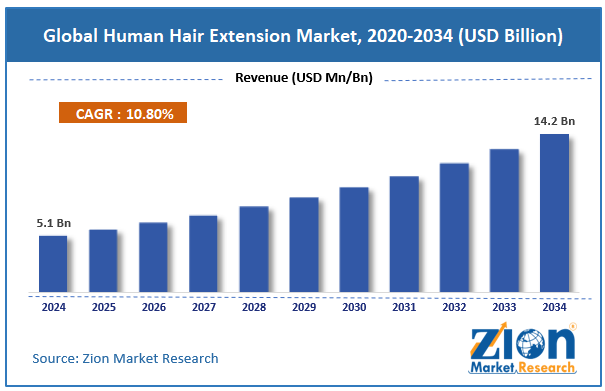
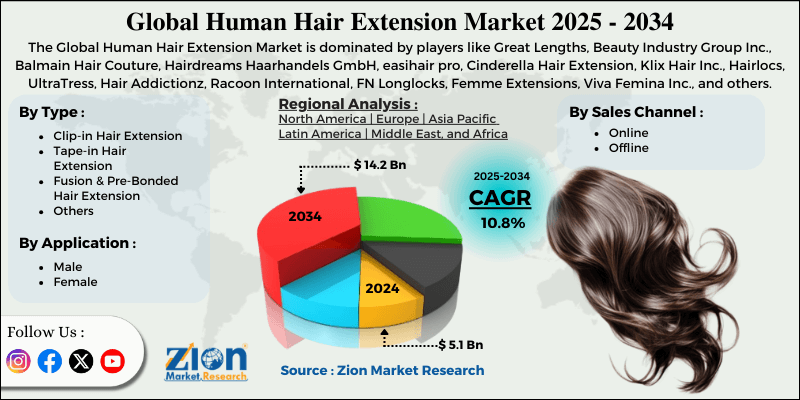
The global human hair extension market size was worth around USD 5.1 billion in 2024 and is predicted to grow to around USD 14.2 billion by 2034, with a compound annual growth rate (CAGR) of roughly 10.8% between 2025 and 2034.
Key Insights
- As per the analysis shared by our research analyst, the global human hair extension market is estimated to grow annually at a CAGR of around 10.8% over the forecast period (2025-2034).
- In terms of revenue, the global human hair extension market size was valued at around USD 5.1 billion in 2024 and is projected to reach USD 14.2 billion by 2034.
- Rising disposable incomes & beauty spending in emerging markets are expected to drive the human hair extension market.
- Based on the type, the clip-in hair extension holds the largest market share of 35% in 2024.
- Based on the application, the female dominates the industry growth, accounting for more than 90% of the market share.
- Based on the sales channel, the offline sales channel captures the largest revenue share of over 70% in 2024.
- Based on region, North America captures the largest revenue share of 48% in 2024.
Human Hair Extension Market: Overview
The human hair extension market encompasses all processes involved in the procurement, processing, manufacturing, selling, and retailing of human hair-based hairpieces used to add either volume, length, color, or texture to hair; the human quality used provides a more natural, longer-lasting, and versatile product than a synthetic alternative. Human hair extensions can be purchased as clip-in, tape-in, sew-in (weft), fusion, or hair extensions (already “weaved” in and ready to sew into clients' own hair), or as a wig. These products can be sold via either salons, specialty beauty retail outlets, or increasingly over the internet. The human hair extension market further involves the ‘raw’ procurement of the hair (from a number of countries, such as India, Vietnam, and China) through to manufacturing & branding, and retail distribution. The demand for human hair extensions is closely linked to current fashion trends, celebrity styling, rising personal care spending, and aesthetic demand, as well as to the medical implications of hair loss, including treatments such as chemotherapy or alopecia.
Human Hair Extension Market: Dynamics
Growth Drivers
How does the rapid growth of e-commerce and direct-to-consumer brands propel the market expansion?
The proliferation of e-commerce platforms and direct-to-consumer (D2C) brands, in particular, is propelling the growth in the human hair extension industry at a faster rate, as consumers are empowered by accessibility, transparency, and engagement through online channels. The online space eliminates many access restrictions related to geography, texture, length, color, and installation methods by providing consumers with options outside the salon ecosystem, primarily through a brand's own website instead of at a department store or high-end retailer. By eliminating the middleman/retailer margin, D2C models allow brands to lower end-user prices compared to the high-end salon experience, while still achieving a higher margin. Digital advertising through influencer merchandising, social media tutorial clips, targeted social media advertisements, and reviews propels consumer confidence. E-commerce affords tailored recommendations, test-in hooks virtually, subscription-based maintenance kits, and free returns, enabling consumers to place larger, more confident orders and fostering a strong affinity with the brand.
For instance, the Census Bureau of the Department of Commerce announced that the estimate of U.S. retail e-commerce sales for the third quarter of 2025, adjusted for seasonal variation but not for price changes, was $310.3 billion, an increase of 1.9 percent (+/-0.4%) from the second quarter of 2025.
Restraints
High cost of premium human hair extensions is hindering the market growth
The initial high cost of premium human hair extensions is a limiting factor for further market growth in high-demand, price-sensitive areas. A high-quality product (such as Remy-grade, naturally derived, or virgin human hair) involves a lot of sorting, collection, quality testing, and processing steps. Additionally, to make the most of the expenditure, styling in most cases requires professional fitting and substantial maintenance, highly increasing the cost of the product. Many cannot afford such a product and either purchase a synthetic alternative or limit the quantity they buy to enable financing the lifetime investment, resulting in limited access to the broadest market. This scenario also affects the mass market by maintaining the premium status of the urban, educated elite, thus preventing any serious penetration.
Opportunities
Does the prevalence of hair disorders offer a potential opportunity for the human hair extension market growth?
The prevalence of hair problems is increasing, such that there is a promising opportunity for growth in the human hair extension market. Growth in incidences of alopecia, androgenetic hair loss, traction alopecia, and hair thinning due to stress, aging, and medical treatments such as chemotherapy is contributing to a broader consumer target for human hair extension products. Since consumers with hair problems will naturally want to look more aesthetically pleasing, they are undoubtedly seeking hair recovery and covering solutions, such as wigs and hair extensions, in the time to come. The growth of the human hair market will be driven by the size of this consumer base and the rising demand for high-quality human hair extension products, as consumers prefer more realistic solutions to synthetics. In particular, consumers with medical hair issues will require longer-lasting, more comfortable, and more realistic solutions, such as human hair, to boost confidence and quality of life.
Service providers in salons and medical wig sellers are also increasing the awareness of hair health while offering hair growth and restoration, creating a larger market for styling human hair extensions. Overall, the growing number of consumers with hair problems will not only maintain the existing demand for human hair extensions but also support the development and growth of higher-quality (medical-grade or premium-quality) human hair extensions.
For instance, according to a secondary source, in China, a staggering 250 million people are currently experiencing hair loss, and among men, 60% have reported hair health problems.
Challenges
Why do raw material availability & durability issues pose a major challenge to the human hair extension market growth?
Availability of raw materials and durability issues are significant obstacles for the human hair extension markets because demand is predicated on a finite, irregular supply of natural human hair of consistently high quality. The unprocessed, high-end extension market, particularly with Remy and virgin hair, demands cuticle protection, aligned hair growth, and the absence of chemicals. These elite raw materials are subject to the ebb and flow of international flights, regional export restrictions, and global politics.
Consequently, the increased need for such a competitive raw material increases costs and forward price trends for suppliers, which, in turn, impacts the retail prices for consumers and challenges market growth. Human hair‘s natural durability is also a barrier—if the product belongs on a shelf or a head for reasons other than price, quality, or process, and instead regularly tangles, sheds, loses strength and shine, or presents other problems, then the pressures to purchase the product again diminish while the potential for re-returns rises.
Human Hair Extension Market: Report Scope
| Report Attributes | Report Details |
|---|---|
| Report Name | Human Hair Extension Market |
| Market Size in 2024 | USD 5.1 Billion |
| Market Forecast in 2034 | USD 14.2 Bllion |
| Growth Rate | CAGR of 10.8% |
| Number of Pages | 224 |
| Key Companies Covered | Great Lengths, Beauty Industry Group Inc., Balmain Hair Couture, Hairdreams Haarhandels GmbH, easihair pro, Cinderella Hair Extension, Klix Hair Inc., Hairlocs, UltraTress, Hair Addictionz, Racoon International, FN Longlocks, Femme Extensions, Viva Femina Inc., and others. |
| Segments Covered | By Type, By Application, By Sales Channel, and By Region |
| Regions Covered | North America, Europe, Asia Pacific (APAC), Latin America, Middle East, and Africa (MEA) |
| Base Year | 2024 |
| Historical Year | 2019 to 2023 |
| Forecast Year | 2025 - 2034 |
| Customization Scope | Avail customized purchase options to meet your exact research needs. Request For Customization |
Human Hair Extension Market: Segmentation
Type Insights
Why does clip-in hair extension hold the dominant position in the human hair extension market?
The clip-in hair extension holds the largest market share of 35% in 2024. The reason for the growth is that it is comfortable to use, affordable, and appeals to most consumers. Permanent installation methods, such as tap-ins or sew-ins, are more time-consuming and require a professional, which makes them less appealing to first-time consumers and average buyers who want to temporarily change their length and volume. It has brought in customers, including retail shoppers and online customers.
Application Insights
Why does female hold the largest share in the human hair extension industry?
The female dominates the industry growth, accounting for more than 90% of the market share. The reasons behind this growth include that women are typically the largest consumers of hair enhancement products and are more likely to opt for extensions due to their value as an aesthetic measure and to enhance self-confidence. The vast majority of our personal and cultural ideas of beauty revolve around the idea that women should have long, gorgeous hair, an idea reinforced by trends constantly seen on fashion runways and on celebrities' magazine covers, which in turn increases demand for locks that look easily and quickly achieved.
Women will also try more styles, hair colors, and textures, not only because they are easy to wear in various day-to-day, event, and social media scenarios, but also because they buy them more frequently and are willing to invest in premium human hair extensions. They are also more targeted in marketing campaigns and influencer-sponsored social media videos on platforms such as Instagram, TikTok, and YouTube.
Sales Channel Insights
Do the offline sales channels grow substantially in the human hair extension industry?
The offline sales channel captures the largest revenue share, over 70%, in 2024. The growing consumer inclination towards customized services over web-based services is one of the major reasons for the upswing in the offline channel segment. Also, professional hairdressers and salons have been the most penetrated by all types of hair extensions. The offline channel enables consumers to stay updated on product & consumption trends and offers efficient insights to manufacturers for developing new products & offerings based on consumer buying behaviors.
Regional Insights
Why does North America lead the human hair extension market?
North America captures the largest revenue share of 48% in 2024. The region's growth is driven by a wide range of cultural, economic, and consumer-behavioral influences. For example, in North America (primarily the United States & Canada), having a large population with high disposable incomes as well as a long history and widespread penetration of the beauty industry and related services (i.e., salons, professional beauticians, and others) resulted in millions of consumers willing and able to spend adequate financial resources on paying for higher-end personal care and hairstyling products, including human hair extensions. Affluent consumers are also much more willing to adopt these products for use in their appearance for everyday life, special events, and staying ahead of fashion trends, which ultimately leads to long-term sales.
Furthermore, the influence of modern media trends (e.g., celebrities and magazines) and the prevailing cultural acceptance of extensions as a fashion accessory, as well as a “cover-up” for hair thinning and hair loss, have all played a significant role in driving North American consumer demand. Further, North America has a large number of upscale salons, beauticians, and online retailers, providing consumers with easy access to affordable and professional options, which drives market growth.
Human Hair Extension Market: Competitive Analysis
The global human hair extension market is dominated by players like:
- Great Lengths
- Beauty Industry Group Inc.
- Balmain Hair Couture
- Hairdreams Haarhandels GmbH
- easihair pro
- Cinderella Hair Extension
- Klix Hair Inc.
- Hairlocs
- UltraTress
- Hair Addictionz
- Racoon International
- FN Longlocks
- Femme Extensions
- Viva Femina Inc.
The global human hair extension market is segmented as follows:
By Type
- Clip-in Hair Extension
- Tape-in Hair Extension
- Fusion & Pre-Bonded Hair Extension
- Others
By Application
- Male
- Female
By Sales Channel
- Online
- Offline
By Region
- North America
- The U.S.
- Canada
- Europe
- France
- The UK
- Spain
- Germany
- Italy
- Rest of Europe
- Asia Pacific
- China
- Japan
- India
- South Korea
- Southeast Asia
- Rest of Asia Pacific
- Latin America
- Brazil
- Mexico
- Rest of Latin America
- Middle East & Africa
- GCC
- South Africa
- Rest of Middle East & Africa
Table Of Content
Methodology
FrequentlyAsked Questions
The human hair extension market encompasses all processes involved in the procurement, processing, manufacturing, selling, and retailing of human hair-based hairpieces used to add either volume, length, color, or texture to hair; the human quality used provides a more natural, longer-lasting, and versatile product than a synthetic alternative.
The human hair extension market is primarily driven by rising beauty consciousness, evolving fashion trends, and the growing influence of social media and celebrity culture. Consumers increasingly seek instant solutions to enhance hair length, volume, and style without waiting for natural growth, making human hair extensions an attractive option for their natural appearance and styling flexibility.
One of the primary constraints is the high cost of premium human hair products, particularly Remy and virgin hair, which limits adoption among price-sensitive consumers and emerging markets. In addition, the industry depends heavily on the availability of high-quality raw human hair sourced from specific regions, making supply vulnerable to fluctuations, export restrictions, and pricing volatility. Quality inconsistencies and counterfeit or mislabeled products marketed as “100% human hair” further erode consumer trust and damage brand reputation.
Based on the application, the female segment is expected to dominate the human hair extension market growth during the projected period.
Advances in application techniques — including micro-links, pre-bonded systems, and tape-ins — are enhancing user comfort, reducing installation time, and minimizing damage to natural hair.
According to the report, the global human hair extension market size was worth around USD 5.1 billion in 2024 and is predicted to grow to around USD 14.2 billion by 2034.
The global human hair extension market is expected to grow at a CAGR of 10.8% during the forecast period.
The global human hair extension industry growth is expected to be led by North America over the forecast period.
The global human hair extension market is dominated by players like Great Lengths, Beauty Industry Group Inc., Balmain Hair Couture, Hairdreams Haarhandels GmbH, easihair pro, Cinderella Hair Extension, Klix Hair, Inc., Hairlocs, UltraTress, Hair Addictionz, Racoon International, FN Longlocks, Femme Extensions, and Viva Femina, Inc., among others.
The human hair extension market report covers the geographical market along with a comprehensive competitive landscape analysis. It also includes cash flow analysis, profit ratio analysis, market basket analysis, market attractiveness analysis, sentiment analysis, PESTLE analysis, trend analysis, SWOT analysis, trade area analysis, demand & supply analysis, Porter’s five forces analysis, and value chain analysis.

HappyClients

