
Global Homecare Ingredients Market Size, Share, Trends, Growth and Forecast 2034

Homecare Ingredients Market By Product Type (Surfactants, Solvents, Chelating Agents, Enzymes, Fragrances, Preservatives, and Others), By Application (Laundry Care, Dishwashing, Surface Care, Air Care, and Others), By Distribution Channel (Online Stores, Supermarkets/Hypermarkets, Specialty Stores, and Others), and Region - Global and Regional Industry Overview, Market Intelligence, Comprehensive Analysis, Historical Data, and Forecasts 2026 - 2034
| Market Size in 2025 | Market Forecast in 2034 | CAGR (in %) | Base Year |
|---|---|---|---|
| USD 3.67 Billion | USD 5.99 Billion | 5.6% | 2025 |
Homecare Ingredients Industry Perspective:
What will be the size of the global homecare ingredients market during the forecast period?
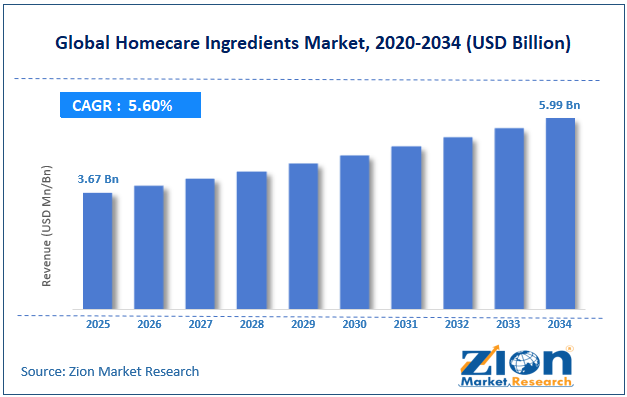
The global homecare ingredients market size was worth around USD 3.67 billion in 2025 and is predicted to grow to around USD 5.99 billion by 2034, with a compound annual growth rate (CAGR) of roughly 5.6% between 2026 and 2034.
Key Insights
- As per the analysis shared by our research analyst, the global homecare ingredients market is estimated to grow annually at a CAGR of around 5.6% over the forecast period (2026-2034).
- In terms of revenue, the global homecare ingredients market size was valued at around USD 3.67 billion in 2025 and is projected to reach USD 5.99 billion by 2034.
- Growing demand for sustainable and bio-based ingredients is expected to propel the homecare ingredients market over the projected period.
- Based on the product type, the surfactants segment dominates the market with a revenue share of 28.7% in 2025.
- Based on the application, the laundry care segment holds a majority of market share of 39% in 2025.
- Based on the distribution channel, the supermarkets/hypermarkets segment holds a majority of market share in 2025 of 47.5%.
- Based on region, the Asia Pacific dominates the Homecare Ingredients market with a revenue share of 35.7% in 2025.
Homecare Ingredients Market: Overview
Homecare ingredients generally refer to chemical or naturally occurring compounds with intended functions in relation to homecare cleaning or maintenance products. These are substances that clean, degrease, disinfect, scent, foam, thicken, preserve, or protect surfaces in a variety of ways. Some of these are surfactants, solvents, enzymes, builders, preservatives, fragrances, bleach, disinfectants, polymers, and chelating agents. Most home care products contain a combination of these components. The products typically include laundry detergents, dishwashing liquids, surface cleaners, toilet cleaners, fabric care treatments, air fresheners, and other related items. Consumer demand for more effective, convenient, safe, and eco-friendly products is driving manufacturers to develop biodegradable, plant-based, concentrated, and less toxic homecare ingredients.
Impact of the USA-Israel War on Iran on the Homecare Ingredients Market
The USA-Israel war with Iran is likely to impact the homecare ingredients market, causing price and supply chain disruptions. Disruptions to oil and gas trade through the Strait of Hormuz create elevated risks for Middle East chemical and petrochemical trading, resulting in higher logistics and energy prices. Additionally, increased energy and shipping costs are likely to raise the prices of petrochemicals and related ingredients, including surfactants, solvents, and specialty chemicals. However, since oil prices started dropping, geopolitical tensions and shipping disruptions are the key drivers affecting ingredient pricing and supply chains. Thus, creating a diverse supplier base and maintaining stockpiles will be the preferred option for manufacturers.
Homecare Ingredients Market: Dynamics
Growth Drivers
How does rising household hygiene awareness drive the homecare ingredients market?
Increasing awareness towards home hygiene, sanitation, and cleanliness is one of the key factors driving the homecare ingredients market. Government initiatives have played a significant role in promoting and proliferating sanitation awareness and household hygiene practices across the country. Take, for instance, the case of India. The Government’s Swachh Bharat Mission led to a rise in sanitation levels in the country’s rural regions from 39% in 2014 to 100% in 2019. There is an increase in the number of individual household toilets built during Swachh Bharat Mission Phase I from 10 crore in 2014. As of March 2026, more than 12.11 crore individual household toilets had been built. Enhanced sanitation levels and awareness result in more people buying toilet cleaners, surface disinfectants, laundry detergents, dishwashing tablets, floor cleaners, and other hygiene-related products. As a result, there is a rise in the demand for surfactants, disinfectants, enzymes, preservatives, fragrance, and builders.
Moreover, according to government data, there was a sharp rise in sanitation levels in the nation – the percentage of the Indian population residing in households with improved sanitation facilities rose from 48.5% in 2015-16 to 70.2% in 2019-21. Apart from government initiatives, public health authorities recommend cleaning and disinfecting as a way to lower the risk of illness transmission. The U.S. Centers for Disease Control and Prevention (CDC) recommends cleaning surfaces with soap and water, and disinfection is appropriate when a sick person is present. Therefore, growing awareness about hygiene is complemented by public health guidelines, encouraging people to purchase various cleaning and hygiene products, fueling the homecare ingredients market growth.
Restraints
Why does the volatility in raw material prices act as a major restraint to the homecare ingredients industry's growth?
Volatility in raw material prices is a significant restraint on growth in the homecare ingredients market because many materials are derived from petrochemicals and vegetable oils. For instance, surfactants are sensitive to crude oil, ethylene oxide, palm oil, palm-kernel oil, and coconut oil prices, among others. Price changes in these materials affect manufacturers’ production costs. Therefore, if the prices of these materials rise, ingredient manufacturers’ profit margins are likely to be adversely impacted, especially when the homecare product manufacturers are reluctant to increase the prices of their products because of their price sensitivity. The situation becomes challenging when ingredient prices keep fluctuating, making it difficult for manufacturers to forecast and plan production processes and raw material purchases, and consequently to negotiate contracts effectively. This volatility in pricing increases ingredient manufacturers’ production costs and decreases their pricing power, thus negatively affecting the homecare ingredients market growth.
Opportunities
How do growing product launches offer a lucrative opportunity for the homecare ingredients market?
A growing number of product launches is driving the homecare ingredients market by stimulating manufacturers to develop improved ingredients and formulations that offer enhanced cleaning performance, convenience, sustainability, fragrance, and long-lasting effects. In this regard, Unilever’s recent launch of Cif Infinite Clean in 2025, a reloadable multi-surface cleaning spray with built-in active cleaning technology that continues to clean three days after application, is a significant development. This product, initially launched in five European countries, uses probiotic technology to break down dirt for up to 72 hours after use. Another key innovation was Henkel’s introduction of concentrated variants of all®, Persil®, and Snuggle® liquid laundry detergents in 2025.
On average, the redesigned packages had 16% more dose per wash and were made from 50% recycled plastic. By introducing concentrated products, Henkel likely aimed to meet rising demand for ingredients that provide higher cleaning performance, especially for its laundry detergents, and to respond to the need for more sustainable packaging. As a result, homecare product innovations that promote intensive cleaning, including concentrated and probiotic products, create new demand for ingredients and formulations that meet the goals of performance, sustainability, and convenience, thus stimulating their growth.
Challenges
Limited availability of specialized ingredients poses a significant challenge to the growth of the homecare ingredients industry
The shortage of specialized ingredients is a major threat to the growth of the homecare ingredients market. Ingredients such as enzymes, surfactants, bio-based ingredients, fragrance, polymers, or other high-performance chemical additives require specialized production, technical expertise, and reliable supply chains. For instance, laundry and dishwashing enzymes require specific production processes such as proteases, amylases, cellulases, and lipases.
Moreover, the availability of some sustainable ingredients may also be constrained due to limited production capacity in the early stages of commercialization, increasing procurement difficulties, lead time, and costs. A similar shortage risk is present in the homecare ingredients market due to the ingredients’ special production requirements. The scarcity of these ingredients could cause delays in new product launches, greater ingredient costs, and a decrease in the rate of innovative homecare products, inhibiting market growth.

Homecare Ingredients Market: Report Scope
| Report Attributes | Report Details |
|---|---|
| Report Name | Homecare Ingredients Market |
| Market Size in 2025 | USD 3.67 Billion |
| Market Forecast in 2034 | USD 5.99 Billion |
| Growth Rate | CAGR of 5.6% |
| Number of Pages | 229 |
| Key Companies Covered | BASF SE, Dow Inc., Evonik Industries AG, Clariant AG, Croda International, Ashland Global Holdings, Solvay, Stepan Company, Akzo Nobel, Huntsman Corporation, Kao Corporation, LG Household & Health Care, Procter & Gamble, Unilever, Henkel, Lonza Group, Lubrizol Corporation, Eastman Chemical, Momentive Performance Materials, Wacker Chemie, and others. |
| Segments Covered | By Product Type, By Application, By Distribution Channel, and By Region |
| Regions Covered | North America, Europe, Asia Pacific (APAC), Latin America, Middle East, and Africa (MEA) |
| Base Year | 2025 |
| Historical Year | 2020 - 2024 |
| Forecast Year | 2026 - 2034 |
| Customization Scope | Avail customized purchase options to meet your exact research needs. Request For Customization |
Homecare Ingredients Market: Segmentation
Product Type Insights
Why does the surfactants segment hold a prominent position in the homecare ingredients market?
The surfactants segment dominates the homecare ingredients market with a revenue share of 28.7% in 2025. The growth of surfactant revenue is mainly driven by their ability to remove dirt and grime and provide wetting, emulsifying, and foaming characteristics. Thus, the rising consumption of laundry detergents, dishwashing liquids, and other household cleaning products is expected to propel the demand for surfactants. Moreover, the growing awareness about home hygiene, urbanization, and the need for high-performance cleaning agents are also contributing factors. The rising demand for biodegradable, bioderived, concentrated, and multifunctional surfactants is also expected to create incremental growth opportunities for the market participants, as end-users aim to gain better functionality and sustainability.
Application Insights
How does the laundry care segment capture the largest share in the homecare ingredients market?
The laundry care segment holds a majority of the homecare ingredients market share of 39% in 2025. Market growth is expected to be driven by rising awareness of home care products, increasing urbanization, rising disposable incomes, and a growing preference for premium and convenient laundry products. Moreover, the development of innovative products using concentrated, enzymatic, eco-friendly, and low-temperature laundry detergents is further expected to propel the demand for surfactants, enzymes, polymers, fragrance, and conditioning agents in the region.
Distribution Channel Insights
Does the supermarkets/hypermarkets segment capture the largest share in the homecare ingredients market?
The supermarkets/hypermarkets segment holds a majority of the homecare ingredients market share in 2025 of 47.5%. The expansion of modern retail infrastructure and urbanization is increasing consumer visits to supermarkets and hypermarkets for household essentials.
Regional Insights
What factors drive the Asia Pacific region in the homecare ingredients market?
The Asia Pacific dominates the global homecare ingredients market with a revenue share of 35.7% in 2025. The growth of the home care market is driven by the region’s large and growing population, rapidly urbanizing societies, rising disposable incomes, the growing importance of homecare and hygiene, and a surge in laundry detergents, dishwashing products, surface cleaning products, and other homecare products. India and China are important homecare markets due to their large consumer bases and rising adoption of branded and premium homecare products. Homecare product innovation by companies is also driving growth in the region. In India, Hindustan Unilever is launching new homecare products such as Surf Excel 3-in-1 Smart Shots, a single-use soluble liquid detergent capsule for washing machines that aims to provide an easy and smarter laundry solution. The company is focusing on innovation in the homecare segment and met with success in its latest launch, reporting high-single-digit volume growth for the fiscal year (FY2025) and a strong double-digit growth in its liquid portfolio, as consumers continue to embrace modernized homecare solutions.
Moreover, such product launches will drive the demand for surfactants, enzymes, polymers, solvents, and other specialty chemicals needed to manufacture concentrated, soluble, and high-performance liquid laundry detergents and other homecare products. As a result, rising product innovation, premiumization and format upgrades, and rising consumption in the Asia Pacific region will drive the homecare ingredients market revenue in the coming years.
Homecare Ingredients Market: Competitive Analysis
The global homecare ingredients market is dominated by players like:
- BASF SE
- Dow Inc.
- Evonik Industries AG
- Clariant AG
- Croda International
- Ashland Global Holdings
- Solvay
- Stepan Company
- Akzo Nobel
- Huntsman Corporation
- Kao Corporation
- LG Household & Health Care
- Procter & Gamble
- Unilever
- Henkel
- Lonza Group
- Lubrizol Corporation
- Eastman Chemical
- Momentive Performance Materials
- Wacker Chemie
The global homecare ingredients market is segmented as follows:
By Product Type
- Surfactants
- Solvents
- Chelating Agents
- Enzymes
- Fragrances
- Preservatives
- Others
By Application
- Laundry Care
- Dishwashing
- Surface Care
- Air Care
- Others
By Distribution Channel
- Online Stores
- Supermarkets/Hypermarkets
- Specialty Stores
- Others
By Region
- North America
- The U.S.
- Canada
- Mexico
- Europe
- France
- The UK
- Spain
- Germany
- Italy
- Rest of Europe
- Asia Pacific
- China
- Japan
- India
- Australia
- South Korea
- Rest of Asia Pacific
- The Middle East & Africa
- Saudi Arabia
- UAE
- Egypt
- Kuwait
- South Africa
- Rest of the Middle East & Africa
- Latin America
- Brazil
- Argentina
- Rest of Latin America
Table Of Content
Methodology
FrequentlyAsked Questions
Homecare ingredients generally refer to chemical or naturally occurring compounds with intended functions in relation to homecare cleaning or maintenance products. These are substances that clean, degrease, disinfect, scent, foam, thicken, preserve, or protect surfaces in a variety of ways.
The homecare ingredients market is primarily driven by rising household hygiene awareness, increasing demand for effective cleaning products, rapid urbanization, and growing disposable incomes. Consumers are increasingly seeking products that provide better cleaning performance while being safer and more environmentally friendly, supporting demand for surfactants, enzymes, polymers, fragrances, and bio-based ingredients.
The homecare ingredients market faces several challenges that can limit its growth. Volatility in raw material prices can increase production costs and reduce manufacturers’ profit margins. Stringent environmental and chemical regulations require additional testing, documentation, and reformulation, increasing development costs and extending product-launch timelines.
Based on the product type, the surfactants segment is expected to dominate the homecare ingredients market growth during the projected period.
The homecare ingredients market is being shaped by several emerging trends and innovations. Sustainable and bio-based ingredients such as plant-derived surfactants, biosurfactants, biodegradable polymers, and fermentation-derived ingredients are gaining importance as manufacturers seek alternatives to petrochemical-based ingredients.
According to the report, the global homecare ingredients market size was worth around USD 3.67 billion in 2025 and is predicted to grow to around USD 5.99 billion by 2034.
The global homecare ingredients market is expected to grow at a CAGR of 5.6% during the forecast period.
The global homecare ingredients industry growth is expected to be led by the Asia Pacific over the forecast period.
The global homecare ingredients market is dominated by players like BASF SE, Dow Inc., Evonik Industries AG, Clariant AG, Croda International, Ashland Global Holdings, Solvay, Stepan Company, Akzo Nobel, Huntsman Corporation, Kao Corporation, LG Household & Health Care, Procter & Gamble, Unilever, Henkel, Lonza Group, Lubrizol Corporation, Eastman Chemical, Momentive Performance Materials, and Wacker Chemie, among others.
The homecare ingredients market report covers the geographical market along with a comprehensive competitive landscape analysis. It also includes cash flow analysis, profit ratio analysis, market basket analysis, market attractiveness analysis, sentiment analysis, PESTLE analysis, trend analysis, SWOT analysis, trade area analysis, demand & supply analysis, Porter’s five forces analysis, and value chain analysis.

HappyClients

