
Oil and Gas Descaler Market Size, Growth, Global Trends, Forecast 2034

Oil and Gas Descaler Market By Product Type (Acid-Based Descalers, Chelant-Based Descalers, Enzyme-Based Descalers, and Mechanical Descalers), By Application (Pipeline Maintenance, Heat Exchanger Cleaning, Wellbore Treatment, and Production Equipment Maintenance), By End-User (Upstream Oil and Gas Operators, Midstream Pipeline Companies, Downstream Refineries, and Oilfield Service Providers), By Distribution Channel (Direct Sales to Operators, Oilfield Chemical Distributors, Service Company Contracts, and Online Industrial Platforms), and By Region - Global and Regional Industry Overview, Market Intelligence, Comprehensive Analysis, Historical Data, and Forecasts 2025 - 2034
| Market Size in 2024 | Market Forecast in 2034 | CAGR (in %) | Base Year |
|---|---|---|---|
| USD 392.18 Million | USD 488.7 Million | 2.44% | 2024 |
Oil and Gas Descaler Industry Perspective:
What will be the size of the oil and gas descaler market during the forecast period?
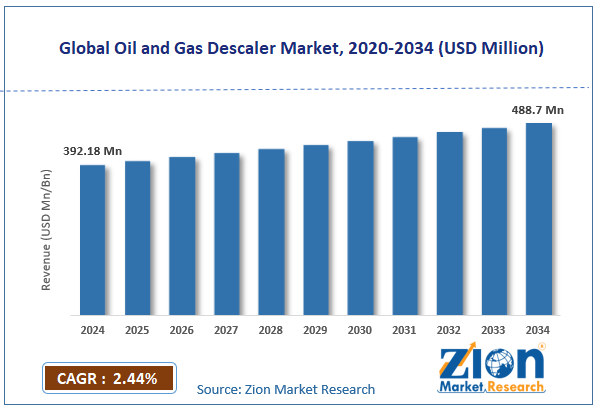
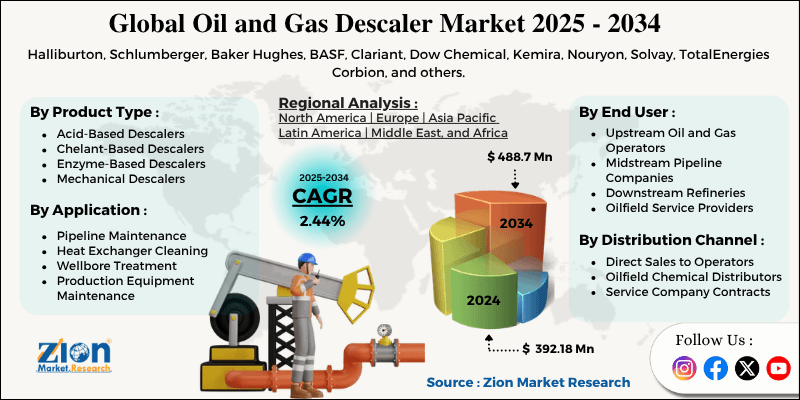
The global oil and gas descaler market size was worth approximately USD 392.18 million in 2024 and is projected to grow to around USD 488.7 million by 2034, with a compound annual growth rate of roughly 2.44% between 2025 and 2034.
Oil and Gas Descaler Market: Overview
Descalers in the oil and gas industry are chemicals or tools used to remove hard mineral deposits from pipelines, wells, and processing equipment, keeping operations running smoothly. Scale forms when mineral-rich water leaves behind solids such as calcium carbonate, barium sulfate, and calcium sulfate under high-temperature, high-pressure conditions. These deposits slowly accumulate in pipes and equipment, reducing flow, impeding heat transfer, and damaging metal surfaces over time. Without proper cleaning, production efficiency drops, energy use increases, and the risk of equipment failure becomes higher. Regular descaling is essential for maintaining oil and gas production rates and avoiding costly shutdowns or repairs. Acid-based descalers break down tough mineral deposits through chemical reactions, while chelant-based solutions safely bind and remove scale without harming equipment.
Effective scale removal improves performance, extends equipment life, and supports safe, efficient operations across oil and gas facilities. The growing demand for efficient production and reduced maintenance costs is further driving the adoption of advanced descaling solutions across global oil and gas operations. The oil and gas descaler market is growing due to rising energy demand, aging assets, offshore expansion, stricter regulations, and increased investment in maintenance to reduce costly downtime.
Key Insights
- As per the analysis shared by our research analyst, the global oil and gas descaler market is estimated to grow annually at a compound annual growth rate of around 2.44% over the forecast period from 2025 to 2034.
- In terms of revenue, the global oil and gas descaler market size was valued at approximately USD 392.18 million in 2024 and is projected to reach USD 488.7 million by 2034.
- The market is expected to grow steadily, driven by aging oilfield infrastructure requiring frequent maintenance, deep-water and unconventional resource development, rising energy demand from developing economies, and the increasing adoption of environmentally safer descaling formulations.
- Based on product type, acid-based descalers are expected to lead the overall market, while enzyme-based and chelant-based descalers are anticipated to grow at a notably faster pace as environmental regulations become more stringent.
- Based on application, the pipeline maintenance segment is expected to lead the oil and gas descaler market, while wellbore treatment is anticipated to grow rapidly, driven by increasing horizontal drilling and hydraulic fracturing activity.
- Based on end-user, upstream oil and gas operators form the largest current end-user group, while oilfield service providers are anticipated to grow most rapidly as outsourced chemical treatment contracts gain wider adoption.
- Based on distribution channel, direct sales to operators are expected to lead the market, while online industrial platforms are anticipated to grow steadily as procurement digitization expands across the energy sector.
- Based on region, North America is projected to dominate the global oil and gas descaler market during the estimated period, followed by the Middle East.
Impact of the USA-Israel War on Iran on the Oil and Gas Descaler Market
Geopolitical tensions involving the United States, Israel, and Iran may affect oil supply and slow activity in some regions, reducing short-term demand for descalers locally. Other oil-producing countries are expected to increase production, creating new opportunities for maintenance services and boosting demand for descaling solutions in active regions. Rising oil prices and renewed investment in older, complex fields are expected to support steady growth, creating long-term opportunities for the global oil and gas descaler market.
Oil and Gas Descaler Market: Technology Roadmap 2025–2034
What is the projected development roadmap of the oil and gas descaler market over the forecast period?
The oil and gas descaler market is advancing through eco-friendly chemicals, smart monitoring systems, precise dosing technologies, and multi-purpose solutions that combine scale removal with corrosion protection. The market is expected to grow at a compound annual growth rate of around 2.44% over the forecast period, driven by ongoing operational demands in global oil and gas production and the growing pressure to adopt more sustainable field practices.
The following roadmap outlines key development phases expected through 2034.
2025–2027: Smart Monitoring and Targeted Treatment Phase
- Operators are expected to invest more in real-time downhole monitoring tools that detect scale formation early, allowing treatment teams to respond before significant blockages develop and production losses occur.
- Chemical companies are expected to develop descalers that perform better under specific pressure, temperature, and water conditions in deep, complex oil fields.
- Digital systems are expected to connect with chemical injection systems, helping teams automatically adjust descaler use based on live production data and significantly reduce chemical waste.
2028–2031: Green Chemistry and Regulatory Compliance Phase
- Companies are expected to shift toward safer, biodegradable descaling chemicals as environmental regulations become stricter.
- Local production of oilfield chemicals is expected to grow in regions such as Latin America, West Africa, and Southeast Asia to improve supply and reduce reliance on imports.
- Certification programs for eco-friendly chemicals are expected to develop further, helping companies meet environmental standards and operate smoothly in sensitive regions.
2032–2034: Integrated Asset Integrity and Circular Chemistry Phase
- Multi-purpose chemicals are expected to handle scale removal, corrosion protection, and bacteria control in a single treatment.
- Recycling systems for oilfield chemicals are expected to be introduced, helping reduce costs and limit waste in offshore operations.
- Artificial intelligence tools are expected to guide operators on when to clean, which chemicals to use, and how much to apply, improving efficiency and reducing costs.
Oil and Gas Descaler Market: Dynamics
Growth Drivers
What is driving the growth of the oil and gas descaler market as global energy demand and aging field infrastructure accelerate maintenance requirements?
The oil and gas descaler market is growing due to rising global energy demand and aging oilfield infrastructure that requires regular maintenance and cleaning. Older wells and pipelines tend to collect more mineral deposits over time, especially as water content increases during long production cycles. Heavy scale buildup reduces flow efficiency and forces operators to use descaling chemicals more frequently to maintain output. Regions such as the North Sea, the Gulf of Mexico, and mature basins in the Middle East and Russia are seeing strong demand driven by aging assets. Growth in unconventional oil and gas production is also supporting market expansion.
Techniques such as hydraulic fracturing use large volumes of water, increasing the risk of scale formation in wells and surface equipment. Expanding shale operations, especially in North America, are increasing the need for effective descaling solutions. Continuous focus on maintaining production efficiency and reducing downtime is driving steady demand for oil and gas descalers worldwide.
Industrial demand and environmental considerations are further strengthening the growth of the oil and gas descaler market.
The oil and gas descaler market is growing due to stricter environmental rules and increasing focus on improving operational efficiency across global energy companies. Governments in regions such as Europe and North America require operators to reduce chemical leaks, control emissions, and maintain detailed environmental records, thereby encouraging regular maintenance practices. Preventive descaling helps avoid equipment failure, lowers pollution risks, and keeps production running smoothly without unexpected shutdowns. Companies are also focusing on increasing output from existing wells rather than spending heavily on new exploration projects.
Regular use of descaling solutions helps improve flow, reduce energy use, and extend equipment life, making operations more cost-effective. Financial pressure to control expenses and maximize asset performance is increasing the use of maintenance chemicals across mature oilfields. Strong emphasis on sustainability, safety, and efficient production is driving stable, long-term demand for descaling solutions in the oil and gas descaler market worldwide.
Restraints
Volatile raw material costs and handling risks are key challenges in the oil and gas descaler market.
The oil and gas descaler industry faces several restraints, including fluctuating raw material costs and challenges with handling hazardous chemicals used in scale-removal processes. Many descaling products rely on acids and specialty chemicals whose prices change with global commodity trends, increasing production costs and affecting pricing stability for suppliers. When costs rise, operators may reduce or delay maintenance treatments to control budgets, thereby slowing market growth. Strong chemicals like Hydrochloric acid require careful handling, storage, and transportation, adding operational complexity and safety concerns.
Specialized equipment and trained personnel are needed, increasing overall expenses for oilfield operations. Remote and offshore locations face additional logistical challenges, making chemical management more difficult and costly. Smaller companies and developing regions may lack the proper infrastructure to use such materials, limiting their safe wider adoption. These factors collectively create barriers that can restrict the steady expansion of the oil and gas descaler market.
Opportunities
How are deep water expansion, digitalization, and sustainability mandates creating new opportunities in the oil and gas descaler market?
The oil and gas descaler market is creating significant opportunities driven by deep-water drilling, digital monitoring, and demand for eco-friendly oilfield chemicals worldwide. Deepwater and ultra-deep-water projects in regions such as Brazil, West Africa, Norway, and the Gulf of Mexico face large-scale significant scale-up due to extreme pressure, temperature, and water conditions, increasing the need for advanced descaling solutions. Digital tools such as sensors and data analytics are helping operators track equipment condition and plan cleaning activities more efficiently, creating demand for smart descaling programs linked with real-time monitoring systems.
Predictive maintenance allows companies to reduce waste, improve efficiency, and avoid costly shutdowns. The growing focus on sustainability is also driving demand for safer, low-toxicity descaling chemicals that meet environmental standards. Oil companies are selecting suppliers that offer eco-friendly and certified solutions. Continuous innovation in chemical formulations and digital services is opening new revenue streams and strengthening long-term growth opportunities in the global oil and gas descaler market.
Challenges
What challenges does the oil and gas descaler market face in chemical compatibility and global regulatory compliance?
The oil and gas descaler market faces challenges due to chemical compatibility issues and complex regulatory differences across global production regions. Oilfield equipment uses different metals, coatings, and rubber parts, so descaling chemicals must remove scale without damaging these materials. Incorrect chemical selection can cause corrosion, leaks, or contamination, leading to costly repairs and reduced trust in suppliers. Managing performance across varied field conditions requires strong technical expertise and careful product formulation. Regulatory rules on chemical use, disposal, and environmental safety vary widely across countries, making it difficult for companies to use the same products everywhere.
A solution approved in one region may need additional testing or face restrictions in another, increasing time and costs for market entry. These challenges also complicate global operators' supply chains. Companies must invest in research, compliance, and customization to maintain reliability and meet local standards in the oil and gas descaler market.
Oil and Gas Descaler Market: Report Scope
| Report Attributes | Report Details |
|---|---|
| Report Name | Oil and Gas Descaler Market |
| Market Size in 2024 | USD 392.18 Million |
| Market Forecast in 2034 | USD 488.7 Million |
| Growth Rate | CAGR of 2.44% |
| Number of Pages | 225 |
| Key Companies Covered | Halliburton, Schlumberger, Baker Hughes, BASF, Clariant, Dow Chemical, Kemira, Nouryon, Solvay, TotalEnergies Corbion, and others. |
| Segments Covered | By Product Type, By Application, By End-User, By Distribution Channel, and By Region |
| Regions Covered | North America, Europe, Asia Pacific (APAC), Latin America, Middle East, and Africa (MEA) |
| Base Year | 2024 |
| Historical Year | 2019 - 2023 |
| Forecast Year | 2025 - 2034 |
| Customization Scope | Avail customized purchase options to meet your exact research needs. Request For Customization |
Oil and Gas Descaler Market: Segmentation
The global oil and gas descaler market is segmented by product type, application, end-user, distribution channel, and region.
What makes acid-based descalers the expected leader in the oil and gas descaler market?
Based on product type, the global market is divided into acid-based, chelant-based, enzyme-based, and mechanical descalers. Acid-based descalers hold about 55% of the oil and gas descaler market, leading due to fast action, low cost, and proven use across onshore and offshore operations. Chelant-based and enzyme-based descalers collectively hold around 25% share. It is driven by environmental regulations and operator demand for lower-hazard alternatives in sensitive locations.
How does the pipeline maintenance application segment maintain its leading position in the oil and gas descaler market?
Based on application, the oil and gas descaler industry is categorized into pipeline maintenance, heat exchanger cleaning, wellbore treatment, and production equipment maintenance. The pipeline maintenance segment accounts for approximately 38% of the market share, driven by extensive global pipelines that require regular maintenance to maintain flow and prevent blockages. The wellbore treatment segment holds around 28% share. It is growing rapidly due to horizontal drilling, large-scale water injection, and hydraulic fracturing.
What makes upstream oil and gas operators the leading end-user in the oil and gas descaler market?
Based on end-user, the market is classified into upstream oil and gas operators, midstream pipeline companies, downstream refineries, and oilfield service providers. The upstream oil and gas operators segment leads the market with approximately 50% of global market share, driven by the need for frequent descaling to maintain well and facility performance. The oilfield service providers segment holds around 22% share. It is growing quickly as more operators outsource their chemical treatment programs to specialist companies that can deliver integrated maintenance services.
How do direct sales to operators dominate the distribution landscape of the oil and gas descaler market?
Based on distribution channel, the oil and gas descaler market is segregated into direct sales to operators, oilfield chemical distributors, service company contracts, and online industrial platforms. Direct sales to operators account for around 45% of the global market, as large integrated and national oil companies prefer to negotiate directly with chemical suppliers to secure volume pricing, technical support, and customized formulation services. Online industrial platforms hold around 6% share. They are growing as smaller operators use digital channels to source chemicals and compare performance data.
Oil and Gas Descaler Market: Regional Analysis
How is North America shaping global demand in the oil and gas descaler market?
The oil and gas descaler market is led by North America and is expected to grow steadily at a CAGR of around 4.8% during the forecast period. Strong oil and gas production, advanced maintenance practices, and widespread use of chemical treatment solutions support market leadership. The United States drives growth with extensive shale operations, where high water usage leads to frequent scale buildup, increasing demand for descalers. Mature oilfields across the region require regular cleaning to maintain flow and avoid equipment damage. Offshore activity in the Gulf of Mexico further boosts demand for high-performance descaling solutions that can handle harsh operating conditions. Strict environmental and safety regulations encourage preventive maintenance, supporting steady chemical usage.
Well-developed oilfield service networks and easy access to advanced technologies make operations more efficient. Continuous investment in energy infrastructure and focus on maximizing production from existing assets keep North America at the forefront of the oil and gas descaler market. Rising demand for energy security and stable supply chains is further strengthening long-term growth. Ongoing innovation in eco-friendly chemicals and smart monitoring tools is also supporting future expansion.
How does the Middle East maintain its strong position in the oil and gas descaler market?
The oil and gas descaler market ranks the Middle East as the second-leading region and is expected to grow at a CAGR of around 5.1% during the forecast period. Strong oil production, large reserves, and continuous field development activities support steady demand for descaling solutions. Countries like Saudi Arabia, the United Arab Emirates, and Kuwait play a key role due to their extensive upstream operations and mature oilfields where scale buildup is common. High water injection rates used to maintain reservoir pressure further increase the need for regular descaling treatments. National oil companies are investing heavily to maintain production efficiency and extend the life of existing assets. Harsh operating conditions, including high temperatures and salinity, create a strong demand for advanced, reliable descaling chemicals.
Growing focus on operational efficiency and reduced downtime continues to support consistent usage. Expansion of oilfield services and chemical supply networks is improving accessibility across the region. Rising investments in enhanced oil recovery techniques are further increasing the need for maintenance solutions. Increasing focus on sustainability and safer chemical use is also shaping future demand.
Recent Market Developments
- In January 2026, Schlumberger Limited enhanced its oilfield chemical technologies for drilling and production systems, focusing on improving operational efficiency and chemical treatment performance in scale-prone environments.
- In February 2026, Halliburton launched advanced specialty oilfield chemical solutions to improve well performance and reservoir efficiency, supporting more effective scale control and production optimization across global operations.
- In March 2026, Baker Hughes expanded its specialty chemical portfolio for enhanced oil recovery and drilling efficiency, strengthening demand for treatment solutions, including descaling chemicals in complex field conditions.
Oil and Gas Descaler Market: Competitive Analysis
The leading players in the global oil and gas descaler market are:
- Halliburton
- Schlumberger
- Baker Hughes
- BASF
- Clariant
- Dow Chemical
- Kemira
- Nouryon
- Solvay
- TotalEnergies Corbion
The global oil and gas descaler market is segmented as follows:
By Product Type
- Acid-Based Descalers
- Chelant-Based Descalers
- Enzyme-Based Descalers
- Mechanical Descalers
By Application
- Pipeline Maintenance
- Heat Exchanger Cleaning
- Wellbore Treatment
- Production Equipment Maintenance
By End-User
- Upstream Oil and Gas Operators
- Midstream Pipeline Companies
- Downstream Refineries
- Oilfield Service Providers
By Distribution Channel
- Direct Sales to Operators
- Oilfield Chemical Distributors
- Service Company Contracts
- Online Industrial Platforms
By Region
- North America
- The U.S.
- Canada
- Mexico
- Europe
- France
- The UK
- Spain
- Germany
- Italy
- Rest of Europe
- Asia Pacific
- China
- Japan
- India
- Australia
- South Korea
- Rest of Asia Pacific
- The Middle East & Africa
- Saudi Arabia
- UAE
- Egypt
- Kuwait
- South Africa
- Rest of the Middle East & Africa
- Latin America
- Brazil
- Argentina
- Rest of Latin America
Table Of Content
Methodology
FrequentlyAsked Questions
Descalers in the oil and gas industry are chemicals or tools used to remove hard mineral deposits from pipelines, wells, and processing equipment, keeping operations running smoothly.
The global oil and gas descaler market is expected to grow, driven by aging oil field infrastructure requiring more intensive maintenance, rising deep water and unconventional resource development, growing operator demand for environmentally safer chemical formulations, expanding outsourced chemical treatment services, and increasing adoption of digital monitoring tools that enable more precise and timely descaling treatments.
According to research, the global oil and gas descaler market size was worth around USD 392.18 million in 2024 and is predicted to grow to around USD 488.7 million by 2034.
The compound annual growth rate value of the oil and gas descaler market is expected to be around 2.44% during 2025 to 2034.
North America is expected to lead the global oil and gas descaler market during the forecast period, driven by the enormous scale of shale and conventional oil and gas production in the United States and Canada, the high prevalence of scale-related production challenges in these operations, and the well-established network of oilfield chemical suppliers and service companies operating across the region.
The major players in the global oil and gas descaler market include Halliburton, Schlumberger, Baker Hughes, BASF, Clariant, Dow Chemical, Kemira, Nouryon, Solvay, and TotalEnergies Corbion.
The report examines key aspects of the oil and gas descaler market, including growth drivers, restraints, emerging opportunities, challenges, a competitive landscape analysis, regional breakdowns, and a detailed future outlook across all major product types, applications, end users, and geographies.
The oil and gas descaler market requires stakeholders to focus on eco-friendly formulations, digital monitoring integration, strong supply chains, and customized solutions while investing in research and development, partnerships, and cost-efficient production to meet evolving operator and regulatory demands globally.
The oil and gas descaler market is being shaped by smart monitoring tools, automated dosing systems, and advanced formulations that improve efficiency, reduce chemical usage, and enable predictive maintenance across oilfield operations.
The oil and gas descaler market faces challenges from raw material price volatility, hazardous chemical handling, strict environmental regulations, supply chain constraints, and technical compatibility issues, all of which increase costs and limit adoption among smaller operators and in developing regions.

HappyClients

