
Digital Label Printing Machines Market Size, Share, Value and Forecast 2034

Digital Label Printing Machines Market By Type (Roll-to-Roll, Sheet-Fed, and Hybrid), By Technology (Inkjet, Laser, UV, and Thermal), By End-User (Food & Beverages, Healthcare & Pharmaceuticals, Consumer Goods, Industrial, and Others), and By Region - Global and Regional Industry Overview, Market Intelligence, Comprehensive Analysis, Historical Data, and Forecasts 2025 - 2034
| Market Size in 2024 | Market Forecast in 2034 | CAGR (in %) | Base Year |
|---|---|---|---|
| USD 3.10 Billion | USD 8.65 Billion | 9.80% | 2024 |
Digital Label Printing Machines Industry Perspective:
What will be the global digital label printing machines market size during the forecast period?
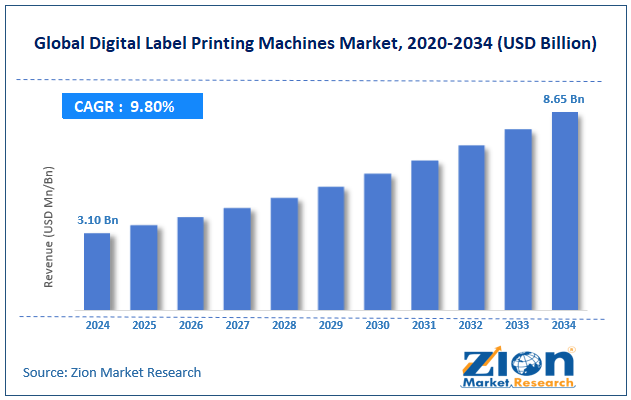
The global digital label printing machines market size was worth around USD 3.10 billion in 2024 and is predicted to grow to around USD 8.65 billion by 2034, with a compound annual growth rate (CAGR) of roughly 9.80% between 2025 and 2034.
Key Insights:
- As per the analysis shared by our research analyst, the global digital label printing machines market is estimated to grow annually at a CAGR of around 9.80% over the forecast period (2025-2034)
- In terms of revenue, the global digital label printing machines market size was valued at around USD 3.10 billion in 2024 and is projected to reach USD 8.65 billion by 2034.
- The digital label printing machines market is projected to grow at a significant rate due to the increasing demand for customized and high-quality packaging solutions around the world.
- Based on the type, the roll-to-roll machines segment is growing at a high rate and will continue to dominate the global market, as per industry projections
- Based on the end-user, the food & beverages segment is anticipated to command the largest market share
- Based on region, the Asia-Pacific is projected to dominate the global market during the forecast period
Digital Label Printing Machines Market: Overview
Digital label printers produce high-quality printed labels using digital files with variable data, elaborate detail, and vibrant colors. They do this much more quickly, with significantly less waste and greater flexibility than analogue printing processes such as flexo or offset. Digital printers are the only feasible solution for fast-paced environments that require frequent design updates and on-demand printing technology. Label printing is of utmost importance in many different industries, such as the food & beverage industry, where labels must serve the dual purposes of brand identification and regulatory compliance; pharmaceutical/therapeutics companies rely on the need for label printing to be done correctly with accuracy and clarity in order to stay in compliance with safety regulations; and companies marketing consumer goods want to use high-resolution digital label printing for creating premium aesthetics for their packaging. Due to changing consumer demands for personalized products and the need for faster market entry, digital label printers are displacing traditional printing methods, which were conventionally produced on traditional printing presses.
In addition to digital printer advancements, continued modernization of label printing, investment in the development of industrial automation, and growth of e-commerce packaging will support the continued growth of the digital label printing industry throughout the forecast period. The high cost of digital print equipment, as well as the need for the technical skills required to operate these printers, may pose challenges to the adoption of this new technology in developing markets.
Digital Label Printing Machines Market: Dynamics
Growth Drivers
How will the growing demand for customized packaging drive the digital label printing machines market?
The global digital label printing machines market will grow due to the increasing demand for customized and high-quality packaging solutions around the world. Consumers today buy from companies that offer personalization, have special-edition labels, and feature beautiful graphics on their labels. Digital label printers allow manufacturers to create short runs without large setup times.
Thus, digital printers are well-suited for small batch runs and seasonal promotions. The rapid expansion of e-commerce has created opportunities for brands to invest in premium labels that will attract consumers and increase shelf appeal. A reduction in product life cycles requires manufacturers to change their designs more frequently, where digital printing methods offer more rapid results than traditional printing methods and therefore are being increasingly utilized by companies in food and beverage, cosmetics, and specialized products that previously had been using analogue print technologies.
Efficiency and sustainability to propel market growth during the projection period
By eliminating the need for plates and lengthy make-ready processes, digital label printing machines are helping manufacturers to reduce waste. Digital printing machines also allow for variable data printing (i.e., each label can be different) at no extra cost or time. The ability to print unique labels in this manner offers the greatest level of flexibility to meet compliance labelling requirements, provide accurate batch tracking, and assist with the fight against counterfeit products.
Sustainability considerations are becoming increasingly important within the packaging industry. By utilizing digital printing technology, manufacturers can significantly reduce both material waste and energy use through environmentally friendly processes, aligning with corporate sustainability efforts. These environmental and operational advantages are anticipated to greatly increase the global use of digital label printing solutions in the future.
Restraints
Why will high equipment costs and skill requirements restrict the digital label printing machines market growth?
The global industry for digital label printing machines is expected to be limited due to existing cost barriers. High initial investment costs related to more complex (i.e., hybrid) and advanced models of digital label printing machines have significantly limited the adoption of digital printing technology, particularly in developing regions. In primarily price-driven markets, small and medium-sized enterprises (SMEs) may be reluctant to invest in their first digital printer; as such, there will continue to be a delay in the growth of the digital printing market. Digital label printers also require trained technicians and ongoing support to operate and maintain them. Access to technically skilled personnel is limited in emerging markets; therefore, widespread adoption of digital printing equipment presents additional barriers to overcome. When evaluating potential digital printing options, manufacturers will continue to evaluate the balance between the cost of the machine, its technical capabilities, and expected ROI.
Opportunities
How will increasing innovation in print technologies to create new growth avenues for the digital label printing machines market players?
Ongoing technological advancement will provide further opportunities for expansion in the global digital label printing machines market. High-speed inkjet systems, improved ultraviolet (UV) curing technology, and hybrid digital/analogue capabilities continue to be developed by the manufacturers.
In 2025, major industry players launched high-resolution inkjet-based label printers that offer much higher throughput and require less maintenance. This is especially important when looking at the growing complexity of the packaging requirements, such as serialization and random variable data printing, and the growing use of eco-based inks. The increasing demand for smart labels (i.e., QR codes and RFID) will continue to present additional opportunities for the advancement of digital label printing.
Challenges
Standardization gaps and integration issues impede the digital label printing machines market growth.
One of the issues for the global digital label printing machines industry is the unstandardized workflow processes of several different industries, which result in various end-user sectors having different requirements for label durability, material compatibility, and regulatory compliance. Integrating digital printing equipment into current production lines (especially in food processing or pharmaceutical manufacturing) can be very complex and expensive to implement.
Furthermore, the technical challenges related to the compatibility of various label substrates and finishing systems have also contributed to these challenges. Overcoming these integration issues will be critical to the continuing growth of the digital label printing market.
Digital Label Printing Machines Market: Report Scope
| Report Attributes | Report Details |
|---|---|
| Report Name | Digital Label Printing Machines Market |
| Market Size in 2024 | USD 3.10 Billion |
| Market Forecast in 2034 | USD 8.65 Bllion |
| Growth Rate | CAGR of 9.80% |
| Number of Pages | 227 |
| Key Companies Covered | Xeikon. Markem-Imaje, Epson America Inc., HP Inc., Roland DG Corporation, Durst Phototechnik AG, OKI Data Americas Inc., Prati S.p.A., Mimaki Engineering Co. Ltd., Colordyne Technologies Inc., Afinia Label, Konica Minolta Inc., Nilpeter A/S, Canon Inc., and others. |
| Segments Covered | By Type, By Technology, By End-User Industry, and By Region |
| Regions Covered | North America, Europe, Asia Pacific (APAC), Latin America, Middle East, and Africa (MEA) |
| Base Year | 2024 |
| Historical Year | 2019 to 2023 |
| Forecast Year | 2025 - 2034 |
| Customization Scope | Avail customized purchase options to meet your exact research needs. Request For Customization |
Digital Label Printing Machines Market: Segmentation
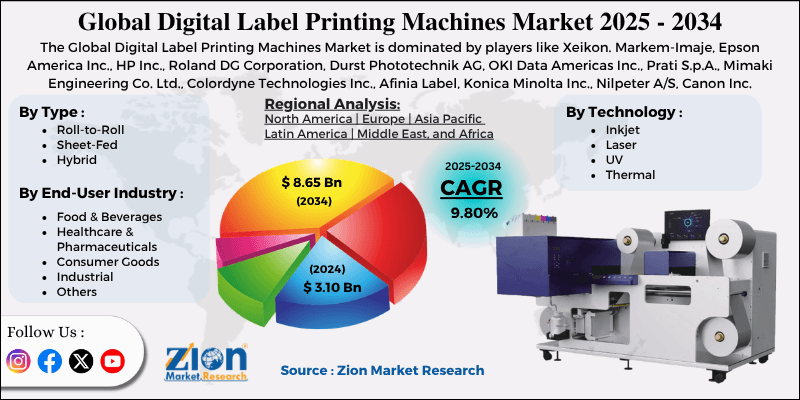
The global digital label printing machines market is segmented by type, technology, end-user industry, and region.
Why will the roll-to-roll segment dominate the digital label printing machines industry?
Based on type, the global market is segmented into roll-to-roll, sheet-fed, and hybrid. In 2024, roll-to-roll machines were preferred for continuous, high-volume label printing and hence enjoyed control over maximum market share. Sheet-fed systems are suited for short runs, specialty labels, and premium packaging. Hybrid machines offer flexibility by combining features of both types.
Based on technology, the global digital label printing machines industry is divided into inkjet, laser, UV, and thermal.
Will the food and beverage segment emerge as the leading in the digital label printing machines market?
Based on end-user, the global market is divided into food & beverages, healthcare & pharmaceuticals, consumer goods, industrial, and others. In 2024, the food & beverages segment accounted for the largest share owing to strict labelling standards, high customization needs, and extensive product variety. The segment will continue to deliver higher returns on investment during the projection period.
Digital Label Printing Machines Market: Regional Analysis
Why will Asia-Pacific dominate the digital label printing machines market in the coming years?
The Asia-Pacific Region will lead the global digital label printing machines market with a CAGR of 9.4% during the forecast period. The main factors driving the market in this region are rapid industrialization, an increase in manufacturing capacity for paper and packaging, and growing production of consumer goods in the region, especially in China, India, and Southeast Asia. Local companies are making significant investments in label printing technology to supply both their own markets and export markets. Additionally, rising awareness of brand differentiation and product traceability is driving the adoption of digital label printing solutions throughout the region.
What position will North America hold in the digital label printing machines industry?
The North America region is expected to emerge as the second-highest revenue generator in the digital label printing machines market with a CAGR of 5% in the coming years. The regional revenue will be driven by strong demand for digital label printing solutions coming from the healthcare, retail, and e-commerce sectors. The rapid growth of digital label printing in North America is driven by the sector’s increased ability to support variable data printing, regulatory compliance, and rapid turnaround production of digital labels in both the U.S. and Canada.
Digital Label Printing Machines Market: Competitive Analysis
The global digital label printing machines market is led by players such as:
- Xeikon. Markem-Imaje
- Epson America Inc.
- HP Inc.
- Roland DG Corporation
- Durst Phototechnik AG
- OKI Data Americas Inc.
- Prati S.p.A.
- Mimaki Engineering Co. Ltd.
- Colordyne Technologies Inc.
- Afinia Label
- Konica Minolta Inc.
- Nilpeter A/S
- Canon Inc.
Digital Label Printing Machines Market: Key Market Trends
On-Demand & Short-Run Printing Dominates
Brands have transitioned from a long print run to an 'on-demand' model to reduce stock and waste and get their products to market quicker.
Decreasing Transparency in Serialization/Smart Labelling
There is increasing demand in the pharmaceutical/luxury goods industries for "smart label" products (including QR codes, NFC, RFID, etc.) to improve product traceability and assist with anti-counterfeiting.
The global digital label printing machines market is segmented as follows:
By Type
- Roll-to-Roll
- Sheet-Fed
- Hybrid
By Technology
- Inkjet
- Laser
- UV
- Thermal
By End-User Industry
- Food & Beverages
- Healthcare & Pharmaceuticals
- Consumer Goods
- Industrial
- Others
By Region
- North America
- The U.S.
- Canada
- Mexico
- Europe
- France
- The UK
- Spain
- Germany
- Italy
- Rest of Europe
- Asia Pacific
- China
- Japan
- India
- Australia
- South Korea
- Rest of Asia Pacific
- The Middle East & Africa
- Saudi Arabia
- UAE
- Egypt
- Kuwait
- South Africa
- Rest of the Middle East & Africa
- Latin America
- Brazil
- Argentina
- Rest of Latin America
Table Of Content
Methodology
FrequentlyAsked Questions

HappyClients

