
Green Chemicals Market Size, Trend, Growth, Industry Analysis 2034

Green Chemicals Market By Product (Bio-alcohols, Biopolymers, Bio-organic Acids, and Others), By Application (Construction, Packaging, Food and Beverages, Automotive, Paints and Coatings, Pharmaceuticals, Textile, and Others), and By Region - Global and Regional Industry Overview, Market Intelligence, Comprehensive Analysis, Historical Data, and Forecasts 2026 - 2034
| Market Size in 2025 | Market Forecast in 2034 | CAGR (in %) | Base Year |
|---|---|---|---|
| USD 121 Billion | USD 300 Billion | 10.6% | 2025 |
English Language Learning Industry Perspective:
What will be the size of the global green chemicals market during the forecast period?
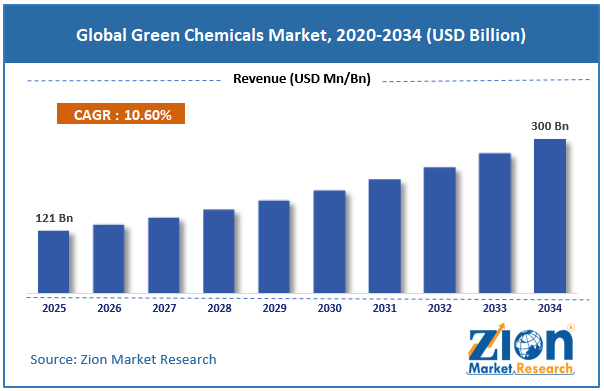
The global green chemicals market size was worth around USD 121 billion in 2025 and is predicted to grow to around USD 300 billion by 2034, with a compound annual growth rate (CAGR) of roughly 10.6% between 2026 and 2034.
Key Insights
- As per the analysis shared by our research analyst, the global green chemicals market is estimated to grow annually at a CAGR of around 10.6% over the forecast period (2026-2034).
- In terms of revenue, the global green chemicals market size was valued at around USD 121 billion in 2025 and is projected to reach USD 300 billion by 2034.
- Rising demand for bio-based and renewable feedstocks is expected to propel the green chemicals market over the projected period.
- Based on the product, the bio-alcohols segment captures a significant revenue share of 45% in 2025.
- Based on the application, the packaging segment held the largest revenue share in 2025 of 27%.
- Based on region, the Asia Pacific region holds a prominent market share in 2025 of 32%.
Green Chemicals Market: Overview
Green chemicals are designed, produced, and consumed using environmentally friendly approaches that minimize the production and use of harmful substances. They are produced using renewable resources while also reducing energy consumption, emissions, and waste production. The green chemicals market trends are projected to grow significantly due to the growing emphasis on sustainable low-carbon production methods and the utilization of renewable resources. Companies are investing in alternative carbon sources such as sugarcane, vegetable oils, algae, and agricultural wastes to produce bio-based chemicals.
Meanwhile, the circular economy concept is being emphasized, and investments are being made in chemical recycling, treatment, and overall waste-to-chemicals processes and technologies. Some of the biotechnology innovations that can contribute to the production of green chemicals and materials include enzymes, synthetic biology, and fermentation, among others. On the other hand, using renewable energy and green hydrogen in the production process can promote sustainable production methods.
Impact of the USA-Israel War on Iran on the Green Chemicals Market
The USA-Israel conflict over Iran is not beneficial for the green chemicals market, although it is partially positive. On the one hand, the increased tension leads to higher oil prices and a rise in the cost of petrochemical feedstocks. It makes petrochemicals more expensive and stimulates the use of alternative products. On the other hand, authorities and manufacturers try to secure the energy supply by developing domestic production and implementing renewable feedstocks to produce chemicals. It reduces the impact of geopolitical events on the market. Nevertheless, a prolonged conflict can disrupt international transport and raise production costs due to limited supply, which can temporarily affect the demand for green chemicals from other sources.
Green Chemicals Market: Dynamics
Growth Drivers
How does the stringent environmental regulations and sustainability policies drive the green chemicals market?
The main reason for the thriving green chemicals market is environmental policies and sustainable initiatives undertaken by governments around the world, which promote the use of alternative and organic chemicals while limiting the use of dangerous materials, emissions, and pollution. According to Regulation (EU) 2020/1001, the EU member states will undertake 85 actions as part of the Chemicals Strategy for Sustainability, which is part of the European Green Deal. The strategy aims to reduce the impact of chemicals on the environment and human health by promoting safer and more sustainable chemistry and a transition to a circular economy. Additionally, through the European Green Deal, the EU has pledged to become climate neutral by 2050 and has proposed to reduce greenhouse gas emissions by at least 55% from 1990 levels by 2030.
Due to these regulations, the demand for bio-based chemicals in Europe is growing, and chemical producers are investing in alternative feedstock and cleaner production methods. Moreover, as the European Commission’s 2025 Chemicals Industry Action Plan aims to make the chemicals industry a pioneer in innovation and sustainability, the EU, home to 29000 chemical manufacturers and 1.2 million direct jobs, with 19 million jobs in total across all industry sectors, is taking steps to transform its chemical sector.
Restraints
High production costs hamper the growth of the green chemicals industry
High production costs are among the key factors that restrain the green chemicals market. Biochemicals require expensive renewable feedstock, bioprocessing, catalysts, and other equipment. Moreover, green chemicals typically involve higher production costs than petrochemicals produced using simple and inexpensive technologies. This trend is especially evident in the case of polymers, which are key intermediate products in the plastics, construction, textile, and chemical industries. Therefore, green chemicals encounter significant demand-side barriers in price-sensitive industries. Even though the cost of producing biochemicals is gradually decreasing due to process optimization and higher economies of scale, they remain higher than those of petrochemicals. Therefore, the biggest challenge for the green chemicals sector in developing countries is to meet the demand for chemicals at prices comparable to petrochemicals.
Opportunities
Does the growing number of product launches by key players offer a lucrative opportunity for the green chemicals market?
The rising number of product launches by key players is projected to offer substantial growth opportunities for the green chemicals market. Key chemical companies are witnessing surging demand for their bio-solvents, biodegradable surfactants, renewable polymers, green coatings, sustainable adhesives, and low-carbon-footprint specialty chemicals from end-use industries including packaging, automotive, construction, agricultural, and personal care. The extensive product portfolio of green chemicals offered by leading manufacturers enables a wide range of applications, supporting the replacement of petrochemicals with bio-based feedstocks.
Moreover, the continuous development and launch of products, extensive formulation to enhance performance, and strategic collaborations and investment in production capacity by key manufacturers offer benefits including reduced production costs and improved sustainability credentials. The rising trend of incorporating products with low carbon intensity is driving demand in the market and generating potential revenue for green chemicals.
For instance, in April 2025, BASF Aroma Ingredients successfully launched L-Menthol FCC rPCF as its first product with a reduced Product Carbon Footprint (rPCF). Further rPCF product launches are planned to help customers achieve their ambitious Scope 3 carbon reduction targets. BASF's rPCF aroma ingredients come with a PCF reduction of about 10 to 15% compared to conventional BASF products. The product carbon footprints of BASF's rPCF portfolio are calculated in accordance with the guidance issued by the 'Together for Sustainability' (TfS) initiative. TÜV Rheinland has certified the conformance of the BASF calculation method used with this standard.
Challenges
How does the competition from low-cost petrochemical products pose a significant challenge to the growth of the green chemicals industry?
Competition from low-cost petrochemicals is a major threat to the growth of the green chemicals industry. Petrochemical products are produced from readily available, inexpensive sources of carbon, such as petroleum, and benefit from well-developed production processes. Moreover, during periods of low crude oil prices, petrochemical production becomes even more cost-efficient, which removes any cost-related motivation for the petrochemical industry to switch to bio-based alternatives. Downstream manufacturers of plastics, paints, construction materials, and other products derived from petrochemicals prefer cheaper, albeit less sustainable, options whenever possible, which limits the growth potential of the green chemicals market. On the other hand, ongoing cost reductions and process optimization contribute to diminishing cost premiums, making competitive pricing a critical success factor in the price-sensitive emerging markets.
Green Chemicals Market: Report Scope
| Report Attributes | Report Details |
|---|---|
| Report Name | Green Chemicals Market |
| Market Size in 2025 | USD 121 Billion |
| Market Forecast in 2034 | USD 300 Billion |
| Growth Rate | CAGR of 10.6% |
| Number of Pages | 227 |
| Key Companies Covered | Archer Daniels Midland Company, Croda International PLC, BASF SE, Cargill, Incorporated, Vertec BioSolvents Inc., Evonik Industries AG, Arkema Group, Braskem SA, Total Corbion PLA, Novozymes A/S, DuPont de Nemours Inc., SECOS Group Ltd, Evonik Industries AG, Solugen, DUDE CHEM, Greenchemicals S.r.l., Inkemia Green Chemicals, Stepan Company, PCC Group, Versalis (Novamont Spa), and others. |
| Segments Covered | By Product, By Application, and By Region |
| Regions Covered | North America, Europe, Asia Pacific (APAC), Latin America, Middle East, and Africa (MEA) |
| Base Year | 2025 |
| Historical Year | 2020 to 2024 |
| Forecast Year | 2026 - 2034 |
| Customization Scope | Avail customized purchase options to meet your exact research needs. Request For Customization |
Green Chemicals Market: Segmentation
Product Insights
Why does the bio-alcohols segment hold a prominent position in the green chemicals market?
The bio-alcohols segment captures a significant revenue share of the green chemicals industry of 45% in 2025. The market's growth is primarily driven by rising demand for renewable fuels, sustainable solvents, and bio-based chemical intermediates across several end-use industries, including transportation, pharmaceuticals, coatings, cosmetics, and others. The demand for bioethanol, biobutanol, biomethanol, and other renewable alcohols is rising due to government-mandated ethanol blending, growing investment in advanced biorefineries, and a shift toward alternative carbon sources in the chemical industry. Similarly, the continuous development of fermentation technologies and the commercialization of second-generation technologies have improved yields and opened up new applications for various renewable alcohols.
For instance, Catalyst Biosciences (formerly known as Godavari Biorefineries) signed an exclusive licensing agreement with Catalyxx Inc. for the commercialization of advanced ethanol-to-biobutanol conversion technologies in 2025. The company has an option to manufacture up to 30,000 tonnes of biobutanol and higher alcohols per annum. Catalyst Biosciences will construct the first biobutanol plant with a capacity of 15,000 MTPA, which is poised to boost the supply of various sustainable bio-alcohols in the chemical industry. Thus, the new product and technology pipeline are anticipated to diversify the company’s sustainable chemical portfolio and drive robust revenue growth in the renewable alcohol segment.
Application Insights
Does the packaging segment capture the largest share in the green chemicals market?
The packaging segment held the largest revenue share of the green chemicals market in 2025 of 27%. The growth of the green chemicals market is primarily driven by the surging need for sustainable, recyclable, compostable, and bio-based packaging. Rising demand in the food & beverage, healthcare, personal care, and e-commerce industries for eco-friendly materials is projected to propel the growth of the green chemicals market. Moreover, growing regulatory restrictions on plastic use, sustainability initiatives by companies, and rising consumer preference for green packaging are driving manufacturers to substitute petrochemical-based chemicals with bio-based polymers, biodegradable plastics, bio-adhesives, coatings, and renewable barrier materials.
In addition, rising R&D initiatives focused on developing innovative biopolymer technologies and circular economy-based packaging solutions create growth opportunities for the green chemicals market. Manufacturers in the packaging value chain are capitalizing on biopolymers to make durable products, offer exceptional performance, and be sustainable. With brand owners adopting renewable and low-carbon packaging materials to meet their ESG goals and comply with tightening regulations, the packaging end-use segment shows a high revenue CAGR, making it the fastest-growing segment for the global green chemicals market.
Regional Insights
What factors drive the Asia Pacific region in the green chemicals market?
The Asia Pacific region holds a prominent share of the green chemicals market in 2025 of 32%. The growth is attributed to rapid industrialization, rising bio-based production capabilities, and favorable government initiatives encouraging carbon neutrality and sustainable industrialization. Governments of countries such as China, Japan, India, and South Korea are undertaking aggressive decarbonization policies to promote the adoption of renewable feedstocks, green chemistry, and low-carbon intensity industrialization. For instance, China has resolved to pursue dual carbon goals entailing peaking carbon emissions before 2030 and becoming carbon neutral by 2060. Moreover, the country’s 15th Five-Year Plan emphasizes a transition to low-carbon intensity industrialization while raising the share of non-fossil energy to about 25% by 2030 and reducing carbon emission intensity by over 65% compared to 2005 levels, thus creating an increased demand for green chemicals in various industries.
Similarly, Japan’s Green Transformation (GX) will see allocated budgets surpassing 150 trillion yen (USD 1 trillion) for the next decade, with the country targeting to achieve carbon neutrality by 2050 and according to the nation’s Final Statement on Green Growth and GX for FY2024, greenhouse gas emissions stood at 994 million tonnes of CO2 equivalent in FY2024, down by 28.7% from FY2013 levels. These efforts towards decarbonization while promoting chemical production using sustainable methods will result in heightened demand for bio-based chemicals and products. Overall, the government’s aggressive initiatives in support of carbon neutrality and sustainable industrialization are projected to propel the demand for bio-based chemicals while encouraging the increased production of biodegradable materials in the Asia Pacific region.
Green Chemicals Market: Competitive Analysis
The global green chemicals market is dominated by players like:
- Archer Daniels Midland Company
- Croda International PLC
- BASF SE
- Cargill
- Incorporated
- Vertec BioSolvents Inc.
- Evonik Industries AG
- Arkema Group
- Braskem SA
- Total Corbion PLA
- Novozymes A/S
- DuPont de Nemours Inc.
- SECOS Group Ltd
- Evonik Industries AG
- Solugen
- DUDE CHEM
- Greenchemicals S.r.l.
- Inkemia Green Chemicals
- Stepan Company
- PCC Group
- Versalis (Novamont Spa)
The global green chemicals market is segmented as follows:
By Product
- Bio-alcohols
- Biopolymers
- Bio-organic Acids
- Others
By Application
- Construction
- Packaging
- Food and Beverages
- Automotive
- Paints and Coatings
- Pharmaceuticals
- Textile
- Others
By Region
- North America
- The U.S.
- Canada
- Mexico
- Europe
- France
- The UK
- Spain
- Germany
- Italy
- Rest of Europe
- Asia Pacific
- China
- Japan
- India
- Australia
- South Korea
- Rest of Asia Pacific
- The Middle East & Africa
- Saudi Arabia
- UAE
- Egypt
- Kuwait
- South Africa
- Rest of the Middle East & Africa
- Latin America
- Brazil
- Argentina
- Rest of Latin America
Table Of Content
Methodology
FrequentlyAsked Questions
Green chemicals are designed, produced, and consumed using environmentally friendly approaches that minimize the production and use of harmful substances. They are produced using renewable resources while also reducing energy consumption, emissions, and waste production.
The green chemicals market trends are projected to grow significantly due to the growing emphasis on sustainable low-carbon production methods and the utilization of renewable resources. Companies are investing in alternative carbon sources such as sugarcane, vegetable oils, algae, and agricultural wastes to produce bio-based chemicals. Meanwhile, the circular economy concept is being emphasized, and investments are being made in chemical recycling, treatment, and overall waste-to-chemicals processes and technologies.
The green chemicals market faces several challenges, including high production costs, limited availability and price volatility of renewable feedstocks, and competition from lower-cost petrochemical-based chemicals. In addition, substantial capital investment requirements for biorefineries and advanced manufacturing technologies, inconsistent global sustainability standards, and performance limitations of certain bio-based products in demanding industrial applications can slow adoption. These factors, particularly in price-sensitive and developing markets, continue to restrain the widespread commercialization and growth of green chemicals.
Based on the application, the packaging segment is expected to dominate the green chemicals market growth during the projected period.
The green chemicals market is being shaped by rapid advancements in bio-based feedstocks, biotechnology, and green chemistry processes that improve production efficiency and reduce environmental impact. Emerging trends include the growing adoption of biodegradable polymers, sustainable solvents, carbon capture and utilization (CCU), renewable hydrogen integration, and waste-to-chemical technologies. Companies are also investing in advanced biorefineries, enzyme catalysis, and AI-enabled process optimization to lower production costs and enhance scalability.
According to the report, the global green chemicals market size was worth around USD 121 billion in 2025 and is predicted to grow to around USD 300 billion by 2034.
The global green chemicals market is expected to grow at a CAGR of 10.6% during the forecast period.
The global green chemicals industry growth is expected to be led by the Asia Pacific over the forecast period.
The global green chemicals market is dominated by players like Archer Daniels Midland Company, Croda International PLC, BASF SE, Cargill, Incorporated, Vertec BioSolvents Inc., Evonik Industries AG, Arkema Group, Braskem SA, Total Corbion PLA, Novozymes A/S, DuPont de Nemours, Inc., SECOS Group Ltd, Evonik Industries AG, Solugen, DUDE CHEM, Greenchemicals S.r.l., Inkemia Green Chemicals, Stepan Company, PCC Group, and Versalis (Novamont Spa), among others.
The green chemicals market report covers the geographical market along with a comprehensive competitive landscape analysis. It also includes cash flow analysis, profit ratio analysis, market basket analysis, market attractiveness analysis, sentiment analysis, PESTLE analysis, trend analysis, SWOT analysis, trade area analysis, demand & supply analysis, Porter’s five forces analysis, and value chain analysis.

HappyClients

