
Energy Consumption Market Size, Share, Industry Trends 2034

Energy Consumption Market By Energy Source (Renewable Energy, Hydro, Solar, Wind, Geothermal, Non-Renewable Energy, Biomass, Fossil Fuels (Coal, Oil, Natural Gas), and Nuclear), By Type of Consumption (Primary Energy Consumption and Secondary Energy Consumption), By End-User (Residential, Industrial, and Commercial), and By Region - Global and Regional Industry Overview, Market Intelligence, Comprehensive Analysis, Historical Data, and Forecasts 2025 - 2034
| Market Size in 2024 | Market Forecast in 2034 | CAGR (in %) | Base Year |
|---|---|---|---|
| USD 768 Million | USD 1147 Million | 4.1% | 2024 |
Energy Consumption Industry Prospective
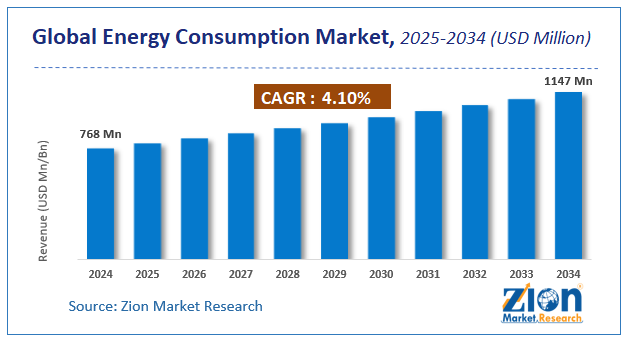
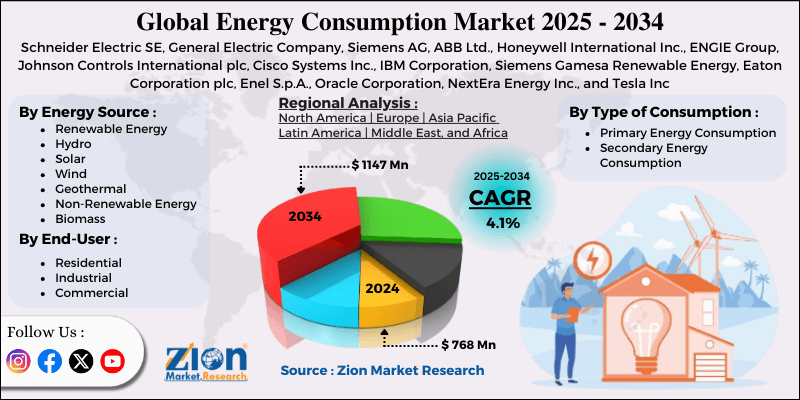
The global energy consumption market size was worth around USD 768 million in 2024 and is predicted to grow to around USD 1147 million by 2034, with a compound annual growth rate (CAGR) of roughly 4.1% between 2025 and 2034.
Key Insights
- As per the analysis shared by our research analyst, the global energy consumption market is estimated to grow annually at a CAGR of around 4.1% over the forecast period (2025-2034).
- In terms of revenue, the global energy consumption market size was valued at around USD 768 million in 2024 and is projected to reach USD 1147 million by 2034.
- Growing electricity demand is expected to drive the energy consumption market over the forecast period.
- Based on the energy source, the renewable energy segment is expected to dominate the market over the projected period.
- Based on the type of consumption, the primary energy consumption segment is expected to capture the largest market share over the projected period.
- Based on the end-user, the industrial segment is expected to capture the largest market share over the projected period.
- Based on region, the Asia Pacific is expected to dominate the market during the forecast period.
Energy Consumption Market: Overview
Energy consumption is the total amount of energy used over a period of time by all the activities and sectors mentioned above, including people, companies, transportation systems, and commercial and residential buildings. The different sources of energy are included in total energy consumption, including fossil fuels (oil, coal, and natural gas), electricity, and renewable sources such as solar, wind, hydropower, and biomass. The pattern of energy consumption reflects the energy needs for economic development support, industrial production, domestic consumption, infrastructure construction, and transportation. It is a significant indicator of economic development, quality of life, and industrialization level, and, at the same time, very important for environmental impact assessment, resource management, and energy policy planning and evaluation worldwide.
Energy Consumption Market Dynamics
Growth Drivers
Why does the rising electricity demand propel the energy consumption industry?
Industrial growth largely determines electricity demand, as electricity is the most important energy source in modern economies. The above-named very slow changes also added to the increase of primary and secondary power supply, transmission, and distribution capacities. Besides, there has been a clear trend toward greater electricity use in transportation, heating, and cooking, which not only raises demand but also drives significant investments in new power stations, renewable energy projects, grid modernization, and electricity storage systems. Urbanization, income levels, and the use of electrical devices, air conditioning systems, and smart gadgets are gradually and increasingly reflected in electricity consumption patterns, particularly in the residential and commercial sectors of developing countries, where usage remains very low.
Additionally, the rapid expansion of data centers, cloud computing, AI, and 5G networks is turning electricity into a constant, high-demand resource, and thus demand is expected to increase in the long run. All these factors combined signify significant investments, breakthroughs in technology, and the entire energy generation and capacity development value chain, which, in turn, is accelerating the energy consumption market overall growth. For instance, according to the International Energy Agency, global electricity demand is forecast to increase by an average annual 3.3% in 2025 and by 3.7% in 2026.
Restraints
Stringent environmental & emission regulations are impeding the industry's growth
Strict environmental and emissions regulations are widely regarded as a significant obstacle to the development of energy-intensive industries, particularly those that rely on fossil fuels, as they impose the strictest limitations on gas, power, and operational practices. Electricity suppliers, manufacturers, and large-scale energy-consuming sectors are paying more and more to comply with carbon emission limits, pollution control regulations, and net-zero goals set by governments worldwide. Sometimes, industries have no choice but to spend a lot of money on emission control technologies, cleaner fuels, or process modifications, which later increase both capital and operational expenditures while growth plans are delayed. In some cases, such rules force the closure of coal- and oil-fired plants before the end of their projected lifetimes, thus reducing, by virtue of this physical property, overall power production and supply. Besides, uncertainty in regulations and constant policy changes could be the reason for the deferral of landmark energy and infrastructure investments, as companies are cautious about their long-term projects might delay them. Thus, it hampered the market expansion.
Opportunities
Does the growing product launch offer a potential opportunity for the energy consumption industry?
The growing product launch is expected to offer a potential opportunity to the energy consumption market over the analysis period. For instance, in January 2025, at IMTEX 2025, Siemens unveiled MACHINUM, an impressive digitalization portfolio that promises to accelerate, make the industry more flexible, and strengthen the Indian machine tool industry. One of the key advantages of MACHINUM is its potential to reduce set-up times by up to 20%* and to reduce cost cycles and power usage by 18%**. The influx of investment in India in state-of-the-art production facilities catering to both local and export markets is one of the major factors contributing to the rapid digital transformation of the Indian machine tool market. The growth is further supported by the widespread use of advanced technologies. The requirements for complex machine tools are driven by demands for high accuracy, personalization, and the infusion of technology into the manufacturing process.
Challenges
How do policy uncertainty & investment risks pose a major challenge to energy consumption market expansion?
One of the main reasons energy consumption market expansions are difficult to achieve is the uncertainty in policies and investment risks, which act as barriers, as the energy industry is built on long-term, capital-intensive investments that require stable, predictable regulatory frameworks. Continuous changes in government policies on tariffs, subsidies, carbon pricing, fuel bans, or renewable energy targets create investment uncertainty, making it difficult to estimate project returns that often span decades. This uncertainty, in turn, makes investors perceive the situation as higher risk, increases the cost of capital, and finally pushes them away from private and institutional funding in areas such as power generation, grid infrastructure, and energy technologies.
Consequently, companies might postpone, reduce, or even cancel their projects; thus, the process of adding capacity and deploying technology will be slowed. Moreover, inconsistent policy signals can disrupt supply chains, erode investor confidence, and restrict cross-border investments, particularly in emerging markets. All these factors, therefore, have a combined effect of restricting the availability of funds and slowing infrastructure development, thereby impeding overall market growth even when demand remains.
Energy Consumption Market : Report Scope
| Report Attributes | Report Details |
|---|---|
| Report Name | Energy Consumption Market Research Report |
| Market Size in 2024 | USD 768 Million |
| Market Forecast in 2034 | USD 1147 Million |
| Growth Rate | CAGR of 4.1% |
| Number of Pages | 220 |
| Key Companies Covered | Schneider Electric SE, General Electric Company, Siemens AG, ABB Ltd., Honeywell International Inc., ENGIE Group, Johnson Controls International plc, Cisco Systems Inc., IBM Corporation, Siemens Gamesa Renewable Energy, Eaton Corporation plc, Enel S.p.A., Oracle Corporation, NextEra Energy Inc., and Tesla Inc |
| Segments Covered | By Energy Source, By Type of Consumption, By End-User, and By Region |
| Regions Covered | North America, Europe, Asia Pacific (APAC), Latin America, The Middle East and Africa (MEA) |
| Base Year | 2024 |
| Historical Year | 2019 to 2023 |
| Forecast Year | 2025 - 2034 |
| Customization Scope | Avail customized purchase options to meet your exact research needs. Request For Customization |
Energy Consumption Market: Segmentation
The global energy consumption market is segmented based on energy source, type of consumption, end-user and region.
By Energy Source, The renewable energy segment is expected to dominate the market. The increase is attributable to rising demand for electricity, government support measures, and the energy transition progressing more rapidly. The government is helping the industry along by offering incentives and subsidies. The energy transition is a major driver of rising electricity demand. All countries are gradually phasing out coal and oil, using various measures to mitigate the impacts of these fossil fuels on the climate. With this, capital is still flowing into the renewables sector, meaning solar, wind, hydro, and others are not only increasing their installed capacity but also directly generating and consuming electricity from these sources. The power of renewables has grown in many ways, and it is not just the revenue of energy providers that has grown, but also that of electric power companies, equipment manufacturers, and service providers.
By Type of consumption, The primary energy consumption segment of the energy consumption market is growing steadily in revenue due to increased global demand for primary sources of energy, such as oil, natural gas, coal, nuclear, and renewables, which are directly extracted or harnessed before conversion. The main driver of the increasing demand for primary energy for electricity generation, transportation, manufacturing, and infrastructure development has been rapid population growth, urbanization, and industrialization in developing countries. The production of goods and the growing need to move people have kept oil and natural gas consumption very high, while in some areas, coal remains a major source of power generation, especially as demand increases.
By End-User, The industrial segment is expected to grow substantially over the forecast period. Market growth is driven by ongoing advances in manufacturing, processing, and heavy industries across both developed and emerging economies. The Asia Pacific region and parts of the Middle East and Latin America are experiencing rapid industrialization, which is increasing energy consumption in steel, cement, chemical, mining, and refining industries, which are already intensive energy users. In fact, energy consumption in industrial facilities increases as production volumes rise to meet growing global demand for infrastructure, construction materials, consumer goods, and industrial equipment, thereby directly and indirectly supporting the income of energy suppliers and utilities.
Energy Consumption Market: Regional Analysis
Why is the Asia Pacific growing at the highest rate in the energy consumption market?
The energy consumption market in the Asia Pacific region is expanding rapidly, boosting revenue considerably. Factors contributing to this growth include rapid population growth, urbanization, and industrialization in major countries such as China, India, Southeast Asia, and other developing countries. Power plants and utilities are the primary beneficiaries of increased electricity demand from industry, commercial buildings, and households—the latter driven by large-scale electrification and grid expansion. Besides, economic growth and higher incomes are driving increased energy use in residences and commercial spaces, as more people buy the latest appliances, air conditioners, digital devices, and electric vehicles. Across the region, governments are investing heavily in power generation capacity, transmission networks, and renewable energy projects to meet increasing demand and secure energy supply.
Renewable energy is on the rise, but overall energy consumption is also increasing due to high demand; thus, both the conventional and clean energy sectors have seen strong revenue growth. All these factors have made the Asia Pacific region the fastest-growing market for energy consumption in terms of revenue generation.
Energy Consumption Market: Competitive Analysis
The global energy consumption market is dominated by players like
- Schneider Electric SE
- General Electric Company
- Siemens AG
- ABB Ltd
- Honeywell International Inc
- ENGIE Group
- Johnson Controls International plc
- Cisco Systems Inc
- IBM Corporation
- Siemens Gamesa Renewable Energy
- Eaton Corporation plc
- Enel S p A
- Oracle Corporation
- NextEra Energy Inc
- Tesla Inc
The global energy consumption market is segmented as follows:
By Energy Source
- Renewable Energy
- Hydro
- Solar
- Wind
- Geothermal
- Non-Renewable Energy
- Biomass
- Fossil Fuels (Coal, Oil, Natural Gas)
- Nuclear
By Type of Consumption
- Primary Energy Consumption
- Secondary Energy Consumption
By End-User
- Residential
- Industrial
- Commercial
By Region
- North America
- The U.S.
- Canada
- Europe
- France
- The UK
- Spain
- Germany
- Italy
- Rest of Europe
- Asia Pacific
- China
- Japan
- India
- South Korea
- Southeast Asia
- Rest of Asia Pacific
- Latin America
- Brazil
- Mexico
- Rest of Latin America
- Middle East & Africa
- GCC
- South Africa
- Rest of Middle East & Africa
Table Of Content
Methodology
FrequentlyAsked Questions

HappyClients

