
Fire Resistant Lubricants Market Size, Share, Value and Forecast 2034

Fire Resistant Lubricants Market By Base Oil Type (Synthetic Oil Based, Mineral Oil Based, and Semi-Synthetic Oil Based), By Application (Gears & Bearings, Compressor Oils, Hydraulic Fluids, Metalworking Fluids, and Others), By Additive Technology (Polyphenyl Ethers, Chlorinated Paraffins, Ammonium Polyphosphate, and Tricresyl Phosphate (TCP)), By End-User Industry (Oil & Gas, Automotive, Aerospace & Defense, Mining & Fire Resistant Lubricant, and Power Generation), and By Region - Global and Regional Industry Overview, Market Intelligence, Comprehensive Analysis, Historical Data, and Forecasts 2026 – 2034-
| Market Size in 2025 | Market Forecast in 2034 | CAGR (in %) | Base Year |
|---|---|---|---|
| USD 3.81 Billion | USD 5.68 Billion | 4.47% | 2025 |
Fire Resistant Lubricants Industry Perspective:
What is the anticipated size of the fire resistant lubricants market during the projection period?
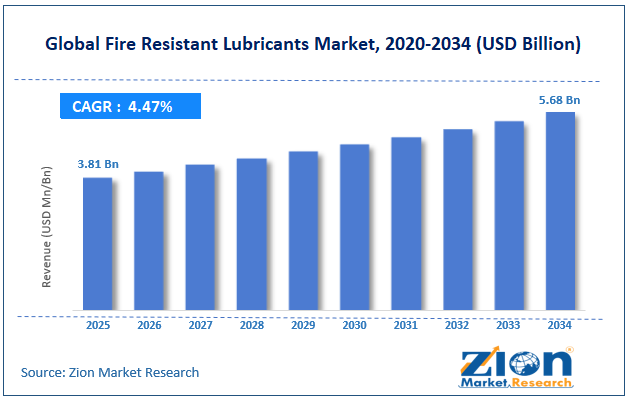
The global fire resistant lubricants market size was worth around USD 3.81 billion in 2025 and is predicted to grow to around USD 5.68 billion by 2034, with a compound annual growth rate (CAGR) of roughly 4.47% between 2026 and 2034.
Key Insights:
- As per the analysis shared by our research analyst, the global fire resistant lubricants market is estimated to grow annually at a CAGR of around 4.47% over the forecast period (2026-2034)
- In terms of revenue, the global fire resistant lubricants market size was valued at around USD 3.81 billion in 2025 and is projected to reach USD 5.68 billion by 2034.
- The fire resistant lubricants market is projected to grow at a significant rate due to the accelerated shift toward improving worker safety across industrial spaces.
- Based on the base oil type, the synthetic oil-based segment is growing at a high rate and will continue to dominate the global market as per industry projections.
- Based on the application, the hydraulic fluids segment is anticipated to command the largest market share.
- Based on the additive technology, the tricresyl phosphate (TCP) segment is expected to lead the market growth trends.
- Based on the end-user industry, the oil & gas segment is projected to influence revenue in the market.
- Based on region, North America is projected to dominate the global market during the forecast period.
Fire Resistant Lubricants Market: Overview
Fire-resistant lubricants are specially designed materials used in fields or applications where the chances of ignition are high. The most common use of fire-resistant lubricants is in areas where sparks, flames, or hot metals are present or nearby. Water glycols, oil-water emulsions, phosphate esters, and polyol esters are the common types of fire-resistant lubricants with several end-use applications. During the forecast period, the global fire resistant lubricants market is expected to be driven by growing efforts toward improving workplace safety, higher applications in aerospace and aviation industries, and accelerating research & development. However, factors such as high cost of production, limited awareness, failure to comply with established standards, and limited compatibility with equipment may affect market revenue in the long run.
Impact of the USA-Israel and Iran War on the Fire Resistant Lubricants Market:
The ongoing war between the USA-Israel and Iran is expected to disrupt the supply chain of essential raw materials, leading to delayed shipments and increased costs. However, the war has also amplified the use of fire-resistant lubricants in defense and energy sectors. During the forecast period, current circumstances are expected to encourage production and supply chain diversification.
Fire Resistant Lubricants Market: Dynamics
Growth Drivers
How will focus on worker safety influence fire resistant lubricants market growth?
The global fire resistant lubricants market is anticipated to be driven by the accelerated shift toward improving worker safety across industrial spaces. Stricter government rules promoting industrial safety when dealing with high-risk elements have amplified the use of fire-resistant lubricants worldwide. For instance, under the modernized Occupational Safety, Health, and Working Conditions Code and the National Building Code Standards, stricter industrial safety codes have been mandated across the country. The European Union has updated the Seveso III Directive to control major accident hazards caused by dangerous substances. As laws become more stringent, more industrial firms are expected to incorporate effective safety measures, such as fire-resistant lubricants, in business operations.
Expansion of the oil & gas and mining sectors to generate higher market revenue during the forecast period
The oil & gas and mining industries are some of the largest consumers of fire-resistant lubricants. These sectors deal with highly dangerous and flammable components, thus requiring advanced safety tools. In July 2026, Lanxess AG, a German specialty chemicals company, announced that it would start producing fire-resistant hydraulic fluids (FRHF) at its Indian facility as the region expands its economic investments across industries. The global fire resistant lubricants market will continue to benefit as more economies invest in the expansion of the oil and mining sectors, since global demand is expected to grow steadily.
Restraints
How will limited awareness and equipment compatibility affect fire resistant lubricants market growth?
The global fire resistant lubricants industry is projected to be restricted due to limited awareness about product benefits, especially in emerging economies. Fire-resistant lubricants are produced using advanced engineering solutions and require years of research & development. Developing economies may not have supportive infrastructure to support the scaling of fire-resistant lubricants production. In addition, there is a strong possibility that the lubricants may not be compatible with all equipment, limiting product applications.
Opportunities
Ongoing technological advancements in the market to generate growth opportunities during the forecast period
The global fire resistant lubricants market is expected to generate growth opportunities due to consistent technological advancements recorded across production cycles. This includes the use of Artificial Intelligence (AI), Machine Learning (ML), and automation systems to develop new formulas and expand end applications of existing lubricants. In 2022, BioBlend, a prominent sustainable lubricating oils and greases provider, announced the addition of a new range of synthetic, fire-resistant hydraulic oils to its existing portfolio. The company added BioFlo Synthetic HFDU, a novel synthetic fire-resistant product that offers a more reliable and safer choice to buyers. New lubricants are designed to handle extreme temperatures and ensure optimal performance in harsh environments. Advancements reported in the additive industry will further aid market expansion in the coming years.
Challenges
Why will cost emerge as the leading challenge in the fire resistant lubricants market?
The global fire resistant lubricants industry will be challenged by the high cost of research and production. Modern fire-resistant lubricants, such as water-glycol formulations, are costlier to develop. Businesses are currently seeking ways to reduce losses and improve profit margins. The availability of low-cost or affordable alternatives, such as mineral oil lubricants, may affect market revenue during the forecast period.
Fire Resistant Lubricants Market: Report Scope
| Report Attributes | Report Details |
|---|---|
| Report Name | Fire Resistant Lubricants Market |
| Market Size in 2025 | USD 3.81 Billion |
| Market Forecast in 2034 | USD 5.68 Billion |
| Growth Rate | CAGR of 4.47% |
| Number of Pages | 228 |
| Key Companies Covered | Chevron, ExxonMobil, Quaker Houghton, Shell, Lubrizol Corporation, Petro-Canada Lubricants, Klüber Lubrication, BP (Castrol), ENEOS Corporation, TotalEnergies, PETRONAS Lubricants International, Phillips 66 Lubricants, FUCHS, Sinopec Lubricant Company, Idemitsu Kosan, and others. |
| Segments Covered | By Base Oil Type, By Application, By Additive Technology, By End-User Industry, and By Region |
| Regions Covered | North America, Europe, Asia Pacific (APAC), Latin America, Middle East, and Africa (MEA) |
| Base Year | 2025 |
| Historical Year | 2020 to 2024 |
| Forecast Year | 2026 - 2034 |
| Customization Scope | Avail customized purchase options to meet your exact research needs. Request For Customization |
Fire Resistant Lubricants Market: Segmentation
The global fire resistant lubricants market is segmented based on base oil type, application, additive technology, end-user, and region.
Why will the synthetic oil based segment lead the fire resistant lubricants industry revenue during the forecast period?
Based on base oil type, the global market segments are synthetic oil based, mineral oil based, and semi-synthetic oil based. In 2025, the highest growth was listed in the synthetic oil based segment. It accounted for 63% of global revenue and will continue to grow at a CAGR of 6.56%. Synthetic oil based fire resistant lubricants offer exceptional performance due to higher oxidation and thermal stability. Moreover, they have a longer shelf life, thus aiding higher segmental growth.
Which will be the fastest-growing application during the forecast period in the fire resistant lubricants market?
Based on application, the global fire resistant lubricants industry is fragmented into gears & bearings, compressor oils, hydraulic fluids, metalworking fluids, and others. The highest revenue in 2025 was listed in the hydraulic fluids segment, contributing up to 47% of total revenue. It is anticipated to grow at a 6.56% CAGR, as these fluids have greater applications in high-risk applications.
Which factors drive demand in the tricresyl phosphate (TCP) segment in the fire resistant lubricants industry?
Based on additive technology, the global market divisions are polyphenyl ethers, chlorinated paraffins, ammonium polyphosphate, and tricresyl phosphate (TCP). During the forecast period, tricresyl phosphate (TCP) is expected to offer a CAGR of 6.31%. It accounted for 45% of the global revenue since it delivers extreme-pressure (EP). It enjoys the benefits of a mature market as applications across the mining and steel industries surge.
What will be the influence of the oil & gas segment on the fire resistant lubricants market?
Based on the end-user industry, the global market divisions are oil & gas, automotive, aerospace & defense, mining & fire resistant lubricant, and power generation. The oil & gas sector was the highest revenue generator in 2025, accounting for 35% of the global revenue. It is expected to grow at a CAGR of 6.57% during the forecast period, driven by the expansion of the oil industry, rising global demand, and the use of advanced technologies for oil exploration projects.
Fire Resistant Lubricants Market: Regional Analysis
Why will North America lead the fire resistant lubricants market in the coming years?
The global fire resistant lubricants market is currently led by North America. In 2025, it accounted for 37.8% of the global revenue and will grow at a CAGR of 5.52% during the forecast period. The presence of a growing and well-established oil & gas sector, increased mining projects, and strict industrial safety codes will aid regional growth. In addition, leading fire-resistant lubricant producers with global presence are located across the US and Canada, resulting in improved regional revenue.
Why will Asia-Pacific generate the fastest CAGR in the fire resistant lubricants market during the forecast period?
Asia-Pacific is expected to emerge as the fastest-growing region in the fire resistant lubricants market with a CAGR of 7.37% during the forecast period. In 2025, it accounted for 28.56% of the global revenue. The expansion of the regional chemicals & materials industry, rising oil exploration projects, and rapid industrialization will propel growth across the Asia-Pacific. Moreover, growing energy demands and investments in power generation, along with steel production initiatives, will work in favor of the regional market.
Fire Resistant Lubricants Market: Competitive Analysis
The global fire resistant lubricants market is led by players like:
- Chevron
- ExxonMobil
- Quaker Houghton
- Shell
- Lubrizol Corporation
- Petro-Canada Lubricants
- Klüber Lubrication
- BP (Castrol)
- ENEOS Corporation
- TotalEnergies
- PETRONAS Lubricants International
- Phillips 66 Lubricants
- FUCHS
- Sinopec Lubricant Company
- Idemitsu Kosan
What are the latest key trends in the fire resistant lubricants market?
Eco-friendly fire-resistant lubricants
Eco-friendly fire-resistant lubricants are expected to witness a higher adoption rate during the forecast period. These materials are developed to deliver excellent performance with limited environmental impact, thus meeting sustainability goals.
Predictive maintenance and remote monitoring
The growing integration of the Industrial Internet of Things (IIoT) and higher demand for industrial automation will drive the use of advanced oil condition monitoring and predictive maintenance systems.
The global fire resistant lubricants market is segmented as follows:
By Base Oil Type
- Synthetic Oil Based
- Mineral Oil Based
- Semi-Synthetic Oil Based
By Application
- Gears & Bearings
- Compressor Oils
- Hydraulic Fluids
- Metalworking Fluids
- Others
By Additive Technology
- Polyphenyl Ethers
- Chlorinated Paraffins
- Ammonium Polyphosphate
- Tricresyl Phosphate (TCP)
By End-User Industry
- Oil & Gas, Automotive
- Aerospace & Defense
- Mining & Fire Resistant Lubricant
- Power Generation
By Region
- North America
- The U.S.
- Canada
- Mexico
- Europe
- France
- The UK
- Spain
- Germany
- Italy
- Rest of Europe
- Asia Pacific
- China
- Japan
- India
- Australia
- South Korea
- Rest of Asia Pacific
- The Middle East & Africa
- Saudi Arabia
- UAE
- Egypt
- Kuwait
- South Africa
- Rest of the Middle East & Africa
- Latin America
- Brazil
- Argentina
- Rest of Latin America
Table Of Content
Methodology
FrequentlyAsked Questions
Fire-resistant lubricants are specially designed materials used in fields or applications where the chances of ignition are high.
The global fire resistant lubricants market is anticipated to be driven by the accelerated shift toward improving worker safety across industrial spaces.
According to study, the global fire resistant lubricants market size was worth around USD 3.81 billion in 2025 and is predicted to grow to around USD 5.68 billion by 2034.
The CAGR value of fire resistant lubricants market is expected to be around 4.47% during 2026-2034.
The global fire resistant lubricants industry will be challenged by the high cost of research and production.
Eco-friendly fire-resistant lubricants and predictive maintenance and remote monitoring are the emerging trends and innovations impacting the fire resistant lubricants market.
The global fire resistant lubricants market has performed well so far and will offer similar trends in the coming years.
North America will contribute notably towards the fire resistant lubricants market value.
The global fire resistant lubricants market is led by players like Chevron, ExxonMobil, Quaker Houghton, Shell, Lubrizol Corporation, Petro-Canada Lubricants, Klüber Lubrication, BP (Castrol), ENEOS Corporation, TotalEnergies, PETRONAS Lubricants International, Phillips 66 Lubricants, FUCHS, Sinopec Lubricant Company, and Idemitsu Kosan.
The report explores crucial aspects of the fire resistant lubricants market, including a detailed discussion of existing growth factors and restraints, while also browsing future growth opportunities and challenges that impact the market.

HappyClients

