
Global Fetal Monitoring, Diagnostics and Predictive Tests Market Size, Share, and Forecasts 2034

Fetal Monitoring, Diagnostics and Predictive Tests Market By Product Type (Fetal Monitoring Devices, Predictive Tests, and Fetal Diagnostic Tests), By Technology (Invasive Monitoring, Conventional Diagnostics, Non-invasive Monitoring, Molecular Diagnostics, and Imaging-based Diagnostics), By Application (Intrapartum Monitoring, Pre-term Birth Prediction, Gestational Risk Assessment, Genetic Abnormality Screening, and Antepartum Monitoring), and Region - Global and Regional Industry Overview, Market Intelligence, Comprehensive Analysis, Historical Data, and Forecasts 2026 - 2034
| Market Size in 2025 | Market Forecast in 2034 | CAGR (in %) | Base Year |
|---|---|---|---|
| USD 12.5 Billion | USD 20.1 Billion | 5.4% | 2025 |
Fetal Monitoring, Diagnostics and Predictive Tests Industry Perspective:
What will be the size of the global fetal monitoring, diagnostics and predictive tests market during the forecast period?
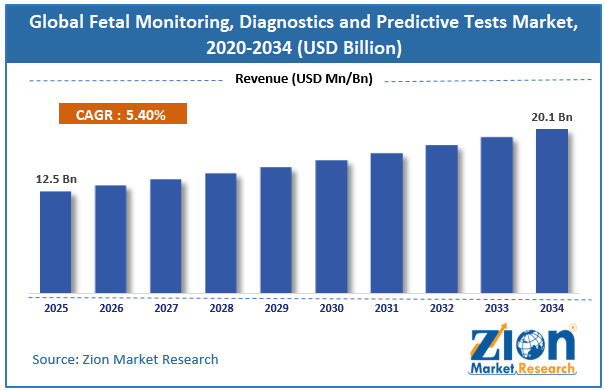
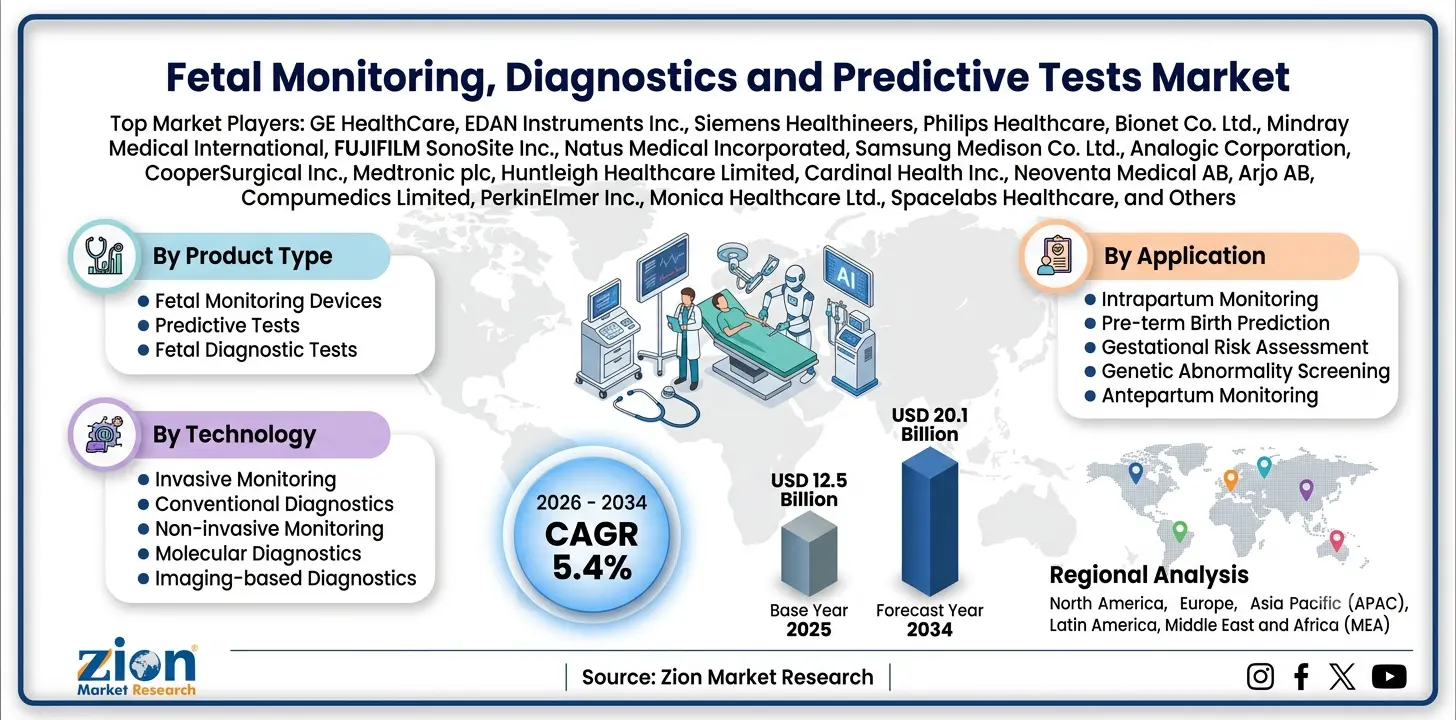
The global fetal monitoring, diagnostics and predictive tests market size was worth around USD 12.5 billion in 2025 and is predicted to grow to around USD 20.1 billion by 2034, with a compound annual growth rate (CAGR) of roughly 5.4% between 2026 and 2034.
The report examines the primary drivers, challenges, and restraints shaping global demand for the fetal monitoring, diagnostics and predictive tests market throughout the forecast period and identifies high-growth opportunities across the industry.
Key Insights
- As per the analysis shared by our research analyst, the global fetal monitoring, diagnostics and predictive tests market is estimated to grow annually at a CAGR of around 5.4% over the forecast period (2026-2034).
- In terms of revenue, the global fetal monitoring, diagnostics and predictive tests market size was valued at around USD 12.5 billion in 2025 and is projected to reach USD 20.1 billion by 2034.
- Expansion of genetic testing capabilities is expected to propel the fetal monitoring, diagnostics, and predictive tests market over the projected period.
- Based on the product type, the fetal monitoring devices segment dominates the market.
- Based on the technology, the non-invasive monitoring segment holds a majority of market share in 2025.
- Based on the application, the intrapartum monitoring segment holds a majority of market share in 2025.
- Based on region, North America dominates the fetal monitoring, diagnostics, and predictive tests market.
Fetal Monitoring Diagnostics and Predictive Tests Market: Overview
Fetal monitoring, diagnostics, and predictive tests refer to technological advancements and testing procedures developed to assess fetal well-being, detect anomalies, identify risks during pregnancy or childbirth, and determine fetal status. Fetal monitoring can be done through fetal heart rate monitoring, cardiotocography (CTG), ultrasound-based fetal heart rate monitoring, fetal movement evaluation, etc. Fetal diagnostic tests include ultrasound, amniocentesis, chorionic villus sampling (CVS), and genetic testing to diagnose structural, chromosomal, or genetic anomalies in the fetus. On the other hand, fetal predictive tests are performed using maternal, fetal, and pregnancy markers and clinical measures to determine the risk of various complications such as preterm birth, fetal growth restrictions, preeclampsia, or other pregnancy complications.
Impact of the USA-Israel War on Iran on the Fetal Monitoring, Diagnostics and Predictive Tests Market
The USA-Israel war with Iran is expected to have a negative effect in the short term on the fetal monitoring, diagnostics, and predictive tests market, especially in Iran and the rest of the Middle East, owing to the disturbance of the healthcare infrastructure, transportation, medical devices' supply chain, and hospital management. The war and restrictions imposed on the Strait of Hormuz are disrupting international shipping and raising energy and petrochemical prices, which will increase the cost of components used to manufacture medical devices and the consumables used in diagnostics. In addition, hospitals in the region might shift priorities toward emergency and trauma cases instead of prenatal care, limiting short-term demand.
Fetal Monitoring Diagnostics and Predictive Tests Market: Dynamics
Growth Drivers
Why does the rising focus on prenatal and fetal health drive the fetal monitoring, diagnostics and predictive tests market?
The fetal monitoring, diagnostics and predictive tests market is expected to expand due to growing concern for the well-being of fetuses and pregnant women. The need for prenatal health and monitoring of the fetus is increasing, and there is increasing importance on prevention and early diagnosis and treatment of any issue related to pregnancy and the fetus. With the help of prenatal health checkups, healthcare professionals can take note of the health of the fetus and any issues that may arise. For high-risk pregnancies, there is the use of fetal surveillance, including non-stress tests, biophysical profile tests, fetal movement tests, and Doppler ultrasound tests.
Restraints
High cost of advanced testing acts as a major restraint on the market growth
High costs associated with advanced tests are the primary restraint on the expansion of the fetal monitoring, diagnostics and predictive tests market in price-sensitive and developing healthcare markets. Genetic, molecular, specific ultrasound, and predictive testing may require specialized equipment, facilities, and personnel, which increases the total cost of prenatal care services. American College of Obstetricians & Gynecologists (ACOG) noted that genetic test costs vary by test and laboratory and remain a significant concern for patients. Additionally, unequal insurance coverage and out-of-pocket costs may become barriers to use. Thus, patients with low incomes may avoid advanced testing because of cost.
Opportunities
How does the growing healthcare investment in maternal and neonatal care offer a lucrative opportunity for the fetal monitoring, diagnostics and predictive tests market?
As government and healthcare funding for maternal and neonatal health increases, the fetal monitoring, diagnostics and predictive tests market has significant opportunity because more funding allows hospitals and maternity care centers to expand prenatal, fetal, and newborn health care services, as well as their diagnostic capabilities. In the U.S., the Department of Health and Human Services (HHS) allocated $767.25 million in FY2026 to support activities under the Maternal and Child Health Services Block Grant, including prenatal and postnatal care. HHS also noted that in 2023, 76% of U.S. women were receiving early prenatal care within their first trimester. This highlights the scope of the prenatal care system, including fetal monitoring and diagnostic tools.
Funding is also leading to infrastructure investments in healthcare. Globally, the 2024/2025 WHO report shows increased country funding for maternal and newborn health services; for instance, Tanzania created 30 facilities for small and sick babies in 2024 and plans another 20 for 2025.
Challenges
Why does the limited clinical utility of certain predictive tests pose a significant challenge to the growth of the fetal monitoring, diagnostics and predictive tests industry?
Clinical limitations in the accuracy of some predictive tests have become a major impediment to the development of the Fetal Monitoring, Diagnostics, and Predictive Tests Market because clinicians are often hesitant to implement tests when the results do not provide useful information for further patient treatment. Certain new genetic and predictive tests can help detect the risks, but there is no way to predict if the fetus will have the disease and to what extent. According to the American College of Obstetricians and Gynecologists (ACOG), genetic testing does not detect all fetal anomalies, and test results cannot predict all clinical outcomes.
Moreover, ACOG has indicated a lack of evidence and clinical validation for certain predictive genetic testing methods, and some techniques are considered investigational and not applicable in pregnancy. Therefore, the clinical usefulness of certain techniques is unknown; data on positive clinical outcomes are insufficient, and additional confirmatory tests and genetic counseling are needed to increase clinicians' confidence.
Fetal Monitoring Diagnostics and Predictive Tests Market: Report Scope
| Report Attributes | Report Details |
|---|---|
| Report Name | Fetal Monitoring, Diagnostics and Predictive Tests Market |
| Market Size in 2025 | USD 12.5 Billion |
| Market Forecast in 2034 | USD 20.1 Billion |
| Growth Rate | CAGR of 5.4% |
| Number of Pages | 229 |
| Key Companies Covered | GE HealthCare, EDAN Instruments Inc., Siemens Healthineers, Philips Healthcare, Bionet Co. Ltd., Mindray Medical International, FUJIFILM SonoSite Inc., Natus Medical Incorporated, Samsung Medison Co. Ltd., Analogic Corporation, CooperSurgical Inc., Medtronic plc, Huntleigh Healthcare Limited, Cardinal Health Inc., Neoventa Medical AB, Arjo AB, Compumedics Limited, PerkinElmer Inc., Monica Healthcare Ltd., Spacelabs Healthcare, and others. |
| Segments Covered | By Product Type, By Technology, By Application, and By Region |
| Regions Covered | North America, Europe, Asia Pacific (APAC), Latin America, Middle East, and Africa (MEA) |
| Base Year | 2025 |
| Historical Year | 2020 - 2024 |
| Forecast Year | 2026 - 2034 |
| Customization Scope | Avail customized purchase options to meet your exact research needs. Request For Customization |
Fetal Monitoring Diagnostics and Predictive Tests Market: Segmentation
Product Type Insights
Why does the fetal monitoring devices segment hold a prominent position in the fetal monitoring, diagnostics and predictive tests market?
The fetal monitoring devices segment dominates the market. The primary drivers include increased instances of high-risk pregnancies, premature deliveries, gestational diabetes, hypertension, and various other problems related to pregnancy that demand better monitoring of fetuses. Moreover, increasing maternal age, growing awareness of prenatal care, and improvements in the health care system for expectant mothers are motivating health care professionals to use fetal heart rate monitors, cardiotocography machines, Doppler equipment, and ultrasound monitors. Technological innovations such as wireless, portable, and digitally connected fetal monitors are contributing to their use.
Technology Insights
How does the non-invasive monitoring segment capture the largest market share in the fetal monitoring, diagnostics, and predictive tests market?
The non-invasive monitoring segment holds the largest market share in 2025. There is a growing trend toward using advanced cardiotocography methods because of non-invasive technologies such as external cardiotocography, Doppler examination, and fetal monitors. Thus, the risk of infection, bleeding, trauma, and fetomaternal compromise that can occur when using invasive techniques during examinations can be avoided.
Application Insights
Why does the intrapartum monitoring segment capture the largest share in the fetal monitoring, diagnostics and predictive tests market?
The intrapartum monitoring segment holds the largest market share in 2025. The tendency to increase is explained by the growing prevalence of high- or preterm pregnancy cases, the concern about mothers’ and fetuses’ safety, and the need to detect the fetus’s distress, hypoxia, and irregular heart rate during childbirth. The clinical practice and professional guidelines suggest evaluating the fetal heart rate during labor and using cardiotocography (CTG) for fetal monitoring if perinatal or antenatal danger to the fetus is detected or suspected.
Regional Insights
What factors drive the North America region in the fetal monitoring, diagnostics and predictive tests market?
North America holds the largest market share in 2025. Government statistics show the strong demand and ongoing need for maternal and fetal healthcare services. According to data published by the U.S. Centers for Disease Control and Prevention (CDC), the United States registered 3,628,934 births in 2024, compared to 3,604,237 in 2023, an increase of 1%. Notably, 10.41% of births are preterm, 32.4% are cesarean, and 75.5% of pregnant women began prenatal care in the first trimester. The report also found that average patient age remained relatively constant: 22.9 years for mothers under 35, 26.9 for those between 35 and 39, and 34.5 for those 40 and older. These figures evidence the continuous need for electronic fetal monitoring, cardiotocography, fetal dopplers, ultrasounds, non-invasive assessment, genetic tests, and screening.
Moreover, the CDC data indicates that only 75.5% of pregnant women began prenatal care in the first trimester in 2024, while 7.3% of mothers received late or no prenatal care at all. Therefore, healthcare systems consistently need prenatal screening and assessment. This drives regional market growth.
Fetal Monitoring Diagnostics and Predictive Tests Market: Competitive Analysis
The global fetal monitoring, diagnostics and predictive tests market is dominated by players like:
- GE HealthCare
- EDAN Instruments Inc.
- Siemens Healthineers
- Philips Healthcare
- Bionet Co. Ltd.
- Mindray Medical International
- FUJIFILM SonoSite Inc.
- Natus Medical Incorporated
- Samsung Medison Co. Ltd.
- Analogic Corporation
- CooperSurgical Inc.
- Medtronic plc
- Huntleigh Healthcare Limited
- Cardinal Health Inc.
- Neoventa Medical AB
- Arjo AB
- Compumedics Limited
- PerkinElmer Inc.
- Monica Healthcare Ltd.
- Spacelabs Healthcare
The global fetal monitoring, diagnostics, and predictive tests market is segmented as follows:
By Product Type
- Fetal Monitoring Devices
- Predictive Tests
- Fetal Diagnostic Tests
By Technology
- Invasive Monitoring
- Conventional Diagnostics
- Non-invasive Monitoring
- Molecular Diagnostics
- Imaging-based Diagnostics
By Application
- Intrapartum Monitoring
- Pre-term Birth Prediction
- Gestational Risk Assessment
- Genetic Abnormality Screening
- Antepartum Monitoring
By Region
- North America
- The U.S.
- Canada
- Mexico
- Europe
- France
- The UK
- Spain
- Germany
- Italy
- Rest of Europe
- Asia Pacific
- China
- Japan
- India
- Australia
- South Korea
- Rest of Asia Pacific
- The Middle East & Africa
- Saudi Arabia
- UAE
- Egypt
- Kuwait
- South Africa
- Rest of the Middle East & Africa
- Latin America
- Brazil
- Argentina
- Rest of Latin America
Table Of Content
Methodology
FrequentlyAsked Questions
Fetal monitoring, diagnostics, and predictive tests refer to technological advancements and testing procedures developed to assess fetal well-being, detect anomalies, identify risks during pregnancy or childbirth, and determine fetal status.
The key growth drivers for the fetal monitoring, diagnostics and predictive tests market include the rising prevalence of high-risk pregnancies and pregnancy-related complications, increasing maternal age, growing incidence of preterm births, and greater emphasis on early detection of fetal abnormalities.
The major challenges restraining the growth of the fetal monitoring, diagnostics and predictive tests market include the high cost of advanced monitoring and diagnostic technologies, limited access to specialized maternal-fetal healthcare, and uncertainty regarding the clinical utility of some predictive tests.
Which segment is expected to dominate the fetal monitoring, diagnostics and predictive tests market?
Based on the application, the intrapartum monitoring segment is expected to dominate the fetal monitoring, diagnostics and predictive tests market growth during the projected period.
The fetal monitoring, diagnostics and predictive tests market is being influenced by rapid adoption of artificial intelligence (AI), wearable and wireless monitoring, non-invasive prenatal testing (NIPT), advanced genetic diagnostics, and remote fetal monitoring. AI is increasingly used for fetal heart-rate interpretation, prenatal ultrasound, and predicting pregnancy complications, helping clinicians identify potential risks more efficiently.
According to the report, the global fetal monitoring, diagnostics and predictive tests market size was worth around USD 12.5 billion in 2025 and is predicted to grow to around USD 20.1 billion by 2034.
The global fetal monitoring, diagnostics and predictive tests market is expected to grow at a CAGR of 5.4% during the forecast period.
The global fetal monitoring, diagnostics and predictive tests industry growth is expected to be led by North America over the forecast period.
The global fetal monitoring, diagnostics and predictive tests market is dominated by players like GE HealthCare, EDAN Instruments Inc., Siemens Healthineers, Philips Healthcare, Bionet Co. Ltd., Mindray Medical International, FUJIFILM SonoSite Inc., Natus Medical Incorporated, Samsung Medison Co. Ltd., Analogic Corporation, CooperSurgical Inc., Medtronic plc, Huntleigh Healthcare Limited, Cardinal Health Inc., Neoventa Medical AB, Arjo AB, Compumedics Limited, PerkinElmer Inc., Monica Healthcare Ltd., and Spacelabs Healthcare, among others.
The fetal monitoring, diagnostics and predictive tests market report covers the geographical market along with a comprehensive competitive landscape analysis. It also includes cash flow analysis, profit ratio analysis, market basket analysis, market attractiveness analysis, sentiment analysis, PESTLE analysis, trend analysis, SWOT analysis, trade area analysis, demand & supply analysis, Porter’s five forces analysis, and value chain analysis.

List of Contents
TestsIndustry Perspective:Key InsightsFetal MonitoringDiagnostics and Predictive Tests OverviewFetal MonitoringDiagnostics and Predictive Tests DynamicsFetal MonitoringDiagnostics and Predictive Tests Report ScopeFetal MonitoringDiagnostics and Predictive Tests SegmentationRegional InsightsFetal MonitoringDiagnostics and Predictive Tests Competitive AnalysisThe global fetal monitoring, diagnostics, and predictive tests market is segmented as follows:HappyClients

