Digital Gift Card Market Size, Share, Growth, Opportunities 2034

Digital Gift Card Market By Type (E-Gift Cards, Mobile Gift Cards, Social Gifting Cards, Closed Loop Digital Cards), By Application (Retail and E-commerce, Food and Beverage, Entertainment and Gaming, Travel and Hospitality), By Distribution Channel (Third Party Gifting Platforms, Brand Owned Websites, Mobile Applications, Corporate Gifting Programs), By End User (Individual Consumers, Corporate Buyers, Small and Medium Businesses, Large Enterprises), and By Region - Global and Regional Industry Overview, Market Intelligence, Comprehensive Analysis, Historical Data, and Forecasts 2026 - 2034
| Market Size in 2025 | Market Forecast in 2034 | CAGR (in %) | Base Year |
|---|---|---|---|
| USD 510 Billion | USD 1596 Billion | 13.52% | 2025 |
Digital Gift Card Industry Perspective:
What will be the size of the digital gift card market during the forecast period?
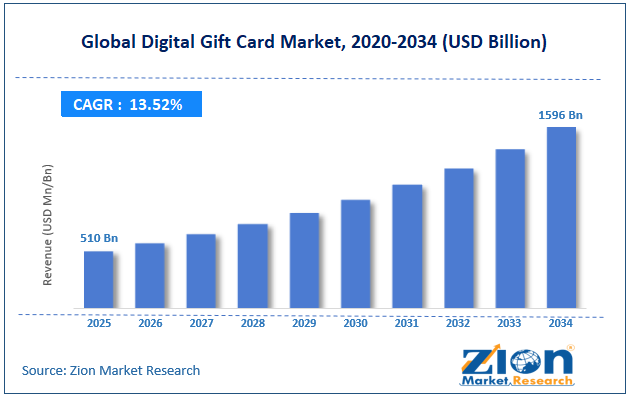
The global digital gift card market size was valued at approximately USD 510 billion in 2025 and is projected to reach around USD 1596 billion by 2034, growing at a compound annual growth rate of approximately 13.52% between 2026 and 2034.
Key Insights
- As per the analysis shared by our research team, the global digital gift card market is estimated to grow at a compound annual growth rate of approximately 13.52% during the forecast period from 2026 to 2034.
- In terms of revenue, the global digital gift card market was valued at approximately USD 510 billion in 2025 and is projected to reach USD 1596 billion by 2034.
- The digital gift card market is expected to grow steadily, driven by rising online shopping adoption, growing preference for instant gifting solutions, increasing corporate rewards spending, and expanding mobile payment integration.
- Based on type, e-gift cards lead the market because of their broad acceptance across major retailers, while social gifting cards are gaining strong momentum as consumers increasingly send gifts directly through messaging and social media applications.
- Based on application, retail and e-commerce lead the market due to the sheer variety of participating merchants. At the same time, entertainment and gaming are the fastest-growing segment as streaming services and gaming platforms expand their digital card offerings.
- Based on distribution channel, third-party gifting platforms lead the market because of their wide selection and easy comparison shopping, while mobile applications are steadily growing as more consumers prefer purchasing and sending gifts directly from their phones.
- Based on end user, individual consumers lead the market due to the popularity of digital cards for birthdays and personal occasions, while corporate buyers are growing rapidly as businesses expand employee recognition and customer loyalty programs.
- Based on region, North America leads the global digital gift card market, while Asia Pacific is the fastest-growing region due to rising smartphone penetration and expanding digital payment adoption.
Digital Gift Card Market: Overview
A digital gift card is an electronic voucher that lets people send or receive a set amount of money for use at a specific retailer, restaurant, website, or online platform. It works like a prepaid gift that can be stored on a phone or digital account and used to pay for products or services without carrying a physical card. The market covers cards bought by individuals for birthdays, holidays, celebrations, and other occasions, as well as bulk purchases by businesses for employee rewards, customer incentives, and loyalty programs. Unlike physical gift cards, digital versions can be delivered instantly through email, text messages, mobile apps, or digital wallets, making gifting faster and more convenient. Growing online shopping, smartphone use, and mobile payments are increasing demand for digital gifting options. Social media and messaging platforms are also making it easier for younger consumers to send digital gifts without visiting a store or mailing a physical card. Retailers are responding with personalized messages, attractive designs, flexible values, and easy redemption options. Online marketplaces are further expanding product choices by helping smaller brands reach more customers. These benefits make digital gift cards a convenient option for personal and business gifting across many occasions, while easy redemption and broad retailer acceptance continue to support wider adoption across global markets.
The digital gift card industry continues to expand as retailers, technology platforms, and corporate gifting programs collaborate to deliver faster, more convenient, and more personalized gifting experiences to consumers worldwide.
Digital Gift Card Market: Strategic Perspective
What trends will shape the future of the digital gift card market?
The digital gift card market is moving toward more personalized and instant gifting as consumers increasingly value convenience, speed, and customization. Digital wallets, social media, and messaging apps are becoming key delivery channels. At the same time, features such as personalized video messages, custom designs, and flexible gifting options make digital cards more engaging than traditional email-based vouchers.
Where are the investment opportunities in the digital gift card market?
Businesses can find growth opportunities in the digital gift card market by investing in mobile wallet integration, corporate gifting platforms, personalization tools, and partnerships with social media and messaging services. Secure payments, simple redemption systems, and effective fraud protection can also help companies build customer trust and manage costs as digital gifting expands in emerging markets.
What factors will influence the future of the digital gift card market?
The digital gift card market will be influenced by the quality of the buying experience, merchant choices, redemption convenience, and customer support. Providers can strengthen their position by offering secure platforms, personalized gifting features, broad brand partnerships, competitive prices, and reliable services that make digital gifting simple for both buyers and recipients.
Digital Gift Card Market: Technology Roadmap 2026–2034
What is the projected development roadmap of the digital gift card market over the forecast period?
The digital gift card market is advancing through improved mobile wallet integration, more sophisticated personalization tools, expanded social gifting features, and growing adoption of fraud-prevention technology, making digital gifting safer and more enjoyable for buyers and recipients alike. The market is expected to grow at a compound annual growth rate of approximately 13.52% over the forecast period, driven by rising e-commerce adoption, evolving payment technology, and ongoing refinement of digital gifting platforms.
The following roadmap outlines key development phases expected through 2034.
2026–2028: Convenience and Awareness Building Phase
- Instant delivery focus: Gifting platforms are expected to reduce redemption friction using improved digital wallet integration while maintaining strong transaction security.
- Fraud-prevention design: Companies are likely to focus more on identity verification, purchase pattern monitoring, and secure redemption codes to reduce common digital gift card fraud issues.
- Occasion-specific product positioning: Retailers are expected to create card designs and offerings targeting specific occasions, including birthdays, holidays, and workplace recognition moments.
2029–2031: Personalization and Distribution Expansion Phase
- Custom experience growth: Products offering personalized video greetings, custom artwork, and recipient-chosen denominations are expected to gain greater shelf space on gifting platforms.
- New feature experimentation: Companies are likely to introduce combinations using group gifting options, scheduled delivery features, and multi-brand bundled cards to differentiate products and attract repeat buyers.
- Digital retail expansion: Social media gifting integrations, direct-to-consumer platforms, and corporate partnership programs are expected to give gift card providers additional ways to reach buyers.
2032–2034: Smart and Integrated Gifting Phase
- Next-generation payment integration: Providers are expected to move toward seamless cryptocurrency options, buy-now-pay-later integration, and lower-friction checkout experiences as payment preferences continue evolving.
- Personalization-driven technology: Smart recommendation systems may increasingly suggest gift card options based on recipient interests, previous purchases, or special occasions.
- Customized loyalty products: Digital gift cards could increasingly be developed around individual spending habits, with products tailored to specific merchant preferences, reward tiers, and personal shopping patterns.
Digital Gift Card Market: Dynamics
Growth Drivers
What is driving changing consumer preferences in the digital gift card market?
Consumer preferences are driving growth in the digital gift card market as shoppers increasingly value speed, convenience, and personalization when choosing gifts. Many consumers now prefer digital cards because they can be purchased and delivered within minutes, making them useful for last-minute occasions. Growing use of mobile payments and digital wallets is also increasing demand for cards that work smoothly with smartphones and payment apps. Younger shoppers are expanding the customer base as social media and messaging platforms make digital gifting as easy as sending a message. Retailers are responding with flexible denominations, personalized messages, custom designs, and cards for birthdays, holidays, and other occasions. Online marketplaces are helping buyers compare brands, redemption rules, and expiration terms before purchasing. Retailers are also giving digital cards greater visibility across websites and mobile apps. Clear information about redemption, balances, and usage terms is improving customer confidence. These changing habits are pushing providers to focus on faster delivery, easier platforms, stronger personalization, and more convenient purchasing experiences to attract and retain users worldwide.
Corporate rewards and loyalty programs are creating opportunities in the digital gift card market.
The digital gift card market is gaining opportunities as businesses demand flexible rewards for employee recognition, customer loyalty, sales incentives, and promotional campaigns. Companies are offering bulk purchasing tools, custom branding, automated delivery, and HR software integrations to make corporate gifting easier. Instant digital delivery is especially useful for remote teams because it removes the storage, shipping, and distribution problems linked to physical cards. Multi-brand platforms are also gaining popularity because they let businesses offer employees or customers multiple merchant choices through one service. Retailers, restaurants, entertainment companies, and other brands are forming corporate partnerships as businesses expand reward and loyalty programs. Online business platforms and workplace software integrations are helping smaller providers reach corporate customers more easily. Customized programs for employee milestones, sales rewards, and customer win-back campaigns can help providers serve specific business needs. Flexible bulk pricing, reporting tools, and dedicated account support can further strengthen business relationships. These features create new growth opportunities by making corporate gifting more convenient, scalable, and personalized across industries and regions.
Restraints
Fraud and security concerns are a key challenge limiting growth in the digital gift card market.
The digital gift card industry faces challenges from rising fraud, phishing scams, and unauthorized transactions that can reduce consumer trust. Companies need strong cybersecurity systems, identity checks, and fraud-monitoring tools to protect buyers and recipients, which increases technology and operating costs. Publicized fraud cases can also make cautious consumers hesitate to purchase digital gift cards. Providers must balance security with convenience because complicated verification steps may frustrate genuine customers and reduce sales. Smaller platforms can face greater pressure because they may lack the resources needed for advanced fraud detection compared with larger companies. Customer support, regulatory compliance, and security upgrades can further increase expenses. To address these challenges, providers can improve fraud detection, strengthen transaction monitoring, simplify secure verification, and work with established payment security companies. Clear customer guidance can also help users recognize scams and protect their accounts. Better security practices and convenient purchasing processes can strengthen trust, reduce losses, and support long-term growth across the market.
Opportunities
Will social gifting integration open new opportunities in the digital gift card market?
The digital gift card market is expanding beyond email delivery as social media and messaging platforms make digital gifting faster and easier. Cards that can be shared instantly through messaging apps, group gifting features, and social media integration are opening new opportunities for providers. Personalized video messages, custom digital greeting cards, and interactive gifting options are also attracting consumers who want more memorable experiences. Multi-brand and flexible-value cards are gaining popularity because recipients can choose products from different retailers based on their preferences. Digital cards are especially suitable for younger, technology-focused consumers and last-minute gifting, while single-brand cards continue to serve loyal shoppers. Corporate gifting programs, loyalty schemes, and subscription services are creating additional demand through employee rewards and customer engagement. Online marketplaces help smaller brands reach wider audiences without relying solely on their own websites. Strong security, clear redemption rules, seasonal collections, charitable gifting options, and personalized recommendations can further improve customer interest. Together, these developments are broadening digital gifting choices, improving convenience, and creating new opportunities for providers to reach different consumer and business segments in increasingly diverse markets worldwide across occasions, platforms, industries, and customer groups.
Challenges
How are regulatory differences and expiration policies affecting the digital gift card market?
The digital gift card industry faces regulatory challenges because rules on expiration dates, dormancy fees, taxes, and consumer protection vary by country and state. Companies operating in multiple regions must follow different legal requirements, which can complicate product design, pricing, and customer communication. Different rules can also confuse buyers and lead to disputes over card usage, balances, or expiration. International businesses may also face issues with currency conversion, cross-border redemption, and tax treatment. Limited industry standardization can make it harder to create corporate gifting platforms that work smoothly across countries. Companies can manage these challenges by working with legal and compliance experts, providing clear terms and conditions, and designing flexible systems that can adjust to regional rules. Clearly explaining expiration dates, redemption limits, fees, and other conditions can also reduce customer complaints and improve satisfaction. Strong compliance practices and transparent communication can help providers maintain customer trust while expanding operations across regions.
Digital Gift Card Market: Report Scope
| Report Attributes | Report Details |
|---|---|
| Report Name | Digital Gift Card Market |
| Market Size in 2025 | USD 510 Billion |
| Market Forecast in 2034 | USD 1596 Billion |
| Growth Rate | CAGR of 13.52% |
| Number of Pages | 228 |
| Key Companies Covered | Amazon, Blackhawk Network, InComm Payments, Tango Card, Gyft, Runa, Cashstar, Prezzee, Giftbit, Raise, and others. |
| Segments Covered | By Type, By Application, By Distribution Channel, By End User, and By Region |
| Regions Covered | North America, Europe, Asia Pacific (APAC), Latin America, Middle East, and Africa (MEA) |
| Base Year | 2025 |
| Historical Year | 2020 - 2024 |
| Forecast Year | 2026 - 2034 |
| Customization Scope | Avail customized purchase options to meet your exact research needs. Request For Customization |
Digital Gift Card Market: Segmentation
The global digital gift card market is segmented by type, application, distribution channel, end user, and region.
Why do e-gift cards lead the digital gift card market?
Based on type, the global digital gift card industry is classified into e-gift cards, mobile gift cards, social gifting cards, and closed-loop digital cards. E-gift cards hold about 44% of the market share, leading due to their broad acceptance across major retail and service brands and their familiar, straightforward redemption process. Social gifting cards hold around 21% market share. It is the fastest-growing segment because consumers increasingly prefer sending gifts directly through messaging and social media platforms.
How are retail and ecommerce maintaining their lead in the digital gift card market?
By application, the digital gift card market is segmented into retail and ecommerce, food and beverage, entertainment and gaming, and travel and hospitality. Retail and ecommerce accounts for approximately 40% of the global market share, driven by the sheer variety of participating merchants and widespread consumer familiarity with retail gift cards. Entertainment and gaming holds around 23% market share. This segment is the fastest-growing, driven by expanding digital card offerings from streaming services, gaming platforms, and app stores.
Where do third-party gifting platforms stand in the digital gift card market?
Based on distribution channel, the market is divided into third-party gifting platforms, brand-owned websites, mobile applications, and corporate gifting programs. Third-party gifting platforms lead with about a 42% share because of their wide selection of participating merchants and convenient comparison shopping experience. Mobile applications hold around 24% market share. They are growing steadily as more consumers embrace the convenience of purchasing and sending gift cards directly from their smartphones.
Who accounts for the largest end-user share in the digital gift card market?
By end user, the market is categorized into individual consumers, corporate buyers, small and medium businesses, and large enterprises. Individual consumers account for about 49% of the market, leading because digital gift cards remain a popular choice for birthdays, holidays, and other personal gifting occasions. Corporate buyers hold around 22% market share. This segment is expanding quickly as businesses increase spending on employee recognition and customer loyalty programs.
Digital Gift Card Market: Regional Analysis
What factors are strengthening North America's position in the digital gift card market?
North America leads the global digital gift card market, accounting for around 43% of the global market share during the forecast period. The region benefits from high e-commerce usage, widespread smartphone adoption, and a strong culture of corporate gifting and employee rewards. The United States and Canada have advanced digital payment systems and a large network of retailers offering digital gift cards across many product categories. Widespread use of digital wallets and mobile payment apps also makes buying and redeeming gift cards quick and convenient. Social gifting through messaging and social media platforms is expanding, while growing corporate spending on employee recognition programs is creating additional demand. Increased online holiday shopping is further supporting market growth as consumers seek fast and convenient gifting options. Retailers are developing personalized cards for different occasions, age groups, and spending needs. Business-to-business gifting platforms are also reaching smaller companies, making corporate rewards easier to manage.
At the same time, continued investment in fraud detection and payment security is helping improve customer confidence. Strong digital infrastructure, high online shopping adoption, and established corporate gifting practices are supporting continued expansion across the regional market.
How is rising smartphone adoption driving growth in the Asia Pacific digital gift card market?
The Asia Pacific digital gift card market accounts for around 25% of the global market share and is expected to remain the fastest-growing regional market during the forecast period. China, India, Japan, and South Korea have large populations of smartphone users who are becoming increasingly comfortable with online purchases and electronic gifting. Messaging apps and social media platforms are adding local gifting features, making digital cards more convenient and attractive, particularly for younger consumers. International and regional retailers are also expanding their digital card options to benefit from growing online shopping and mobile-first purchasing habits. Local technology companies are improving secure payment systems and developing easier gifting platforms to serve the region's expanding digital economy.
Rising middle-class incomes are encouraging consumers to spend more on digital gifts for birthdays, festivals, weddings, holidays, and other celebrations throughout the year. E-commerce marketplaces are also giving customers access to cards from more retailers and brands through convenient online channels. Wider use of mobile wallets and instant payment services is further simplifying purchases and redemptions. These combined trends are creating sustained growth opportunities across the Asia Pacific market, particularly in developing economies where digital commerce continues to expand rapidly.
Recent Market Developments
- In March 2026, Joyogram partnered with Tillo to add digital gift cards to its employee and customer celebration platform. The integration gives users access to gift cards from more than 3,000 brands across over 25 countries, including group gifting options.
- In April 2026, Blackhawk Network (BHN) launched a stored-value platform that combines gift cards, refunds, promotional funds, loyalty rewards, and other balances into a single consumer-facing balance through its Digital Wallet API.
Digital Gift Card Market: Competitive Analysis
The leading players in the global digital gift card market are:
- Amazon
- Blackhawk Network
- InComm Payments
- Tango Card
- Gyft
- Runa
- Cashstar
- Prezzee
- Giftbit
- Raise
The global digital gift card market is segmented as follows:
By Type
- E-Gift Cards
- Mobile Gift Cards
- Social Gifting Cards
- Closed Loop Digital Cards
By Application
- Retail and Ecommerce
- Food and Beverage
- Entertainment and Gaming
- Travel and Hospitality
By Distribution Channel
- Third-Party Gifting Platforms
- Brand-Owned Websites
- Mobile Applications
- Corporate Gifting Programs
By End User
- Individual Consumers
- Corporate Buyers
- Small and Medium Businesses
- Large Enterprises
By Region
- North America
- The U.S.
- Canada
- Mexico
- Europe
- France
- The UK
- Spain
- Germany
- Italy
- Rest of Europe
- Asia Pacific
- China
- Japan
- India
- Australia
- South Korea
- Rest of Asia Pacific
- The Middle East & Africa
- Saudi Arabia
- UAE
- Egypt
- Kuwait
- South Africa
- Rest of the Middle East & Africa
- Latin America
- Brazil
- Argentina
- Rest of Latin America
Table Of Content
Methodology
FrequentlyAsked Questions
A digital gift card is an electronic voucher that lets people send or receive a set amount of money for use at a specific retailer, restaurant, website, or online platform. It works like a prepaid gift that can be stored on a phone or digital account and used to pay for products or services without carrying a physical card.
The global digital gift card market is expected to grow due to rising online shopping adoption, growing preference for instant gifting solutions, increasing corporate rewards spending, and expanding mobile payment integration worldwide.
According to research, the global digital gift card market was valued at approximately USD 510 billion in 2025 and is projected to reach approximately USD 1596 billion by 2034.
The compound annual growth rate of the digital gift card market is expected to be approximately 13.52% from 2026 to 2034.
North America is expected to lead the global digital gift card market throughout the forecast period, driven by high e-commerce penetration, widespread smartphone adoption, and strong corporate gifting culture.
The major players in the global digital gift card market include Amazon, Blackhawk Network, InComm Payments, Tango Card, Gyft, Runa, Cashstar, Prezzee, Giftbit, and Raise.
The report examines key aspects of the digital gift card market, including research and development drivers, adoption barriers, application opportunities, competitive landscape dynamics, detailed regional market performance analysis, and a comprehensive forward-looking outlook across all major types, applications, distribution channels, end-user segments, and geographic regions through 2034.
The digital gift card market faces challenges from fraud, phishing, changing regulations, technical security requirements, and consumer concerns about safe redemption. Differences in expiration rules, fees, taxes, and cross-border usage can also create confusion and increase operating costs for providers.
The digital gift card market includes retailers, technology companies, payment providers, gift card platforms, and corporate gifting companies. Providers compete through brand variety, pricing, personalization, security, easy redemption, mobile integration, and partnerships that help them reach individual shoppers and business customers.
Consumer preferences in the digital gift card market are shifting toward instant delivery, mobile gifting, personalized designs, flexible values, and multi-brand choices. Social media, messaging apps, digital wallets, e-commerce, and corporate reward programs are also increasing demand for convenient digital gifting experiences.
HappyClients