
Global Cosmetics Serum Market Size, Trend, Growth, Industry Analysis, 2034

Cosmetics Serum Market By Product Type (Anti-Aging Serum, Hydrating Serum, Brightening Serum, Anti-Acne Serum, and Others), By Skin Type (Normal, Dry, Oily, Combination, and Sensitive), By Gender (Male, Female, and Unisex), By Distribution Channel (Online Stores, Supermarkets/Hypermarkets, Specialty Stores, and Others), and Region - Global and Regional Industry Overview, Market Intelligence, Comprehensive Analysis, Historical Data, and Forecasts 2026 - 2034
| Market Size in 2025 | Market Forecast in 2034 | CAGR (in %) | Base Year |
|---|---|---|---|
| USD 6.3 Billion | USD 10.8 Billion | 7.8% | 2025 |
Cosmetics Serum Industry Perspective:
What will be the size of the global cosmetics serum market during the forecast period?
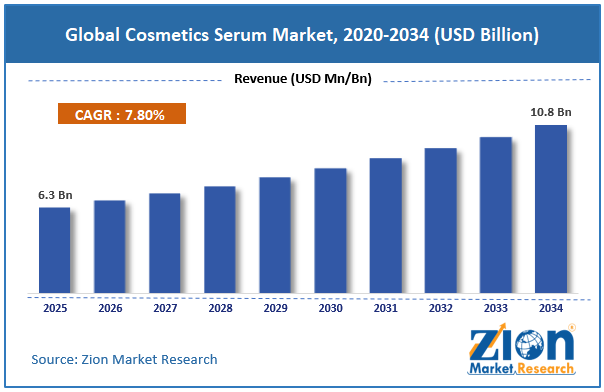
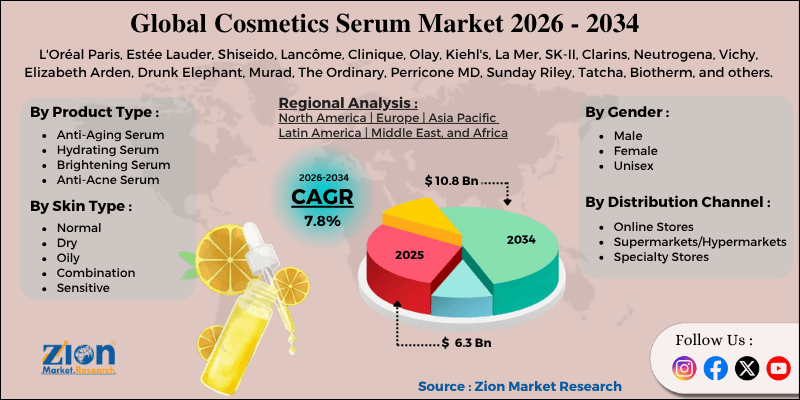
The global cosmetics serum market size was worth around USD 6.3 billion in 2025 and is predicted to grow to around USD 10.8 billion by 2034, with a compound annual growth rate (CAGR) of roughly 7.8% between 2026 and 2034.
Key Insights
- As per the analysis shared by our research analyst, the global cosmetics serum market is estimated to grow annually at a CAGR of around 7.8% over the forecast period (2026-2034).
- In terms of revenue, the global cosmetics serum market size was valued at around USD 6.3 billion in 2025 and is projected to reach USD 10.8 billion by 2034.
- Increasing social media influence is expected to propel the cosmetics serum market over the projected period.
- Based on the product type, the anti-aging serum segment dominates the market with a revenue share of 35.2% in 2025.
- Based on the skin type, the combination segment holds a majority of market share in 2025 of 29.3%.
- Based on gender, the female segment holds a majority of market share in 2025 of 68%.
- Based on the distribution channel, the online stores segment holds a majority of market share in 2025 of 42.3%.
- Based on region, the Asia Pacific dominates the cosmetics serum market with a revenue share of 38.5% in 2025.
Cosmetics Serum Market: Overview
Cosmetic serums are light, highly concentrated beauty products that deliver active ingredients to the skin. It usually contains skin-friendly ingredients such as vitamins, antioxidants, hyaluronic acid, peptides, and botanical extracts, depending on the product's purpose. Cosmetic serums help address dryness, dullness, uneven skin tone, signs of aging, and other skin texture issues. Because of their light texture, cosmetic serums are used after washing the face and before applying heavier cosmetics.
Impact of the USA-Israel War on Iran on the Cosmetics Serum Market
The United States-Israel war against Iran is creating temporary headwinds in the cosmetics serum market by disrupting international supply chains, raising transportation costs, and increasing the cost of key cosmetic ingredients and packaging materials. War-related disruptions and tensions in the Gulf region have raised freight costs and lengthened shipping times. At the same time, petrochemical-derived materials used for cosmetic packaging and formulation have also become more expensive. Suppliers of personal care product ingredients, such as silicones, preservatives, and peroxides, have raised prices, which could increase the manufacturing cost and retail prices of serums.
Cosmetics Serum Market: Dynamics
Growth Drivers
Why does rising skincare awareness drive the growth of the cosmetics serum market?
As skincare awareness grows, the cosmetics serum market is expanding because consumers now understand the importance of healthy skin and the role of active ingredients. This increased awareness has enabled consumers to switch from basic moisturizers to serums containing vitamin C, hyaluronic acid, niacinamide, retinol, and peptides that target conditions like pigmentation, dryness, acne, and signs of aging. In addition, government regulatory data indicates growth in India's beauty industry. In a 2025 SEBI filing, the estimated size of the Indian beauty and cosmetics market stood at US$20 billion, driven by changing customer preferences, rising incomes, and increased use of skincare products in daily routines. Moreover, a government report found that 83% of respondents in Delhi-NCR said they use cosmetic products daily.
Restraints
High product prices act as a major restraint on the growth of the cosmetics serum industry
The high cost of products is one of the biggest constraints on the expansion of the cosmetics serum market, as special serums usually contain concentrated ingredients, special formulae, advanced delivery systems, and advanced packaging, which drives up prices. Price-conscious consumers may opt for regular moisturizers rather than special serums. This constraint matters because consumers now compare products by ingredient efficacy, price, and value for money. The wide range of prices for active-ingredient skincare products further suggests that consumers face significant price variation for similar products. High serum prices may prevent middle- and lower-income customers from adopting these products and push them toward cheaper alternatives, thereby hampering growth of the market.
Opportunities
How does the rising product launch offer a lucrative opportunity for the cosmetics serum market?
The growing product launch is expected to create opportunities for the cosmetics serum market. For instance, in May 2025, Shiseido announced the launch of the “Sengan Serum.” It is a beauty serum that hydrates the skin by blending with water, due to Shiseido's emulsification technology. The “Sengan Serum” is part of the fibona open innovation initiative, which aims to co-create “things that do not yet exist in the world.” The “Sengan Serum” uses Droplet Membrane Emulsification Technology, which makes it possible to wash with a serum. This technology lets the serum contain oil particles that blend with the skin's stratum corneum. When one washes it off, the serum removes unnecessary components while delivering key ingredients to the skin.
Challenges
Why does consumer skepticism regarding product efficacy pose a significant challenge to the growth of the cosmetics serum industry?
Consumer skepticism about product effectiveness is a major impediment to growth in the cosmetics serum market, as consumers often question the value of high-priced serums, especially claims about anti-aging, pigmentation, whitening, acne treatment, and skin repair. With many products on the market and varying concentrations of active ingredients, it becomes hard for consumers to distinguish science-backed products from those with exaggerated claims. The FDA states that cosmetic claims should be truthful and not misleading, and cosmetics are not approved for effectiveness before sale. A 2025 study in Dermatological Reviews shows that evidence supporting these claims is scarce.
Cosmetics Serum Market: Report Scope
| Report Attributes | Report Details |
|---|---|
| Report Name | Cosmetics Serum Market |
| Market Size in 2025 | USD 6.3 Billion |
| Market Forecast in 2034 | USD 10.8 Billion |
| Growth Rate | CAGR of 7.8% |
| Number of Pages | 229 |
| Key Companies Covered | L'Oréal Paris, Estée Lauder, Shiseido, Lancôme, Clinique, Olay, Kiehl's, La Mer, SK-II, Clarins, Neutrogena, Vichy, Elizabeth Arden, Drunk Elephant, Murad, The Ordinary, Perricone MD, Sunday Riley, Tatcha, Biotherm, and others. |
| Segments Covered | By Product Type, By Skin Type, By Gender, By Distribution Channel, and By Region |
| Regions Covered | North America, Europe, Asia Pacific (APAC), Latin America, Middle East, and Africa (MEA) |
| Base Year | 2025 |
| Historical Year | 2020 - 2024 |
| Forecast Year | 2026 - 2034 |
| Customization Scope | Avail customized purchase options to meet your exact research needs. Request For Customization |
Cosmetics Serum Market: Segmentation
Product Type Insights
Why does the anti-aging serum segment hold a prominent position in the cosmetics serum market?
The anti-aging serum segment dominates the cosmetics serum market with a revenue share of 35.2% in 2025. This growth is driven by rising consumer interest in preventive skincare products, skin longevity, wrinkles, fine lines, loss of firmness, and age pigmentation. Premiumization and repurchase rates are rising as consumers increasingly seek highly concentrated skincare formulations enriched with retinol, peptides, hyaluronic acid, antioxidants, and collagen enhancers.
Moreover, product innovation plays an important role in segment growth. In 2025, L'Oréal introduced and promoted new longevity-oriented skincare technologies, namely Longevity Integrative Science and Lancôme Cell BioPrint, based on biomarkers of skin aging and personalized skincare recommendations. The company also said the launch of L'Oréal Paris Revitalift Laser Tri-Peptides Serum in 2025 positively impacted growth in the skincare segment.
Skin Type Insights
How does the combination segment capture the largest share in the cosmetics serum market?
The combination segment holds a majority share of the cosmetics serum industry in 2025 at 29.3%. Growth is driven by customers with combination skin who need a product that controls excess oil in their T-zone while hydrating other areas of their skin. This demand is for lightweight, multitasking serums with ingredients like niacinamide, hyaluronic acid, peptides, and botanical extracts.
Gender Insights
Why does the female segment capture the largest share in the cosmetics serum market?
The female segment holds a majority share of the cosmetics serum market in 2025, at 68%. Growth in skincare awareness, the development of skincare regimens, the need for personalized formulas, the luxury factor, and the impact of beauty content on social media will help drive revenue in the female cosmetics serum segment.
Distribution Channel Insights
How does the online stores segment capture the largest share in the cosmetics serum market?
The online stores segment holds a majority share of the cosmetics serum industry in 2025, at 42.3%. Increasing smartphone and internet penetration, expanding digital payment infrastructure, wider product availability, and the convenience of online purchasing are expected to support revenue growth of online stores in the cosmetics serum market.
Regional Insights
What factors drive the Asia Pacific region in the cosmetics serum market?
The Asia Pacific dominates the cosmetics serum market with a revenue share of 38.5% in 2025. Growth will be driven by rising skincare awareness, a growing middle-class population, higher disposable incomes, K-beauty & J-beauty trends, a stronger e-commerce presence, and increased demand for premium skincare products. Product innovations in 2025 have strengthened the market in the region. One such innovation was the launch of Shiseido ULTIMUNE serum in March 2025, which uses its Power Fermented Camellia+ technology along with over 30 years of R&D, reinforcing demand for high-end anti-aging and skin-strengthening serums.
Moreover, Kao also announced the launch of its Curél Intensive Moisture Care Carbonated Foam Serum in 2025, which uses carbon-dioxide foam technology with ceramide care for dry and sensitive skin, and plans to launch the product in Japan and other Asian countries. In August 2025, Amorepacific also launched its AP Beauty M.D. Serum, which features a “triple shot” concept that combines professional skincare treatments in a cosmetic serum.
Cosmetics Serum Market: Competitive Analysis
The global cosmetics serum market is dominated by players like:
- L'Oréal Paris
- Estée Lauder
- Shiseido
- Lancôme
- Clinique
- Olay
- Kiehl's
- La Mer
- SK-II
- Clarins
- Neutrogena
- Vichy
- Elizabeth Arden
- Drunk Elephant
- Murad
- The Ordinary
- Perricone MD
- Sunday Riley
- Tatcha
- Biotherm
The global cosmetics serum market is segmented as follows:
By Product Type
- Anti-Aging Serum
- Hydrating Serum
- Brightening Serum
- Anti-Acne Serum
- Others
By Skin Type
- Normal
- Dry
- Oily
- Combination
- Sensitive
By Gender
- Male
- Female
- Unisex
By Distribution Channel
- Online Stores
- Supermarkets/Hypermarkets
- Specialty Stores
- Others
By Region
- North America
- The U.S.
- Canada
- Mexico
- Europe
- France
- The UK
- Spain
- Germany
- Italy
- Rest of Europe
- Asia Pacific
- China
- Japan
- India
- Australia
- South Korea
- Rest of Asia Pacific
- The Middle East & Africa
- Saudi Arabia
- UAE
- Egypt
- Kuwait
- South Africa
- Rest of the Middle East & Africa
- Latin America
- Brazil
- Argentina
- Rest of Latin America
Table Of Content
Methodology
FrequentlyAsked Questions
A cosmetics serum is a light, highly concentrated beauty product that delivers active ingredients to the skin. It usually contains skin-friendly ingredients such as vitamins, antioxidants, hyaluronic acid, peptides, and botanical extracts, depending on the product's purpose.
The key growth drivers for the cosmetics serum market include rising skincare awareness, increasing demand for anti-aging and targeted skincare products, growing disposable incomes, premiumization, rapid e-commerce expansion, and continuous innovation in active ingredients and formulations. Consumers increasingly seek concentrated products with ingredients such as vitamin C, hyaluronic acid, niacinamide, retinol, and peptides to address specific concerns, including pigmentation, acne, dryness, and signs of aging.
The major challenges restraining the growth of the cosmetics serum market include high product prices, consumer skepticism regarding product efficacy, skin sensitivity and adverse reactions, stringent cosmetic regulations, counterfeit and low-quality products, formulation complexity, and intense market competition. Premium serums containing advanced active ingredients can be expensive, limiting adoption among price-sensitive consumers. In contrast, concerns about irritation from ingredients such as retinol and exfoliating acids can discourage regular use.
Based on the product type, the anti-aging serum segment is expected to dominate the cosmetics serum market growth during the projected period.
The emerging trends and innovations impacting the cosmetics serum market include AI-powered skin analysis, personalized skincare, biotechnology-based ingredients, clean and sustainable formulations, multifunctional serums, advanced delivery systems, and skin-longevity products. AI is increasingly being used to analyze skin images and recommend customized products, while advances in genomics and proteomics are supporting more precise skincare formulations.
According to the report, the global cosmetics serum market size was worth around USD 6.3 billion in 2025 and is predicted to grow to around USD 10.8 billion by 2034.
The global cosmetics serum market is expected to grow at a CAGR of 7.8% during the forecast period.
The global cosmetics serum industry growth is expected to be led by the Asia Pacific over the forecast period.
The global cosmetics serum market is dominated by players like L'Oréal Paris, Estée Lauder, Shiseido, Lancôme, Clinique, Olay, Kiehl's, La Mer, SK-II, Clarins, Neutrogena, Vichy, Elizabeth Arden, Drunk Elephant, Murad, The Ordinary, Perricone MD, Sunday Riley, Tatcha, and Biotherm, among others.
The cosmetics serum market report covers the geographical market along with a comprehensive competitive landscape analysis. It also includes cash flow analysis, profit ratio analysis, market basket analysis, market attractiveness analysis, sentiment analysis, PESTLE analysis, trend analysis, SWOT analysis, trade area analysis, demand & supply analysis, Porter’s five forces analysis, and value chain analysis.

HappyClients

