
Baby Toys Market Size, Share, Trends, Growth and Forecast 2034

Baby Toys Market By Type (Soft and Plush Toys, Wooden and Sensory Toys, Musical and Electronic Toys, Bath and Water Toys), By Application (Cognitive Development, Motor Skill Development, Sensory Stimulation, Emotional Bonding and Comfort), By End-use Industry (Retail and Specialty Stores, Online and E-commerce Platforms, Daycare and Early Learning Centers, Hospital and Maternity Gift Segment), By Material (Organic Cotton and Fabric, Natural Wood, BPA Free Plastic, Silicone Based Materials), and By Region - Global and Regional Industry Overview, Market Intelligence, Comprehensive Analysis, Historical Data, and Forecasts 2026 - 2034
| Market Size in 2025 | Market Forecast in 2034 | CAGR (in %) | Base Year |
|---|---|---|---|
| USD 27.00 Billion | USD 44.89 Billion | 5.80% | 2025 |
Baby Toys Industry Perspective:
What will be the size of the baby toys market during the forecast period?
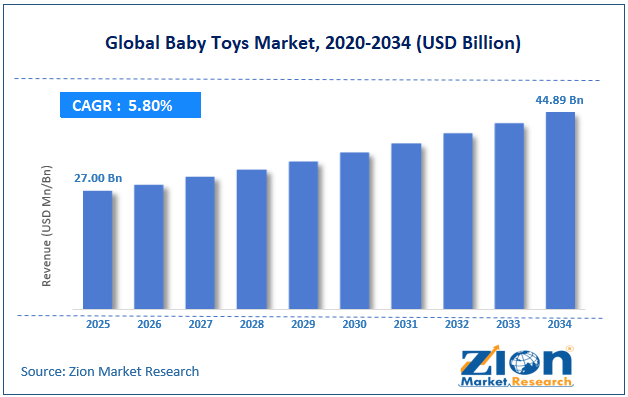
The global baby toys market size was valued at approximately USD 27.00 billion in 2025 and is projected to reach around USD 44.89 billion by 2034, growing at a compound annual growth rate of approximately 5.80% between 2026 and 2034.
Key Insights
- As per the analysis shared by our research team, the global baby toys market is estimated to grow at a compound annual growth rate of approximately 5.80% during the forecast period from 2026 to 2034.
- In terms of revenue, the global baby toys market was valued at approximately USD 27.00 billion in 2025 and is projected to reach USD 44.89 billion by 2034.
- The baby toys market is expected to grow strongly due to rising birth rates in certain developing regions, increasing parental awareness of early childhood development, growing preference for screen-free play, and expanding demand for chemical-free and organic materials.
- Based on type, soft and plush toys lead the market because of their strong appeal for comfort and emotional bonding, while musical and electronic toys are gaining strong momentum as one of the fastest-growing types due to rising demand for interactive and sound-based stimulation.
- Based on application, sensory stimulation leads the market because it is widely used to encourage touch and sound exploration. At the same time, cognitive development is the fastest-growing segment as parents seek toys that support early problem-solving and memory skills.
- Based on end-use industry, online and e-commerce platforms lead the market due to convenient browsing and doorstep delivery for busy parents, while daycare and early learning centers are steadily growing as more families enroll infants in structured early education programs.
- Based on material, BPA-free plastic leads the market due to its durability and affordability, while organic cotton and fabric materials are growing rapidly as parents look for gentler, chemical-free options for their infants.
- Based on region, Asia Pacific leads the global baby toys market. At the same time, North America is the fastest-growing region due to rising awareness of developmental play and strong demand for premium, safety-certified products.
Baby Toys Market: Overview
Baby toys are play products designed for infants and toddlers to support early learning, sensory development, motor skills, and emotional comfort. The baby toys market includes rattles, teething toys, soft toys, activity toys, stacking toys, and other products that help babies explore the world through touch, sound, sight, and movement. Unlike simple entertainment products, baby toys can support important developmental stages by encouraging babies to grasp, reach, hold, shake, chew, and recognize different shapes, sounds, and textures. The market is growing as parents become more aware of early play's role in brain development, coordination, and learning. Demand is also increasing for screen-free toys that encourage hands-on activities and keep babies actively engaged. Safety is another major factor, with parents looking for toys made from non-toxic, BPA-free, natural, organic, and child-safe materials. Manufacturers are also introducing age-specific designs that match different developmental needs. Growing online shopping, rising spending on children’s products, and strong demand for baby shower and newborn gifts are further supporting market growth. Increasing parental interest in educational and sensory toys is creating new opportunities for manufacturers worldwide. Safer designs are becoming important buying factors for families.
The baby toys industry will continue to expand as toy designers, child development researchers, and safety-conscious manufacturers work together to build gentler, smarter, and more nurturing play products for the youngest members of every family.
Baby Toys Market: Strategic Perspective
Where is the baby toys market heading?
The baby toys market is expected to shift toward more developmentally targeted products designed around specific age groups and growth milestones rather than generic play items. A greater focus on natural material sourcing, improved safety testing, and expanded personalization options could help baby toys become even more closely tied to expert-backed early childhood development guidance in the years ahead.
Where should businesses invest in the baby toys market?
The baby toys market offers promising investment opportunities in organic material sourcing, sensory-focused product design, subscription-based toy rotation services, and developmental milestone tracking tools bundled with physical products. Companies that can deliver chemical-free manufacturing, durable, washable designs, and age-appropriate educational content may benefit as more parents seek toys that combine safety with real developmental value.
What will reshape competition in the baby toys market?
Competition in the baby toys market is likely to be shaped by safety certifications, material transparency, brand trust, and the ability to demonstrate genuine developmental benefits backed by pediatric research. Companies that offer strong quality assurance, appealing, gift-able packaging, and reliable availability across retail stores and online platforms are likely to gain an advantage.
Baby Toys Market: Technology Roadmap 2026–2034
What is the projected development roadmap of the baby toys market over the forecast period?
The baby toys market is advancing through improved material safety standards, more thoughtful developmental design, expanding use of natural and organic materials, and growing integration of gentle interactive features, making these products more trustworthy and appealing for cautious modern parents. The market is expected to grow at a compound annual growth rate of approximately 5.80% over the forecast period, driven by rising parental awareness, expanding early education enrollment, and continuous refinement of child safety research.
The following roadmap outlines key development phases expected through 2034.
2026–2028: Safety Standardization and Awareness Building Phase
- Stricter material testing: Manufacturers are expected to adopt more rigorous chemical and choking hazard testing to reassure increasingly cautious parents.
- Growing pediatric collaboration: Toy companies and child development experts are likely to work more closely together to design toys around verified developmental milestones.
- Rising online research culture: Baby toys are expected to see increased scrutiny as parents compare safety ratings, reviews, and certifications before purchasing through online platforms.
2029–2031: Product Personalization and Market Expansion Phase
- Expanded age-specific product lines: Manufacturers are expected to introduce more toys tailored to narrow age brackets, from newborn to toddler stages, for more precise developmental support.
- Subscription and rotation services: Brands are expected to launch toy rental and rotation subscriptions that keep infants engaged with fresh items without constant new purchases.
- Growth in daycare and institutional demand: Baby toys are expected to spread further into daycare centers and early learning facilities as structured infant care programs expand globally.
2032–2034: Mainstream Sustainability and Smart Integration Phase
- Fully biodegradable toy lines: Companies are likely to develop toys made entirely from compostable or plant-based materials to reduce long-term environmental impact.
- Gentle interactive features: Baby toys may increasingly include soft sensors and low-stimulation sounds that respond to a baby's movement without overwhelming young senses.
- Broader safety regulation harmonization: As safety data accumulates globally, more countries may align their testing and certification standards, making cross-border trade of baby toys smoother and more consistent.
Baby Toys Market: Dynamics
Growth Drivers
What is driving the expansion of the baby toys market across developmental applications?
The baby toys market is expanding as parents increasingly seek products that support early development rather than provide entertainment alone. Parents are choosing toys that help babies practice grasping, reaching, holding, and visual tracking during important developmental stages. Soft, colorful, and textured toys also provide comfort while encouraging touch, movement, and sensory exploration. Growing awareness of infant development is prompting manufacturers to design products that support physical coordination, sensory learning, and emotional comfort. Demand for early learning toys is rising as daycare centers and preschools introduce age-appropriate products for guided play and basic skill building. Manufacturing advances are helping companies produce safer, stronger, and more affordable baby toys for everyday use. Baby showers and newborn celebrations are also supporting sales, as families and friends increasingly select toys as practical gifts. In addition, growing awareness of screen-free play is encouraging parents to choose tactile, musical, and activity-based toys instead of phones and tablets. Together, these factors are strengthening demand for baby toys across homes, nurseries, daycare centers, and early learning environments.
Growing parental focus on early development is creating opportunities in the baby toys market.
The baby toys market is creating opportunities as parents and caregivers seek products that combine play with meaningful early learning. Developmental toys can help babies improve motor skills, hand-eye coordination, sensory awareness, and basic problem-solving through simple activities. Daycare centers and nurseries are also adopting age-appropriate and safety-tested toys to create engaging play environments. Retailers are exploring toy subscription and rotation services, giving families access to different products without repeatedly purchasing new toys. Manufacturers are developing specialized baby toys for different age groups, using safe materials, appealing designs, and features linked to specific developmental needs. Rising interest in early childhood education is also encouraging toy companies to collaborate with childcare providers and child development specialists. Sustainable parenting trends are creating demand for durable, reusable, biodegradable, and eco-friendly toys that can reduce household waste. Growing online sales are helping manufacturers reach parents directly while expanding product visibility across wider markets. These developments are creating opportunities for product innovation, sustainable design, specialized offerings, and long-term growth in the baby toys market across multiple consumer segments.
Restraints
How are safety recalls and material concerns affecting the baby toys market?
The baby toys market faces challenges related to product safety, material quality, durability, and changing parental expectations. Safety recalls involving choking hazards, toxic materials, or unsafe coatings can reduce consumer trust, especially among parents buying from unfamiliar brands. Differences in safety standards and testing requirements across countries can also make it difficult for consumers to compare products and identify reliable options. Lower-cost manufacturers may face concerns about inconsistent quality, while established brands often benefit from stronger safety records. Durability is another challenge because babies frequently chew, drop, pull, and throw toys during everyday play. Producing toys that are both safe and durable requires high-quality materials and careful manufacturing, which can increase production costs. Smaller manufacturers may also face limited access to certified testing facilities, causing delays in product approval and market entry. Clear safety labels, stronger quality checks, third-party certification, and transparent information about materials can help manufacturers build parental trust. Improving these areas can support wider acceptance of baby toys across homes, nurseries, and childcare centers worldwide.
Opportunities
Broader developmental awareness is creating new opportunities in the baby toys market.
The baby toys market is gaining new opportunities as parents, daycare centers, and healthcare providers place greater emphasis on early childhood learning. Developmental toys help babies build motor skills, coordination, sensory awareness, and basic learning abilities through age-appropriate activities. Childcare providers are also adopting structured toy sets designed around different age groups and developmental stages. Retailers are using shopping behavior and customer preferences to provide personalized product recommendations across physical stores and e-commerce platforms. Toy manufacturers are introducing themed collections based on learning concepts, popular characters, and seasonal gifting occasions to attract both parents and gift buyers. Growing demand for organic, sustainable, and non-toxic materials is encouraging safer product development for environmentally conscious families. Expanding daycare services, preschool enrollment, and early learning awareness are creating additional demand across homes and childcare facilities. Subscription-based toy rotation services are gaining attention by providing families with regular access to different toys. Hospitals and maternity programs also offer opportunities through newborn gifting initiatives. Companies offering safe, durable, educational, and engaging baby toys can expand across retail, e-commerce, daycare, healthcare, and gifting channels while building stronger customer relationships.
Challenges
Limited trust-building and regulatory variation are creating challenges for the baby toys market.
The baby toys market faces challenges from cautious parents, changing safety regulations, and differences in product quality across manufacturers. Because infant safety is a major concern, parents often hesitate to buy unfamiliar brands, making it difficult for new companies to build trust. Safety rules also differ between countries, particularly for materials, small parts, and choking hazards, creating additional challenges for manufacturers and retailers entering new markets. Product quality can vary by manufacturing process, materials, and quality controls, raising concerns about safety and durability. Soft toys may also require careful cleaning and hygiene management because babies frequently touch, chew, and handle them. Manufacturers must invest in reliable testing, safety certifications, and clear labeling to meet growing parental expectations. Limited access to independent testing facilities in some regions can increase costs and delay product launches. Improving quality control, strengthening safety testing, using safer materials, and providing clear product information can help companies build consumer confidence. Better awareness and consistent safety practices can further support wider adoption across homes, nurseries, and childcare facilities.
Baby Toys Market: Report Scope
| Report Attributes | Report Details |
|---|---|
| Report Name | Baby Toys Market |
| Market Size in 2025 | USD 27.00 Billion |
| Market Forecast in 2034 | USD 44.89 Billion |
| Growth Rate | CAGR of 5.80% |
| Number of Pages | 229 |
| Key Companies Covered | Fisher-Price, Lamaze, VTech, Melissa and Doug, Manhattan Toy, Skip Hop, Sassy Baby, Infantino, Tiny Love, Hape Holding, and others. |
| Segments Covered | By Type, By Application, By End Use Industry, By Material, and By Region |
| Regions Covered | North America, Europe, Asia Pacific (APAC), Latin America, Middle East, and Africa (MEA) |
| Base Year | 2025 |
| Historical Year | 2020 - 2024 |
| Forecast Year | 2026 - 2034 |
| Customization Scope | Avail customized purchase options to meet your exact research needs. Request For Customization |
Baby Toys Market: Segmentation
The global baby toys market is segmented by type, application, end-use industry, material, and region.
What makes soft and plush toys the dominant type in the baby toys market?
By type, the market is segmented into soft and plush, wooden and sensory, musical and electronic, and bath and water toys. Soft and plush toys hold about 38% of the market share, leading due to their strong appeal for comfort, cuddling, and emotional bonding between infants and their toys. Musical and electronic toys hold around 23% market share. This segment is the fastest-growing because demand is rising for interactive products that respond with sound, light, and gentle movement.
How does the sensory stimulation application maintain its leading position in the baby toys market?
Based on application, the baby toys industry is divided into cognitive development, motor skill development, sensory stimulation, and emotional bonding and comfort. Sensory stimulation accounts for about 33% of the global market share, driven by the widespread use of toys that encourage touch, sound, and visual exploration in the early months. Cognitive development accounts for around 22% of the market share. It is the fastest-growing segment because parents are increasingly interested in toys that support early problem-solving and memory formation.
What makes online and e-commerce platforms the dominant end-use industry in the baby toys market?
Based on end-use industry, the market is classified into retail and specialty stores, online and e-commerce platforms, daycare and early learning centers, and the hospital and maternity gift segment. Online and e-commerce platforms lead with about a 36% share because they offer convenience for busy parents who prefer to research and order from home. Daycare and early learning centers hold around 19% market share. This segment is growing steadily as more families enroll infants in structured early education and childcare programs.
How does the BPA-free plastic category shape the demand landscape of the baby toys market?
Based on material, the baby toys market is categorized into organic cotton and fabric, natural wood, BPA-free plastic, and silicone-based materials. BPA-free plastic accounts for about 34% of the market, leading because of its durability, affordability, and wide availability across price points. Organic cotton and fabric materials hold around 25% market share. This segment is expanding quickly as safety-conscious parents look for gentler, chemical-free options for their infants.
Baby Toys Market: Regional Analysis
Why is Asia Pacific leading the global baby toys market?
Asia Pacific holds a 39.15% share of the global baby toys market and is expected to maintain its leading position during the forecast period. The region benefits from large populations of young families, rising disposable incomes, strong manufacturing capabilities, and growing spending on baby products. China, India, and Japan are major contributors, supported by local manufacturers producing toys for domestic markets and exports. Growing awareness of early childhood development is encouraging parents to choose developmental toys that support sensory learning, motor skills, and coordination instead of products focused only on entertainment. Online parenting content and pediatric guidance are also helping families understand the value of age-appropriate play. Government support for early childhood education in several countries is encouraging preschools and daycare centers to use suitable learning toys. The region’s strong textile, plastics, and manufacturing industries also help companies produce affordable products at large volumes. Rapid growth in e-commerce is making baby toys more accessible to families in smaller cities and towns. Parenting fairs, baby product exhibitions, and online marketplaces are further improving product visibility. Increasing investment in safety standards, product quality, and innovative designs is expected to support continued demand across the region during the forecast period.
What makes North America the fastest-growing region in the baby toys market?
North America accounts for 27.93% of the global baby toys market and is expected to remain an important regional market during the forecast period. The region benefits from growing awareness of developmental play, high parental spending power, strong demand for safety-certified products, and increasing interest in products that support early learning. The United States and Canada are major contributors, supported by established retail networks and active online parenting communities. Parents increasingly research toy materials, safety features, age recommendations, and developmental benefits before making purchases, encouraging manufacturers to provide clear product information. Retailers and specialty baby stores are also offering toys designed for specific developmental stages, making it easier for families to choose suitable products. Growing interest in organic, sustainable, and non-toxic baby products is prompting companies to introduce toys made from natural, environmentally friendly materials. Safety testing, quality certification, and transparent labeling remain important factors for manufacturers competing in the region. Baby showers, newborn celebrations, and holiday gifting are also supporting demand for premium, personalized, and educational toys. In addition, daycare centers and early learning facilities are creating opportunities for development-focused products. Expanding e-commerce and direct-to-consumer sales are making baby toys more accessible, supporting continued regional demand across both online and offline channels.
Recent Market Developments
- In April 2026, People Co., Ltd. launched Baby Curiosity, a new baby toy brand designed around changes in infants’ curiosity and play behaviors during their first year. The range focuses on age-appropriate exploration and sensory play.
- In September 2026, Kids2 introduced Hello Einstein, a new toddler and preschool brand that extends Baby Einstein’s curiosity-led learning approach into a broader, milestone-focused product and content range.
Baby Toys Market: Competitive Analysis
The leading players in the global baby toys market are:
- Fisher-Price
- Lamaze
- VTech
- Melissa and Doug
- Manhattan Toy
- Skip Hop
- Sassy Baby
- Infantino
- Tiny Love
- Hape Holding
The global baby toys market is segmented as follows:
By Type
- Soft and Plush Toys
- Wooden and Sensory Toys
- Musical and Electronic Toys
- Bath and Water Toys
By Application
- Cognitive Development
- Motor Skill Development
- Sensory Stimulation
- Emotional Bonding and Comfort
By End Use Industry
- Retail and Specialty Stores
- Online and E-commerce Platforms
- Daycare and Early Learning Centers
- Hospital and Maternity Gift Segment
By Material
- Organic Cotton and Fabric
- Natural Wood
- BPA-Free Plastic
- Silicone-Based Materials
By Region
- North America
- The U.S.
- Canada
- Mexico
- Europe
- France
- The UK
- Spain
- Germany
- Italy
- Rest of Europe
- Asia Pacific
- China
- Japan
- India
- Australia
- South Korea
- Rest of Asia Pacific
- The Middle East & Africa
- Saudi Arabia
- UAE
- Egypt
- Kuwait
- South Africa
- Rest of the Middle East & Africa
- Latin America
- Brazil
- Argentina
- Rest of Latin America
Table Of Content
Methodology
FrequentlyAsked Questions
Baby toys are play products designed for infants and toddlers to support early learning, sensory development, motor skills, and emotional comfort.
The global baby toys market is expected to grow due to rising parental awareness of early development, growing preference for screen-free play, expanding demand for chemical-free materials, and increasing enrollment in structured early education programs.
According to research, the global baby toys market was valued at approximately USD 27.00 billion in 2025 and is projected to reach approximately USD 44.89 billion by 2034.
The baby toys market is expected to grow at a compound annual growth rate of approximately 5.80% from 2026 to 2034.
Asia Pacific is expected to lead the global baby toys market throughout the forecast period, driven by large populations of young families and rapidly rising disposable incomes.
The major players in the global baby toys market include Fisher-Price, Lamaze, VTech, Melissa and Doug, Manhattan Toy, Skip Hop, Sassy Baby, Infantino, Tiny Love, and Hape Holding.
The report examines key aspects of the baby toys market, including research and development drivers, adoption barriers, application opportunities, competitive landscape dynamics, detailed regional market performance analysis, and a comprehensive forward-looking outlook across all major types, applications, end-use industries, materials, and geographic regions through 2034.
The baby toys market offers opportunities in developmental toys, sustainable materials, e-commerce, subscription services, safety-certified products, and partnerships with daycare centers, retailers, healthcare providers, and parenting platforms.
The baby toys market value chain includes raw material sourcing, toy design and development, manufacturing, safety testing, packaging, distribution, retail and e-commerce, followed by sales and customer support.
Sustainable material development, subscription-based toy rotation, pediatric-backed product design, and gentle interactive sensory features are key trends shaping the baby toys market. Growing collaboration between toy manufacturers and child development experts is also expanding their everyday use.

HappyClients

