
Plant-Based Shrimp Market Size, Share, Trends, Growth and Forecast 2034

Plant-Based Shrimp Market By Source (Seaweed, Legume Protein, Plant Based Omega 3, Soy Protein, Pea Protein and Others), By Storage (Frozen, Refrigerated and Shelf Stable), By Distribution Channel (Online and Offline) and By Region - Global and Regional Industry Overview, Market Intelligence, Comprehensive Analysis, Historical Data, and Forecasts 2025 - 2034
| Market Size in 2024 | Market Forecast in 2034 | CAGR (in %) | Base Year |
|---|---|---|---|
| USD 1.2 Billion | USD 3.9 Billion | 12.5% | 2024 |
Plant-Based Shrimp Industry Perspective:
What will be the size of the global plant-based shrimp market during the forecast period?
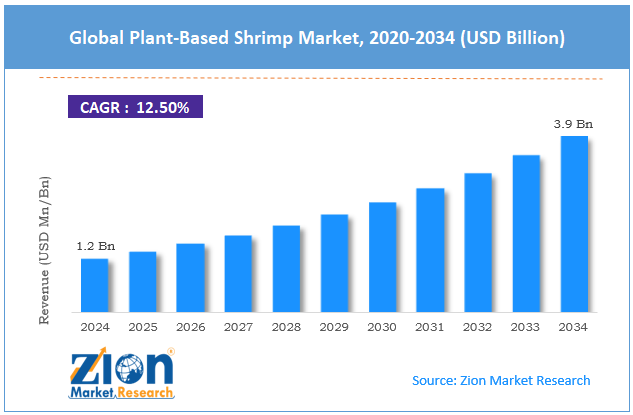
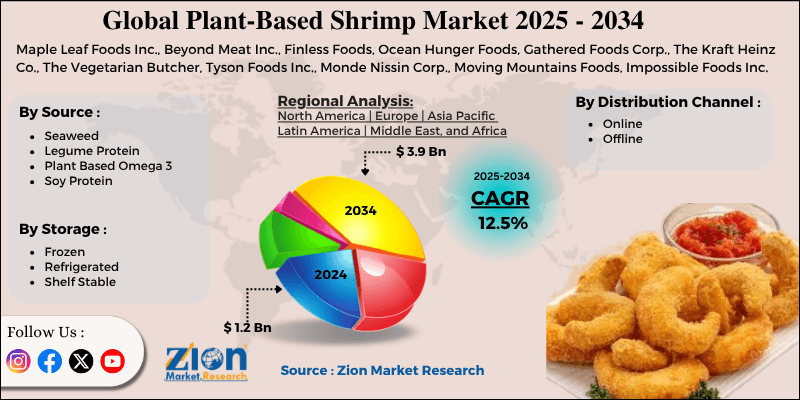
The global plant-based shrimp market size was worth around USD 1.2 billion in 2024 and is predicted to grow to around USD 3.9 billion by 2034 with a compound annual growth rate (CAGR) of roughly 12.5% between 2025 and 2034.
Plant-Based Shrimp Market: Overview
The plant-based shrimp market comprises all industries involved in manufacturing, developing, and selling alternative seafood products. Completely plant-based seafood substitutes are made from soy protein, pea protein, seaweed, algae, konjac, and other natural sources that replicate the look, flavor, and texture of traditional shrimp, but with a more sustainable, cruelty-free, and environmentally friendly approach. Retail, foodservice, ready-to-eat, vegan, vegetarian, flexitarian, and health-conscious plant-based seafood products are growing in popularity. The market is primarily driven by increased consumer awareness of the need for marine preservation, the growing movement toward sustainability, and the rising focus on the health implications of seafood consumption. Food processing and ingredient innovation technological trends have both contributed to major technological advancements, leading to a far more competitive and authentic seafood proxy.
Key Insights
- As per the analysis shared by our research analyst, the global plant-based shrimp market is estimated to grow annually at a CAGR of around 12.5% over the forecast period (2025-2034).
- In terms of revenue, the global Plant-Based Shrimp market size was valued at around USD 1.2 billion in 2024 and is projected to reach USD 3.9 billion by 2034.
- Growing adoption of vegan, vegetarian, and flexitarian diets worldwide is expected to propel the plant-based shrimp market over the projected period.
- Based on the source, the soy protein segment accounted for the largest revenue share in 2024 of 33%.
- Based on the storage, the frozen segment accounted for the largest revenue share in 2024.
- Based on the distribution channel, the offline segment held the largest market share in 2024.
- Based on region, North America led the plant-based shrimp market in 2024 of 38%.
Impact of the USA-Israel War on Iran on the Plant-Based Shrimp Market
The impact of the USA-Israel war, which concerns Iran, has also indirectly affected the global Plant-Based Shrimp Market through its influence on the seafood supply chain, increases in fuel and transport costs, and conventional shrimp prices. The soaring prices of diesel and disruptions in some crucial trade routes (e.g., the Strait of Hormuz) have increased operational costs for the seafood sector, making conventional products more expensive and increasingly unfriendly to consumers. It has prompted a number of consumers and foodservice providers to consider alternative plant-based seafood products, including plant-based shrimps, which could be more reliable and sustainable alternatives to conventional shrimp. Meanwhile, the tension has imposed some obstacles for plant-based seafood firms to develop in a long-term perspective, particularly due to the escalation of raw material, packaging, and shipping costs following inflation and the disruption of logistics.
Plant-Based Shrimp Market: Dynamics
Growth Drivers
Why does the rising consumer demand for sustainable and eco-friendly seafood alternatives drive the plant-based shrimp market?
Growing consumer preferences for eco-friendly, sustainable substitutes for traditional seafood are yet another trend, and driving force behind the plant-based shrimp market. Concerns about overfishing, pollution of the seas, and the damaging environmental impacts of conventional shrimp cultivation are driving a strong consumer trend toward plant-based alternatives to traditional seafood products. As a more sustainable product, Plant-Based Shrimp helps reduce the need for marine resources, greenhouse gas emissions, and water intake involved in the production of traditional seafood. Increasing numbers of vegans, vegetarians, and flexitarians are also driving global demand for ethical, sustainable seafood alternatives.
Restraints
High production and manufacturing costs of plant-based shrimp products hamper the growth of the plant-based shrimp industry
Higher production and manufacturing costs of the plant-based shrimp products restrain the expansion of the Plant-Based Shrimp Market by raising overall product prices, making them less affordable for mass consumers. The creation of realistic shrimp non-meat alternatives poses the challenge of using state-of-the-art food processing technology and equipment, along with high-quality plant-based ingredients such as pea protein, soy proteins, algae and seaweed, which all contribute significantly to higher production costs. Along with this, ongoing innovation, research, and development ensure improved flavor, texture, and nutrition, further increasing total manufacturing costs. Therefore, plant-based shrimp products cost more than conventional shrimp, which limits their adoption, especially in developing and price-sensitive markets.
Opportunities
Why does the growing product launch offer a lucrative opportunity for the Plant-Based Shrimp market?
The growing product launch is expected to offer a lucrative opportunity for the Plant-Based Shrimp market over the projected period. For instance, in November 2024, Mind Blown by The Plant-Based Seafood Co. announced the launch of its newest plant-based seafood product as an LTO: Crispy, Crunchy, Fried Shrimp. To gear up for the holiday season, Mind Blown is thrilled to be launching an exclusive holiday item for consumers looking to indulge and treat themselves and friends to an amazing product that is perfect for vegans and seafood lovers. Alongside of course, their award-winning Mind Blown Crab Cakes, Coconut Shrimp, and Dusted Scallops, the new Crispy, Crunchy, Fried Shrimp will be available in DTC and foodservice channels for a limited time only. The new item joins the Mind Blown portfolio of plant-based seafood products, including the renowned Chesapeake Bay-Style Crab Cakes for both frozen cakes and Dry Ready-to-Mix, frozen Dusted Bay Scallops, frozen Coconut Shrimp for sale to foodservice at Webstaurant Store, and a Shelf Stable Sea Scallop.
Challenges
Why does the strong consumer preference for traditional seafood and conventional shrimp products pose a significant challenge to the plant-based shrimp market?
The strong consumer inclination towards conventional and authentic seafood and shrimp products can hamper the adoption of plant-based shrimp products, as many consumers still crave the taste, aroma, texture, and techniques that go into real shrimp. Traditional dishes and conventional seafood products are a part of many regional cuisines and other food cultures. So, there is resistance in consumers being willing to move on from the real shrimps to shell-free varieties, as the ‘shrimp’ has been largely used as an ingredient in many Asian cuisines, and also in a few other food cultures, and some consumers find it to be less ‘healthy’, less ‘natural,’ and have certain doubts regarding their nutritional value as well. Despite the availability of implementation technologies, manufacturers still struggle to match the primary sensory features of real shrimps to achieve repeat purchases. Also, because traditional seafood and shrimp products are cheaper than plant-based ones, consumers' preference for them would be a major constraint on the plant-based market's success.
Plant-Based Shrimp Market: Report Scope
| Report Attributes | Report Details |
|---|---|
| Report Name | Plant-Based Shrimp Market |
| Market Size in 2024 | USD 1.2 Billion |
| Market Forecast in 2034 | USD 3.9 Billion |
| Growth Rate | CAGR of 12.5% |
| Number of Pages | 227 |
| Key Companies Covered | Maple Leaf Foods Inc., Beyond Meat Inc., Finless Foods, Ocean Hunger Foods, Gathered Foods Corp., The Kraft Heinz Co., The Vegetarian Butcher, Tyson Foods Inc., Monde Nissin Corp., Moving Mountains Foods, Impossible Foods Inc., Good Catch, Van Cleve Seafood, The Tofurky Co. Inc., Sophie’s Kitchen, New Wave Foods, OmniFoods, Vegan Zeastar, Plantish, Aqua Cultured Foods, and others. |
| Segments Covered | By Source, By Storage, By Distribution Channel, and By Region |
| Regions Covered | North America, Europe, Asia Pacific (APAC), Latin America, Middle East, and Africa (MEA) |
| Base Year | 2024 |
| Historical Year | 2019 - 2023 |
| Forecast Year | 2025 - 2034 |
| Customization Scope | Avail customized purchase options to meet your exact research needs. Request For Customization |
Plant-Based Shrimp Market: Segmentation
Source Insights
Why does the soy protein dominate the plant-based shrimp market?
The soy protein segment accounted for the largest revenue share in 2024 of 33%. The growth of soy protein can be attributed to its high protein levels, value for money, and strong replicating properties of traditional shrimp texture and structure. Soy protein is increasingly used by manufacturers due to its good binding, water retention, and fibrous characteristics, which help achieve a more realistic seafood-like mouthfeel. Moreover, the widespread availability and mature supply chain of soy-derived ingredients make production more scalable and cost-effective than other plant-based proteins.
Storage Insights
How does the frozen segment capture the largest market share in the plant-based shrimp market?
The frozen segment accounted for the largest revenue share in 2024. Market growth is driven by rising consumer preference for convenient, ready-to-cook, and longer shelf-life seafood substitutes. Frozen plant-based seafood products ensure product freshness and textural and flavor integrity for a longer shelf life and are suitable for retail, supermarkets, hypermarkets, e-commerce, and other channels. Further, the rising preference among the working urban population for instant meal options as a time-saver is expected to drive demand for frozen plant-based seafood products globally.
Distribution Channel Insights
Does the offline segment capture the largest market share in the plant-based shrimp market?
The offline segment held the largest market share in 2024. The growth can be attributed to the viability of supermarkets, hypermarkets, specialty grocery stores and retail chains providing consumers with easy access and shopping convenience. Consumers prefer to purchase plant-based seafood products in bricks and mortar stores because packaging, ingredients, nutritional information and product quality can be more easily examined before the purchase decision. Promotions in store, sampling campaigns and dedicated sections for plant-based foods are also aiding in the awareness and trial of plant-based shrimp products.
Regional Insights
Why does North America lead the plant-based shrimp market?
North America led the plant-based shrimp market in 2024 of 38%. The market growth in this region is attributed to growing consumer awareness of the benefits of reducing consumption of animal-based products, conserving the environment, and the health advantages of increased consumption of plant-based diets. Moreover, the growing popularity of vegan, vegetarian, and flexitarian lifestyles in the United States and Canada has driven demand for alternative seafood products, including plant-based shrimp. Consumers in the region are increasingly using low-calorie, cholesterol-free, low-fat, and environmentally friendly protein sources, which is aiding the market's growth.
Additionally, the competitive presence of renowned manufacturers of plant-based foods, innovative food technology firms, and the introduction of new offerings are further bolstering market growth in North America. The wider availability of the product through supermarkets, farmers’ markets, grocery stores, restaurants, and online retail outlets is leading to faster consumer reach and market expansion. Besides, increased funding for research and development of alternative protein foods, overwhelming consumer marketing and promotion, and surging availability of frozen, easy-to-prepare plant-based seafood products will drive higher revenue growth in the North American plant-based shrimp market.
Plant-Based Shrimp Market: Competitive Analysis
The global plant-based shrimp market is dominated by players like;
- Maple Leaf Foods Inc.
- Beyond Meat Inc.
- Finless Foods
- Ocean Hunger Foods
- Gathered Foods Corp.
- The Kraft Heinz Co.
- The Vegetarian Butcher
- Tyson Foods Inc.
- Monde Nissin Corp.
- Moving Mountains Foods
- Impossible Foods Inc.
- Good Catch
- Van Cleve Seafood
- The Tofurky Co. Inc.
- Sophie’s Kitchen
- New Wave Foods
- OmniFoods
- Vegan Zeastar
- Plantish
- Aqua Cultured Foods
The global plant-based shrimp market is segmented as follows:
By Source
- Seaweed
- Legume Protein
- Plant Based Omega 3
- Soy Protein
- Pea Protein
- Others
By Storage
- Frozen
- Refrigerated
- Shelf Stable
By Distribution Channel
- Online
- Offline
By Region
- North America
- The U.S.
- Canada
- Mexico
- Europe
- France
- The UK
- Spain
- Germany
- Italy
- Rest of Europe
- Asia Pacific
- China
- Japan
- India
- Australia
- South Korea
- Rest of Asia Pacific
- The Middle East & Africa
- Saudi Arabia
- UAE
- Egypt
- Kuwait
- South Africa
- Rest of the Middle East & Africa
- Latin America
- Brazil
- Argentina
- Rest of Latin America
Table Of Content
Methodology
FrequentlyAsked Questions
The plant-based shrimp market comprises all industries involved in manufacturing, developing, and selling alternative seafood products. Completely plant-based seafood substitutes are made from soy protein, pea protein, seaweed, algae, konjac, and other natural sources that replicate the look, flavor, and texture of traditional shrimp, but with a more sustainable, cruelty-free, and environmentally friendly approach.
Key growth drivers for the Plant-Based Shrimp Market include rising demand for sustainable seafood alternatives, growing adoption of plant-based diets, increasing environmental awareness, and continuous innovation in alternative seafood products.
Major challenges restraining the growth of the Plant-Based Shrimp Market include high production costs, premium product pricing, difficulties in replicating the taste and texture of real shrimp, limited consumer awareness, and strong preference for traditional seafood products.
Based on the distribution channel, the offline segment is expected to dominate the plant-based shrimp market growth during the projected period.
Emerging trends and innovations impacting the plant-based shrimp market include advancements in food technology to improve shrimp-like taste and texture, increasing use of ingredients such as algae, seaweed, and pea protein, growth in clean-label and high-protein formulations, expansion of frozen and ready-to-cook plant-based seafood products, and rising investments in alternative seafood innovation and sustainable packaging solutions.
According to the report, the global plant-based shrimp market size was worth around USD 1.2 billion in 2024 and is predicted to grow to around USD 3.9 billion by 2034.
The global plant-based shrimp market is expected to grow at a CAGR of 12.5% during the forecast period.
The global plant-based shrimp industry growth is expected to be led by North America over the forecast period.
The global plant-based shrimp market is dominated by players like Maple Leaf Foods, Inc., Beyond Meat, Inc., Finless Foods, Ocean Hunger Foods, Gathered Foods Corp., The Kraft Heinz Co., The Vegetarian Butcher, Tyson Foods, Inc., Monde Nissin Corp., Moving Mountains Foods, Impossible Foods Inc., Good Catch, Van Cleve Seafood, The Tofurky Co. Inc., Sophie’s Kitchen, New Wave Foods, OmniFoods, Vegan Zeastar, Plantish and Aqua Cultured Foods among others.
The market report covers the geographical market along with a comprehensive competitive landscape analysis. It also includes cash flow analysis, profit ratio analysis, market basket analysis, market attractiveness analysis, sentiment analysis, PESTLE analysis, trend analysis, SWOT analysis, trade area analysis, demand & supply analysis, Porter’s five forces analysis, and value chain analysis.

HappyClients

