
Global Automotive Heat Exchanger Market Size, Industry Analysis, Report 2034

Automotive Heat Exchanger Market By Type (Air-to-Air and Liquid-to-Air), By Propulsion (Electric and Internal Combustion Engines (ICE)), By Vehicle Type (Commercial Vehicles and Passenger Cars), By Distribution Channel (Aftermarket and Original Equipment Manufacturers (OEMs), and By Region - Global and Regional Industry Overview, Market Intelligence, Comprehensive Analysis, Historical Data, and Forecasts 2025 - 2034
| Market Size in 2024 | Market Forecast in 2034 | CAGR (in %) | Base Year |
|---|---|---|---|
| USD 23.52 Billion | USD 37.11 Billion | 4.73% | 2024 |
Automotive Heat Exchanger Industry Perspective:
What will be the global automotive heat exchanger market size during the forecast period?
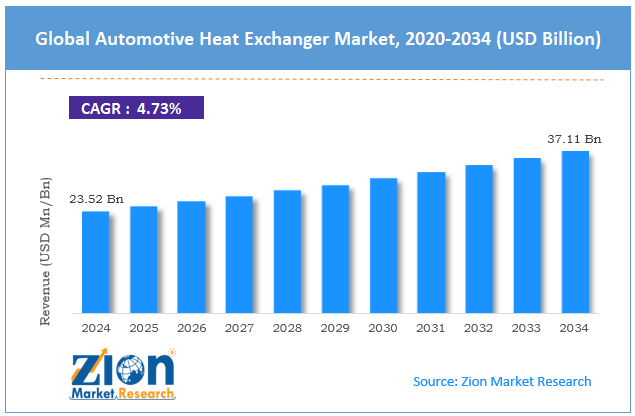
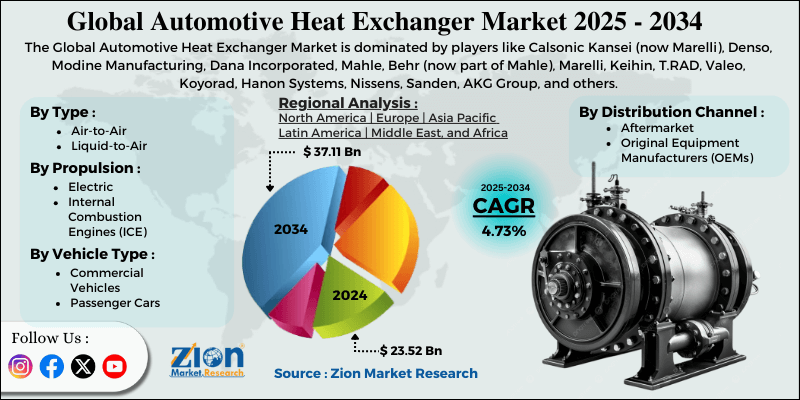
The global automotive heat exchanger market size was worth around USD 23.52 billion in 2024 and is predicted to grow to around USD 37.11 billion by 2034, with a compound annual growth rate (CAGR) of roughly 4.73% between 2025 and 2034.
This report provides a comprehensive analysis of the growth drivers, restraints, and challenges shaping demand across the global automotive heat exchanger market throughout the forecast period, while highlighting high-potential emerging opportunities within the industry.
Key Insights
- As per the analysis shared by our research analyst, the global automotive heat exchanger market is estimated to grow annually at a CAGR of around 4.73% over the forecast period (2025-2034)
- In terms of revenue, the global automotive heat exchanger market size was valued at around USD 23.52 billion in 2024 and is projected to reach USD 37.11 billion by 2034.
- The automotive heat exchanger market is projected to grow at a significant rate due to the rising demand for electric and hybrid vehicles.
- Based on the type, the liquid-to-air segment is growing at a high rate and will continue to dominate the global market, as it accounted for more than 55% of total revenue in 2024 due to growing use in high-performance vehicles.
- Based on the vehicle type, the passenger cars segment is anticipated to command the largest market share
- Based on propulsion, electric support demand, with electric systems gaining momentum through battery thermal management requirements.
- Based on region, the Asia-Pacific is projected to dominate the global market during the forecast period owing to increased demand for vehicles among the growing regional population, urbanization, availability of affordable automobiles, a thriving automotive manufacturing industry, and rising aftermarket services.
Automotive Heat Exchanger Market: Overview
Automotive heat exchangers are an integral component of a vehicle’s cooling system. They are essentially helpful in cooling engine coolants used in radiators. Furthermore, they also play a crucial role in ensuring and enhancing passenger comfort. Over the last few years, the emergence of the electric vehicle (EV) sector has encouraged increased innovation in the market, as these technologies are essential for battery thermal management. During the forecast period, demand for automotive heat exchangers is expected to continue growing, driven by multiple factors.
For instance, increased production of automobiles and a rising vehicle ownership rate will promote market expansion. Additionally, the electric and hybrid vehicle sector will sustain market growth over the forecast period. However, the high production and development cost of automotive heat exchangers may impede market expansion in the long run.
Automotive Heat Exchanger Market: Dynamics
Growth Drivers
What will be the influence of the growing demand for EVs on the growth of the automotive heat exchanger market?
The global automotive heat exchanger market is expected to be driven by the rising demand for electric and hybrid vehicles. These automotives are powered by electric batteries that store energy for extended periods. Hence, electric or hybrid vehicles require efficient battery management systems and electronic cooling solutions. The emergence and expansion of the EV industry have encouraged higher research & development (R&D) toward high-performance heat exchangers.
In November 2025, Shanghai Highly Co., Ltd., a leading developer of integrated thermal management systems for electric vehicles, announced the launch of its most recent offering at the Japan Mobility Show. The company inaugurated its latest portfolio of vehicle thermal systems and technologies. In January 2025, Hyundai Mobis, a leading South Korean automotive supplier, launched a new battery cell cooling material to prevent overheating of EV batteries during ultra-fast charging. Such innovations are likely to work in favor of automotive heat exchanger solution providers across the globe.
Emergence of government emission standards to influence industry growth during the forecast period
Heat exchangers play a critical role in improving engine thermal efficiency. In addition to this, they aid in reducing harmful emissions and help companies meet global regulatory frameworks. Regional governments around the world have introduced stringent emission standards to curb the automotive industry's negative environmental impact.
In July 2025, MAHLE, a global provider of automotive parts, announced that it had developed a new thermal management module for automotives. The novel solution is capable of boosting the system efficiency of electric vehicles. The company aims to help automakers achieve improved decarbonization rates in the coming years.
Restraints
Why will the high cost of production and development limit the automotive heat exchanger market expansion?
The global automotive heat exchanger market is expected to be constrained by the high costs associated with the development and production of new heat management systems for automobiles. The high cost is driven by factors such as the use of expensive raw materials, advanced production processes, and complex product designing & engineering solutions. The overall cost increases further in the case of customization. The rising economic uncertainty worldwide and growing efforts undertaken by market players to improve profit margins may work against industry leaders during the projection period.
Opportunities
Expansion of the aftermarket services segment to offer excellent growth opportunities during the projection period
The global automotive heat exchanger industry is expected to generate growth opportunities due to the rising demand for aftermarket services. Automotive thermal management systems have a limited lifespan, as consistent use and exposure to harsh environments can degrade component performance.
For instance, radiators generally have a lifespan of 8 to 12 years, depending on material quality and operating conditions. The frequent need to repair and maintain critical elements of automotives has created extensive growth opportunities for aftermarket service providers since they are considered more cost-efficient.
How will demand in the luxury vehicle industry open new avenues for the automotive heat exchanger industry?
The luxury vehicle market is one of the largest consumers of precision-engineered and expensive heat exchangers. The surging demand for high-performance vehicles worldwide may help the industry players access new growth possibilities during the forecast period. In June 2025, Conflux Technology, a leading heat transfer and additive manufacturing (AM) company, announced its collaboration with hypercar manufacturer Pagani. The company has developed a next-generation and powerful heat exchanger for Pagani Utopia, especially for the vehicle’s transmission oil domain. Conflux managed to achieve a 30% increase in heat rejection with its latest offering.
Challenges
Price volatility of raw materials and a lack of skilled professionals to challenge industry growth
The global automotive heat exchanger market is expected to be restricted due to the high price volatility of raw materials used during production. The prices of steel, copper, and aluminum, the most commonly used raw materials, are vulnerable to changes in external conditions such as geopolitical partnerships and supply chain disruptions.
This subsequently impacts material prices, leading to restricted revenue for market players. Additionally, a lack of sufficient supply of skilled professionals may further impact market expansion during the forecast period.
Automotive Heat Exchanger Market: Report Scope
| Report Attributes | Report Details |
|---|---|
| Report Name | Automotive Heat Exchanger Market |
| Market Size in 2024 | USD 23.52 Billion |
| Market Forecast in 2034 | USD 37.11 Billion |
| Growth Rate | CAGR of 4.73% |
| Number of Pages | 255 |
| Key Companies Covered | Calsonic Kansei (now Marelli), Denso, Modine Manufacturing, Dana Incorporated, Mahle, Behr (now part of Mahle), Marelli, Keihin, T.RAD, Valeo, Koyorad, Hanon Systems, Nissens, Sanden, AKG Group, and others. |
| Segments Covered | By Type, By Propulsion, By Vehicle Type, By Distribution Channel, and By Region |
| Regions Covered | North America, Europe, Asia Pacific (APAC), Latin America, Middle East, and Africa (MEA) |
| Base Year | 2024 |
| Historical Year | 2019 - 2023 |
| Forecast Year | 2025 - 2034 |
| Customization Scope | Avail customized purchase options to meet your exact research needs. Request For Customization |
Automotive Heat Exchanger Market: Segmentation
The automotive heat exchanger market is segmented by type, propulsion, vehicle type, distribution channel, and region. All the segments of the automotive heat exchanger market have been analyzed based on present and future trends and the market is estimated from 2025 to 2034.
Why will the liquid-to-air segment dominate the automotive heat exchanger market?
Based on type, the global market is segmented into air-to-air and liquid-to-air. In 2024, the highest growth was listed in the liquid-to-air segment, which dominated more than 55% of total revenue. The growing use of liquid-to-air heat exchangers in high-performance vehicles is expected to drive segmental growth in the coming years. The air-to-air segment is projected to deliver improved CAGR during the forecast period.
Based on propulsion, the global automotive heat exchanger industry is fragmented into electric and internal combustion engines (ICE). Electric propulsion is gaining increasing importance due to the critical need for efficient battery thermal management and electronic cooling solutions in electric and hybrid vehicles. This growth supports market expansion through higher research and development investment in high-performance heat exchangers. Internal combustion engine applications continue to represent a substantial secondary base of demand linked to engine cooling and emission control requirements.
Why will the passenger cars segment lead the automotive heat exchanger industry?
Based on vehicle type, the global market is segmented into commercial vehicles and passenger cars. According to industry research, the passenger cars segment was the highest revenue generator in 2024. It will continue to lead market growth during the projection period. The rising vehicle ownership rate worldwide, along with increased demand for used cars, will facilitate segmental revenue over the projection duration.
Based on the distribution channel, the global industry is fragmented into aftermarket and Original Equipment Manufacturers (OEMs). Original equipment manufacturers anchor primary volume through integration of heat exchangers into new vehicle production. The aftermarket channel offers strong secondary growth opportunities because thermal management systems have a limited lifespan and require periodic repair or replacement, creating sustained demand for cost-efficient service solutions.
Automotive Heat Exchanger Market: Regional Analysis
What are the factors contributing to the dominance of Asia-Pacific in the automotive heat exchanger market?
The global automotive heat exchanger market is projected to be led by Asia-Pacific during the forecast period. The region is anticipated to deliver a CAGR of 4.35% in the coming years. Growth in the Asia-Pacific will be led by increased demand for vehicles among the growing regional population. Factors such as urbanization, changes in consumer lifestyle, and availability of affordable automobiles will fuel regional expansion during the projection period. In addition, the presence of a thriving automotive manufacturing industry, rising aftermarket services sales, and increased innovation-led investments will propel Asia-Pacific toward renewed growth.
What position will Europe hold in the automotive heat exchanger industry?
Europe is set to emerge as the second-highest revenue generator, recording a CAGR of 3.22% over the forecast period. Germany and the UK will continue to lead demand for automotive heat exchangers across Europe. European countries have strict regulatory laws concerning emissions from the automotive sector. The region has a high demand for fuel-efficient automotives, propelling the European market growth rate. In addition, the surging demand for cutting-edge heat exchangers for the region’s luxury vehicle sector is expected to open new avenues for regional growth.
North America maintains a substantial presence through established automotive manufacturing, ongoing electrification activity, and demand for advanced thermal management systems that support both conventional and electric powertrains. Focus on performance, efficiency, and regulatory compliance sustains regional contribution.
Automotive Heat Exchanger Market: Competitive Analysis
The global automotive heat exchanger market is led by players like:
- Calsonic Kansei (now Marelli)
- Denso
- Modine Manufacturing
- Dana Incorporated
- Mahle
- Behr (now part of Mahle)
- Marelli
- Keihin
- T.RAD
- Valeo
- Koyorad
- Hanon Systems
- Nissens
- Sanden
- AKG Group
Automotive Heat Exchanger Market: Key Market Trends
Compact designs
A notable trend in the automotive heat exchanger industry is the growing demand for compact and integrated thermal management systems. These solutions will allow vehicles to achieve higher fuel efficiency and improved performance by reducing the overall weight of the vehicles.
Eco-friendly production
The automotive heat exchanger industry is seeing increased adoption of eco-friendly production processes for automotive components. This includes the use of sustainable manufacturing processes and recycling of raw materials.
Segments Covered
The global automotive heat exchanger market is segmented as follows:
By Type
- Air-to-Air
- Liquid-to-Air
By Propulsion
- Electric
- Internal Combustion Engines (ICE)
By Vehicle Type
- Commercial Vehicles
- Passenger Cars
By Distribution Channel
- Aftermarket
- Original Equipment Manufacturers (OEMs)
By Region
- North America
- The U.S.
- Canada
- Mexico
- Europe
- France
- The UK
- Spain
- Germany
- Italy
- Rest of Europe
- Asia Pacific
- China
- Japan
- India
- Australia
- South Korea
- Rest of Asia Pacific
- The Middle East & Africa
- Saudi Arabia
- UAE
- Egypt
- Kuwait
- South Africa
- Rest of the Middle East & Africa
- Latin America
- Brazil
- Argentina
- Rest of Latin America
Table Of Content
Methodology
FrequentlyAsked Questions
Automotive heat exchangers are an integral component of a vehicle’s cooling system. They are essentially helpful in cooling engine coolants used in radiators.
The global automotive heat exchanger market is expected to be driven by the rising demand for electric and hybrid vehicles.
According to study, the global automotive heat exchanger market size was worth around USD 23.52 billion in 2024 and is predicted to grow to around USD 37.11 billion by 2034.
The CAGR value of the automotive heat exchanger market is expected to be around 4.73% during 2025-2034.
The global automotive heat exchanger market is expected to be restricted due to the high price volatility of raw materials used during production.
Compact designs and eco-friendly production are the emerging trends and innovations impacting the automotive heat exchanger market.
The OEM sales channel segment holds the largest market share in the automotive heat exchanger market.
The global automotive heat exchanger market is projected to be led by Asia-Pacific during the forecast period.
The global automotive heat exchanger market is led by players like Calsonic Kansei (now Marelli), Denso, Modine Manufacturing, Dana Incorporated, Mahle, Behr (now part of Mahle), Marelli, Keihin, T.RAD, Valeo, Koyorad, Hanon Systems, Nissens, Sanden, and AKG Group.
The report explores crucial aspects of the automotive heat exchanger market, including a detailed discussion of existing growth factors and restraints, while also browsing future growth opportunities and challenges that impact the market.

HappyClients

