3D Pens Market Size, Trend, Growth, Industry Analysis Report 2034

3D Pens Market By Type (Low Temperature 3D Pens, High Temperature 3D Pens, Wireless Battery Operated 3D Pens, Corded Plug In 3D Pens), By Application (Educational and Learning Tools, Arts and Crafts Projects, Prototyping and Design, Hobby and Recreational Use), By End Use Industry (Education Sector, Consumer and Household, Design and Architecture Studios, Toy and Entertainment Industry), By Material (PLA Filament, ABS Filament, Eco Friendly Filament, Specialty Filament), and By Region - Global and Regional Industry Overview, Market Intelligence, Comprehensive Analysis, Historical Data, and Forecasts 2026 - 2034
| Market Size in 2025 | Market Forecast in 2034 | CAGR (in %) | Base Year |
|---|---|---|---|
| USD 87.04 Million | USD 363.47 Million | 17.15% | 2025 |
3D Pens Industry Perspective:
What will be the size of the 3D pens market during the forecast period?
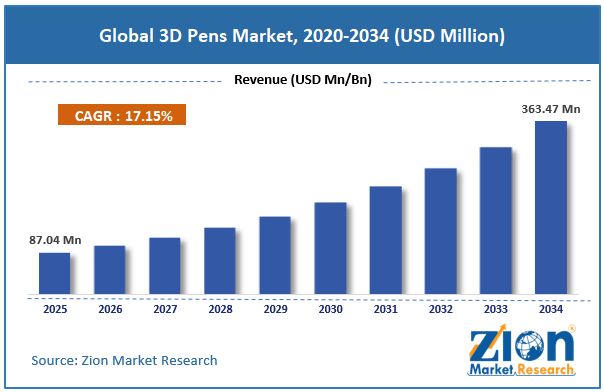
The global 3D pens market size was valued at approximately USD 87.04 million in 2025 and is projected to reach around USD 363.47 million by 2034, growing at a compound annual growth rate of approximately 17.15% between 2026 and 2034.
Key Insights
- As per the analysis shared by our research team, the global 3D pens market is estimated to grow at a compound annual growth rate of approximately 17.15% during the forecast period from 2026 to 2034.
- In terms of revenue, the global 3D pens market was valued at approximately USD 87.04 million in 2025 and is projected to reach USD 363.47 million by 2034.
- The 3D pens market is expected to grow strongly due to rising interest in hands-on learning tools, the growing popularity of maker culture, increasing adoption in classrooms, and the expanding availability of safer, more affordable devices.
- Based on type, low-temperature 3D pens lead the market because of their strong appeal among parents seeking child-safe options, while wireless battery-operated 3D pens are gaining strong momentum as one of the fastest-growing types due to rising demand for portable and cord-free convenience.
- Based on application, arts and crafts projects lead the market because hobbyists and casual creators use them widely. At the same time, educational and learning tools are the fastest-growing segment as schools look for interactive ways to teach spatial and design concepts.
- Based on end-use industry, consumer and household use leads the market due to broad appeal among families and hobbyists, while the education sector is steadily growing as institutions add 3D pens to hands-on learning programs.
- Based on material, PLA filament leads the market due to its biodegradable nature and beginner-friendly qualities, while eco-friendly filament is growing rapidly as buyers look for greener options that reduce plastic waste.
- Based on region, Asia Pacific leads the global 3D pens market, supported by rapid urbanization and growing educational demand. At the same time, North America is the fastest-growing region, driven by expanding STEM education initiatives and rising demand for creative learning tools.
3D Pens Market: Overview
A 3D pen is a handheld creative tool that melts plastic filament and releases it through a heated nozzle to draw raised shapes, designs, and objects in three dimensions. The 3D pen market is growing as more consumers, schools, designers, and hobbyists seek simple and affordable tools for creative learning and hands-on projects. Unlike traditional drawing tools that create flat images, 3D pens allow users to build directly in the air or on surfaces, making it easier to understand shapes, structures, and basic three-dimensional concepts. People increasingly use them to make small models, decorations, toys, artwork, prototypes, architectural models, and simple plastic repairs. Growing interest in do-it-yourself projects, maker activities, and creative education is encouraging schools and families to adopt these devices for learning and entertainment. Parents are also drawn to 3D pens because they support creativity, hand coordination, problem-solving, and spatial thinking through hands-on activities. Manufacturers are improving product safety by adding better temperature controls, ergonomic designs, and easier filament-loading systems. Affordable models and a wider range of plastic filaments are further expanding consumer choice. Online tutorials, social media content, and craft communities are also helping users discover new applications, supporting wider adoption across homes, schools, and creative spaces worldwide.
The 3D pens industry continues to grow as toy manufacturers, educational technology companies, and creative hobby brands work together to build safer, more user-friendly, and more versatile drawing tools for people of all ages.
3D Pens Market: Strategic Perspective
Where is the 3D pens market heading?
The 3D pens market is expected to move toward smarter, more precise, and more beginner-friendly devices that help students, hobbyists, and professional designers create more easily every day. Better safety features, improved temperature control, longer-lasting batteries, and wider filament options could help 3D pens become a mainstream creative and educational tool for homes, schools, libraries, workshops, and everyday learning worldwide.
Where should businesses invest in the 3D pens market?
The 3D pens market offers strong investment opportunities in child-safe pen design, biodegradable filament development, classroom-ready educational kits, and smart app-connected drawing tools for schools, homes, and creative learning. Companies that create beginner-friendly solutions, durable build quality, and engaging learning content may benefit as more schools, families, and creators choose the 3D pens market for practical, daily skill-building.
What will reshape competition in the 3D pens market?
Competition in the 3D pens market will likely be driven by product safety, ease of use, filament compatibility, and engaging design templates that improve the user experience across skill levels. Companies that provide reliable customer support, attractive gift-ready packaging, and strong retail and online distribution can help the 3D pens market reach more buyers and build long-term brand trust.
3D Pens Market: Technology Roadmap 2026–2034
What is the projected development roadmap of the 3D pens market over the forecast period?
The 3D pens market is advancing through improved ergonomic designs, safer heating mechanisms, longer battery life, and growing use of eco-conscious filament materials, making these devices more practical and appealing for everyday creative use. The market is expected to grow at a compound annual growth rate of approximately 17.15% over the forecast period, driven by rising classroom adoption, expanding hobbyist communities, and continuous refinement of pen design and filament technology.
The following roadmap outlines key development phases expected through 2034.
2026–2028: Safety Enhancement and Awareness Building Phase
- Improved temperature regulation: Manufacturers are expected to develop better cooling and heat control systems so pens remain safe for younger users without sacrificing print quality.
- Growing educational partnerships: Toy companies and schools are likely to work more closely together to introduce structured 3D pen lesson plans and classroom kits.
- Rising online community engagement: 3D pens are expected to see increased visibility through social media tutorials, craft influencers, and online hobbyist groups that showcase creative projects.
2029–2031: Product Diversification and Market Expansion Phase
- Expanded filament variety: Manufacturers are expected to introduce more color options, textures, and specialty materials to widen users' creative possibilities.
- Wireless and application-connected features: Brands are expected to launch pens with companion applications offering guided tutorials, design templates, and progress tracking for young learners.
- Growth in professional design use: 3D pens are expected to spread further into architecture, product prototyping, and art studios as precision and control continue to improve.
2032–2034: Mainstream Integration and Smart Technology Phase
- Sensor-equipped smart pens: Companies are likely to develop pens with built-in sensors that guide users through complex shapes and reduce drawing mistakes.
- Advanced sustainable filaments: 3D pens may increasingly use plant-based and fully biodegradable filament materials to reduce environmental impact.
- Broader curriculum recognition: As educational outcomes are studied further, more school systems may formally include 3D pen-based activities within standard STEM and art curriculums.
3D Pens Market: Dynamics
Growth Drivers
What is driving the expansion of the 3D pens market across educational applications?
The 3D pens industry is growing as parents, teachers, and hobbyists seek simple tools that make learning and creativity more hands-on and enjoyable. Schools are adopting 3D pens because they help students understand three-dimensional shapes, structures, and spatial relationships more easily than flat drawings. Hobbyists use 3D pens to create sculptures, repair plastic items, design decorations, personalize gifts, and develop small prototypes, supporting demand across craft and creative activities. Advances in ergonomic design are also helping manufacturers develop lightweight pens that are easier and more comfortable to hold, including for younger users. Growing interest in STEM education and after-school programs is encouraging schools, libraries, and community centers to introduce 3D pen workshops and practical projects. At the same time, improved manufacturing is making these devices more affordable and accessible to a wider consumer base. Birthday and holiday gifting is further increasing interest, while adult users are exploring applications such as art, jewelry design, modeling, and prototyping. These trends are helping 3D pens become useful creative and educational tools, not just novelty gadgets, across homes, classrooms, studios, and creative spaces worldwide.
Rising interest in creative learning tools is creating fresh opportunities in the 3D pens market.
The 3D pens market is creating new opportunities as families, schools, and creative businesses seek tools that combine entertainment with practical skill development. Educators can use 3D pens to teach geometry, basic engineering, design, and artistic expression through hands-on activities, while toy companies can develop age-specific kits for younger users. Craft businesses can use these pens to create custom jewelry, decorations, models, and small gifts without expensive equipment. Manufacturers are also developing beginner-friendly kits with templates, stencils, and easy-to-use features that help new users learn quickly. Growing support for STEM education is encouraging schools, toy makers, technology companies, and education providers to explore new classroom applications for 3D pens. Rising demand for personalized and handmade products is creating further opportunities in custom accessories, home decor, and creative gifting. As adoption increases across age groups, 3D pens are becoming useful tools for education, art, hobbies, and everyday creativity. This broader use can expand the 3D pens industry across household, education, hobby, gifting, and creative markets worldwide and support long-term market growth.
Restraints
How are safety concerns and learning curve issues affecting the 3D pens market?
The 3D pens market faces challenges including safety concerns, a learning curve for beginners, and uneven printing quality across different filament types and brands. Younger users may need adult supervision with high-temperature pens, while unclear filament compatibility can make it hard for buyers to choose materials and avoid printing problems. Parents may also hesitate because of burn risks, improper use, or concerns about children handling heated parts without guidance. Filament clogging, uneven flow, and difficulty controlling the pen can frustrate first-time users and reduce use. Manufacturers also face higher costs when developing safer designs, temperature controls, and reliable components while keeping prices affordable. Limited awareness in some regions can create another barrier to growth. Clearer safety instructions, better filament standards, simpler controls, stronger product support, and user education can build consumer confidence and encourage wider adoption of 3D pens in homes, schools, and creative spaces worldwide.
Opportunities
Broader creative adoption is creating new opportunities in the 3D pens market.
The 3D pens market is gaining opportunities as interest in hands-on creativity grows across schools, households, and hobbyist communities. Teachers use 3D pens to make geometry, design, and engineering lessons more engaging, while parents explore them as screen-free activities that encourage children to create and learn. Craft businesses are applying 3D pens to produce custom jewelry, home decor, models, and personalized gifts using simple techniques. Toy and hobby brands are also developing themed kits around characters, holidays, and creative projects to attract younger users. New filament materials, including eco-friendly options, are expanding the range of projects users can create. Growing STEM education programs, maker spaces, and after-school activities are opening additional applications for 3D pens. Companies offering safer heating systems, compatible filament options, easy controls, and beginner-friendly learning content can benefit from these opportunities. Increasing use in small-scale prototyping and design studios is also supporting specialized applications. Rising investment in classroom technology is encouraging adoption, while demand for engaging screen-free activities is creating opportunities across education, households, hobbies, gifting, and creative learning worldwide. As awareness increases through online tutorials and social media, more consumers are discovering uses and creative possibilities.
Challenges
Limited standardization is creating challenges for the 3D pens market.
The 3D pens industry faces challenges from inconsistent product quality, different safety concerns among parents, and varying filament performance across brands. Since 3D pens are newer than traditional art supplies, many consumers may struggle to find products that perform reliably and operate safely. Different safety requirements across countries can also create uncertainty for manufacturers, retailers, schools, and parents choosing products for children. Print quality can vary by filament type, brand, or pen settings, which can frustrate beginners. Filament clogging and uneven flow during longer projects can further affect usability and customer satisfaction. Manufacturers also need clear safety certifications and labeling to build trust among cautious buyers. Schools may face additional barriers when teachers lack training or suitable instructional materials for using 3D pens effectively. Better product testing, clearer safety guidance, wider filament compatibility, simpler controls, and stronger educational resources can address these concerns. These improvements can increase consumer confidence and support wider adoption across homes, schools, creative spaces, and hobby communities.
3D Pens Market: Report Scope
| Report Attributes | Report Details |
|---|---|
| Report Name | 3D Pens Market |
| Market Size in 2025 | USD 87.04 Million |
| Market Forecast in 2034 | USD 363.47 Million |
| Growth Rate | CAGR of 17.15% |
| Number of Pages | 227 |
| Key Companies Covered | 3Doodler, Scribbler, Mynt3D, 7TECH, SL3D, Soyan, Aerbes, CreoPop, LIX Pen, Tecboss, and others. |
| Segments Covered | By Type, By Application, By End-Use Industry, By Material, and By Region |
| Regions Covered | North America, Europe, Asia Pacific (APAC), Latin America, Middle East, and Africa (MEA) |
| Base Year | 2025 |
| Historical Year | 2020 - 2024 |
| Forecast Year | 2026 - 2034 |
| Customization Scope | Avail customized purchase options to meet your exact research needs. Request For Customization |
3D Pens Market: Segmentation
The global 3D pens market is segmented by type, application, end-use industry, material, and region.
What makes low-temperature 3D pens the dominant type in the 3D pens market?
Based on type, the market is segmented into low-temperature, high-temperature, wireless battery-operated, and corded plug-in pens. Low-temperature 3D pens hold about 41% of the market share, leading because they strongly appeal to parents who prioritize child safety during creative activities. Wireless battery-operated 3D pens hold around 24% market share. This segment is the fastest-growing because demand is rising for portable devices that nearby power outlets don't limit.
How does the arts and crafts application maintain its leading position in the 3D pens market?
Based on application, the 3D pens industry is divided into educational and learning tools, arts and crafts projects, prototyping and design, and hobby and recreational use. Arts and crafts projects account for approximately 34% of the global market share, driven by widespread use among casual creators and gift makers. Educational and learning tools account for around 21% of the market share. It is the fastest-growing segment, driven by rising interest in interactive teaching methods for spatial reasoning and design thinking.
What makes the consumer and household segment the dominant end-use industry in the 3D pens market?
Based on end-use industry, the market is classified into the education sector, consumer and household, design and architecture studios, and the toy and entertainment industry. Consumer and household use leads with about a 35% share because of broad appeal among families looking for creative screen-free activities. The education sector holds around 26% market share. It is growing steadily as schools look for engaging tools to support STEM- and art-based learning.
How does the PLA filament category shape the demand landscape of the 3D pens market?
Based on material, the 3D pens market is categorized into PLA filament, ABS filament, eco-friendly filament, and specialty filament. PLA filament accounts for about 39% of the market, leading because of its lower melting point, biodegradable qualities, and beginner-friendly handling. Eco-friendly filament holds around 20% market share. This segment is expanding quickly as environmentally conscious buyers look for materials that reduce plastic waste and environmental impact.
3D Pens Market: Regional Analysis
Why is Asia Pacific leading the global 3D pens market?
Asia Pacific holds a 36.82% share of the global 3D pens market and is expected to maintain its leading position during the forecast period. The region benefits from strong manufacturing capabilities, established toy and electronics industries, and rising interest in STEM education among families and schools. China, Japan, and South Korea are major contributors, supported by manufacturers producing affordable 3D pens and filaments for domestic and international markets. Rising disposable incomes and greater awareness of hands-on learning are encouraging parents to purchase creative tools that support children’s learning and skill development. Schools and educational centers are also using 3D pens in science, technology, engineering, art, and design activities to make lessons more practical and engaging. Asia Pacific’s developed electronics and plastics supply chains help manufacturers control production costs and expand product availability. Rapid e-commerce growth is further improving access to 3D pens, allowing emerging brands to reach customers beyond major cities and established retail networks.
Toy fairs, technology exhibitions, and educational events are also increasing product visibility and encouraging new partnerships. Ongoing investment in manufacturing, product innovation, safer designs, affordable materials, and educational programs is expected to support demand. Growing online learning content is further supporting consumer awareness. These factors are helping Asia Pacific strengthen its position as a key regional market and production hub for 3D pens worldwide.
What makes North America the fastest growing region in the 3D pens market?
North America accounts for 29.47% of the global 3D pens market and is expected to remain one of the fastest-growing regional markets during the forecast period. Growing STEM education programs, demand for creative learning tools, and interest in screen-free learning are supporting regional adoption. The United States and Canada are major contributors, supported by strong retail networks and established maker communities. Schools, libraries, and community centers are increasingly offering 3D pen workshops, helping students understand their creative and educational uses. Rising interest in personalized gifts is also encouraging consumers to purchase 3D pens for children, teenagers, and hobby enthusiasts.
Toy companies and educational technology providers are improving product safety, ease of use, and filament choices to meet user needs. Growing interest in do-it-yourself projects is creating opportunities for 3D pens in crafts, decorations, repairs, and model making. Increased investment in classroom technology and after-school learning programs is also supporting demand for educational kits and content. Online tutorials and creator communities are helping users learn new techniques and applications, increasing product awareness. Continued innovation, wider educational use, and strong consumer interest in creative technology are expected to support North America’s growth and strengthen its position in the global market.
Recent Market Developments
- In August 2026, JER Education announced its participation in the HKTDC Hong Kong Electronics Fair 2026, where it is showcasing its range of creative and educational electronics, including 3D printing pens, to international buyers.
3D Pens Market: Competitive Analysis
The leading players in the global 3D pens market are:
- 3Doodler
- Scribbler
- Mynt3D
- 7TECH
- SL3D
- Soyan
- Aerbes
- CreoPop
- LIX Pen
- Tecboss
The global 3D pens market is segmented as follows:
By Type
- Low Temperature 3D Pens
- High Temperature 3D Pens
- Wireless Battery Operated 3D Pens
- Corded Plug-in 3D Pens
By Application
- Educational and Learning Tools
- Arts and Crafts Projects
- Prototyping and Design
- Hobby and Recreational Use
By End-Use Industry
- Education Sector
- Consumer and Household
- Design and Architecture Studios
- Toy and Entertainment Industry
By Material
- PLA Filament
- ABS Filament
- Eco-Friendly Filament
- Specialty Filament
By Region
- North America
- The U.S.
- Canada
- Mexico
- Europe
- France
- The UK
- Spain
- Germany
- Italy
- Rest of Europe
- Asia Pacific
- China
- Japan
- India
- Australia
- South Korea
- Rest of Asia Pacific
- The Middle East & Africa
- Saudi Arabia
- UAE
- Egypt
- Kuwait
- South Africa
- Rest of the Middle East & Africa
- Latin America
- Brazil
- Argentina
- Rest of Latin America
Table Of Content
Methodology
FrequentlyAsked Questions
A 3D pen is a handheld creative tool that melts plastic filament and releases it through a heated nozzle to draw raised shapes, designs, and objects in three dimensions.
The global 3D pens market is expected to grow due to rising interest in hands-on learning, the growing popularity of maker culture, expanding classroom adoption, and the increasing availability of safer, more affordable devices worldwide.
According to research, the global 3D pens market was valued at approximately USD 87.04 million in 2025 and is projected to reach approximately USD 363.47 million by 2034.
The compound annual growth rate of the 3D pens market is expected to be approximately 17.15% from 2026 to 2034.
Asia Pacific is expected to lead the global 3D pens market throughout the forecast period, driven by large-scale manufacturing capabilities and growing interest in STEM-based education among families.
The major players in the global 3D pens market include 3Doodler, Scribbler, Mynt3D, 7TECH, SL3D, Soyan, Aerbes, CreoPop, LIX Pen, and Tecboss.
The report examines key aspects of the 3D pens market, including research and development drivers, adoption barriers, application opportunities, competitive landscape dynamics, detailed regional market performance analysis, and a comprehensive forward-looking outlook across all major types, applications, end-use industries, materials, and geographic regions through 2034.
Evolving safety guidelines around heating elements, growing attention to child-appropriate temperature limits, and expanding certification programs for toys and learning devices are shaping the 3D pens market. Governments and safety bodies are also encouraging clearer labeling and testing standards.
Educational learning tools, personalized craft projects, small-scale prototyping, classroom STEM programs, and hobbyist design work will offer strong opportunities in the 3D pens market. Growing demand for engaging, screen-free creative activities is driving adoption across these areas.
Smart sensor integration, application-connected guided drawing, eco-friendly filament development, and growing classroom curriculum inclusion are key trends shaping the 3D pens market. Rising collaboration between toy manufacturers and educational institutions is also expanding its everyday use.

HappyClients