
Global Smart Education Infrastructure Market Size, Share, Value and Forecast 2034

Smart Education Infrastructure Market By Type (Software-as-a-Service (SaaS), Infrastructure-as-a-Service (IaaS), and Platform-as-a-Service (PaaS), By Application (Apps for Online Courses and School Management Systems), and By Region - Global and Regional Industry Overview, Market Intelligence, Comprehensive Analysis, Historical Data, and Forecasts 2026 - 2034
| Market Size in 2025 | Market Forecast in 2034 | CAGR (in %) | Base Year |
|---|---|---|---|
| USD 321.28 Billion | USD 1818.61 Billion | 21.24% | 2025 |
Smart Education Infrastructure Market: Industry Perspective
What is the anticipated size of the smart education infrastructure market during the projection period?
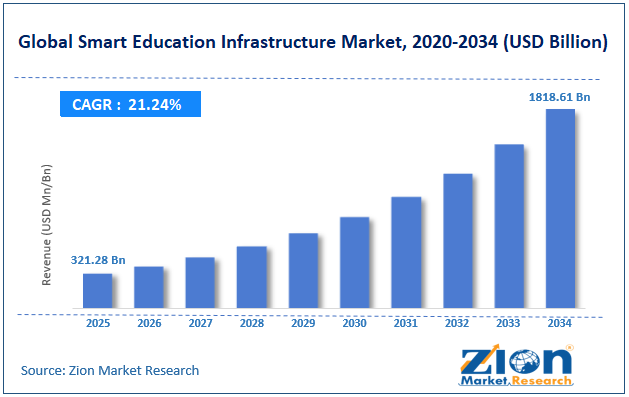
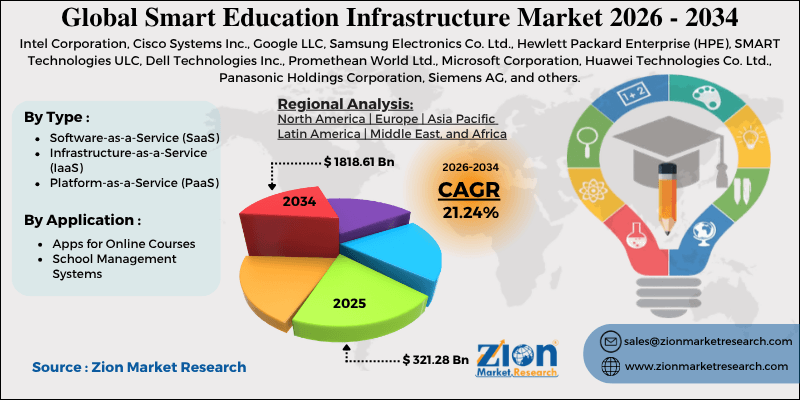
The global smart education infrastructure market size was worth around USD 321.28 billion in 2025 and is predicted to grow to around USD 1818.61 billion by 2034, with a compound annual growth rate (CAGR) of roughly 21.24% between 2026 and 2034.
Key Insights:
- As per the analysis shared by our research analyst, the global smart education infrastructure market is estimated to grow annually at a CAGR of around 21.24% over the forecast period (2026-2034)
- In terms of revenue, the global smart education infrastructure market size was valued at around USD 321.28 billion in 2025 and is projected to reach USD 1818.61 billion, by 2034.
- The smart education infrastructure market is projected to grow at a significant rate due to rapid industry digitalization.
- Based on the type, the Platform-as-a-Service (PaaS) segment is expected to generate the highest CAGR during the forecast period.
- Based on the application, the online courses segment is anticipated to command the largest market share.
- Based on region, North America is projected to dominate the global market during the forecast period.
Smart Education Infrastructure Market: Overview
Smart education infrastructure is the use of advanced technologies such as digital tools, internet connectivity, and next-generation facilities in an educational setup. These technologies are leveraged to teach, learn, and conduct school operations. Experts perceive smart education infrastructure as an advancement over existing systems and often regard it as a tool for education optimization. During the forecast period, demand for smart education infrastructure is expected to be driven by rapid privatization across education facilities, emergence of online learning systems, and advancements in smart education-enabling technologies. However, high cost of systems, limited adoption in emerging economies, and concerns over the effectiveness of smart education may affect overall market revenue in the long run.
Impact of the USA-Israel and Iran war on the Smart Education Infrastructure Market:
The USA-Israel and Iran war is expected to affect the smooth supply of raw materials required to produce technologies that facilitate smart education infrastructure. This includes transportation of items such as electronic components, rare earth minerals, semiconductors, display panels, and other hardware items. However, the war may encourage domestic production and supply chain diversification to reduce the impact on business operations.
Smart Education Infrastructure Market: Dynamics
Growth Drivers
How will digitalization of the education sector influence the smart education infrastructure market?
The global smart education infrastructure market is expected to be driven by rapid industry digitalization. It includes integration of new digital technologies such as internet connectivity, cloud-based learning systems, and digital classrooms. Smart education infrastructure is considered the next stage of current learning architecture.
According to market analysis, digital learning systems offer several advantages such as access to global resources and scalability. As per the International Journal of Scientific Research and Technology, a recent study concluded that digital learning systems positively influence students through higher motivation, engagement, and learning outcomes.
Government-backed learning projects to encourage market growth during the forecast period
Governments worldwide have launched several new initiatives to encourage the development of smart education infrastructure. For instance, the Indian government has introduced the Vikshit Bharat 2047 vision. A major part of the initiative is to transform the regional education sector into a digital technology-driven learning ecosystem.
In April 2026, Germany announced the launch of Digital Pact 2.0, which aims to expand digital education infrastructure. The pact will facilitate an investment of EUR 5 billion nationwide over 5 years. More efficient procedures will allow the targeted development of high-performance digital infrastructure in schools, thus aiding growth in the global smart education infrastructure market.
Restraints
Which are the leading limitations in the smart education infrastructure market?
The global smart education infrastructure industry is anticipated to be restricted due to cost constraints. Digital systems enabling smart education infrastructure are expensive to develop and deploy. For instance, the average cost of installing a high-speed network in a K-12 school can range between USD 25,000 and USD 110,000. Advanced technologies such as cloud infrastructure and administration software are more expensive. High costs of maintenance further add to the final cost of technology ownership.
Opportunities
Remote learning and digital assessment systems to generate growth opportunities during the forecast period
The global smart education infrastructure market is anticipated to generate growth opportunities due to rising investments in remote learning and the introduction of digital assessment systems. Remote learning promotes global education as students and instructors can connect through digital mediums and the internet.
In addition, remote learning has become an integral part of skill development among working professionals, further amplifying market growth trends. Digital assessment systems have found greater adoption as these tools allow creation, delivery, and grade analysis using software applications. In March 2026, Association for Applied Research in IT (AAVIT) launched the fifth edition of the IT Fitness Test. It is the largest digital skills assessment initiative for primary and secondary schools in Central Europe.
Challenges
How will limited technology accessibility and resistance to change challenge the smart education infrastructure market?
The global smart education infrastructure industry will be challenged by limited access to required technology such as high-speed internet connectivity and sufficient capital. Rural areas with limited digital infrastructure face additional challenges. Furthermore, resistance to change is a prominent growth barrier. Transitioning to digital systems may prove overwhelming to teachers, students, or administrators. Other factors such as a lack of training facilities and the digital divide may limit industry revenue during the forecast period.
Smart Education Infrastructure Market: Report Scope
| Report Attributes | Report Details |
|---|---|
| Report Name | Smart Education Infrastructure Market |
| Market Size in 2025 | USD 321.28 Billion |
| Market Forecast in 2034 | USD 1818.61 Billion |
| Growth Rate | CAGR of 21.24% |
| Number of Pages | 227 |
| Key Companies Covered | Intel Corporation, Cisco Systems Inc., Google LLC, Samsung Electronics Co. Ltd., Hewlett Packard Enterprise (HPE), SMART Technologies ULC, Dell Technologies Inc., Promethean World Ltd., Microsoft Corporation, Huawei Technologies Co. Ltd., Panasonic Holdings Corporation, Siemens AG, and others. |
| Segments Covered | By Type, By Application, and By Region |
| Regions Covered | North America, Europe, Asia Pacific (APAC), Latin America, Middle East, and Africa (MEA) |
| Base Year | 2025 |
| Historical Year | 2020 - 2024 |
| Forecast Year | 2026 - 2034 |
| Customization Scope | Avail customized purchase options to meet your exact research needs. Request For Customization |
Smart Education Infrastructure Market: Segmentation
The global smart education infrastructure market is segmented based on type, application, and region.
Why will the Software-as-a-Service (SaaS) segment lead the smart education infrastructure industry revenue during the forecast period?
Based on type, the global market segments are Software-as-a-Service (SaaS), Infrastructure-as-a-Service (IaaS), and Platform-as-a-Service (PaaS). In 2025, the highest growth was listed in the Software-as-a-Service (SaaS) segment. It accounted for 65% of the global revenue. During the forecast period, Platform-as-a-Service (PaaS) is expected to deliver the fastest CAGR of 25%, driven by growing use of learning management systems (LMS) and digital assessment tools.
Which will be the fastest-growing application during the forecast period in the smart education infrastructure market?
Based on application, the global market is fragmented into apps for online courses and school management systems. In 2025, the online courses segment emerged as the highest revenue generator, accounting for 69% of the global revenue. It is expected to continue growing at a CAGR of 21.5% during the forecast period due to rising adoption of remote learning models and higher demand for self-paced education systems.
Smart Education Infrastructure Market: Regional Analysis
Why will North America lead the smart education infrastructure market in the coming years?
The global smart education infrastructure market is currently led by North America. In 2025, it accounted for 39.78% of the global revenue and will grow at a CAGR of 17.27% during the forecast period. The presence of digitally equipped K-12 schools and colleges is a leading regional growth driver. In addition, the growing focus on deploying cloud systems, electronic administration software, and acceptance among students and instructors will aid regional growth during the forecast period.
Why will Asia-Pacific generate the fastest CAGR in the smart education infrastructure market during the forecast period?
Asia-Pacific is expected to emerge as the fastest-growing region in the smart education infrastructure market with a CAGR of 23.9% during the forecast period. In 2025, it accounted for 31% of the global revenue. Countries such as China, India, Japan, and South Korea will lead the regional growth. Increasing government initiatives, investments toward smart campuses, higher demand for online learning, and a rising number of regional app developments will work in favor of the regional market.
Smart Education Infrastructure Market: Competitive Analysis
The global smart education infrastructure market is led by players like:
- Intel Corporation
- Cisco Systems Inc.
- Google LLC
- Samsung Electronics Co. Ltd.
- Hewlett Packard Enterprise (HPE)
- SMART Technologies ULC
- Dell Technologies Inc.
- Promethean World Ltd.
- Microsoft Corporation
- Huawei Technologies Co. Ltd.
- Panasonic Holdings Corporation
- Siemens AG
What are the latest key trends in the smart education infrastructure market?
Integration of Artificial Intelligence (AI), Virtual Reality (VR), and Augmented Reality (AR)
The integration of AI, VR, and AR in smart education infrastructure is a promising market trend. This includes AI-powered tutoring technologies and interactive learning sessions driven by VR and AR.
Smart campuses
Internet of Things (IoT)-enabled smart campuses facilitate energy management, campus security, and smart attendance tracking. Rising investments toward smart campuses will promote market growth during the projection period.
The global smart education infrastructure market is segmented as follows:
By Type
- Software-as-a-Service (SaaS)
- Infrastructure-as-a-Service (IaaS)
- Platform-as-a-Service (PaaS)
By Application
- Apps for Online Courses
- School Management Systems
By Region
- North America
- The U.S.
- Canada
- Mexico
- Europe
- France
- The UK
- Spain
- Germany
- Italy
- Rest of Europe
- Asia Pacific
- China
- Japan
- India
- Australia
- South Korea
- Rest of Asia Pacific
- The Middle East & Africa
- Saudi Arabia
- UAE
- Egypt
- Kuwait
- South Africa
- Rest of the Middle East & Africa
- Latin America
- Brazil
- Argentina
- Rest of Latin America
Table Of Content
Methodology
FrequentlyAsked Questions
Smart education infrastructure is the use of advanced technologies such as digital tools, internet connectivity, and next-generation facilities in an educational setup.
The global smart education infrastructure market is expected to be driven by rapid industry digitalization.
According to study, the global smart education infrastructure market size was worth around USD 321.28 billion in 2025 and is predicted to grow to around USD 1818.61 billion by 2034.
The CAGR value of the smart education infrastructure market is expected to be around 21.24% during 2026-2034.
The global smart education infrastructure industry will be challenged by limited access to required technology such as high-speed internet connectivity and sufficient capital.
Integration of Artificial Intelligence (AI), Virtual Reality (VR), and Augmented Reality (AR), and smart campuses are the emerging trends and innovations impacting the smart education infrastructure market.
The global smart education infrastructure market has performed well so far and will offer similar trends in the coming years.
North America will contribute notably towards the smart education infrastructure market value.
The global smart education infrastructure market is led by players like Intel Corporation, Cisco Systems Inc., Google LLC, Samsung Electronics Co. Ltd., Hewlett Packard Enterprise (HPE), SMART Technologies ULC, Dell Technologies Inc., Promethean World Ltd., Microsoft Corporation, Huawei Technologies Co. Ltd., Panasonic Holdings Corporation, Siemens AG, and others.
The report explores crucial aspects of the smart education infrastructure market, including a detailed discussion of existing growth factors and restraints while also browsing future growth opportunities and challenges that impact the market.

HappyClients

