
Tattoo Aftercare Market Size, Share, Growth, Opportunities 2034

Tattoo Aftercare Market By Product Type (Clean Towel, Moisturizing lotion and Others), By End-Use (Tattoo Parlour, Individual and Beauty & Skincare Parlour), By Material Use (Synthetic and Natural) and By Region - Global and Regional Industry Overview, Market Intelligence, Comprehensive Analysis, Historical Data, and Forecasts 2025 - 2034
| Market Size in 2024 | Market Forecast in 2034 | CAGR (in %) | Base Year |
|---|---|---|---|
| USD 135 Million | USD 305 Million | 8.5% | 2024 |
Tattoo Aftercare Industry Perspective:
What will be the size of the global tattoo aftercare market during the forecast period?
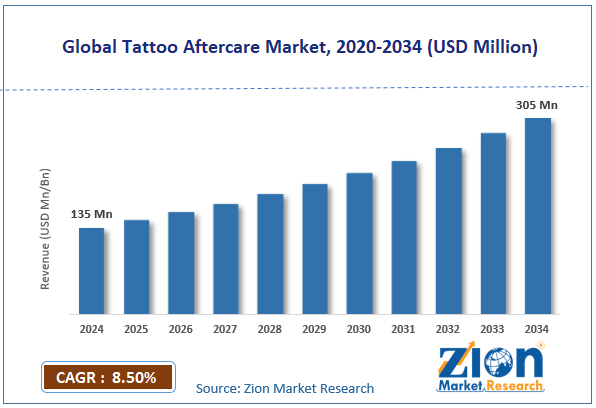
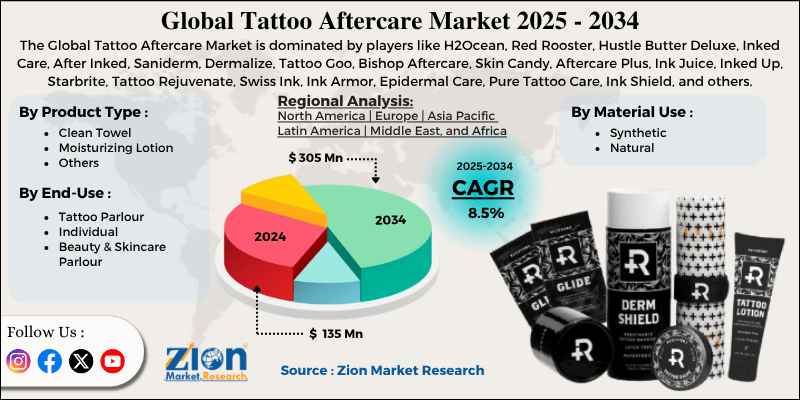
The global tattoo aftercare market size was worth around USD 135 million in 2024 and is predicted to grow to around USD 305 million by 2034 with a compound annual growth rate (CAGR) of roughly 8.5% between 2025 and 2034.
Key Insights
- As per the analysis shared by our research analyst, the global tattoo aftercare market is estimated to grow annually at a CAGR of around 8.5% over the forecast period (2025-2034).
- In terms of revenue, the global tattoo aftercare market size was valued at around USD 135 million in 2024 and is projected to reach USD 305 million by 2034.
- Expansion of product variety & innovation is expected to propel the tattoo aftercare market over the projected period.
- Based on the product type, the moisturizing lotion segment is expected to dominate the market over the projected period.
- Based on the end-use, the individual segment captures the largest revenue share in 2024.
- Based on the material use, the synthetic segment captures the largest revenue share in 2024.
- Based on region, North America leads the market with 38% of revenue share in 2024.
Tattoo Aftercare Market: Overview
Aftercare for tattoos is the care process and the products used to care for the skin where the tattoo is done. This is because getting a tattoo involves injecting ink into the dermal layers of the skin. As such, it leaves behind a wound that requires proper care to prevent infection or irritation. Some common techniques in the aftercare of tattoos include cleaning the tattooed area with antiseptics and moisturizing the affected areas. Additionally, the tattooed areas must not be exposed to excessive sunlight, dirt, or moisture. The purpose of these procedures is to maintain clear colors while avoiding complications such as irritation, fading, or scarring.
Impact of the USA-Israel War on Iran on the Tattoo Aftercare Market
There has been an effect on the market for tattoo aftercare products because of the USA-Israel conflict concerning Iran (conflict in 2026). As the conflict affects the stability of the global economy, it indirectly impacts supply chains and consumption patterns. Energy shock prices, inflation, and other supply chain issues are driven by instability in the transportation of fuel through channels such as the Strait of Hormuz. These increases in the cost of materials used in production raise manufacturing costs for personal care products like tattoo aftercare.
Tattoo Aftercare Market: Dynamics
Growth Drivers
Why does the rising popularity of tattoos drive the tattoo aftercare market?
The preference for tattoos increases demand for tattoo aftercare, since every new tattoo requires proper care. Because tattooing involves piercing the skin to inject ink into the body, there is always some injury that should be properly cared for. The more people get tattoos, the higher the demand will be for specialized products, including balms and cleansers used to ensure good results after tattooing. In particular, it is highly advisable for tattooists and dermatologists to recommend these products to their clients, as they are necessary at all stages of tattooing.
Restraints
Stringent regulatory environment hindering the tattoo aftercare industry growth
A highly regulated environment makes it more difficult to expand the tattoo aftercare market by increasing regulatory compliance requirements, limiting the innovation of new products, and increasing the cost of manufacturing them. Tattoo aftercare products are regulated as cosmetic and dermatological products and are subject to safety and labeling requirements, as well as ingredient regulations, with different rules in each jurisdiction, making the process more complicated. Meeting regulatory requirements involves substantial costs for testing, certification, and documentation, delaying the time to launch a new product or develop new formulations.
Regulatory variation across countries is another factor limiting international expansion, as product ingredients or compositions must be adjusted to meet local regulations. Smaller, newer brands have the extra challenge of products not being available due to high regulatory costs and entry barriers. Consequently, regulatory requirements can slow market expansion.
Opportunities
Why does the influence of social media & celebrity culture offer a lucrative opportunity for the tattoo aftercare market?
Celebrities and social media have created a more conducive environment for growth in the tattoo aftercare market by increasing tattoo adoption and influencing consumer behavior around post-tattoo care. Platforms such as Instagram, TikTok, and YouTube have allowed consumers to see and aspire to the tattoos of celebrities and influencers, which are typically shown alongside their aftercare routines and product choices. Celebrity/influencer tattoos and their demonstrated or implied aftercare routines and product choices, therefore, serve as an educational mechanism (directly or indirectly) for many consumers to become aware of the importance of, and demand for, tattoo aftercare.
Influencers also generally promote specific aftercare brands, which has led to high product awareness, trust, and aspirational purchase behavior. Furthermore, the highly visual nature of media platforms makes consumers so consistently obsessed with aesthetics that they are increasingly concerned with aftercare quality and the need for high-end, specialized products; therefore, social media and celebrity endorsements are a critical growth opportunity for this market.
Challenges
Why does the limited content update flexibility pose a significant challenge to the tattoo aftercare market?
Potential for allergic reactions and skin sensitivity. This is a real challenge because of its impact on consumer acceptance. Many of the existing formulations of tattoo aftercare products contain ingredients such as perfume, preservatives, or active ingredients that are known to cause irritation, redness, or allergic dermatitis on sensitive, freshly tattooed skin. Combining this with the fact that the skin is already compromised by the tattoo lesions may mean that any adverse reactions could further damage the tattoo image.
This may also mean that consumers in general exhibit a degree of caution when using branded tattoo aftercare products and may resort to home remedies as an alternative skin treatment. Moreover, consumer feedback on adverse skin reactions leads regulators and healthcare authorities to be skeptical of the products and their claims.
Tattoo Aftercare Market: Report Scope
| Report Attributes | Report Details |
|---|---|
| Report Name | Tattoo Aftercare Market |
| Market Size in 2024 | USD 135 Million |
| Market Forecast in 2034 | USD 305 Million |
| Growth Rate | CAGR of 8.5% |
| Number of Pages | 225 |
| Key Companies Covered | H2Ocean, Red Rooster, Hustle Butter Deluxe, Inked Care, After Inked, Saniderm, Dermalize, Tattoo Goo, Bishop Aftercare, Skin Candy, Aftercare Plus, Ink Juice, Inked Up, Starbrite, Tattoo Rejuvenate, Swiss Ink, Ink Armor, Epidermal Care, Pure Tattoo Care, Ink Shield, and others. |
| Segments Covered | By Product Type, By End-Use, By Material Use, and By Region |
| Regions Covered | North America, Europe, Asia Pacific (APAC), Latin America, Middle East, and Africa (MEA) |
| Base Year | 2024 |
| Historical Year | 2019 to 2023 |
| Forecast Year | 2025 - 2034 |
| Customization Scope | Avail customized purchase options to meet your exact research needs. Request For Customization |
Tattoo Aftercare Market: Segmentation
Product Type Insights
Why does the moisturizing lotion dominate the tattoo aftercare market?
The moisturizing lotion segment is expected to dominate the market over the projected period. Growth is mainly driven by their critical role in tattoo healing and maintenance. Post-tattoo application, keeping the skin hydrated is one of the most essential factors in avoiding excessive dryness, scabbing, itching, and fading of the color, which accounts for numerous moisturizing lotions among the leading aftercare products, used throughout and post-healing.
While ointments are generally used only during the initial stages, lotions are lighter in weight, more easily absorbed, and can be used on a long-term basis. This translates into higher repeat purchases and increased revenue. Furthermore, this segment is supported by increasing consumer demand for non–greasy, skin-friendly, natural, and fragrance-free products.
End-Use Insights
Why does the individual end-use in the tattoo aftercare market?
The individual segment captures the largest revenue share in 2024. The growth is fueled by more consumers getting tattoos and taking greater responsibility for their own healing and aftercare. As tattoos become more common across ages and demographics, consumers are becoming more conscious of tattoo maintenance and healing, and more are using tattoo aftercare products such as lotions, balms, and cleansers.
Unlike institutional and professional use, individual customers buy products for their own use. Consumers are exposed to tattoo products through tattoo artists, magazines, social media, and online blogs.
Material Use Insights
Does synthetic material use dominates the tattoo aftercare market?
The synthetic material use segment dominates the market in 2024. The growth is due to the mass production of the product by manufacturers and is considered to be more effective than most natural based products.
Regional Insights
Why does North America lead the tattoo aftercare market?
North America leads the market with 38% of revenue share in 2024. The growth will be led by high tattoo penetration, high consumer awareness, and the saturation of the established personal care industry in the region. The high tattoo penetration in the North American region (e.g. US, where more than 20% of the population has at least one tattoo) would drive demand for tattoo aftercare products such as lotions, balms, and cleansers. Consumer concerns related to skin health, hygiene, and aesthetics among North American consumers are high, and thus willing to spend on premium, dermatologist-recommended, and specialized tattoo aftercare formulations.
With a large number of existing professional tattoo shops, artists often educate their customers about tattoo aftercare products and often offer a wide range of them for sale. The widespread use of social media, celebrity culture, and e-commerce penetration in the region have helped these products achieve high visibility and availability among North American consumers.
Tattoo Aftercare Market: Competitive Analysis
The global tattoo aftercare market is dominated by players like:
- H2Ocean
- Red Rooster
- Hustle Butter Deluxe
- Inked Care
- After Inked
- Saniderm
- Dermalize
- Tattoo Goo
- Bishop Aftercare
- Skin Candy
- Aftercare Plus
- Ink Juice
- Inked Up
- Starbrite
- Tattoo Rejuvenate
- Swiss Ink
- Ink Armor
- Epidermal Care
- Pure Tattoo Care
- Ink Shield
The global tattoo aftercare market is segmented as follows:
By Product Type
- Clean Towel
- Moisturizing Lotion
- Others
By End-Use
- Tattoo Parlour
- Individual
- Beauty & Skincare Parlour
By Material Use
- Synthetic
- Natural
By Region
- North America
- The U.S.
- Canada
- Mexico
- Europe
- France
- The UK
- Spain
- Germany
- Italy
- Rest of Europe
- Asia Pacific
- China
- Japan
- India
- Australia
- South Korea
- Rest of Asia Pacific
- The Middle East & Africa
- Saudi Arabia
- UAE
- Egypt
- Kuwait
- South Africa
- Rest of the Middle East & Africa
- Latin America
- Brazil
- Argentina
- Rest of Latin America
Table Of Content
Methodology
FrequentlyAsked Questions
Aftercare for tattoos is the care process and the products used to care for the skin where the tattoo is done. This is because getting a tattoo involves injecting ink into the dermal layers of the skin.
Key growth drivers for the tattoo aftercare market include rising tattoo popularity, increasing awareness of proper aftercare and skin health, expanding product innovation, strong influence of tattoo artists and social media, and growing availability through e-commerce channels.
Major challenges restraining the growth of the tattoo aftercare market include stringent regulatory requirements, risk of allergic reactions and skin sensitivity, lack of standardized aftercare practices, short-term product usage with low repeat purchases, availability of low-cost alternatives, and limited awareness in emerging markets.
Based on the material use, the synthetic segment is expected to dominate the tattoo aftercare market growth during the projected period.
Emerging trends and innovations are significantly reshaping the tattoo aftercare market by aligning it more closely with advanced skincare science, consumer preferences, and digital retail evolution. One of the most prominent trends is the shift toward natural, organic, and vegan formulations, as consumers increasingly prefer chemical-free, skin-friendly products, especially for sensitive and healing skin.
According to the report, the global tattoo aftercare market size was worth around USD 135 million in 2024 and is predicted to grow to around USD 305 million by 2034.
The global tattoo aftercare market is expected to grow at a CAGR of 8.5% during the forecast period.
The global tattoo aftercare industry growth is expected to be led by North America over the forecast period.
The global tattoo aftercare market is dominated by players like H2Ocean, Red Rooster, Hustle Butter Deluxe, Inked Care, After Inked, Saniderm, Dermalize, Tattoo Goo, Bishop Aftercare, Skin Candy, Aftercare Plus, Ink Juice, Inked Up, Starbrite, Tattoo Rejuvenate, Swiss Ink, Ink Armor, Epidermal Care, Pure Tattoo Care and Ink Shield among others.
The market report covers the geographical market along with a comprehensive competitive landscape analysis. It also includes cash flow analysis, profit ratio analysis, market basket analysis, market attractiveness analysis, sentiment analysis, PESTLE analysis, trend analysis, SWOT analysis, trade area analysis, demand & supply analysis, Porter’s five forces analysis, and value chain analysis.

HappyClients

