
Global Solvent Based Inks Market Size, Share, Trends, Growth 2032

Solvent Based Inks Market By Technology (Lithographic, Gravure, Flexographic, Screen-Printing, Letterpress, Digital, and Others), By Application (Label & Packaging, Commercial Printing, Publication, and Others), and By Region - Global and Regional Industry Overview, Market Intelligence, Comprehensive Analysis, Historical Data, and Forecasts 2024 - 2032
| Market Size in 2023 | Market Forecast in 2032 | CAGR (in %) | Base Year |
|---|---|---|---|
| USD 7.49 Billion | USD 11.83 Billion | 5.2% | 2023 |
Solvent Based Inks: Industry Perspective
What will be the global solvent based inks market size during the forecast period?
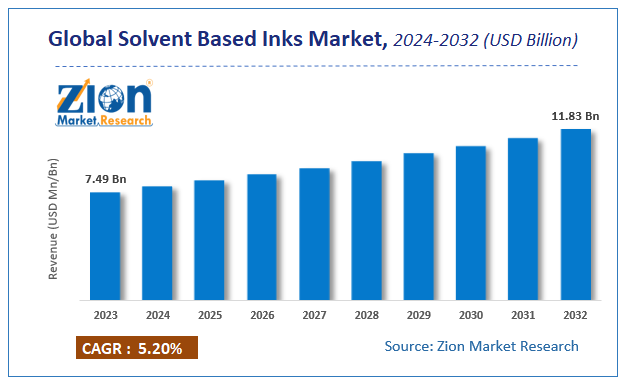
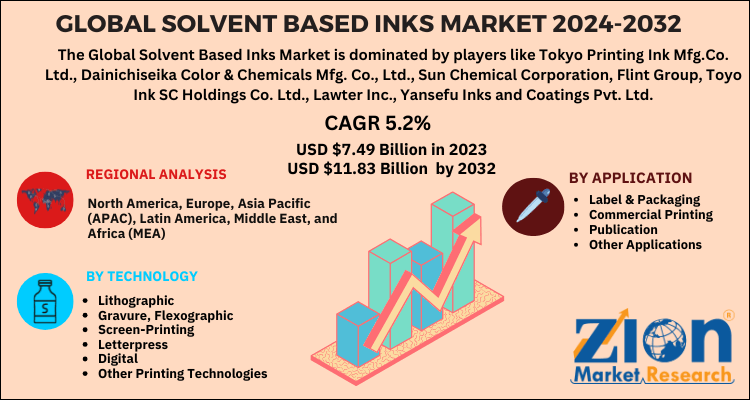
The global solvent based inks market size was worth around USD 7.49 billion in 2023 and is predicted to reach around USD 11.83 billion by 2032, with a compound annual growth rate (CAGR) of roughly 5.2% between 2024 and 2032.
This report provides a comprehensive analysis of the growth drivers, restraints, and challenges shaping demand across the global solvent based inks market throughout the forecast period, while highlighting high-potential emerging opportunities within the industry.
Key Insights
- As per the analysis shared by our research analyst, the global solvent based inks market is estimated to grow annually at a CAGR of around 5.2% over the forecast period (2024-2032).
- In terms of revenue, the global solvent based inks market size was valued at around USD 7.49 billion in 2023 and is projected to reach USD 11.83 billion by 2032.
- The global solvent based inks market is driven by escalating demand for lightweight, flexible packaging solutions in the food and beverage industry and the continuous expansion of digital industrial printing platforms.
- By technology, the lithographic segment held the largest market share of about 38% due to its superior deposition speed, outstanding print brilliance, and unmatched cost efficiency across continuous, high-volume packaging substrates.
- By application, the label & packaging segment accounted for the largest market share of around 46% due to surging consumer goods consumption, stringent moisture-resistance packaging requirements, and rising outdoor retail display usage.
- Based on the region, Asia Pacific dominated the worldwide market with a revenue share of approximately 42% driven by expansive packaging converting hubs, extensive manufacturing output, and massive capacity investments across China and India.
Solvent Based Inks Market: Overview
Solvent-based inks bind to non-absorbent surfaces and are commonly used to print items for outdoor use. Solvent-based inks offer many benefits. For starters, fade proof, water proof, and scratch resistant are these inks. In outdoor printing, these attributes improve their utility. Solvent-based inks are used on a wide range of surfaces and substrates and are known for advanced properties such as weather tolerance. The market for solvent-based inks is led by an increase in demand for lightweight and specialized packaging, predominantly in the food & beverage and health care industries. In addition, the growth of the digital printing industry is likely to increase demand for solvent-based inks in the near future.
Solvent Based Inks Market: Growth Factors
What factors are primarily accelerating demand in the solvent based ink market?
The rise of the packaging industry is the key factor driving the worldwide demand for solvent-based inks. Global demand for solvent-based inks is also growing with the growth of the transportation industry worldwide, especially in developed regions, and rising industrialization. In the packaging industry, solvent-based inks are commonly used in various exterior applications because they resist unfavorable weather conditions. In the packaging market, increasing demand for printed materials is driving growth. This, in turn, is driving growth in the solvent-based ink market.
Solvent Based Inks Market: Restraints
What factors are limiting the expansion of the solvent based ink market?
Environmental and regulatory pressures related to volatile organic compounds and solvent emissions can constrain growth in certain markets and encourage shifts toward alternative ink systems.
Competition from water-based and other lower-solvent technologies in specific applications may also limit volume growth where regulatory or customer preferences favor more sustainable options.
Solvent Based Inks Market: Opportunities
Where do significant growth opportunities lie for the solvent based ink market?
Demand for lightweight and specialized packaging in the food and beverage and healthcare industries creates ongoing opportunities. Growth in flexible packaging and the printing of tags and labels further supports volume expansion.
Expansion of manufacturing activities and plant capacity in Asia Pacific, together with rising outdoor and commercial printing needs, offers additional avenues for market development.
Solvent Based Inks Market: Challenges
What key challenges confront participants in the solvent based ink market?
Balancing performance requirements such as weather resistance and adhesion with evolving environmental regulations remains a key challenge. Producers must invest in formulations that maintain durability while addressing emission and safety concerns.
Maintaining competitiveness against alternative printing technologies and ink systems requires continuous product development and cost management.
Solvent Based Inks Market: Report Scope
| Report Attributes | Report Details |
|---|---|
| Report Name | Solvent Based Inks Market |
| Market Size in 2023 | USD 7.49 Billion |
| Market Forecast in 2032 | USD 11.83 Billion |
| Growth Rate | CAGR of 5.2% |
| Number of Pages | 230 |
| Key Companies Covered | Tokyo Printing Ink Mfg.Co. Ltd., Dainichiseika Color & Chemicals Mfg. Co., Ltd., Sun Chemical Corporation, Flint Group, Toyo Ink SC Holdings Co. Ltd., Lawter Inc., Yansefu Inks and Coatings Pvt. Ltd., Siegwerk Druckfarben AG & Co. KGaA, Sakata INX Corporation, Huber Group, SICPA Holding SA, Fujifilm Sericol India Private Limited, Royal Dutch Printing Ink Factories Van Son, T&K TOKA CO. LTD., among others |
| Segments Covered | By Printing Technology, By Application, and By Region |
| Regions Covered | North America, Europe, Asia Pacific (APAC), Latin America, Middle East, and Africa (MEA) |
| Base Year | 2023 |
| Historical Year | 2018 - 2022 |
| Forecast Year | 2024 - 2032 |
| Customization Scope | Avail customized purchase options to meet your exact research needs. Request For Customization |
Solvent Based Inks Market: Segmentation
The solvent based ink market is segmented by technology, application, and region. All the segments of the solvent based ink market have been analyzed based on present and future trends, and the market is estimated from 2024 to 2032.
By printing technology, the market is divided into lithographic, gravure, flexographic, screen-printing, letterpress, digital, and others. The lithographic category accounted for the largest share of overall demand and is projected to remain highly lucrative during the forecast period. Growth in flexible packaging and the printing of tags and labels around the globe supports this position. Lithography is widely used for high-quality printing of books, catalogs, and posters because of its performance and print quality. This leadership helps drive overall market volume by anchoring demand in both packaging and commercial print applications and encouraging continued refinement of solvent based formulations suited to these processes.
By application, the solvent based ink market is divided into label and packaging, commercial printing, publication, and others. The label and packaging segment is a primary contributor, supported by rising demand for lightweight and specialized packaging, particularly in the food and beverage and healthcare industries. This dominance supports market growth by linking solvent based ink consumption to expanding packaging volumes and outdoor durability requirements. The publication segment, which includes newspapers, journals, books, and catalogs, is expected to witness more moderated trends due to the rise of internet advertising and digital publishing, while commercial printing continues to contribute steady demand.
Global Solvent Based Inks Market: Regional Analysis
Why will Asia Pacific continue to dominate growth in the global market during the projection period?
Asia Pacific is expected to expand significantly during the forecast period. Growth in the lamination and food packaging industries in the region is a major driver of demand for solvent based inks. Large-scale manufacturing activities and plant expansion further support rising market share. Countries across the region continue to invest in packaging and printing capacity to serve domestic and export markets. This momentum drives overall market growth by generating higher consumption volumes, encouraging capacity additions among ink producers, and reinforcing the role of solvent based systems in weather-resistant and flexible packaging applications that influence global supply and technology trends.
North America and Europe maintain established demand supported by mature packaging and commercial printing sectors. Latin America and the Middle East and Africa are progressing as industrial and packaging activity expands, creating additional opportunities for solvent based ink applications.
Recent Developments
-
In January 2024, Toyo Ink SC Holdings Co., Ltd. formally rebranded as artience Co., Ltd., launching an expanded development initiative targeting eco-friendly solvent and biomass-derived packaging ink formulations to support circular packaging initiatives worldwide.
-
In November 2023, Siegwerk Druckfarben AG & Co. KGaA introduced an enhanced series of low-retention, high-speed solvent inks engineered specifically for high-performance flexible packaging converting, reducing solvent residue migration on multi-layer barrier films.
Solvent Based Inks Market: Competitive Landscape
The global solvent based ink market is dominated by players:
- Tokyo Printing Ink Mfg.Co. Ltd
- Dainichiseika Color & Chemicals Mfg. Co., Ltd
- Sun Chemical Corporation
- Flint Group
- Toyo Ink SC Holdings Co. Ltd
- Lawter Inc
- Yansefu Inks and Coatings Pvt. Ltd
- Siegwerk Druckfarben AG & Co. KGaA
- Sakata INX Corporation
- Huber Group
- SICPA Holding SA
- Fujifilm Sericol India Private Limited
- Royal Dutch Printing Ink Factories Van Son
- T&K TOKA CO. LTD
Solvent Based Inks Market: Key Trends
What are the key trends in the solvent based ink market?
Sustained demand from packaging and outdoor applications
Growth in flexible packaging, labels, and weather-resistant outdoor printing continues to support demand for solvent based inks that offer fade, water, and scratch resistance on non-absorbent surfaces.
Focus on high-quality lithographic and specialized printing
Lithographic processes remain important for books, catalogs, posters, tags, and labels, encouraging ongoing refinement of solvent based ink systems suited to high-quality and durable print applications.
Segments Covered
The global solvent based ink market is segmented as follows:
By Technology
- Lithographic
- Gravure
- Flexographic
- Screen-Printing
- Letterpress
- Digital
- Others
By Application
- Label & Packaging
- Commercial Printing
- Publication
- Others
By Region
- North America
- The U.S.
- Canada
- Mexico
- Europe
- France
- The UK
- Spain
- Germany
- Italy
- Rest of Europe
- Asia Pacific
- China
- Japan
- India
- Australia
- South Korea
- Rest of Asia Pacific
- The Middle East & Africa
- Saudi Arabia
- UAE
- Egypt
- Kuwait
- South Africa
- Rest of the Middle East & Africa
- Latin America
- Brazil
- Argentina
- Rest of Latin America
Table Of Content
Methodology
FrequentlyAsked Questions
Solvent based inks are specialized printing colorants formulated with pigments, binder resins, and organic chemical solvents that evaporate rapidly during printing, allowing the ink to chemically etch and mechanically bind onto non-absorbent, non-porous surfaces such as plastic films, vinyl, and foils. They provide exceptional water resistance, scratch resistance, and lightfastness for outdoor and high-wear applications.
Key growth drivers include growth in the packaging and transportation industries, increasing industrialization, demand for weather-resistant inks for exterior applications, and the expansion of flexible packaging and label printing.
The global solvent based ink market was valued at approximately USD 7.49 billion in 2023 and is projected to reach around USD 11.83 billion by 2032.
The global solvent based ink market is expected to expand at a compound annual growth rate of approximately 5.2% between 2024 and 2032.
Asia Pacific is expected to expand significantly, supported by growth in the lamination and food packaging industries, large-scale manufacturing activities, and plant expansion.
Major players include Tokyo Printing Ink Mfg. Co., Ltd., Dainichiseika Color & Chemicals Mfg. Co., Ltd., Sun Chemical Corporation, Flint Group, Toyo Ink SC Holdings Co. Ltd., Lawter Inc., Yansefu Inks and Coatings Pvt. Ltd., Siegwerk Druckfarben AG & Co. KGaA, Sakata INX Corporation, Huber Group, SICPA Holding SA, Fujifilm Sericol India Private Limited, Royal Dutch Printing Ink Factories Van Son, and T&K TOKA CO. LTD.
The report provides comprehensive analysis of market size, growth drivers, restraints, opportunities, segmentation by technology and application, regional dynamics, competitive landscape, and future outlook for the period 2024-2032.

HappyClients

