
Global Prescription Lens Market Growth, Size, Share, Trends, and Forecast 2032

Prescription Lens Market Analysis By Type (Single Vision [Convex, Concave, and Cylindrical], Bifocal, Trifocal, Progressive, Workspace Progressives, and Others), By Application (Myopia, Hyperopia/ Hypermetropia, Astigmatism, and Presbyopia), By Coating (Anti-Reflective, Scratch Resistant Coating, Anti-Fog Coating, and Ultraviolet Treatment), and By Region - Global and Regional Industry Overview, Market Intelligence, Comprehensive Analysis, Historical Data, and Forecasts 2024 - 2032
| Market Size in 2023 | Market Forecast in 2032 | CAGR (in %) | Base Year |
|---|---|---|---|
| USD 45.42 Billion | USD 71.19 Billion | 5.12% | 2023 |
Prescription Lens Industry Perspective
What will be the global prescription lens market size during the forecast period?
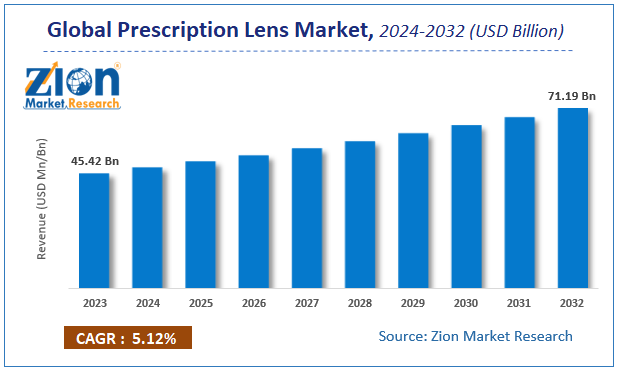
The global prescription lens market size was valued at around USD 45.42 billion in 2023 and is projected to reach about USD 71.19 billion by 2032, with a compound annual growth rate (CAGR) of roughly 5.12% between 2024 and 2032.
This report provides a comprehensive analysis of the growth drivers, restraints, and challenges shaping demand across the global prescription lens market throughout the forecast period, while highlighting high-potential emerging opportunities within the industry.
Key Insights
- As per the analysis shared by our research analyst, the global prescription lens market is estimated to grow at a CAGR of approximately 5.12% during the forecast period from 2024 to 2032.
- In terms of revenue, the global prescription lens market size was valued at around USD 45.42 billion in 2023 and is projected to reach USD 71.19 billion by 2032.
- The market is driven by the rising occurrence of refractive errors such as myopia and astigmatism, increasing vision impairment cases, digital screen exposure, aging population needs, and growth in eye care services and eyewear demand.
- Based on the type, single vision lenses hold a leading position with around a 25% share of the global market, supported by strong consumer demand and continuous research and development focused on correcting refractive faults.
- Based on the application, myopia represents the dominant segment due to the rising prevalence of myopia, particularly across East Asia, which continues to support expansion of the prescription lens industry.
- Based on the coating, anti-reflective coatings lead the market as consumers increasingly prefer high-quality prescription lenses that deliver improved clarity and a superior visual experience.
- Regionally, Europe is expected to lead the prescription lens market during the forecast period, supported by established eye care infrastructure, high awareness of vision correction, and sustained demand for quality ophthalmic lenses and coatings.
Prescription Lens Market: Overview
A prescription lens is customized eyewear designed according to an individual’s vision needs. It corrects refractive eye conditions by helping the eye focus light properly onto the retina. Lens power is measured in diopters, with negative values indicating myopia and positive values indicating hyperopia. Primary categories include single vision, bifocal, trifocal, progressive, workspace progressive, and other specialized designs. Convex lenses are used for hyperopia, concave lenses for myopia, and cylindrical lenses for astigmatism.
Prescription Lens Market: Dynamics
Growth Drivers
What factors are accelerating the expansion of the prescription lens market?
The rising occurrence of refractive error cases, particularly myopia and astigmatism, is a primary growth driver. Prescription lenses correct the eye’s inability to focus light onto the retina and thereby improve vision. Increasing awareness and earlier identification of uncorrected refractive errors further support market expansion as more people seek professional eye care and corrective eyewear.
Digital screen exposure and an aging population also fuel demand. Prolonged near work and screen use contribute to vision strain and refractive issues, while older adults increasingly require solutions for presbyopia. Growth in eye care services and broader demand for quality eyewear reinforce these trends and encourage continuous product development across lens types and coatings.
Restraints
What factors are limiting the growth of the prescription lens market?
Price competition can constrain margins and limit the uptake of higher-value products in cost-sensitive segments. Customization complexity associated with precise prescriptions, specialized designs, and multiple coating options adds manufacturing and fulfillment challenges. Supply chain variability can affect the availability of materials and finished lenses, influencing delivery times and cost structures.
These factors require manufacturers and distributors to balance quality, personalization, and operational efficiency while remaining competitive in a market where consumers and eye care professionals have access to a wide range of alternatives.
Opportunities
What emerging opportunities exist in the prescription lens market?
Rising myopia prevalence, especially in younger populations and in East Asia, creates substantial opportunities for corrective and myopia-management lenses. Demand for premium coatings such as anti-reflective treatments and for high-index and blue-light filtering options supports value growth. Expansion of online eyewear sales and aging-related needs for progressive and workspace lenses further broaden the addressable market.
Advances in digital surfacing, customization technologies, and specialized designs for different visual tasks enable manufacturers to differentiate offerings and capture demand from both standard and premium consumer segments.
Challenges
What challenges does the prescription lens market face?
Delivering consistent optical quality across a wide range of prescriptions and designs while managing cost and supply reliability remains an ongoing challenge. Educating consumers about the benefits of appropriate lens types and coatings, and ensuring accurate fitting and adaptation for progressive and specialized designs, requires coordination among manufacturers, laboratories, and eye care professionals. Competition and the need for continuous innovation also influence investment priorities and market positioning.
Prescription Lens Market: Report Scope
| Report Attributes | Report Details |
|---|---|
| Report Name | Prescription Lens Market |
| Market Size in 2023 | USD 45.42 Billion |
| Market Forecast in 2032 | USD 71.19 Billion |
| Growth Rate | CAGR of 5.12% |
| Number of Pages | 285 |
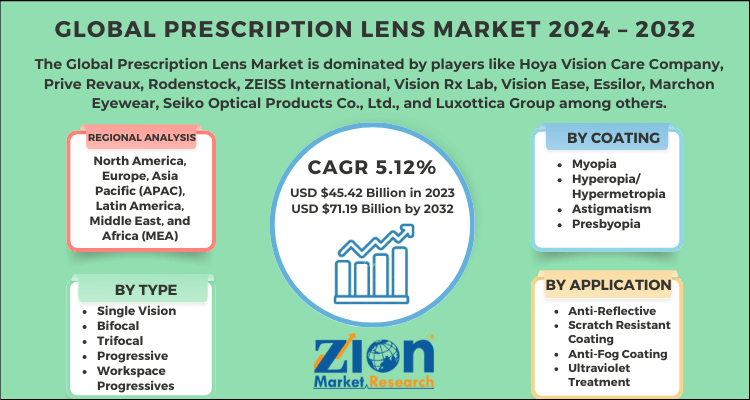
| Key Companies Covered | Hoya Vision Care Company, Prive Revaux, Rodenstock, ZEISS International, Vision Rx Lab, Vision Ease, Essilor, Marchon Eyewear, Seiko Optical Products Co., Ltd., and Luxottica Group, among others. |
| Segments Covered | By Type, By Application, By Coating, and By Region |
| Regions Covered | North America, Europe, Asia Pacific (APAC), Latin America, Middle East, and Africa (MEA) |
| Base Year | 2023 |
| Historical Year | 2018 - 2022 |
| Forecast Year | 2024 - 2032 |
| Customization Scope | Avail customized purchase options to meet your exact research needs. Request For Customization |
Prescription Lens Market: Segmentation Analysis
The prescription lens market is segmented by type, application, coating, and region. All the segments of the prescription lens market have been analyzed based on present and future trends and the market is estimated from 2024 to 2032.
Based on Type, the prescription lens market is divided into single vision, bifocal, trifocal, progressive, workspace progressives, and others. Single vision lenses hold a leading position with around 25% of the global market, driven by strong consumer demand and ongoing research focused on correcting refractive faults. These lenses remain a preferred choice for many wearers, including those seeking straightforward distance or near correction. Progressive and related multifocal designs serve growing needs among adults requiring seamless vision at multiple distances, while bifocal, trifocal, workspace progressive, and other specialized options address specific visual tasks and lifestyle requirements, supporting overall market diversity and growth.
Based on Application, the prescription lens market is divided into myopia, hyperopia/hypermetropia, astigmatism, and presbyopia. Myopia is the dominant application segment due to its rising prevalence worldwide and particularly high rates in East Asian countries such as China, Japan, South Korea, and Singapore. This trend continues to drive volume and innovation in corrective and control-oriented lenses. Hyperopia, astigmatism, and presbyopia each contribute meaningful demand as aging populations and diverse refractive profiles require appropriate lens solutions, reinforcing the need for a broad product portfolio across applications.
Based on Coating, the prescription lens market is divided into anti-reflective, scratch-resistant coating, anti-fog coating, and ultraviolet treatment. Anti-reflective coatings lead the market because they significantly improve visual quality and reduce glare, making them highly desirable for consumers seeking a superior experience with prescription eyewear. Scratch-resistant coatings support durability and everyday practicality. Anti-fog and ultraviolet treatments address specific environmental and protective needs, expanding the value proposition of finished lenses and encouraging uptake of coated products across retail and clinical channels.
Prescription Lens Market: Regional Analysis
Why will Europe continue to dominate the global market during the projection period?
Europe is expected to lead the prescription lens market during the forecast period. The region benefits from well-established eye care infrastructure, high awareness of vision correction, and strong consumer preference for quality ophthalmic lenses and advanced coatings. Mature optical retail and clinical networks support consistent demand for single vision, progressive, and specialized designs. These conditions enable Europe to influence product standards, technology adoption, and competitive dynamics, reinforcing its role in driving overall market development and innovation.
North America maintains substantial demand supported by high rates of eyewear use, access to professional eye care, and interest in premium and digitally optimized lenses. Asia Pacific is a major growth engine driven by the high prevalence of myopia, expanding middle-class populations, and increasing access to vision correction services in countries such as China, Japan, India, and South Korea. Latin America and the Middle East and Africa represent emerging opportunities where rising awareness and improving eye care access are expected to support gradual market expansion.
Prescription Lens Market: Competitive Analysis
Some of the major players in the global prescription lens market include;
- Hoya Vision Care Company
- Prive Revaux
- Rodenstock
- ZEISS International
- Vision Rx Lab
- Vision Ease
- Essilor
- Marchon Eyewear
- Seiko Optical Products Co., Ltd.
- Luxottica Group
Segments Covered
The global prescription lens market is segmented as follows:
By Type
- Single Vision
- Convex
- Concave
- Cylindrical
- Bifocal
- Trifocal
- Progressive
- Workspace Progressives
- Others
By Application
- Myopia
- Hyperopia/ Hypermetropia
- Astigmatism
- Presbyopia
By Coating
- Anti-Reflective
- Scratch Resistant Coating
- Anti-Fog Coating
- Ultraviolet Treatment
By Region
- North America
- The U.S.
- Canada
- Mexico
- Europe
- France
- The UK
- Spain
- Germany
- Italy
- Rest of Europe
- Asia Pacific
- China
- Japan
- India
- Australia
- South Korea
- Rest of Asia Pacific
- The Middle East & Africa
- Saudi Arabia
- UAE
- Egypt
- Kuwait
- South Africa
- Rest of the Middle East & Africa
- Latin America
- Brazil
- Argentina
- Rest of Latin America
Table Of Content
Methodology
FrequentlyAsked Questions
A prescription lens is customized eyewear based on an individual’s vision needs. It corrects refractive eye conditions such as myopia, hyperopia, astigmatism, and presbyopia by helping the eye focus light properly onto the retina.
The global prescription lens market is driven by rising rates of vision disorders and refractive errors, increased exposure to digital screens, an aging population, and growth in eye care services and demand for quality eyewear.
The global prescription lens market size was valued at approximately USD 45.42 billion in 2023 and is expected to reach around USD 71.19 billion by 2032.
The global prescription lens market is expected to grow at a compound annual growth rate (CAGR) of approximately 5.12% during the forecast period from 2024 to 2032.
Europe is expected to lead and contribute notably to the global prescription lens market, supported by strong eye care infrastructure and sustained demand for quality lenses and coatings.
Some of the major players leveraging the prescription lens market growth are Hoya Vision Care Company, Prive Revaux, Rodenstock, ZEISS International, Vision Rx Lab, Vision Ease, Essilor, Marchon Eyewear, Seiko Optical Products Co., Ltd., and Luxottica Group.
The report provides a detailed examination of growth drivers, restraints, opportunities, and challenges, along with comprehensive segmentation analysis, regional insights, competitive landscape, and forward-looking forecasts that enable stakeholders to make informed strategic decisions.

HappyClients

