
Silver Jewelry Market Size, Growth, Global Trends, Forecast 2034

Silver Jewelry Market By Type (Rings, Bracelets, Earrings, Necklaces, Anklets, and Others), By Distribution Channel (Offline and Online), and By Region - Global and Regional Industry Overview, Market Intelligence, Comprehensive Analysis, Historical Data, and Forecasts 2025 - 2034
| Market Size in 2024 | Market Forecast in 2034 | CAGR (in %) | Base Year |
|---|---|---|---|
| USD 38.6 Billion | USD 63.5 Billion | 5.1% | 2024 |
Silver Jewelry Industry Perspective:
What will be the size of the global silver jewelry market during the forecast period?
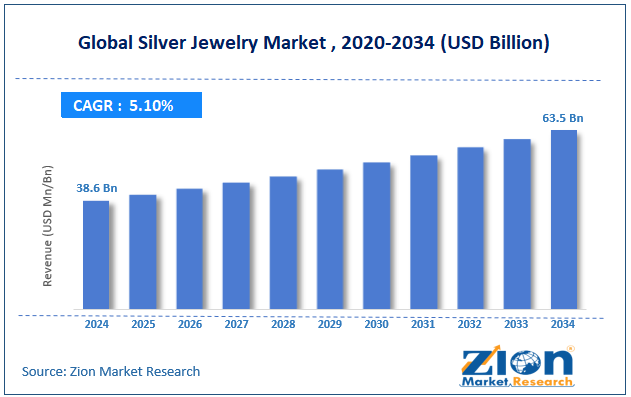
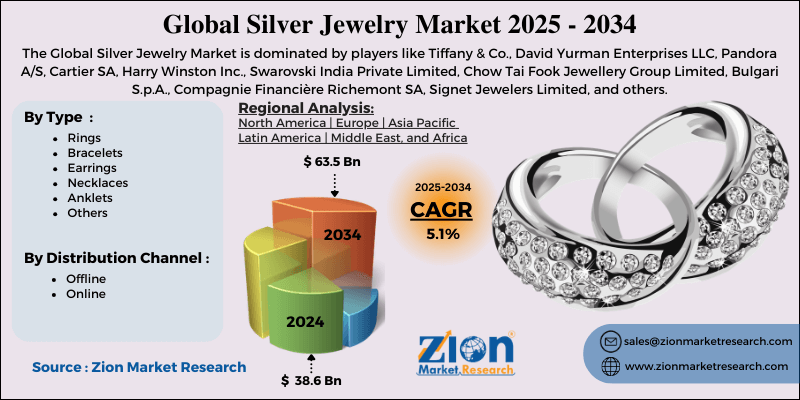
The global silver jewelry market size was worth around USD 38.6 billion in 2024 and is predicted to grow to around USD 63.5 billion by 2034, with a compound annual growth rate (CAGR) of roughly 5.1% between 2025 and 2034.
Key Insights
- As per the analysis shared by our research analyst, the global silver jewelry market is estimated to grow annually at a CAGR of around 5.1% over the forecast period (2025-2034).
- In terms of revenue, the global silver jewelry market size was valued at around USD 38.6 billion in 2024 and is projected to reach USD 63.5 billion by 2034.
- Changing fashion trends and the strong influence of millennials and Gen Z consumers—who prefer minimalist, trendy, and customizable designs—are further accelerating demand.
- Based on the type, in 2024, the bracelets segment dominates the market.
- Based on the distribution channel, the offline distribution channel captured the largest share of revenue, exceeding 60%, in 2024.
- Based on region, the Asia Pacific is expected to lead the silver jewelry market over the projected period.
Silver Jewelry Market: Overview
Silver jewelry comprises decorative items worn on the body, primarily made of silver and silver-based alloys. The majority of silver jewelry sold in stores is made from sterling silver, which is 92.5 percent pure silver that metalworkers combine with other materials to create stronger, longer-lasting products. People value silver jewelry because it shines brightly and complements various fashion styles, costs less than gold and platinum, and is easy to modify for different designs. People use this product for daily activities, wear it as a fashion accessory, give it as a gift, and use it for cultural and ceremonial purposes. It is available through jewelry stores, artisan outlets, and online retail platforms, which continue to grow. The silver jewelry market exists because more people want to buy affordable luxury products, which silver provides through its visual appeal that resembles precious metals at a much lower cost than gold or platinum. The rising disposable incomes in developing countries have led to increased consumer spending on fashion and lifestyle products, including silver jewelry, which people buy for daily use and as gifts. Silver price fluctuations pose a significant challenge because they affect all aspects of business operations, making it difficult for manufacturers and retailers to develop long-term business strategies. The pricing power of traditional silver jewelry is facing new challenges as customers increasingly choose between stainless steel, fashion metals, and gold-plated jewelry.
Silver Jewelry Market: Dynamics
Growth Drivers
Why does affordable-luxury/rising disposable income propel the development of the silver jewelry market?
Cheap luxury goods and more discretionary income are two big reasons why the sector is growing. Customers want things that look better and seem more valuable, but they don't want to pay the high prices associated with typical luxury materials. People are spending much more on lifestyle and fashion items, especially middle-class families and younger customers with more money to spend. This style is wonderful for silver jewelry since it looks and feels like fine jewelry but costs less. This makes it great for everyday wear, for buying for yourself, or for giving as a present. This plan attracts more customers, encourages repeat purchases, and sustains steady sales growth across both physical locations and rapidly expanding online stores.
For instance, personal income increased $30.6 billion (0.1 percent at a monthly rate) in October 2025, followed by an increase of $80.0 billion (0.3 percent) in November 2025, according to estimates released by the U.S. Bureau of Economic Analysis.
Restraints
Does competition from substitute materials hamper the growth of the silver jewelry industry?
Competition from other materials, particularly in markets that prioritize price and fashion, is slowing the growth of the silver jewelry sector. Stainless steel, trendy metals, gold-plated alloys, and imitation jewelry often appear just as nice but cost less. They also offer features such as greater durability and less upkeep, which make them attractive to folks on a budget. Another reason these options are better is that fashion trends change constantly. They are easier to replace and function better with products that don't last long. Because of this, silver jewelry designers have to deal with lower costs, narrower profit margins, and the need to continually develop innovative designs to make their pieces stand out. This might slow the market's overall expansion and limit the growth of some client groups.
Opportunities
Will the increasing customization efforts by key market players create opportunities for the silver jewelry industry expansion?
Key market participants are poised to create significant opportunities for industry expansion by launching more personalized projects. Increasingly, customers seek personalized and unique jewelry, such as engraved pieces, birthstone designs, customizable charms, and made-to-order collections. This is driving up demand for goods that aren't mass-produced. Customization adds emotional value and helps silver jewelry makers stand out in a crowded market, charge higher prices, and build stronger client loyalty. Digital design tools, CAD modeling, and 3D printing have also made personalized silver jewelry cheaper and faster to produce, enabling its mass production. As a result, personalization increases the customer base, encourages repeat purchases, and helps the market grow in the long term, both online and offline.
For instance, in January 2026, Angara added silver metal customization to its jewelry design portfolio in India. This means that users can select silver as a material option for certain designs on the India website. The company stated that the change provides customers with more choices within its current line of gemstone jewelry, which includes gold products in 9K, 14K, and 18K. Silver is now an option for approved designs, giving buyers more choices in price and style.
Challenges
Intense competition & price pressure pose a significant threat to the industry's growth
There are many different silver jewelry makers, from small enterprises to big-name brands, and they all compete on pricing and design. The industry is struggling to succeed due to intense competition and pressure to lower prices. It can be difficult to distinguish products because there are so many companies in this area. This can often lead to price wars, especially on e-commerce sites where it's easy for purchasers to compare prices.
Because of this, profit margins are low, making it hard for manufacturers and retailers to invest in new designs, branding, marketing, and environmentally friendly sourcing. Smaller companies may be unable to withstand long-term pressure on margins, whereas larger companies may prioritize volume over value, thereby limiting premiumization. People still want to buy things, but this climate could make them less willing to invest, lower product quality, and slow market growth.
Silver Jewelry Market: Report Scope
| Report Attributes | Report Details |
|---|---|
| Report Name | Silver Jewelry Market |
| Market Size in 2024 | USD 38.6 Billion |
| Market Forecast in 2034 | USD 63.5 Billion |
| Growth Rate | CAGR of 5.1% |
| Number of Pages | 215 |
| Key Companies Covered | Tiffany & Co., David Yurman Enterprises LLC, Pandora A/S, Cartier SA, Harry Winston Inc., Swarovski India Private Limited, Chow Tai Fook Jewellery Group Limited, Bulgari S.p.A., Compagnie Financière Richemont SA, Signet Jewelers Limited, and others. |
| Segments Covered | By Type, By Distribution Channel, and By Region |
| Regions Covered | North America, Europe, Asia Pacific (APAC), Latin America, Middle East, and Africa (MEA) |
| Base Year | 2024 |
| Historical Year | 2019 to 2023 |
| Forecast Year | 2025 - 2034 |
| Customization Scope | Avail customized purchase options to meet your exact research needs. Request For Customization |
Silver Jewelry Market: Segmentation
Type Insights
Why do bracelets segment dominate the Silver Jewelry market in 2024?
In 2024, the bracelets segment dominates the market. There is strong demand for silver bracelets because they pair well with many styles and appeal to diverse tastes. Because silver is inexpensive and easy to work with, it is a great material for creating beautiful, intricate bracelet designs that will appeal to a wide range of customers. One may wear silver bracelets in both classic and modern styles, making them suitable for many occasions. Also, the trend of stacking bracelets and mixing metals is making silver bracelets even more popular. The bracelet segment is a growing and evolving part of the worldwide silver jewelry business, as customers have diverse tastes.
Distribution Channel Insights
Did the offline distribution channel segment hold the largest share in the silver jewelry market in 2024?
The offline distribution channel captured the largest share of revenue, exceeding 60%, in 2024. The surge is attributable to consumers' strong need for in-person scrutiny, trust, and personalized care when purchasing jewelry. Many customers prefer to buy jewelry from stores, specialist boutiques, and brand-exclusive outlets because they can inspect the quality, purity, weight, craftsmanship, and fit of the items before purchase. These are all extremely important factors for precious metal jewelry. Offline stores also benefit from existing brand trust, hallmark verification, in-store discounts, and after-sales services like resizing, polishing, and the option to buy again. These things make customers feel more confident and encourage them to buy again.
Regional Insights
Why does the Asia Pacific hold the largest market share in the silver jewelry market?
Asia Pacific holds the largest market share in 2024 and is expected to maintain this pattern over the analysis period. A strong cultural connection, high levels of spending, and the growing buying power of the middle class are factors that have contributed to the regional boom. In countries like India, China, Thailand, and Indonesia, silver jewelry is an important part of their cultures and religions. People wear it every day, at festivals, at weddings, and as gifts, which keeps demand steady. A large population and rising disposable incomes in the area also help. People are becoming more interested in inexpensive luxury jewelry as an alternative to more expensive gold.
Asia Pacific is also a major center for the production of silver jewelry. It has skilled artisans, cheap labor, and well-established supply chains, which enable it to offer a wide selection of products at competitive prices. The presence of both organized retail brands and a significant unorganized sector, along with increased urbanization and e-commerce usage, helps the market grow and solidifies the Asia Pacific's position as the world's leading silver jewelry market.
Silver Jewelry Market: Competitive Analysis
The global silver jewelry market is dominated by players like:
- Tiffany & Co.
- David Yurman Enterprises LLC
- Pandora A/S
- Cartier SA
- Harry Winston Inc.
- Swarovski India Private Limited
- Chow Tai Fook Jewellery Group Limited
- Bulgari S.p.A.
- Compagnie Financière Richemont SA
- Signet Jewelers Limited
The global silver jewelry market is segmented as follows:
By Type
- Rings
- Bracelets
- Earrings
- Necklaces
- Anklets
- Others
By Distribution Channel
- Offline
- Online
By Region
- North America
- The U.S.
- Canada
- Europe
- France
- The UK
- Spain
- Germany
- Italy
- Rest of Europe
- Asia Pacific
- China
- Japan
- India
- South Korea
- Southeast Asia
- Rest of Asia Pacific
- Latin America
- Brazil
- Mexico
- Rest of Latin America
- Middle East & Africa
- GCC
- South Africa
- Rest of Middle East & Africa
Table Of Content
Methodology
FrequentlyAsked Questions

HappyClients

