
Home Appliances Market Size, Share, Trends, Growth and Forecast 2034

Home Appliances Market By Type (Major Appliances, Small Appliances, Smart Home Appliances), By Distribution Channel (Supermarkets & Hypermarkets, Specialty Stores, Online/E-commerce, and Others), and By Region - Global and Regional Industry Overview, Market Intelligence, Comprehensive Analysis, Historical Data, and Forecasts 2025 - 2034
| Market Size in 2024 | Market Forecast in 2034 | CAGR (in %) | Base Year |
|---|---|---|---|
| USD 503 Billion | USD 754.56 Billion | 5.20% | 2024 |
Home Appliances Industry Perspective:
What will be the size of the global home appliances market during the forecast period?
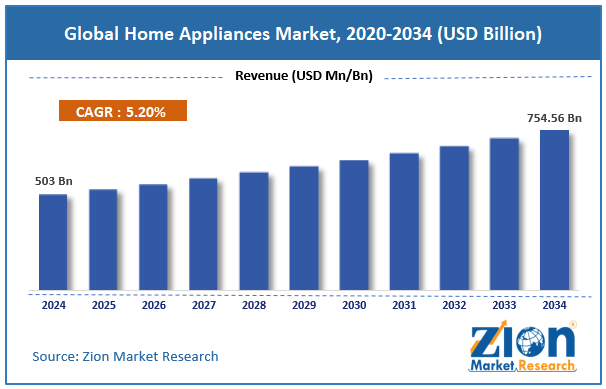
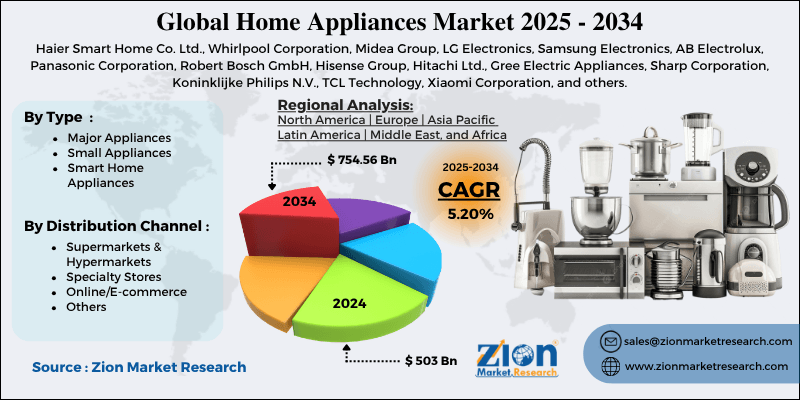
The global home appliances market size was around USD 503 billion in 2024 and is projected to reach USD 754.56 billion by 2034, with a compound annual growth rate (CAGR) of roughly 5.20% between 2025 and 2034.
Key Insights:
- As per the analysis shared by our research analyst, the global home appliances market is estimated to grow annually at a CAGR of around 5.20% over the forecast period (2025-2034)
- In terms of revenue, the global home appliances market size was valued at around USD 503 billion in 2024 and is projected to reach USD 754.56 billion by 2034.
- The home appliances market is projected to grow significantly, driven by rising disposable incomes, technological advancements (smart/IoT appliances), and demand for energy-efficient and eco-friendly appliances.
- Based on type, the major appliances segment is expected to lead the market, demonstrating a stronger market share compared to the small appliances segment, which is also projected to display considerable growth.
- Based on distribution channel, the specialty stores segment is expected to lead the market, followed by the online/e-commerce segment.
- Based on region, the Asia Pacific is projected to dominate the global market during the estimated period, followed by North America.
Home Appliances Market: Overview
Home appliances are mechanical or electrical devices designed to help with everyday household tasks, such as food storage, cooking, climate control, and cleaning. Common instances include washing machines, refrigerators, microwaves, vacuum cleaners, and air conditioners. These appliances save time and effort, enhance convenience, and improve the overall efficiency and comfort of modern homes. The global home appliances market is projected to grow substantially, driven by rising disposable incomes, technological advancements, the adoption of smart appliances, and demand for energy-efficient models. Growing disposable incomes, especially in developing economies, allow households to spend more on consumer durables. As living standards improve, consumers are more willing to invest in modern appliances that improve efficiency and comfort. This economic progress continues to expand the worldwide consumer base for appliances.
Moreover, improvements such as AI-enabled features, voice control, and IoT connectivity are transforming household appliances. Smart appliances offer features like predictive maintenance, remote monitoring, and energy optimization. These technological enhancements appeal to tech-savvy consumers and stimulate industry growth. Furthermore, consumers are actively adopting energy-efficient appliances to reduce utility and electricity costs. Government labeling programs and environmental awareness are motivating households to upgrade to eco-friendly models. This trend fuels innovation and replacement purchases in global markets.
Although drivers exist, the global market is challenged by factors such as the high initial cost of advanced appliances and high maintenance and repair costs. Premium appliances with smart technology and energy-efficient components often command higher prices. Cost-sensitive consumers, especially in emerging nations, may avoid or delay such purchases. This pricing restricts the adoption of advanced appliances. Likewise, several modern appliances need specialized care, which may increase maintenance expenses for users. Limited availability of spare parts or skilled experts may also delay repairs. These concerns discourage buyers from adopting high-tech or complex appliances.
Even so, the global home appliances industry is well-positioned due to growing demand for connected and smart appliances and the rise of sustainable, energy-efficient products. Smart appliances integrated with artificial intelligence, IoT, and mobile applications are gaining prominence worldwide. Consumers prefer connected devices that offer automation, remote control capabilities, and energy optimization. This trend offers new opportunities for innovation and premium products for manufacturers. Additionally, environmental awareness and growing energy prices encourage consumers to adopt eco-friendly appliances. Manufacturers can develop products with low energy consumption, sustainable designs, and recyclable materials. This shift towards green technology offers long-term growth potential.
Home Appliances Market: Dynamics
Growth Drivers
How is the home appliances market fueled by the replacement demand and product upgradation?
Replacement demand is a key contributor to the market growth. Nearly 57% of appliance purchases worldwide are made to replace outdated appliances. Consumers are actively upgrading to appliances that offer better technology, smart features, and efficiency. Shorter product innovation cycles also lead to more frequent replacements. As technology advances, households continue to replace outdated appliances with energy-efficient, modern alternatives.
How are technological improvements and smart appliance integration driving the global home appliances market?
Technological innovation is transforming the global home appliances market through the introduction of connected, smart appliances. Modern appliances are increasingly integrating technologies such as IoT, AI, and voice control systems. In the past years, over 35% of newly sold appliances worldwide have had smart connectivity features. These technologies allow users to control appliances remotely and enhance energy efficiency. Continuous innovation motivates consumers to adopt advanced appliances and upgrade their existing devices.
Restraints
Long product replacement cycles adversely impact the market progress
Home appliances typically have lifespans of 10-15 years, reducing the need for frequent replacements. Consumers usually prefer to repair appliances rather than replace them, which slows overall market growth and hampers annual sales. While durable designs benefit users, they also reduce demand for replacements, posing challenges for manufacturers. To sustain growth, companies should focus on innovation, introducing new features, solutions, and upgrades to encourage repeat purchases and expand the market.
Opportunities
How does the expansion of smart and connected appliances benefit the growth of the home appliances market?
The growth of smart homes is driving demand for connected appliances with features such as automation, remote monitoring, and voice control. In several developed markets, nearly 40% of the households already use smart appliances. Consumers prefer devices that integrate with digital ecosystems and AI to improve energy efficiency and convenience. This trend is transforming expectations and encouraging manufacturers to advance and offer new service-based solutions. Overall, smart appliances offer strong opportunities for technology-driven, long-term growth in the home appliances industry.
How is the rising demand for energy-efficient appliances an opportunity for the growth of the global market?
Home appliances usually have long lifespans of nearly 15 years, which lowers the frequency of replacement purchases. Consumers usually choose to repair appliances rather than replace them, thereby driving total market growth and limiting annual sales volumes. Reliable and durable product designs, while beneficial for consumers, also reduce the need for replacements. This increases intricacies for manufacturers trying to maintain consistent revenue and industry share. To fuel growth, companies should emphasize continuous innovation by launching new features, upgrades, and technologies that encourage repeat purchases and enhance consumer engagement.
Challenges
Environmental and e-waste management issues restrict the market growth
Disposing of old appliances may harm the environment due to hazardous materials such as refrigerants, plastics, and metals. Governments are enforcing stringent regulations needing manufacturers to implement recycling and take-back programs. These programs comprise collection, product designs, and certified recycling that ease material recovery. Compliance increases operational complexity and costs for manufacturers. Despite these measures, effective electronic-waste management remains a major challenge due to informal recycling, high volumes, and limited consumer awareness.
Home Appliances Market: Report Scope
| Report Attributes | Report Details |
|---|---|
| Report Name | Home Appliances Market |
| Market Size in 2024 | USD 503 Billion |
| Market Forecast in 2034 | USD 754.56 Bllion |
| Growth Rate | CAGR of 5.20% |
| Number of Pages | 223 |
| Key Companies Covered | Haier Smart Home Co. Ltd., Whirlpool Corporation, Midea Group, LG Electronics, Samsung Electronics, AB Electrolux, Panasonic Corporation, Robert Bosch GmbH, Hisense Group, Hitachi Ltd., Gree Electric Appliances, Sharp Corporation, Koninklijke Philips N.V., TCL Technology, Xiaomi Corporation, and others. |
| Segments Covered | By Type, By Distribution Channel, and By Region |
| Regions Covered | North America, Europe, Asia Pacific (APAC), Latin America, Middle East, and Africa (MEA) |
| Base Year | 2024 |
| Historical Year | 2019 to 2023 |
| Forecast Year | 2025 - 2034 |
| Customization Scope | Avail customized purchase options to meet your exact research needs. Request For Customization |
Home Appliances Market: Segmentation
The global home appliances market is segmented based on type, distribution channel, and region.
Why is the Major Appliances segment projected to dominate the home appliances market?
Based on type, the global home appliances industry is divided into major appliances, small appliances, and smart home appliances. The major appliances segment holds a dominating 64% share of the total market. This segment comprises refrigerators, washing machines, dishwashers, ovens, and air conditioners, which are essential household products with high adoption rates worldwide. Strong demand for smart-enabled, energy-efficient white goods, along with the growth of home construction and urbanization, continues to fuel the segment's prominence.
Conversely, the small appliances segment ranks second in the market with a 36-38% share. This category includes products such as blenders, coffee makers, electric kettles, toasters, and vacuum cleaners, which are widely used for daily household tasks and convenience. Growing consumer preferences for multifunctional, compact, and affordable appliances have notably driven the segmental dominance.
What are the key reasons for the leadership of the Specialty Stores segment in the home appliances market?
Based on distribution channel, the global home appliances market is segmented into supermarkets & hypermarkets, specialty stores, online/e-commerce, and others. The specialty stores segment leads the market with a 45% share. These stores emphasize appliances and electronics, offering product demonstrations, expert guidance, and a broad range of brands. Their specialized service and in-store experience strongly influence consumer purchasing decisions.
However, the online/e-commerce segment holds the second-largest market share at 30-36%. Consumers prefer online channels because of convenience, product comparison features, competitive pricing, and home delivery options. Growing internet penetration and digital payment adoption continue to accelerate the segmental growth.
Home Appliances Market: Regional Analysis
What enables Asia Pacific's strong foothold in the global Home Appliances Market?
Asia Pacific is likely to sustain its leadership in the home appliances market, with a 6.5% CAGR, driven by rapid urbanization and population growth, rising disposable incomes and living standards, and the expansion of e-commerce and retail channels. APAC has the largest population worldwide, and growing urbanization is creating millions of new households. Growing urban middle-class families fuel strong demand for essential home devices, making the region a leading hub.
Moreover, economic growth in countries such as India, China, and Southeast Asian nations has increased disposable incomes. Consumers are now willing to spend on energy-efficient, modern, and smart appliances, driving the market growth. Furthermore, the rapid growth of specialty stores, supermarkets, and online platforms has enhanced access to appliances. Competitive pricing and convenient distribution encourage high adoption rates in semi-urban and urban areas.
Why does North America rank second in the global Home Appliances Market?
North America continues to hold the second-highest share, with a 4% CAGR in the home appliances industry, owing to high consumer purchasing power, urbanization, established housing stock, technological advancements, and the adoption of smart appliances. North America has the highest per capita income worldwide, allowing consumers to invest in energy-efficient and premium home appliances. Strong purchasing power fuels demand across both high-end and basic appliance segments. With established urban infrastructure and a high rate of home ownership, there is steady demand for upgraded appliances and replacements. Established households often replace old appliances with feature-rich and modern models.
Additionally, North American consumers are quick to adopt connected and smart appliances with AI and IoT capabilities. Integration with home automation systems encourages the purchase of advanced appliances.
Home Appliances Market: Competitive Analysis
The leading players in the global home appliances market are:
- Haier Smart Home Co. Ltd.
- Whirlpool Corporation
- Midea Group
- LG Electronics
- Samsung Electronics
- AB Electrolux
- Panasonic Corporation
- Robert Bosch GmbH
- Hisense Group
- Hitachi Ltd.
- Gree Electric Appliances
- Sharp Corporation
- Koninklijke Philips N.V.
- TCL Technology
- Xiaomi Corporation
What are the key trends in the global Home Appliances Market?
Smart and connected appliance adoption:
Consumers increasingly prefer appliances with voice-control, IoT connectivity, and mobile app integration. Washers, smart refrigerators, and air conditioners offer automated functions and remote monitoring. This trend improves energy optimization and convenience in households.
Customization and multifunctional product innovation:
Consumers seek appliances that offer multiple functions and suit different lifestyles, especially in urban living spaces. Space-saving, multifunctional designs and compact features are gaining popularity. Advancements in product features address changing consumer requirements and improve usability.
Growth of e‑commerce and digital retailing:
Online platforms are becoming a dominant sales channel for home devices, offering easy comparisons, home delivery, and a wide selection. Financing options and digital promotions further encourage purchases. This shift drives accessibility, mainly in remote and semi-urban areas.
The global home appliances market is segmented as follows:
By Type
- Major Appliances
- Small Appliances
- Smart Home Appliances
By Distribution Channel
- Supermarkets & Hypermarkets
- Specialty Stores
- Online/E-commerce
- Others
By Region
- North America
- The U.S.
- Canada
- Mexico
- Europe
- France
- The UK
- Spain
- Germany
- Italy
- Rest of Europe
- Asia Pacific
- China
- Japan
- India
- Australia
- South Korea
- Rest of Asia Pacific
- The Middle East & Africa
- Saudi Arabia
- UAE
- Egypt
- Kuwait
- South Africa
- Rest of the Middle East & Africa
- Latin America
- Brazil
- Argentina
- Rest of Latin America
Table Of Content
Methodology
FrequentlyAsked Questions

HappyClients

