Wet and Dry Vacuum Cleaners Market Size, Share, Trends, Growth 2034

Wet and Dry Vacuum Cleaners Market By Type (Floor Vacuum Cleaner, Pool Vacuum Cleaner and Window Vacuum Cleaner), By Operation Mode (Remote Control and Self-Drive), By Distribution Channel (Offline and Online), and By Region - Global and Regional Industry Overview, Market Intelligence, Comprehensive Analysis, Historical Data, and Forecasts 2025 - 2034
| Market Size in 2024 | Market Forecast in 2034 | CAGR (in %) | Base Year |
|---|---|---|---|
| USD 1.45 Billion | USD 2.50 Billion | 5.6% | 2024 |
Wet and Dry Vacuum Cleaners Industry Perspective:
What will be the size of the global wet and dry vacuum cleaners market during the forecast period?
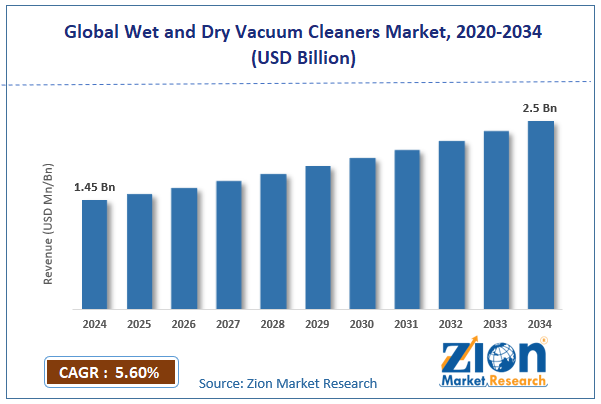
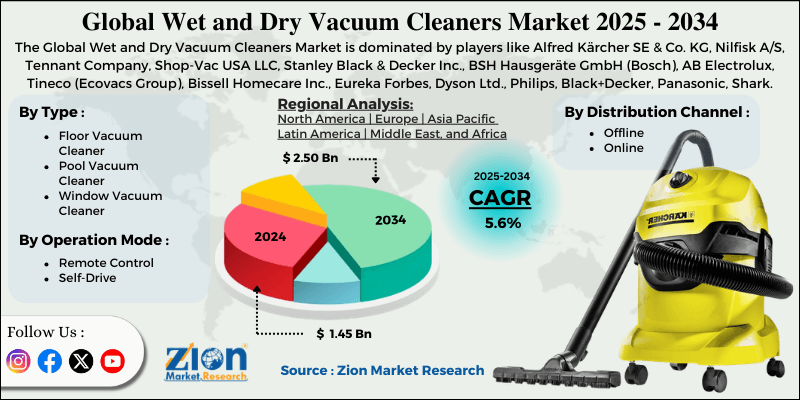
The global wet and dry vacuum cleaners market size was worth around USD 1.45 billion in 2024 and is predicted to grow to around USD 2.50 billion by 2034, with a compound annual growth rate (CAGR) of roughly 5.6% between 2025 and 2034.
Key Insights
- As per the analysis shared by our research analyst, the global wet and dry vacuum cleaners market is estimated to grow annually at a CAGR of around 5.6% over the forecast period (2025-2034).
- In terms of revenue, the global wet and dry vacuum cleaners market size was valued at around USD 1.45 billion in 2024 and is projected to reach USD 2.50 billion by 2034.
- Growth in commercial & industrial cleaning demand is expected to drive the wet and dry vacuum cleaners market.
- Based on the type, the wet and dry vacuum cleaners capture the largest revenue share in 2024.
- Based on the operation mode, the remote control is expected to dominate the industry growth.
- Based on the distribution channel, the offline distribution channel leads the market.
- Based on region, the North American region is expected to witness strong growth.
Wet and Dry Vacuum Cleaners Market: Overview
Wet and dry vacuum cleaners are multi-purpose cleaning devices. It can clean or clear solid materials (such as Dust, dirt, and small particulates) or liquid-contaminated surfaces (such as water or other liquids) with one tool. Compared to a standard dry vacuum cleaner, wet-and-dry vacuum cleaners are characterized by a specific motor, a sealed cabinet, and individual collection chambers or tanks that safely aspirate liquids without damaging motor components or other parts. Such devices are commonplace in homes, commercial buildings, manufacturing factories, construction sites, workshops, and other industrial areas because they have extraordinary vacuuming power and multi-purpose cleaning capabilities. The multi-functionality makes these devices very attractive for various end-use applications, from everyday use to spillage cleanup, construction debris, and industrial waste disposal.
Wet and Dry Vacuum Cleaners Market: Dynamics
Growth Drivers
Why does the rising focus on hygiene & cleanliness drive the wet and dry vacuum cleaners market growth?
The growing focus on hygiene and cleanliness is another important factor driving the expansion of the wet and dry vacuum cleaner market. Growing concerns about health, cleanliness, and infection control have brought about a seismic shift in buyer behavior across the residential, commercial, and industrial landscapes. People are ready to spend more on better cleaning appliances to ensure a dust-free, germ-free environment, and companies across hotels, hospitals, offices, and retailers are increasingly installing state-of-the-art cleaning equipment to meet new hygiene norms and regulatory standards. The ability of wet and dry vacuum cleaners to clean both dry debris and liquid spillage is proving to be an efficient, time-saving, and cost-effective solution for meeting consumer demand.
Restraints
High purchase cost compared to standard vacuums poses a major restraint to the industry growth
The significantly higher purchase price compared to conventional vacuum cleaners is one of the biggest constraints on growth in the wet and dry vacuum market. Due to their multifunctionality, vacuum cleaners can be priced significantly higher than conventional air units, particularly because they are generally more powerful, have a larger storage capacity, and are fitted with additional features such as HEPA filters, cordless technology, or intelligent sensors. Price-conscious consumers, particularly emerging-market consumers who are likely to spend less on a vacuum cleaner anyway, may perceive the high purchase price as too high. Many consumers may therefore choose a less expensive dry vacuum, or opt to buy or rent/lease more conventional cleaning equipment, or use traditional equipment such as brooms. Commercial units cater more towards the industrial and industrial cleaning sectors, which are likely to be even more expensive, therefore pricing most small companies/machines out of the market.
Opportunities
Does the innovative product launch offer a potential opportunity for the wet and dry vacuum cleaners market growth?
A new product launch presents a great opportunity to expand the market for wet and dry vacuum cleaners. Ongoing innovation to “make life easier” includes cordless and rechargeable technologies, intelligent sensor technology, self-cleaning functions, increased battery life, greater suction power, and lightweight, smaller, more compact sizes, allowing manufacturers to distinguish themselves in a competitive marketplace. As benefits to the user, added efficiency, power, and energy saving are introduced, the popularity of wet and dry vacuum cleaners should reach consumers more easily.
For instance, in February 2026, Dyson introduced its most svelte floor cleaner to date - the PencilWash. The svelte design represents the thinnest wet-and-dry cleaner Dyson has ever introduced; it measures a mere 38mm in diameter. The total weight of this lightweight 2.2kg machine is complemented by a significant 380g weight in the hand, the lighter so to speak. The PencilWash was introduced to be lighter and more easily maneuvered than previous cleaners, yet to be used for wet manual cleaning in a hygienic manner. It employs deposition, agitation, and extraction to effectively handle wet spills and dry debris in a single swipe. The mantra of the new sponge is to always supply fresh water to floors, not the sludge left by previous swipes.
Challenges
Does competition from other cleaning technologies pose a challenge to the expansion of the wet and dry vacuum cleaner industry?
One of the most formidable barriers to the development of the wet and dry vacuum cleaner industry is competition from other cleaning technologies. The proliferation of cleaning equipment on the market has broadened individuals' choices regarding the specific type of cleaning they are interested in. Among other equipment are robotic vacuum cleaners, steam mops, dry-only vacuums, and automated floor scrubbers. While many prefer robotic vacuum cleaners for hassle-free, hands-free cleaning, others enjoy the lightweight cordless stick vacuum as an easy option for day-to-day dusting and quick cleaning, and, in commercials, they prefer large floor scrubbers/sweepers for their extensive coverage.
Because wet and dry vacuum cleaners are marketed as heavy-duty, multi-purpose equipment and can therefore compete directly with specialized equipment, customers are likely to find specialized equipment more convenient, smaller, and easier to maintain. Further, the existence of less expensive substitutes may divert the attention of price-sensitive customers, thereby lowering market volume and delaying the penetration of wet and dry vacuum cleaners into the market.
Wet and Dry Vacuum Cleaners Market: Report Scope
| Report Attributes | Report Details |
|---|---|
| Report Name | Wet and Dry Vacuum Cleaners Market |
| Market Size in 2024 | USD 1.45 Billion |
| Market Forecast in 2034 | USD 2.50 Bllion |
| Growth Rate | CAGR of 5.6% |
| Number of Pages | 221 |
| Key Companies Covered | Alfred Kärcher SE & Co. KG, Nilfisk A/S, Tennant Company, Shop-Vac USA LLC, Stanley Black & Decker Inc., BSH Hausgeräte GmbH (Bosch), AB Electrolux, Tineco (Ecovacs Group), Bissell Homecare Inc., Eureka Forbes, Dyson Ltd., Philips, Black+Decker, Panasonic, Shark (SharkNinja), and others. |
| Segments Covered | By Type, By Operation Modem, By Distribution Channel, and By Region |
| Regions Covered | North America, Europe, Asia Pacific (APAC), Latin America, Middle East, and Africa (MEA) |
| Base Year | 2024 |
| Historical Year | 2019 to 2023 |
| Forecast Year | 2025 - 2034 |
| Customization Scope | Avail customized purchase options to meet your exact research needs. Request For Customization |
Wet and Dry Vacuum Cleaners Market: Segmentation
Type Insights
What factors cause the floor vacuum cleaner segment to be in a dominating position in the wet and dry vacuum cleaners market?
The wet and dry vacuum cleaners capture the largest revenue share in 2024. Growth is driven by consumer and commercial demand for efficient multi-surface floor-cleaning devices in home and business environments. There is greater consumer demand for devices capable of cleaning everyday dust and dirt, as well as accidental liquid spills, making wet and dry floor vacuum cleaners an affordable and effective investment. Increasing urbanization, rising disposable incomes, and greater awareness of hygiene standards are facilitating uptake, particularly in developing countries. In the commercial sector, there is strong demand across the healthcare, retail, hospitality, and office building segments, with the need for fast, efficient, multi-surface floor maintenance to meet health and safety standards. Innovations, such as cordless technology, stronger suction, HEPA filtration, lighter weight, and smarter technologies, are also stimulating demand.
Operation Mode Insights
Why does the remote control hold the largest share in the wet and dry vacuum cleaners market?
The remote control is expected to dominate the industry growth. This is driven by growing consumer demand for convenience, automation, and smart home integration. Remote-controlled wet and dry vacuum cleaners and robotic vacuum cleaners allow the operation, scheduling, and monitoring of cleaning activities without being physically near the vacuum cleaner. This significantly enhances the convenience offered by the equipment, and the market growth is primarily driven by rising adoption of smart home ecosystems, increasing consumer demand for time-saving home appliances, and greater smartphone and internet penetration.
Commercial applications such as hotels, offices, and healthcare settings demand remote operation of equipment to improve productivity and efficiency and reduce reliance on human resources. Enhancements in wireless connectivity and IoT integration have further improved product quality, performance, and reliability, adding momentum to premium product purchases. Increasing consumer inclination towards comfort, technological integration, and hands-free cleaning is expected to continue to favorably influence revenue growth in the remote control category.
Distribution Channel Insights
Why do the offline dominate the wet and dry vacuum cleaners market?
The offline distribution channel leads the market. This increase has been supported by heavy consumer preference towards in-store product evaluation and the availability of samples at the time of purchase. Physical Retail: organized electronics stores and hypermarkets, especially for expensive appliances like wet and dry vacuum cleaners, are preferred locations for people to check device features such as build quality, suction rating, size, and design, and then select the best-suited model. Factors such as customer demonstrations, sales representative coaching, and after-sales service help build consumer trust, particularly in developing markets where physical retail still holds sway.
Further, bulk commercial and industrial purchases are often routed through specialty dealers/distributors who provide technical consultation and full maintenance support along with the product. Promotions, holiday season discounts, inclusive finance, and after-sales support also played a major role in maintaining volume sales in the offline channel, compared to emerging direct-to-consumer options.
Regional Insights
Why does North America hold the largest share of the wet and dry vacuum cleaners market?
The North American region is expected to witness strong growth owing to consumer awareness of hygienic products, high disposable incomes, and the popularity of high-end home appliances. The region has matured in the adoption of vacuum cleaners for everyday domestic and commercial cleaning, which assures a consistent demand for multi-purpose wet and dry machines. The growth in home renovations, DIY projects, and garage workshops would generate further demand for versatile cleaning devices capable of removing both dry dirt and spills. The healthcare, hotel, retail, and manufacturing sectors would set strict hygiene benchmarks, resulting in greater use of these machines. Product innovations such as cordless, smart, and connected devices, improved filtration technology, and energy-efficient models would encourage consumers to replace existing units with newer, premium variants. Established market leaders, with proficient offline/online distribution channels, would ensure consistent revenue in the North American market.
Wet and Dry Vacuum Cleaners Market: Competitive Analysis
The global wet and dry vacuum cleaners market is dominated by players like;
- Alfred Kärcher SE & Co. KG
- Nilfisk A/S
- Tennant Company
- Shop-Vac USA LLC
- Stanley Black & Decker Inc.
- BSH Hausgeräte GmbH (Bosch)
- AB Electrolux
- Tineco (Ecovacs Group)
- Bissell Homecare Inc.
- Eureka Forbes
- Dyson Ltd.
- Philips
- Black+Decker
- Panasonic
- Shark (SharkNinja)
The global wet and dry vacuum cleaners market is segmented as follows:
By Type
- Floor Vacuum Cleaner
- Pool Vacuum Cleaner
- Window Vacuum Cleaner
By Operation Mode
- Remote Control
- Self-Drive
By Distribution Channel
- Offline
- Online
By Region
- North America
- The U.S.
- Canada
- Mexico
- Europe
- France
- The UK
- Spain
- Germany
- Italy
- Rest of Europe
- Asia Pacific
- China
- Japan
- India
- Australia
- South Korea
- Rest of Asia Pacific
- The Middle East & Africa
- Saudi Arabia
- UAE
- Egypt
- Kuwait
- South Africa
- Rest of the Middle East & Africa
- Latin America
- Brazil
- Argentina
- Rest of Latin America
Table Of Content
Methodology
FrequentlyAsked Questions

HappyClients