
Residential Robotic Vacuum Cleaner Market Size, Share, Growth, Trends, Analysis Forecast 2032

Residential Robotic Vacuum Cleaner Market - By Type (In-house Robot and Outdoor Robot), Charging Type (Manual Charging and Battery Charging), Operation Mode (Self-Mode and Remote Control), Distribution Channel (Online and Offline): Global Industry Perspective, Comprehensive Analysis and Forecast, 2024 - 2032
| Market Size in 2023 | Market Forecast in 2032 | CAGR (in %) | Base Year |
|---|---|---|---|
| USD 3.28 Billion | USD 12.80 Billion | 14.6% | 2023 |
Residential Robotic Vacuum Cleaner Market Insights
According to Zion Market Research, the global Residential Robotic Vacuum Cleaner Market was worth USD 3.28 Billion in 2023. The market is forecast to reach USD 12.80 Billion by 2032, growing at a compound annual growth rate (CAGR) of 14.6% during the forecast period 2024-2032. The report offers a comprehensive analysis of the market, highlighting the factors that will determine growth, potential challenges, and opportunities that could emerge in the Residential Robotic Vacuum Cleaner industry over the next decade.
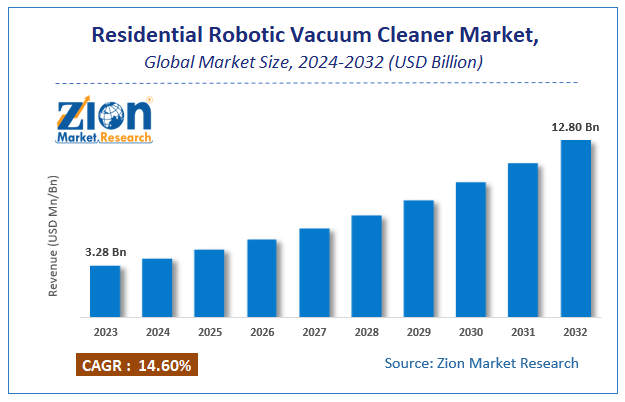
Global Residential Robotic Vacuum Cleaner Market: Overview
Robotic vacuum cleaners refers to the equipment primarily used in order to clean industrial as well as residential environments, including swimming pools, ground, etc. A robotic vacuum cleaner typically contains cleaning system, programming tools, batteries, mobile base etc. The popularity of the these vacuum cleaner in increasing worldwide owing to the advantages offered by residential robotic vacuum cleaners including surveillance cameras, intercom systems, navigation technology, UV sterilisation, etc.
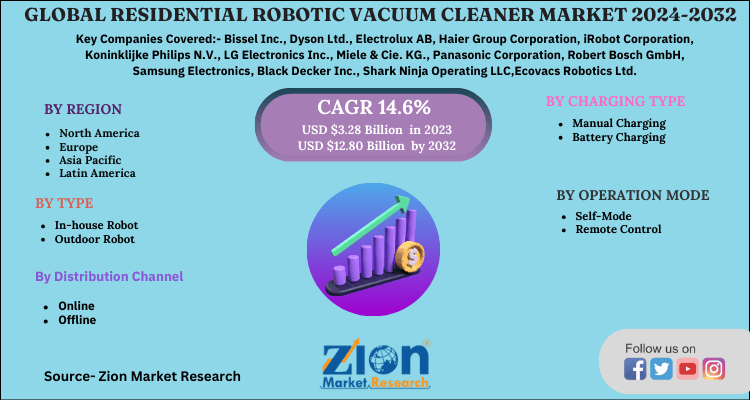
Global Residential Robotic Vacuum Cleaner Market: Growth Factors
Changing people's lifestyles over the last decade, leading to long working hours, leads to a lack of time for domestic tasks, which often fuel increased demand for residential robotic vacuum cleaners. In the future, the key growth factor of the global residential robotic vacuum cleaner market is increasing product demand due to hectic work schedules and shifting lifestyles. Another aspect that is expected to lead in particular to the global growth of the residential robotic vacuum cleaner industry over the projected timeframe is the growing number of technical developments in the production of innovative goods. Moreover, today 's residential robotic vacuum cleaners have numerous advanced technologies, including space mapping, laser vision, rotating brushes, etc., which are expected to have a positive effect on the demand for residential robotic vacuum cleaners in the years ahead.
Global Residential Robotic Vacuum Cleaner Market: Segmentation
The residential robotic vacuum cleaner market is segmented based on type, charging type, operation mode, and distribution channel. On the basis of type the global residential robotic vacuum cleaner market is divided into in-house robot and outdoor robot. On the basis of charging type, the target market is segregated as manual charging and battery charging. Based on operation mode segment global industry is divided into self-mode and remote control and based on distribution channel the target market is divided into online and offline.
Region-wise, the global market is segregated into North America, Europe, Asia Pacific, Latin America, and Middle East & Africa.
Residential Robotic Vacuum Cleaner Market: Report Scope
| Report Attributes | Report Details |
|---|---|
| Report Name | Residential Robotic Vacuum Cleaner Market |
| Market Size in 2023 | USD 3.28 Billion |
| Market Forecast in 2032 | USD 12.80 Billion |
| Growth Rate | CAGR of 14.6% |
| Number of Pages | 110 |
| Key Companies Covered | Bissel Inc., Dyson Ltd., Electrolux AB, Haier Group Corporation, iRobot Corporation, Koninklijke Philips N.V., LG Electronics Inc., Miele & Cie. KG., Panasonic Corporation, Robert Bosch GmbH, Samsung Electronics, Black Decker Inc., Shark Ninja Operating LLC,Ecovacs Robotics Ltd., Cecotec Innovaciones Sl, and Neato Robotics, Inc. among others |
| Segments Covered | By Type, By Charging Type, By Operation Mode, By Distribution Channel And By Region |
| Regions Covered | North America, Europe, Asia Pacific (APAC), Latin America, Middle East, and Africa (MEA) |
| Base Year | 2023 |
| Historical Year | 2018 to 2022 |
| Forecast Year | 2024 - 2032 |
| Customization Scope | Avail customized purchase options to meet your exact research needs. Request For Customization |
Global Residential Robotic Vacuum Cleaner Market: Regional Analysis
The North America residential robotic vacuum cleaner market is projected to hold the significant share globally in the future, owing to early adoption of advanced technologies such as automation, robotics, IoT in the countries of this region including U.S. Canada of the North America. Further, increasing product usage due to hectic work schedules and altering lifestyles are among the major factors expected to fuel growth of the market in the Asia Pacific. The Europe residential robotic vacuum cleaner market is anticipated to grow at a rapid rate in the years ahead.
Global Residential Robotic Vacuum Cleaner Market: Competitive Players
Some main participants of the residential robotic vacuum cleaner market are :
- Bissel Inc.
- Dyson Ltd.
- Electrolux AB
- Haier Group Corporation
- iRobot Corporation
- Koninklijke Philips N.V.
- LG Electronics Inc.
- Miele & Cie. KG.
- Panasonic Corporation
- Robert Bosch GmbH
- Samsung Electronics
- Black Decker Inc.
- Shark Ninja Operating LLC
- Ecovacs Robotics Ltd.
- Cecotec Innovaciones Sl
- Neato Robotics, Inc. among others.
Major players in the global market are focusing on strengthening position in the target industry by applying various business strategies.
The Global Residential Robotic Vacuum Cleaner Market is segmented as follows:
By Type
- In-house Robot
- Outdoor Robot
By Charging Type
- Manual Charging
- Battery Charging
By Operation Mode
- Self-Mode
- Remote Control
By Distribution Channel
- Online
- Offline
By Region
- North America
- The U.S.
- Canada
- Mexico
- Europe
- France
- The UK
- Spain
- Germany
- Italy
- Rest of Europe
- Asia Pacific
- China
- Japan
- India
- Australia
- South Korea
- Rest of Asia Pacific
- The Middle East & Africa
- Saudi Arabia
- UAE
- Egypt
- Kuwait
- South Africa
- Rest of the Middle East & Africa
- Latin America
- Brazil
- Argentina
- Rest of Latin America
Table Of Content
Methodology
FrequentlyAsked Questions
A residential robotic vacuum cleaner is an automated device used for home floor cleaning. It navigates rooms independently to remove dust and debris
The global Residential Robotic Vacuum Cleaner market is expected to be driven by the smart home adoption, busy lifestyles, and demand for automated cleaning. Advancements in AI navigation and affordability boost market growth.
According to study, the global Residential Robotic Vacuum Cleaner market size was worth around USD 3.28 Billion in 2023 and is predicted to grow to around USD 12.80 Billion By 2032.
The global Residential Robotic Vacuum Cleaner market is expected to grow at a Compound Annual Growth Rate (CAGR) of around CAGR 14.6% during the forecast period from 2024-2032.
The global Residential Robotic Vacuum Cleaner industry is projected to be challenged by Challenges include high price sensitivity, navigation accuracy issues, and competition from low-cost brands.
The Opportunities include smart home adoption, urban lifestyles, AI-based navigation, and rising demand for convenience appliances will offer significant growth opportunities in the Residential Robotic Vacuum Cleaner market.
AI navigation and room mapping; self-emptying and smart home integration; improved battery life and suction efficiency are the emerging trends and innovations impacting the Residential Robotic Vacuum Cleaner market.
The global Residential Robotic Vacuum Cleaner market is expected to be led by APAC during the forecast period.
Some of the prominent players operating in the global Residential Robotic Vacuum Cleaner market are; Bissel Inc., Dyson Ltd., Electrolux AB, Haier Group Corporation, iRobot Corporation, Koninklijke Philips N.V., LG Electronics Inc., Miele & Cie. KG., Panasonic Corporation, Robert Bosch GmbH, Samsung Electronics, Black Decker Inc., Shark Ninja Operating LLC,Ecovacs Robotics Ltd., Cecotec Innovaciones Sl, and Neato Robotics, Inc. among others and others.
The report explores crucial aspects of the Residential Robotic Vacuum Cleaner market, including a detailed discussion of existing growth factors and restraints, while also browsing future growth opportunities and challenges that impact the market.

HappyClients

