
Europe Cosmetic Packaging Market Size, Share, Value and Forecast 2034

Europe Cosmetic Packaging Market By Material Type (Plastic, Glass, Metal, Paper and Paperboard, Biodegradable and Sustainable Materials), By Product Type (Bottles and Jars, Tubes, Pumps and Dispensers, Caps and Closures, Containers, Pouches and Sachets), By Cosmetic Type (Skincare, Haircare, Makeup and Color Cosmetics, Fragrances, Personal Care), By End-User (Mass Market, Premium and Luxury, Professional), and By Country - Regional Industry Overview, Market Intelligence, Comprehensive Analysis, Historical Data, and Forecasts 2025 - 2034
| Market Size in 2024 | Market Forecast in 2034 | CAGR (in %) | Base Year |
|---|---|---|---|
| USD 18.43 Billion | USD 29.42 Billion | 5.34% | 2024 |
Europe Cosmetic Packaging Industry Perspective:
What will be the size of the Europe cosmetic packaging market during the forecast period?
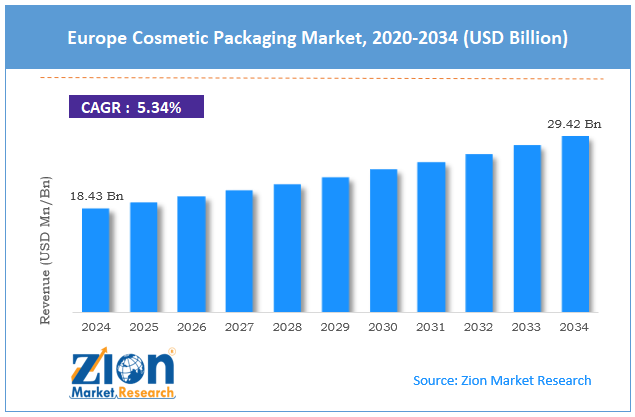
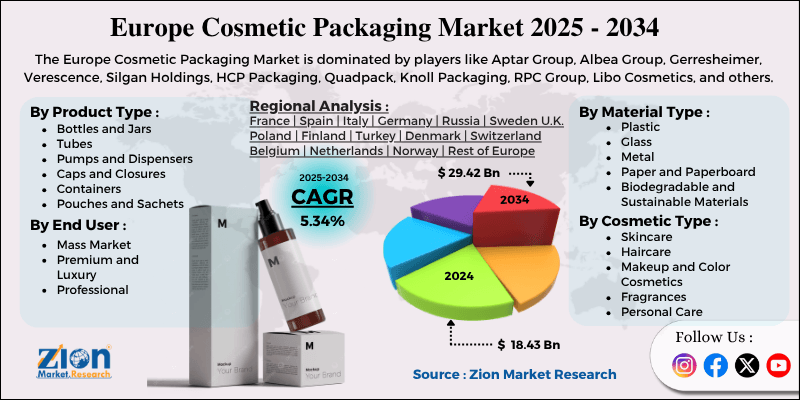
The Europe cosmetic packaging market size was worth approximately USD 18.43 billion in 2024 and is projected to grow to around USD 29.42 billion by 2034, with a compound annual growth rate (CAGR) of roughly 5.34% between 2025 and 2034.
Key Insights
- As per the analysis shared by our research analyst, the Europe cosmetic packaging market is estimated to grow annually at a CAGR of around 5.34% over the forecast period (2025–2034).
- In terms of revenue, the Europe cosmetic packaging market size was valued at approximately USD 18.43 billion in 2024 and is projected to reach USD 29.42 billion by 2034.
- The Europe cosmetic packaging market is projected to grow significantly due to rising demand for premium and sustainable packaging solutions, tightening European Union environmental regulations on single-use plastics, growing consumer interest in refillable and zero-waste beauty products, and continued innovation in luxury packaging design for high-end cosmetic brands.
- Based on material type, the plastic segment is expected to lead the Europe cosmetic packaging market, while the glass segment is anticipated to grow significantly.
- Based on product type, the bottles and jars segment is expected to lead the Europe cosmetic packaging market, while the pumps and dispensers segment is anticipated to grow at a notable pace.
- Based on cosmetic type, the skincare segment is expected to lead the Europe cosmetic packaging market, while the haircare segment is anticipated to grow rapidly.
- Based on end-user, the premium and luxury segment is the dominating high-value segment, while the mass market segment holds the largest volume-based overall market share.
- Based on country, France is projected to dominate the Europe cosmetic packaging market during the estimated period, followed by Germany and the United Kingdom.
Europe Cosmetic Packaging Market: Overview
Cosmetic packaging refers to the materials and containers used to safely store, protect, and present beauty and personal care products, such as creams, lotions, perfumes, and makeup. It includes bottles, jars, tubes, pumps, caps, and pouches that help keep products fresh and easy to use. Cosmetic packaging does more than just hold a product, as it protects the formula from air, light, and contamination that can affect quality and performance over time. It also allows users to apply the product in a clean, controlled manner.
In addition, packaging plays a major role in branding, as it creates the first impression for customers and helps products stand out on store shelves and online platforms. In the beauty industry, packaging is often seen as the first point of interaction before a customer experiences the product itself. Europe is one of the leading markets for cosmetic packaging, supported by strong beauty industries in countries like France, Germany, Italy, the United Kingdom, and Spain. These countries are known for high-quality beauty products and innovative packaging designs. European consumers also place a strong emphasis on sustainability, which has led to strict regulations on recyclable materials and eco-friendly packaging, pushing companies to develop better, greener solutions.
The growing shift toward sustainable and refillable cosmetic packaging, driven by tightening European Union regulations and increasing consumer environmental awareness, is expected to be one of the most powerful forces shaping the Europe cosmetic packaging market throughout the forecast period.
Europe Cosmetic Packaging Market: Technology Roadmap 2025–2034
What is the projected development roadmap of the Europe cosmetic packaging market over the forecast period?
The Europe cosmetic packaging market is being reshaped by sustainability regulations, digital printing technologies, the rise of refillable beauty formats, demand for smart packaging, and premiumization trends in the skincare and fragrance categories. The market is expected to grow at a CAGR of around 5.34% over the forecast period, driven by both regulatory pressure and consumer demand for more responsible, innovative packaging solutions.
The following roadmap outlines key development phases expected through 2034.
2025–2027: Sustainable Materials Transition Phase
- Cosmetic brands across Europe are replacing virgin plastic with recycled plastic, bio-based materials, and post-consumer recycled content to meet European Union packaging rules.
- Refillable packaging for skincare, fragrance, and makeup is growing fast as brands test refill options in stores.
- Digital printing is replacing traditional labels, helping reduce waste and enabling small-batch packaging.
2028–2031: Smart and Connected Packaging Phase
- Packaging with built-in chips will help consumers check product authenticity, ingredients, and usage details using smartphones.
- Waterless and concentrated products will need new packaging formats for powders, solids, and tablets.
- Augmented reality features will let customers try products virtually before buying.
2032–2034: Circular Economy Packaging Phase
- Closed-loop refill systems will become common, with brands offering return-and-refill programs across retail stores and online platforms to reduce packaging waste and support circular-economy goals.
- Compostable and biodegradable packaging will become widely available.
- Tracking systems will help monitor the packaging life cycle and environmental impact.
Europe Cosmetic Packaging Market: Dynamics
Growth Drivers
How are tightening European Union sustainability regulations on packaging driving growth and innovation in the Europe cosmetic packaging market?
The Europe cosmetic packaging industry is being strongly shaped by strict government rules on packaging design, recycling, and plastic use. The European Union has introduced regulations, such as the Packaging and Packaging Waste Regulation and Green Deal targets, that require brands to use more recycled materials, improve recyclability, and reduce unnecessary packaging. These are not optional guidelines but legal requirements, and companies that fail to follow them can face penalties and market restrictions. As a result, cosmetic brands across Europe are investing heavily in redesigning their packaging to meet these standards. This shift is increasing demand for packaging manufacturers and material suppliers that can provide eco-friendly, compliant, and attractive alternatives to traditional plastic packaging. At the same time, brands that adopt sustainable packaging early are gaining a competitive edge, as European consumers prefer environmentally responsible products. Retailers and large beauty companies are also selecting suppliers based on sustainability, further driving innovation and change across the entire packaging supply chain.
The rapid growth of premium skincare and prestige beauty categories is creating strong demand for high-quality cosmetic packaging solutions in Europe.
The Europe cosmetic packaging market has grown strongly in recent years, driven by higher demand for anti-aging creams, facial serums, treatment masks, and advanced moisturizers. Many consumers in Europe are willing to spend more money on premium skincare products that promise better results and higher quality. In this segment, packaging plays a crucial role by conveying the product's value and effectiveness before it is even used. High-end packaging, such as thick glass jars, airless pump bottles, and frosted containers with stylish designs, creates a sense of luxury and trust. These packaging styles also help protect the product and improve its use.
As demand for premium beauty products continues to rise, there is also a growing need for packaging companies capable of creating both attractive and technically advanced designs at reasonable costs. Countries like France and Italy, known for their strong beauty industries, invest heavily in packaging development because it helps brands stand out, build identity, and compete more effectively in the global market.
Restraints
How do rising raw material costs and supply chain volatility create challenges for the Europe cosmetic packaging market?
The Europe cosmetic packaging market is facing constant pressure due to rising and changing raw material prices. Materials such as plastic resins, aluminum, glass, and specialty paper have become more expensive due to global supply chain issues, higher energy costs in Europe, and increased transportation costs. These rising costs are making it more difficult for packaging manufacturers to manage production efficiently. When material prices rise suddenly, companies must decide whether to absorb the extra cost, which reduces their profits, or pass it on to beauty brands, which can affect business relationships and product pricing. For smaller cosmetic brands and independent beauty companies, higher packaging costs create serious challenges. They may struggle to keep their product prices affordable while also investing in better, more sustainable packaging solutions.
As a result, these cost pressures can slow down innovation and delay the shift toward eco-friendly packaging, especially in the mass-market and budget beauty segments where profit margins are already very low.
Opportunities
Growing consumer demand for refillable, zero-waste, and minimalist cosmetic packaging formats is creating major new opportunities in the Europe cosmetic packaging market.
The Europe cosmetic packaging industry is seeing strong growth driven by rising demand for eco-friendly, refillable packaging solutions. European beauty consumers, especially younger millennials and Generation Z, are actively choosing products that create less waste and have a lower environmental impact. Refillable packaging is becoming very popular, in which customers buy a durable container once and then purchase refill pouches or cartridges for future use. This trend is growing quickly in skincare, fragrance, and deodorant categories. Leading beauty retailers like Sephora and Douglas have also introduced refill stations in stores, making it easier for customers to reuse packaging rather than throw it away. This shift is increasing demand for packaging designs that are both practical and visually attractive. Brands that offer refillable options also benefit from higher customer loyalty, as people are more likely to continue buying refills from the same brand after investing in a reusable container. At the same time, simple, minimalist packaging designs that use less material, less ink, and lighter components are becoming more popular among environmentally conscious consumers, further supporting sustainable market growth.
Challenges
How do complex European Union packaging regulations and compliance requirements create operational challenges for cosmetic packaging companies?
The Europe cosmetic packaging market faces challenges due to complex and changing government rules related to sustainability. While these regulations encourage eco-friendly innovation, they also make it harder for packaging manufacturers, especially small companies, to keep up. Businesses must regularly track updates on the use of recycled materials, packaging types, recyclability standards, and waste responsibility rules. In some cases, a packaging design that meets the rules in one European country may not fully comply with those in another, creating confusion and extra work. Companies that sell products across multiple countries need to carefully adjust their packaging to comply with local rules, which increases costs and effort.
In addition, testing and getting approval for new packaging materials can take a long time and require a high investment. For brands looking to launch new products quickly, these strict, detailed regulations can slow innovation and delay product launches, making it harder to stay competitive in the fast-moving beauty market.
Europe Cosmetic Packaging Market: Report Scope
| Report Attributes | Report Details |
|---|---|
| Report Name | Europe Cosmetic Packaging Market |
| Market Size in 2024 | 18.43 Billion |
| Market Forecast in 2034 | 29.42 Billion |
| Growth Rate | CAGR of 5.34% |
| Number of Pages | 229 |
| Key Companies Covered | Aptar Group, Albea Group, Gerresheimer, Verescence, Silgan Holdings, HCP Packaging, Quadpack, Knoll Packaging, RPC Group, Libo Cosmetics, and others. |
| Segments Covered | By Material Type, By Product Type, By Cosmetic Type, By End-User, and By Region |
| Regions Covered in Europe | France, Spain, Italy, Germany, Russia, Sweden, U.K., Poland, Finland, Turkey, Denmark, Switzerland, Belgium, Netherlands, Norway, and Rest of Europe |
| Base Year | 2024 |
| Historical Year | 2019 to 2023 |
| Forecast Year | 2025 - 2034 |
| Customization Scope | Avail customized purchase options to meet your exact research needs. Request For Customization |
Europe Cosmetic Packaging Market: Segmentation
The Europe cosmetic packaging market is segmented based on material type, product type, cosmetic type, end-user, and region.
Why is the plastic segment expected to lead the Europe cosmetic packaging market?
Based on material type, the Europe cosmetic packaging industry is categorized into plastic, glass, metal, paper and paperboard, and biodegradable and sustainable materials. The plastic segment accounted for approximately 42% of the regional market share and is expected to remain dominant due to its versatility, light weight, low cost, and ability to be molded into various shapes and designs required by cosmetic brands. Glass holds around a 26% share, as it offers a premium look and better product protection, especially for skincare and fragrance products.
Why does the bottles and containers segment dominate the Europe cosmetic packaging market?
Based on product type, the Europe cosmetic packaging market is segmented into bottles and jars, tubes, pumps and dispensers, caps and closures, containers, pouches and sachets, and others. The bottles and jars segment accounted for approximately 38% of the regional market share and is expected to remain the leading category during the forecast period, mainly due to their wide use across skincare, haircare, and fragrance products, as well as their durability, convenience, and ease of storage. Tubes hold around a 21% share, as they are cost-effective, portable, and widely used in mass-market cosmetic products.
Why does the skincare segment dominate the Europe cosmetic packaging market?
Based on cosmetic type, the Europe cosmetic packaging market is divided into skincare, haircare, makeup, color cosmetics, fragrances, and personal care. The skincare segment accounts for nearly 35% of the regional market share. It leads because skincare is the fastest-growing and highest-value category in the European beauty market, requiring diverse and sophisticated packaging formats, ranging from airless pumps and glass jars to ampoules and dropper bottles. Haircare accounts for around 24% of the market, supported by consistent demand for everyday products such as shampoos and conditioners.
Why does the premium and luxury end-user segment lead the Europe cosmetic packaging market in value terms?
Based on end-user, the market is divided into mass market, premium and luxury, and professional segments. The premium and luxury segment accounts for around 39% of the total market value. It leads in value terms because luxury cosmetic brands require exceptional packaging quality, bespoke design, premium materials, and high-precision manufacturing, which command significantly higher prices than mass-market packaging solutions. The mass market accounts for around 46% of market share, driven by large-scale consumption of everyday beauty products.
Europe Cosmetic Packaging Market: Regional Analysis
What factors enable France to dominate the Europe cosmetic packaging market during the forecast period?
France is expected to account for around 28% of the Europe cosmetic packaging market, remaining the leading country during the forecast period. The cosmetic packaging market in France is strongly driven by its global leadership in luxury beauty and fragrance products. The country is home to some of the world’s most prestigious cosmetic and perfume brands, which require high-quality, innovative, and visually appealing packaging to maintain their premium image. These brands invest heavily in advanced packaging design, materials, and finishing techniques to differentiate themselves in a highly competitive market. French consumers also have a refined preference for aesthetics, quality, and sustainability, which increases demand for both premium and eco-friendly packaging solutions.
In addition, France benefits from a well-established ecosystem of packaging manufacturers, designers, and raw material suppliers, particularly concentrated around Paris and other industrial hubs. This strong supply chain supports continuous innovation and efficient production. The country’s significant export of luxury beauty products further boosts demand for high-end packaging solutions that meet global standards. Supportive regulations, strong brand presence, and continuous investment in packaging innovation collectively ensure that France maintains its dominant position in the Europe cosmetic packaging market.
Why is Germany expected to be an important contributor to the Europe cosmetic packaging market?
Germany is expected to account for around 22% of the Europe cosmetic packaging market, making it the second-largest country during the forecast period. The cosmetic packaging market in Germany is supported by a strong presence of personal care, skincare, and mass-market beauty brands that require large volumes of cost-effective and reliable packaging solutions.
The country has a highly developed industrial base with advanced manufacturing capabilities, allowing packaging companies to produce high-quality products at scale for both domestic and international markets. German consumers are highly environmentally aware, driving strong demand for sustainable, recyclable, and minimal-packaging solutions. This has encouraged companies to invest in eco-friendly materials and innovative designs. Germany also has a strong retail network, including supermarkets, drugstores, and e-commerce platforms, which supports high consumption of beauty and personal care products.
Additionally, the country’s expertise in engineering, automation, and material science enables continuous improvements in packaging efficiency and performance. Stable economic conditions, high consumer spending, and a focus on sustainability and innovation make Germany a key contributor to growth and technological advancement in the Europe cosmetic packaging market.
Recent Market Developments
- In January 2026, L’Oréal Group launched its €100 million sustainability accelerator program to support startups developing advanced cosmetic packaging solutions, including biodegradable materials, circular packaging systems, and low-emission packaging technologies.
- In February 2026, Aptar Beauty showcased its latest sustainable dispensing systems and recyclable packaging solutions at Packaging Innovations 2026 in the United Kingdom, with a focus on regulatory compliance and reduced environmental impact.
Europe Cosmetic Packaging Market: Competitive Analysis
The leading players in the Europe cosmetic packaging market are;
- Aptar Group
- Albea Group
- Gerresheimer
- Verescence
- Silgan Holdings
- HCP Packaging
- Quadpack
- Knoll Packaging
- RPC Group
- Libo Cosmetics
The Europe cosmetic packaging market is segmented as follows:
By Material Type
- Plastic
- Glass
- Metal
- Paper and Paperboard
- Biodegradable and Sustainable Materials
By Product Type
- Bottles and Jars
- Tubes
- Pumps and Dispensers
- Caps and Closures
- Containers
- Pouches and Sachets
By Cosmetic Type
- Skincare
- Haircare
- Makeup and Color Cosmetics
- Fragrances
- Personal Care
By End-User
- Mass Market
- Premium and Luxury
- Professional
By Region
- Europe
- France
- Spain
- Italy
- Germany
- Russia
- Sweden
- U.K.
- Poland
- Finland
- Turkey
- Denmark
- Switzerland
- Belgium
- Netherlands
- Norway
- Rest of Europe
Table Of Content
Methodology
FrequentlyAsked Questions
The cosmetic packaging encompasses all commercially manufactured containers, dispensers, closures, tubes, bottles, jars, and other packaging formats used to store, protect, and present beauty and personal care products sold by brands operating across the world.
The Europe cosmetic packaging market is projected to grow due to tightening European Union sustainability packaging regulations, rising demand for premium and luxury beauty packaging, growing consumer preference for refillable and zero-waste formats, continued innovation in sustainable packaging materials, and the expanding prestige skincare and fragrance categories.
According to a study, the Europe cosmetic packaging market size was worth around USD 18.43 billion in 2024 and is predicted to grow to around USD 29.42 billion by 2034.
The CAGR value of the Europe cosmetic packaging market is expected to be around 5.34% during 2025–2034.
France is expected to lead the Europe cosmetic packaging market during the forecast period.
The major players profiled in the Europe cosmetic packaging market include Aptar Group, Albea Group, Gerresheimer, Verescence, Silgan Holdings, HCP Packaging, Quadpack, Knoll Packaging, RPC Group, and Libo Cosmetics.
The report examines key aspects of the Europe cosmetic packaging market, including a detailed analysis of current growth drivers and constraints, as well as future growth opportunities and challenges.
The Europe cosmetic packaging market faces challenges from rising raw material costs, strict environmental regulations, and complex compliance requirements, which increase operational expenses, limit flexibility, and slow down innovation, especially for small and mid-sized packaging manufacturers.
The Europe cosmetic packaging market is shifting toward sustainable, refillable, and minimalist packaging, driven by strong consumer demand for eco-friendly, low-waste solutions.
The Europe cosmetic packaging market is highly competitive, with global packaging conglomerates, regional specialist manufacturers, and innovative material suppliers competing through sustainability credentials, design capability, technical performance, customization flexibility, and strategic partnerships with leading beauty and personal care brands.

HappyClients

