Electric Trike Market Size, Share, Trends, Growth and Forecast 2034

Electric Trike Market By Type (Electric Cargo Trikes, Electric Passenger Trikes, Electric Delivery Trikes, and Electric Recreational Trikes), By Battery Type (Lithium Ion Batteries, Lead Acid Batteries, and Nickel Metal Hydride Batteries), By Application (Personal Mobility, Commercial Delivery and Logistics, Recreational and Leisure Activities, and Elderly and Mobility Assisted Transport), By End User (Individual Consumers, Delivery and Logistics Companies, Rental and Sharing Service Providers, Elderly and Mobility Impaired Individuals, and Tourism and Recreation Operators), and By Region - Global and Regional Industry Overview, Market Intelligence, Comprehensive Analysis, Historical Data, and Forecasts 2026 to 2034
| Market Size in 2025 | Market Forecast in 2034 | CAGR (in %) | Base Year |
|---|---|---|---|
| USD 8.50 Billion | USD 75.66 Billion | 27.55% | 2025 |
Electric Trike Industry Perspective:
What will be the size of the electric trike market during the forecast period?
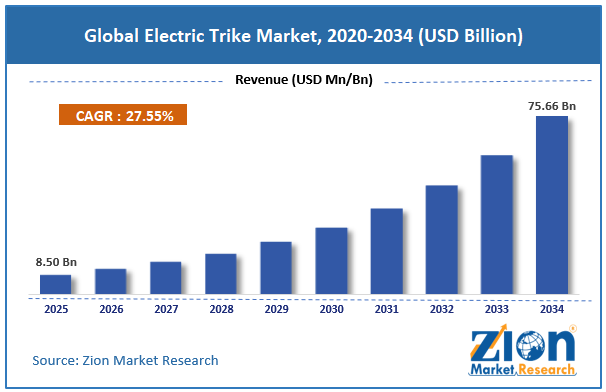
The global electric trike market size was valued at approximately USD 8.50 billion in 2025 and is projected to reach around USD 75.66 billion by 2034, growing at a compound annual growth rate of approximately 27.55% between 2026 and 2034.
Key Insights
- As per the analysis shared by our research team, the global electric trike market is estimated to grow at a compound annual growth rate of approximately 27.55% during the forecast period from 2026 to 2034.
- In terms of revenue, the global electric trike market was valued at approximately USD 8.50 billion in 2025 and is projected to reach USD 75.66 billion by 2034.
- The electric trike market is expected to grow strongly due to rising demand for stable and accessible personal mobility, expanding last-mile delivery needs, growing urban cycling infrastructure, and increasing interest among aging populations.
- Based on type, electric cargo trikes lead the market because of their strong appeal to delivery businesses and small commercial operators. In contrast, electric passenger trikes are the fastest-growing segment as tourism and short-distance transport services expand.
- Based on battery type, lithium-ion batteries lead the market due to their lighter weight and longer lifespan. In contrast, nickel-metal hydride batteries remain a smaller niche as most manufacturers continue shifting toward lithium-based technology.
- Based on application, commercial delivery and logistics lead the market since businesses increasingly rely on electric trikes for efficient urban deliveries. At the same time, elderly and mobility-assisted transport is the fastest-growing application as awareness grows around trikes as an accessible mobility solution.
- Based on end user, delivery and logistics companies account for the largest share because they increasingly rely on efficient last-mile transport. At the same time, elderly and mobility-impaired individuals are the fastest-growing end-user group as trikes gain popularity as a safe, stable transport option.
- Based on region, Asia Pacific leads the global electric trike market, driven by dense urban populations and strong local manufacturing. At the same time, Europe is the fastest-growing region, driven by expanding cycling infrastructure and supportive urban mobility policies.
Electric Trike Market: Overview
An electric trike is a three-wheeled vehicle powered by a rechargeable battery and electric motor, offering better stability and easier handling than traditional two-wheeled electric bicycles. Electric trikes are available in several types, including personal mobility models for commuting, cargo trikes for carrying goods, and passenger versions for short-distance transport. The extra wheel improves balance, making these vehicles suitable for older adults, people with limited mobility, and riders who feel uncomfortable on standard bicycles. The electric motor also reduces the physical effort needed for pedaling, helping users travel farther and carry heavier loads with less fatigue. Delivery businesses increasingly use electric cargo trikes for urban deliveries because they can navigate narrow streets, avoid traffic delays, park easily, and operate without tailpipe emissions. Rental and bike-sharing services are also adding electric trikes to attract riders seeking a stable and comfortable experience. Growing investment in cycling infrastructure and efforts to reduce car use are further supporting adoption. Improved battery range, stronger motors, safer braking systems, and larger storage capacity are making these vehicles more useful for both personal and commercial transportation. Electric trikes are now used for commuting, grocery shopping, deliveries, passenger transport, recreation, and leisure rides, making them a practical option for urban mobility and everyday transportation.
Rising demand for stable, efficient mobility is driving the electric trike industry, with growing adoption across deliveries, commuting, and recreation.
Electric Trike Market: Strategic Perspective
Where is the electric trike market heading?
The electric trike market is moving toward smarter, more practical vehicles designed around specific user needs, including urban deliveries, family transportation, commuting, and mobility support. Manufacturers are improving motor efficiency, battery range, rider comfort, safety features, and storage capacity to make electric trikes more useful for everyday travel and commercial applications.
Where should businesses invest in the electric trike market?
Companies can explore opportunities in the electric trike market through lightweight frames, efficient battery systems, weather-resistant designs, and affordable models suited to everyday urban transportation. Developing customizable cargo solutions, comfortable passenger models, and rental-friendly vehicles can also create new revenue streams.
What will reshape competition in the electric trike market?
The electric trike market will increasingly compete on vehicle affordability, battery range, safety, comfort, durability, and ease of maintenance. Brands that offer practical designs, dependable motors, accessible replacement parts, strong warranties, and convenient servicing can differentiate themselves. Product customization and improved riding technology will also influence purchasing decisions as applications continue to diversify.
Electric Trike Market: Development Roadmap 2026 to 2034
What is the projected development roadmap of the electric trike market over the forecast period?
The electric trike market is progressing through improved battery technology, wider adoption among commercial delivery fleets, growing acceptance as an accessible mobility solution, and expanding availability of specialized trike models for different uses. The market is expected to grow at a compound annual growth rate of approximately 27.55% over the forecast period, driven by rising urbanization, growing e-commerce delivery demand, and continuous product innovation.
The following roadmap outlines key development phases expected through 2034.
2026 to 2028: Commercial Adoption and Awareness Phase
- Delivery fleet integration: Food delivery and logistics companies are expected to expand their use of electric cargo trikes for short-distance urban deliveries, particularly in congested city centers.
- Battery range improvement: Manufacturers are likely to introduce trikes with longer-lasting batteries and swappable battery packs to reduce downtime for commercial operators and support longer daily routes efficiently.
- Growing consumer awareness: Rental and sharing platforms are expected to introduce electric trikes to more cities, helping everyday consumers experience the stability and convenience of three-wheeled electric mobility.
2029 to 2032: Diversification and Accessibility Phase
- Accessibility-focused models: Manufacturers are likely to launch trikes designed with seating, storage, and controls suited to elderly riders and people with mobility challenges.
- Expanded passenger transport use: Cities and tourist destinations are expected to adopt electric passenger trikes more widely for short-distance transport, sightseeing, and last-mile public transit connections.
- Smart connectivity features: Trikes are expected to increasingly include GPS tracking, theft prevention systems, and application-based controls, particularly for commercial and rental fleets.
2033 to 2034: Mainstream Urban Mobility Phase
- Integrated urban transport networks: Electric trikes could become a standard part of city transportation systems, working alongside buses, bikes, and other micro-mobility options across busy urban areas worldwide.
- Advanced battery and motor technology: Continued improvements in battery density and motor efficiency may allow trikes to carry heavier loads over longer distances without sacrificing speed or reliability during demanding daily commercial operations.
- Broader global accessibility: Electric trikes may become more widely available and affordable in developing regions as local manufacturing expands and production costs continue to fall across emerging markets and smaller cities.
Electric Trike Market: Dynamics
Growth Drivers
What factors are driving the growing demand for electric trikes in urban transportation?
The electric trike market is gaining attention as cities and consumers look for cleaner, safer, and more practical ways to travel. Governments are expanding cycling lanes, low-traffic zones, and other infrastructure that makes compact three-wheeled vehicles easier to use than cars or delivery vans in crowded areas. Growing online shopping and food delivery are also pushing businesses to consider cargo trikes because they cost less to operate, take up less parking space, and can navigate narrow urban streets. For consumers, electric trikes provide an affordable option for short-distance travel while requiring less physical effort than traditional bicycles. Their stable design is particularly attractive to older adults and people who need easier mobility, offering more balance and confidence than two-wheeled bicycles.
Manufacturers are responding by adding comfortable seats, larger storage areas, simple controls, improved batteries, and stronger safety features. These improvements are helping electric trikes serve a wider range of uses, including commuting, shopping, deliveries, passenger transport, and recreational travel. As cities continue to reduce car dependence and support cleaner mobility, demand for versatile electric trikes is expected to expand further.
Growing e-commerce and last-mile delivery needs are creating new opportunities in the electric trike market.
The electric trike market is benefiting from the rapid growth of online shopping and food delivery, which require affordable, efficient transport for short-distance urban deliveries. Electric cargo trikes can carry useful loads while moving through narrow streets, cycling lanes, and pedestrian zones that larger vans often cannot access easily. Delivery businesses can also cut operating costs because trikes use less energy, require less maintenance, and don't need fuel. Their compact size helps drivers avoid parking problems and move through congested city areas more easily.
As governments restrict vehicle access in busy central districts to control traffic and pollution, businesses are increasingly considering electric trikes to maintain delivery services. Technology is further supporting this trend, with fleet management systems helping companies plan routes, monitor vehicles, and track battery levels. Rising e-commerce activity, urban congestion, delivery demand, and cleaner transport policies are creating strong opportunities for electric cargo trikes in commercial logistics. This trend is expected to support continued adoption across cities during the forecast period.
Restraints
Limited awareness is restraining adoption in the electric trike market.
The electric trike industry faces adoption barriers because many consumers remain unfamiliar with the category or associate trikes mainly with elderly riders and delivery businesses. Limited awareness can reduce interest among commuters who could benefit from their stability and convenience. Higher upfront prices compared with bicycles and electric bikes can discourage budget-conscious buyers, especially in developing markets. Their larger size creates storage and parking challenges for people living in apartments or crowded urban areas. Battery replacement is another expense that buyers may overlook when calculating ownership costs. In some regions, limited access to spare parts and trained repair technicians creates concerns about maintenance and reliability. These issues can slow adoption even when consumers recognize the benefits of electric mobility. Manufacturers and retailers can address these barriers by improving product education, offering flexible financing, expanding local service centers, ensuring spare-parts availability, and clearly explaining ownership costs. Better customer support can build confidence and encourage adoption.
Opportunities
Will rising demand for accessible mobility solutions open new opportunities in the electric trike market?
The electric trike market is seeing new opportunities as aging populations and people with mobility challenges look for safer, easier, and more comfortable transportation options. Three-wheeled designs provide greater stability than traditional bicycles and can offer useful storage for everyday activities such as grocery shopping and local travel. Manufacturers can attract this customer group by developing comfortable seats, low step-through frames, easy mounting, simple controls, adjustable handlebars, and reliable braking systems. Partnerships with healthcare providers, senior living communities, rehabilitation centers, and mobility organizations can help brands reach potential users through trusted channels. Rental and subscription programs also create opportunities in retirement communities, tourist destinations, and university campuses, where users may prefer temporary access over purchasing a vehicle. Weather-protection accessories and customizable storage solutions can further improve everyday usability.
As more consumers learn about the benefits of stable electric transportation, demand for accessible mobility solutions is expected to increase. Growing interest in age-friendly transportation, urban accessibility, and independent mobility is also driving product development to meet diverse user needs. These developments can make the segment an important contributor to future growth while encouraging manufacturers to focus on comfort, safety, affordability, and ease of use.
Challenges
How are infrastructure gaps and safety concerns affecting the electric trike market?
The electric trike industry faces challenges from limited cycling infrastructure, safety concerns, and different regulations across cities and countries. Many urban areas lack connected cycling lanes, forcing riders to share roads with cars and pedestrians. This can create greater risks for elderly users and businesses carrying heavy cargo. Weather can further affect open designs, particularly during heavy rain or extreme heat, unless suitable protective accessories are provided. Battery theft and vehicle security are additional concerns for delivery operators who leave trikes parked during frequent stops. Manufacturers must also balance affordable pricing with the durability required for regular commercial use. Limited repair facilities and spare-parts availability can create additional ownership concerns in emerging markets. Addressing these issues will require better infrastructure, clearer regulations, stronger security features, weather protection, and cooperation among manufacturers, transport authorities, city planners, and policymakers to support wider adoption of electric trikes in urban transportation.
Electric Trike Market: Report Scope
| Report Attributes | Report Details |
|---|---|
| Report Name | Electric Trike Market |
| Market Size in 2025 | USD 8.50 Billion |
| Market Forecast in 2034 | USD 75.66 Billion |
| Growth Rate | CAGR of 27.55% |
| Number of Pages | 227 |
| Key Companies Covered | Piaggio Group, Yamaha Motor Company, Rad Power Bikes, Arcimoto, Envo Drive Systems, Mobitrike, Terra Kaffe Mobility, Ewheels, Addmotor, Butchers and Bicycles, Lectric eBikes, Worksman Cycles, Van Raam, and others. |
| Segments Covered | By Type, By Battery Type, By Application, By End User, and By Region |
| Regions Covered | North America, Europe, Asia Pacific (APAC), Latin America, Middle East, and Africa (MEA) |
| Base Year | 2025 |
| Historical Year | 2020 - 2024 |
| Forecast Year | 2026 - 2034 |
| Customization Scope | Avail customized purchase options to meet your exact research needs. Request For Customization |
Electric Trike Market: Segmentation
The global electric trike market is segmented by type, battery type, application, end user, and region.
What makes electric cargo trikes the leading type in the electric trike market?
Based on type, the market is classified into electric cargo trikes, electric passenger trikes, electric delivery trikes, and electric recreational trikes. Electric cargo trikes hold about 38% of the market share, leading because small businesses and delivery operators need efficient load-carrying transport. Electric passenger trikes hold around 24% market share. This is the fastest-growing segment as tourism operators and short-distance transport services increasingly adopt them.
Why are lithium-ion batteries preferred in the electric trike market?
By battery type, the electric trike industry is divided into lithium-ion, lead-acid, and nickel-metal hydride batteries. Lithium-ion batteries account for about 71% of the global market share, driven by their lighter weight, longer lifespan, and faster charging than older battery technologies. Lead-acid batteries hold around 21% market share. They are popular mainly in budget-focused markets where upfront cost matters more than performance.
Why is commercial delivery leading applications in the electric trike market?
Based on application, the market is categorized into personal mobility, commercial delivery and logistics, recreational and leisure activities, and elderly and mobility-assisted transport. Commercial delivery and logistics lead with about a 41% share because businesses increasingly rely on trikes for cost-effective urban delivery. Elderly and mobility-assisted transport holds around 19% market share. It is growing rapidly as awareness increases around trikes as a safe and accessible mobility option.
Which end users are driving the electric trike market?
By end user, the global electric trike market is divided into individual consumers, delivery and logistics companies, rental and sharing service providers, elderly and mobility-impaired individuals, and tourism and recreation operators. Delivery and logistics companies account for about 34% of the market, leading because they increasingly rely on trikes for efficient last-mile transport. Elderly and mobility-impaired individuals hold around 20% market share. This segment is expanding quickly as more people discover trikes as a comfortable and stable transportation option.
Electric Trike Market: Regional Analysis
What factors are strengthening Asia Pacific's position in the electric trike market?
Asia Pacific leads the global electric trike market, with growth expected at a CAGR of around 9.6% during the forecast period, driven by large urban populations, widespread use of two- and three-wheeled vehicles, and strong manufacturing capabilities in China, India, and Vietnam. Rapid growth in e-commerce and food delivery is creating fresh demand for electric cargo trikes among small businesses, retailers, and independent delivery workers. At the same time, heavy traffic and rising air pollution in major cities are encouraging consumers and governments to consider compact, low-emission vehicles as practical alternatives to cars and motorcycles. Strong local manufacturing helps keep prices competitive, making electric trikes accessible to a wider range of consumers.
Government incentives and clean mobility programs are further supporting adoption across several countries. Tourism is adding another growth avenue, with passenger trikes increasingly used for sightseeing and convenient short-distance travel. Better batteries, improved vehicle designs, longer driving ranges, and expanding charging infrastructure are making these vehicles more practical for daily use. Growing interest in affordable transportation, last-mile delivery, and cleaner urban mobility is encouraging businesses to expand their electric trike offerings across the region. As cities become more crowded and consumers seek economical travel options, demand is expected to rise across commuting, cargo transportation, tourism, and personal mobility applications. These combined trends are strengthening regional adoption and creating opportunities for manufacturers, delivery companies, rental operators, and mobility service providers.
How is expanding cycling infrastructure driving growth in the European electric trike market?
Europe is expected to grow at a volume CAGR of around 11.4% during the forecast period, supported by strong cycling infrastructure, efforts to reduce car use, and rising demand for accessible transportation. Countries such as the Netherlands, Germany, and Denmark have established cycling cultures that make electric trikes easier to adopt for commuting, shopping, and commercial deliveries. Many European cities are expanding car-free zones, low-emission areas, and restricted traffic districts, encouraging residents and businesses to choose compact electric vehicles for short-distance travel. Aging populations are also driving demand for reliable, easy-to-use transportation among older adults and people with mobility challenges. Some governments provide incentives or subsidies for electric mobility products, helping reduce purchase costs and encourage adoption. Rental and sharing services are also expanding in popular tourist destinations, giving visitors convenient ways to explore cities without relying on cars.
Manufacturers are responding with comfortable seating, larger storage areas, weather protection, improved batteries, and safety features. Growing environmental awareness and stricter emissions policies are further supporting cleaner urban transportation. Rising interest in sustainable commuting, urban accessibility, and convenient last-mile transportation is encouraging broader use across residential and commercial settings. Together, these developments are creating favorable conditions for wider electric trike adoption across European cities and commercial applications during the forecast period.
Recent Market Developments
- In September 2026, Addmotor announced its 2026 electric trike lineup, including the Freetan semi-recumbent series, UTrike tilting series, and Freetri folding e-trike, targeting commuting, mobility support, touring, and everyday transportation.
- In July 2026, Veo introduced the Rover, a three-wheeled shared electric vehicle in Denver designed to improve accessibility and provide a more stable alternative to conventional shared bikes and scooters.
- In April 2026, Hyundai Motor Company and TVS Motor Company signed a joint development agreement to develop and commercialize electric three-wheelers for last-mile mobility in India and other markets.
Electric Trike Market: Competitive Analysis
The leading players in the global electric trike market are:
- Piaggio Group
- Yamaha Motor Company
- Rad Power Bikes
- Arcimoto
- Envo Drive Systems
- Mobitrike
- Terra Kaffe Mobility
- Ewheels
- Addmotor
- Butchers and Bicycles
- Lectric eBikes
- Worksman Cycles
- Van Raam
The global electric trike market is segmented as follows:
By Type
- Electric Cargo Trikes
- Electric Passenger Trikes
- Electric Delivery Trikes
- Electric Recreational Trikes
By Battery Type
- Lithium-Ion Batteries
- Lead-Acid Batteries
- Nickel-Metal Hydride Batteries
By Application
- Personal Mobility
- Commercial Delivery and Logistics
- Recreational and Leisure Activities
- Elderly and Mobility-Assisted Transport
By End User
- Individual Consumers
- Delivery and Logistics Companies
- Rental and Sharing Service Providers
- Elderly and Mobility Impaired Individuals
- Tourism and Recreation Operators
By Region
- North America
- The U.S.
- Canada
- Mexico
- Europe
- France
- The UK
- Spain
- Germany
- Italy
- Rest of Europe
- Asia Pacific
- China
- Japan
- India
- Australia
- South Korea
- Rest of Asia Pacific
- The Middle East & Africa
- Saudi Arabia
- UAE
- Egypt
- Kuwait
- South Africa
- Rest of the Middle East & Africa
- Latin America
- Brazil
- Argentina
- Rest of Latin America
Table Of Content
Methodology
FrequentlyAsked Questions
An electric trike is a three-wheeled vehicle powered by a rechargeable battery and electric motor, offering better stability and easier handling than traditional two-wheeled electric bicycles. Electric trikes are available in several types, including personal mobility models for commuting, cargo trikes for carrying goods, and passenger versions for short-distance transport.
The global electric trike market is expected to grow due to rising last-mile delivery demand, expanding urban cycling infrastructure, growing interest among aging populations, and increasing availability of specialized trike models.
According to research, the global electric trike market was valued at approximately USD 8.50 billion in 2025 and is projected to reach approximately USD 75.66 billion by 2034.
The electric trike market is expected to grow at a compound annual growth rate of approximately 27.55% from 2026 to 2034.
Asia Pacific is expected to lead the global electric trike market throughout the forecast period, driven by dense urban populations, strong local manufacturing, and rapidly growing delivery services.
The major players in the global electric trike market include Piaggio Group, Yamaha Motor Company, Rad Power Bikes, Arcimoto, Envo Drive Systems, Mobitrike, Terra Kaffe Mobility, Ewheels, Addmotor, Butchers and Bicycles, Lectric eBikes, Worksman Cycles, and Van Raam.
The report examines key aspects of the electric trike market, including growth drivers, adoption barriers, application opportunities, competitive landscape dynamics, detailed regional market performance, and a comprehensive forward-looking outlook across all major types, battery types, applications, end users, and geographic regions through 2034.
Technology is improving the electric trike market through better batteries, efficient motors, faster charging, stronger frames, GPS tracking, and smarter safety features, helping vehicles travel farther, carry heavier loads, and provide a more comfortable riding experience.
The electric trike market value chain covers raw material sourcing, battery and component manufacturing, vehicle design and assembly, quality testing, distribution, retail sales, servicing, repairs, and recycling or battery disposal.
Stakeholders in the electric trike market should focus on affordable pricing, reliable batteries, durable designs, product customization, strong after-sales service, local partnerships, and wider distribution while developing models for delivery, commuting, tourism, and accessible mobility.

HappyClients