
Electric Scooter Market Size, Trend, Growth, Industry Analysis 2034

Electric Scooter Market By Type (Standing Electric Scooters, Seated Electric Scooters, Foldable Electric Scooters, Off-Road Electric Scooters), By Application (Personal Commuting, Shared Mobility Services, Recreational Riding, Last-Mile Delivery), By Distribution Channel (Online Retail Stores, Offline Retail and Dealerships, Direct Manufacturer Sales, Rental and Subscription Platforms), By End User (Individual Riders, Micro-Mobility Fleet Operators, Corporate and Delivery Fleets, Government and Municipal Bodies), and By Region - Global and Regional Industry Overview, Market Intelligence, Comprehensive Analysis, Historical Data, and Forecasts 2026 - 2034
| Market Size in 2025 | Market Forecast in 2034 | CAGR (in %) | Base Year |
|---|---|---|---|
| USD 21.45 Billion | USD 62.75 Billion | 12.78% | 2025 |
Electric Scooter Industry Perspective:
What will be the size of the electric scooter market during the forecast period?
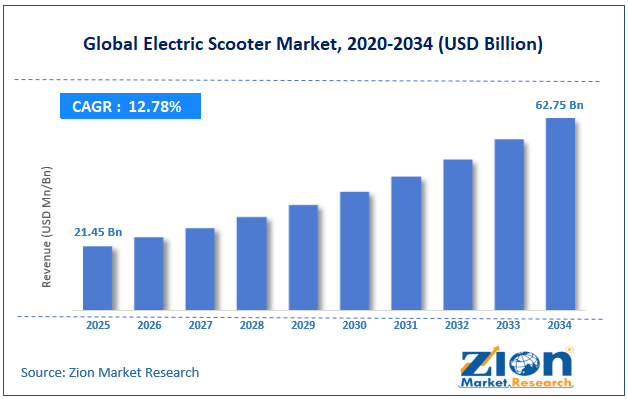
The global electric scooter market size was valued at approximately USD 21.45 billion in 2025 and is projected to reach around USD 62.75 billion by 2034, growing at a compound annual growth rate of approximately 12.78% between 2026 and 2034.
Key Insights
- As per the analysis shared by our research team, the global electric scooter market is estimated to grow at a compound annual growth rate of approximately 12.78% during the forecast period from 2026 to 2034.
- In terms of revenue, the global electric scooter market was valued at approximately USD 21.45 billion in 2025 and is projected to reach USD 62.75 billion by 2034.
- The electric scooter market is expected to grow steadily, driven by rising fuel costs, growing city congestion, increasing government support for clean transportation, and expanding shared mobility networks.
- Based on type, standing electric scooters lead the market because of their light weight and low price, while foldable electric scooters are gaining strong momentum as more commuters look for models that are easy to carry onto buses and trains.
- Based on application, personal commuting leads the market due to rising demand for cheap and quick daily travel. At the same time, last-mile delivery is the fastest-growing segment as food and parcel delivery companies switch to electric scooters for city routes.
- Based on distribution channel, online retail stores lead the market because of the convenience of browsing models and comparing prices from home, while rental and subscription platforms are steadily growing as more riders prefer paying per trip instead of buying a scooter outright.
- Based on end user, individual riders lead the market because electric scooters are popular for daily personal travel, while micro-mobility fleet operators are growing rapidly as more cities adopt shared scooter programs.
- Based on region, Asia Pacific leads the global electric scooter market. At the same time, North America is the fastest-growing region due to expanding shared scooter programs and rising interest in low-cost city transportation.
Electric Scooter Market: Overview
An electric scooter is a battery-powered two- or three-wheeled vehicle designed for short and medium-distance travel without petrol or pedaling. Most models use a rechargeable lithium-ion battery and electric motor, with riders controlling speed through a throttle or simple button. The electric scooter market includes personal scooters for daily commuting, recreational models, and shared scooters rented through mobile applications. Unlike fuel-powered vehicles, electric scooters produce no tailpipe emissions, have lower running costs, require little parking space, and are easy to store or carry. Growing traffic congestion, higher fuel prices, and demand for cleaner transportation are encouraging more people to choose scooters for short urban journeys. Shared mobility companies are also making scooters easier to access without ownership. Manufacturers are improving battery range, charging speed, frame weight, suspension, braking, and safety features such as theft alerts and connected tracking. Cities are also adding dedicated scooter and cycling lanes to improve rider safety. Smartphone adoption, improved charging access, and better vehicle connectivity are further supporting everyday use across busy cities and residential areas. Together, these developments are making electric scooters a practical urban mobility option for commuters, students, delivery workers, leisure users, and short-distance travelers seeking convenient daily transportation solutions.
The electric scooter industry is growing as vehicle manufacturers, shared mobility companies, and city transportation departments work together to make short-distance travel cheaper, cleaner, and more convenient worldwide.
Electric Scooter Market: Strategic Perspective
What trends will shape the future of the electric scooter market?
The electric scooter market is moving toward longer battery life, smarter connected features, and safer designs as individual buyers and city fleet operators need vehicles that can handle regular daily use. Swappable battery packs, built-in GPS tracking, and mobile app-controlled locks are making scooters smarter, while manufacturers are also testing stronger frames and larger wheels to provide smoother rides on uneven city streets.
Where are the investment opportunities in the electric scooter market?
Businesses can find growth opportunities in the electric scooter market by investing in battery technology, city fleet management software, delivery-focused scooter designs, and partnerships with public transportation systems. Building reliable charging and battery-swapping networks, improving rider safety features, and working with city governments can also help companies strengthen their position as electric scooter use continues to grow across urban areas.
What factors will influence the future of the electric scooter market?
Battery performance, vehicle durability, city infrastructure, and rider safety rules will shape the electric scooter market. Companies that provide longer riding ranges, stronger builds, easy repair and maintenance, reasonable prices, and reliable customer support can strengthen their position as more riders and cities use electric scooters for everyday short trips.
Electric Scooter Market: Technology Roadmap 2026–2034
What is the projected development roadmap of the electric scooter market over the forecast period?
The electric scooter market is progressing through stronger battery systems, smarter connected riding features, expanded shared fleet networks, and growing use of safety-focused engineering, making electric scooters a more dependable and appealing transportation choice for riders and city planners alike. The market is expected to grow at a compound annual growth rate of approximately 12.78% over the forecast period, driven by rising urban congestion, falling battery costs, and continued refinement of scooter-sharing platforms.
The following roadmap outlines key development phases expected through 2034.
2026–2028: Adoption and Infrastructure Building Phase
- Range and reliability focus: Manufacturers are expected to improve battery capacity and motor efficiency while keeping scooter prices affordable for everyday commuters.
- Safety-first engineering: Companies are likely to add stronger brakes, better lighting, sturdier frames, and helmet reminder features to reduce common riding accidents.
- City lane expansion: Local governments are expected to build more dedicated scooter and bike lanes, giving riders safer and more direct routes through busy streets.
2029–2031: Connectivity and Fleet Optimization Phase
- Smart riding features: Scooters equipped with location tracking, automatic speed limiting in pedestrian zones, and application-based unlocking are expected to become standard across most shared fleets.
- New service experimentation: Companies are likely to test subscription-based ownership, scooter-and-bicycle bundled memberships, and neighborhood-based swap stations to keep riders engaged.
- Delivery and logistics growth: Food delivery companies and courier services are expected to adopt purpose-built cargo scooters designed to carry parcels safely and efficiently.
2032–2034: Autonomous and Integrated Mobility Phase
- Next-generation charging integration: Providers are expected to move toward faster wireless charging pads, solar-assisted charging docks, and battery-swapping stations across city neighborhoods.
- Self-parking and rebalancing technology: Some fleet scooters may gain the ability to reposition themselves to high-demand areas, reducing the need for manual collection by fleet staff.
- Integrated transit ticketing: Electric scooters could increasingly be linked with public transportation cards, letting riders pay for buses, trains, and scooters through a single account.
Electric Scooter Market: Dynamics
Growth Drivers
What is driving changing consumer preferences in the electric scooter market?
Consumer preferences are driving the electric scooter industry as riders increasingly seek affordable, convenient, easy-to-use options for short trips. Many commuters choose electric scooters because they avoid parking hassles and can be unlocked in seconds through a mobile app. Rising fuel prices and heavy city traffic are also pushing people to consider lighter, cheaper ways to travel. Younger riders are expanding demand because scooters offer a modern, practical, and enjoyable alternative to cars and motorbikes. Manufacturers are responding with folding designs, longer battery ranges, faster charging, and application-connected safety alerts for daily use. Online marketplaces let buyers compare battery capacity, riding range, speed, features, and prices before buying. Retail stores are also giving scooters greater visibility through sporting goods and electronics outlets. Clear information about charging time, warranties, maintenance, and battery life is improving buyer confidence. These changing preferences are encouraging companies to develop safer, stronger, and more convenient scooters while improving charging options and after-sales support for commuting, shopping, leisure, deliveries, and last-mile travel across busy urban areas and neighborhoods.
Shared mobility and delivery services are creating opportunities in the electric scooter market.
The electric scooter market is creating new opportunities as cities and businesses seek flexible transportation for short trips, tourism, and delivery services. Companies are developing fleet management software, solar charging stations, geofencing tools, and mobile payment systems to simplify shared scooter operations. Application-based access is especially useful for tourists and occasional riders because it avoids the cost and effort of owning a vehicle. Multi-vehicle platforms are also gaining popularity, letting users switch between scooters, bicycles, and mopeds through one account. Restaurants, courier companies, and retailers are creating delivery partnerships as cities limit car access in busy central areas. Universities and local transport authorities can also help scooter providers reach new users. Customized fleets designed for hills, cold climates, or humid conditions can meet specific local needs. Flexible pricing, ride tracking, and responsive customer support can improve customer loyalty. These developments are creating opportunities for shared mobility and delivery services by making scooter use more convenient, affordable, scalable, and better suited to different urban travel needs.
Restraints
Safety concerns and regulatory restrictions are key challenges limiting growth in the electric scooter market.
The electric scooter industry faces restraints from accident concerns, unclear traffic rules, and local regulations that can slow adoption in cities. Companies need rider training, safer vehicle designs, and clear riding guidelines to protect users and pedestrians, increasing operating costs. Reported accidents can make officials cautious about approving new scooter programs. Providers must balance rider freedom with public safety, as overly strict rules may reduce usage while relaxed rules can increase safety risks. Smaller companies may face pressure because they may lack resources for advanced safety systems, insurance, permits, and legal compliance. To address these challenges, providers can improve rider education, strengthen braking and lighting systems, simplify permits, and work closely with transportation authorities. Clear road signs and public awareness campaigns help riders and drivers share streets safely. Better safety practices, reliable vehicles, and cooperation with cities can build public trust, reduce accidents, and support long-term market growth.
Opportunities
Will battery innovation and green transportation policies open new opportunities in the electric scooter market?
The electric scooter market is expanding beyond simple commuting as battery technology improves and government support for cleaner transportation grows. Scooters with longer battery life, faster charging, and swappable power packs are creating new opportunities for individual owners and shared fleets. Government subsidies, tax benefits, and clean air programs are also encouraging riders to replace fuel-powered vehicles for short trips. Multi-purpose scooters designed for commuting and light cargo are gaining popularity because they allow riders and small businesses to use one vehicle for different needs. Electric scooters are especially suitable for busy city neighborhoods and college campuses, while suburban and rural areas continue to depend more on personal ownership. Corporate wellness programs, tourism businesses, and universities are creating additional demand through bulk purchases and rental schemes. Online communities and rider forums are helping newer brands build customer trust and reach wider audiences. Strong safety certifications, clear insurance options, maintenance packages, and personalized riding data can further improve customer confidence. These developments are making electric scooters more useful, convenient, and accessible while creating opportunities for manufacturers, rental companies, delivery services, and charging providers across cities, campuses, and urban regions worldwide.
Challenges
How are inconsistent city regulations and infrastructure gaps affecting the electric scooter market?
The electric scooter industry faces regulatory challenges because speed limits, sidewalk riding, parking rules, and minimum rider ages vary by city. Companies operating across several regions must adjust vehicles and operating policies to meet local requirements, making manufacturing, fleet planning, and customer communication more complex. Different regulations can also confuse riders and lead to fines or disputes over where scooters can be ridden or parked. Cities without dedicated scooter and bicycle lanes may create safety concerns, reducing rider confidence and public acceptance. Limited charging facilities in smaller towns can further restrict shared scooter expansion beyond major urban areas. Companies can address these challenges by working with city authorities, providing clear rider instructions, and designing scooters that can meet different regional speed and safety standards. Simple information about parking areas, riding zones, and local restrictions can reduce confusion and improve public acceptance. Better cooperation with authorities, clear communication, and flexible operations can help providers meet local requirements while expanding services across different cities and regions.
Electric Scooter Market: Report Scope
| Report Attributes | Report Details |
|---|---|
| Report Name | Electric Scooter Market |
| Market Size in 2025 | USD 21.45 Billion |
| Market Forecast in 2034 | USD 62.75 Billion |
| Growth Rate | CAGR of 12.78% |
| Number of Pages | 228 |
| Key Companies Covered | Lime, Bird Global, Segway-Ninebot, Xiaomi, Voi Technology, Dott, Tier Mobility, Razor, Gogoro, Yadea, and others. |
| Segments Covered | By Type, By Application, By Distribution Channel, By End User, and By Region |
| Regions Covered | North America, Europe, Asia Pacific (APAC), Latin America, Middle East, and Africa (MEA) |
| Base Year | 2025 |
| Historical Year | 2020 - 2024 |
| Forecast Year | 2026 - 2034 |
| Customization Scope | Avail customized purchase options to meet your exact research needs. Request For Customization |
Electric Scooter Market: Segmentation
The global electric scooter market is segmented by type, application, distribution channel, end user, and region.
Why do standing electric scooters lead the electric scooter market?
Based on type, the global electric scooter industry is classified into standing electric scooters, seated electric scooters, foldable electric scooters, and off-road electric scooters. Standing electric scooters hold about 41% of the market share, leading due to their light weight, low price, and easy handling for short city trips. Foldable electric scooters hold around 26% market share. It is the fastest-growing segment because commuters increasingly want models that fold down small enough to carry onto public transport or store under a desk.
How is personal commuting maintaining its lead in the electric scooter market?
By application, the electric scooter market is divided into personal commuting, shared mobility services, recreational riding, and last-mile delivery. Personal commuting accounts for about 38% of the global market share, driven by rising demand for affordable, traffic-free daily travel. Last-mile delivery holds around 24% market share. This segment is the fastest-growing, driven by food delivery and courier companies switching to electric scooters for quick city drop-offs.
Where do online retail stores stand in the electric scooter market?
Based on distribution channel, the market is divided into online retail stores, offline retail and dealerships, direct manufacturer sales, and rental and subscription platforms. Online retail stores lead with about a 39% share because they make it easy to compare models, prices, and reviews from home. Rental and subscription platforms hold around 27% market share. They are growing steadily as more riders choose to pay for occasional use rather than buy a scooter outright.
Who accounts for the largest end-user share in the electric scooter market?
By end user, the market is categorized into individual riders, micro-mobility fleet operators, corporate and delivery fleets, and government and municipal bodies. Individual riders account for about 46% of the market, leading because electric scooters remain a popular personal choice for daily commuting and weekend errands. Micro-mobility fleet operators hold around 25% market share. This segment is expanding quickly as more cities welcome shared scooter programs to ease traffic congestion.
Electric Scooter Market: Regional Analysis
What factors are strengthening Asia Pacific's position in the electric scooter market?
Asia Pacific leads the global electric scooter market, accounting for around 41% of the global market share during the forecast period. The region benefits from large urban populations, heavy traffic, and a strong culture of two-wheeled transportation in countries such as China, India, Vietnam, and Indonesia. Rising fuel prices and rapid city growth are pushing commuters toward affordable electric alternatives to cars and petrol motorcycles. Local manufacturers are producing electric scooters at competitive prices, making them more accessible to different income groups. Government incentives supporting cleaner transportation and lower air pollution are further increasing adoption across major cities. Growing smartphone use is also making shared scooter apps and digital payments easier to access. Retailers and fleet operators are expanding into university campuses, tourist areas, residential communities, and busy commercial districts to reach more riders. Charging stations and battery swapping networks are also expanding to support personal and shared scooters. Increasing investment in urban infrastructure, greater environmental awareness, improving battery technology, and strong local manufacturing are expected to support continued regional growth during the forecast period, while rising demand for convenient and affordable short-distance mobility further strengthens adoption across cities, neighborhoods, and transportation hubs.
How is expanding shared mobility driving growth in the North America electric scooter market?
North America accounts for around 24% of the global electric scooter market share and is expected to be the fastest-growing regional market during the forecast period. The United States and Canada are seeing rapid growth in shared scooter programs across major cities, with local governments showing greater support for low-emission transportation. Rising car ownership costs and growing traffic congestion are encouraging commuters and tourists to use electric scooters for short trips. Mobile rental applications make it easy for riders to find, unlock, and pay for scooters within seconds. Universities are also introducing scooter-sharing programs to help students get between classes and campus facilities quickly. Clearer safety regulations are helping improve public confidence in shared scooter services. Retailers are expanding personal scooter offerings alongside rental fleets, giving consumers more choices based on their travel needs and budgets. Investment in dedicated bike and scooter lanes is improving rider safety and encouraging new users to adopt this mode of transport. Strong digital infrastructure, environmental awareness, and convenient payment systems are supporting regional growth. Better charging access and improved scooter designs are also making daily urban travel easier and more convenient. Growing partnerships between cities and mobility companies are further expanding access to shared scooter services across urban areas.
Recent Market Developments
- In August 2026, Segway introduced the MAX G3 Plus electric scooter, featuring a larger battery, improved safety features, and an updated range measurement approach for everyday commuting.
- In July 2026, Yamaha launched the Aerox-E electric scooter in India, featuring removable batteries and a performance-focused design for urban transportation.
Electric Scooter Market: Competitive Analysis
The leading players in the global electric scooter market are:
- Lime
- Bird Global
- Segway-Ninebot
- Xiaomi
- Voi Technology
- Dott
- Tier Mobility
- Razor
- Gogoro
- Yadea
The global electric scooter market is segmented as follows:
By Type
- Standing Electric Scooters
- Seated Electric Scooters
- Foldable Electric Scooters
- Off-Road Electric Scooters
By Application
- Personal Commuting
- Shared Mobility Services
- Recreational Riding
- Last-Mile Delivery
By Distribution Channel
- Online Retail Stores
- Offline Retail and Dealerships
- Direct Manufacturer Sales
- Rental and Subscription Platforms
By End User
- Individual Riders
- Micro-Mobility Fleet Operators
- Corporate and Delivery Fleets
- Government and Municipal Bodies
By Region
- North America
- The U.S.
- Canada
- Mexico
- Europe
- France
- The UK
- Spain
- Germany
- Italy
- Rest of Europe
- Asia Pacific
- China
- Japan
- India
- Australia
- South Korea
- Rest of Asia Pacific
- The Middle East & Africa
- Saudi Arabia
- UAE
- Egypt
- Kuwait
- South Africa
- Rest of the Middle East & Africa
- Latin America
- Brazil
- Argentina
- Rest of Latin America
Table Of Content
Methodology
FrequentlyAsked Questions
An electric scooter is a battery-powered two- or three-wheeled vehicle designed for short and medium-distance travel without petrol or pedaling. Most models use a rechargeable lithium-ion battery and electric motor, with riders controlling speed through a throttle or simple button.
The global electric scooter market is expected to grow due to rising fuel costs, growing city congestion, increasing government support for clean transportation, and expanding shared mobility networks worldwide.
According to research, the global electric scooter market was valued at approximately USD 21.45 billion in 2025 and is projected to reach approximately USD 62.75 billion by 2034.
The electric scooter market is expected to grow at a compound annual growth rate of approximately 12.78% from 2026 to 2034.
Asia Pacific is expected to lead the global electric scooter market throughout the forecast period, driven by dense urban populations, rising fuel costs, and a strong culture of two-wheeled transportation.
The major players in the global electric scooter market include Lime, Bird Global, Segway-Ninebot, Xiaomi, Voi Technology, Dott, Tier Mobility, Razor, Gogoro, and Yadea.
The report examines key aspects of the electric scooter market, including growth drivers, adoption barriers, application opportunities, competitive landscape dynamics, detailed regional market performance analysis, and a comprehensive forward-looking outlook across all major types, applications, distribution channels, end-user segments, and geographic regions through 2034.
The electric scooter market faces challenges from safety concerns, unclear traffic regulations, limited charging infrastructure, and inconsistent city rules. Differences in speed limits, parking zones, and minimum rider age requirements can also create confusion and increase operating costs for providers.
The electric scooter market includes vehicle manufacturers, technology companies, shared mobility operators, and delivery service providers. Providers compete through pricing, battery performance, safety features, fleet management technology, and partnerships that help them reach individual riders and city transportation programs.
Rider preferences in the electric scooter market are shifting toward longer battery life, foldable designs, connected safety features, and flexible rental options. Shared mobility applications, clean transportation policies, delivery services, and growing city infrastructure are also increasing demand for convenient electric scooter travel.

HappyClients