
Motive Lithium-Ion Battery Market Size, Share, Trends, Growth 2034

Motive Lithium-Ion Battery Market By Product Type (Lithium Iron Phosphate [LFP], Lithium Nickel Manganese Cobalt Oxide [NMC], Lithium Cobalt Oxide [LCO], Lithium Manganese Oxide [LMO], and Others), By Application (Automotive, Industrial, Aerospace, Marine, and Others), By Voltage Range (Low [Below 12V], Medium [12V-36V], High [Above 36V]), By Distribution Channel (OEMs, Aftermarket), and By Region - Global and Regional Industry Overview, Market Intelligence, Comprehensive Analysis, Historical Data, and Forecasts 2025 - 2034
| Market Size in 2024 | Market Forecast in 2034 | CAGR (in %) | Base Year |
|---|---|---|---|
| USD 34.65 Billion | USD 109.74 Billion | 15.50% | 2024 |
Motive Lithium-Ion Battery Industry Perspective:
What will be the size of the global motive lithium-ion battery market during the forecast period?
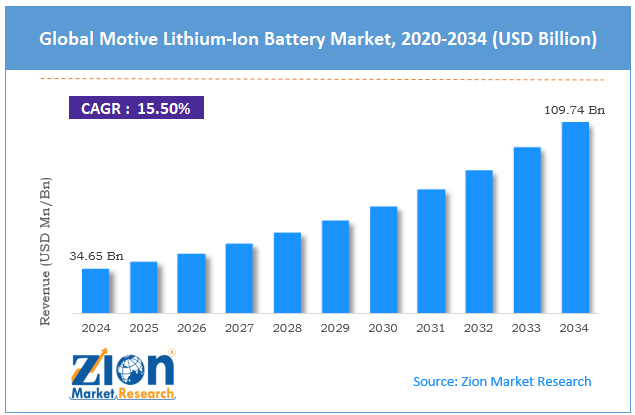
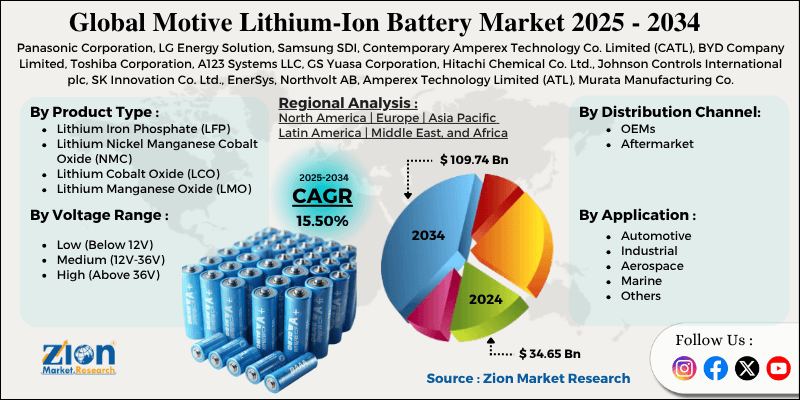
The global motive lithium-ion battery market size was around USD 34.65 billion in 2024 and is projected to reach USD 109.74 billion by 2034, with a compound annual growth rate (CAGR) of roughly 15.50% between 2025 and 2034.
Key Insights:
- As per the analysis shared by our research analyst, the global motive lithium-ion battery market is estimated to grow annually at a CAGR of around 15.50% over the forecast period (2025-2034)
- In terms of revenue, the global motive lithium-ion battery market size was valued at around USD 34.65 billion in 2024 and is projected to reach USD 109.74 billion by 2034.
- The motive lithium-ion battery market is projected to grow significantly owing to the expansion of e-commerce and warehouse automation, increasing adoption of renewable energy storage, and the shift from lead-acid to lithium-ion batteries.
- Based on product type, the Lithium Nickel Manganese Cobalt Oxide (NMC) segment is expected to lead the market, while the Lithium Iron Phosphate (LFP) segment is expected to grow considerably.
- Based on application, the automotive segment leads, while the industrial segment is projected to grow significantly in the coming years.
- Based on the voltage range, the high (above 36V) segment is the dominating segment, while the medium (12V-36V) segment is projected to witness sizeable revenue over the forecast period.
- Based on the distribution channel, the OEMs segment is expected to lead the market, followed by the aftermarket segment.
- Based on region, the Asia Pacific is projected to dominate the global market during the estimated period, followed by North America.
Motive Lithium-Ion Battery Market: Overview
A motive lithium-ion battery is a rechargeable energy storage system to power diverse electric industrial vehicles. It offers higher energy efficiency, a longer lifespan, faster charging, and lower maintenance than traditional lead-acid batteries. These batteries enhance productivity and reduce downtime, making them well-suited for logistics operations and modern material handling. The global motive lithium-ion battery market is likely to expand rapidly, fueled by the growing electrification of transport, growth of logistics and warehousing, and high energy density advantage. The worldwide inclination towards electric mobility, including industrial vehicles and EVs, is a key growth propeller. Governments are promoting electrification through subsidies and emissions norms. This majorly increases the demand for lithium-ion batteries in motive applications.
Moreover, speedy growth in e-commerce has driven demand for material-handling equipment and electric forklifts. Lithium-ion batteries are preferred due to reduced downtime and higher efficiency. Their adoption improves operational productivity in warehouses. Furthermore, lithium-ion batteries offer optimal energy density compared to traditional alternatives. This allows longer operating hours and enhanced performance in motive equipment. It backs compact design and weight optimization in vehicles.
Nevertheless, the global market faces limitations due to high initial investment costs and volatility in raw material prices. Lithium-ion batteries have significantly higher upfront costs than traditional batteries. This discourages adoption, mainly among medium and small enterprises. Cost sensitivity is still a key barrier in emerging regions. Likewise, the prices of cobalt, lithium-ion, and nickel fluctuate due to supply-demand imbalances. This impacts production costs and pricing stability. Manufacturers face challenges in maintaining profitability.
Still, the global motive lithium-ion battery industry benefits from several favorable factors, such as growth in renewable energy integration, improvements in recycling technologies, and development of alternative chemistries. Growing adoption of renewable energy creates demand for effective storage systems. Lithium-ion batteries can support energy management and grid stability. This expands their role beyond mobility applications. Enhanced recycling processes can recover valuable materials and lower environmental impact. This supports circular initiatives. It also helps in stabilizing raw material supply. Additionally, innovations like LFP and cobalt-free batteries reduce reliance on scarce materials. These substitutes enhance cost efficiency and sustainability. They offer new application prospects.
Motive Lithium-Ion Battery Market: Dynamics
Growth Drivers
How is the motive lithium-ion battery market fueled by sustainability & decarbonization policies?
Governments worldwide are imposing stringent emission norms and incentivizing clean energy transitions, driving fleet electrification. Carbon-neutral targets and sustainability architecture encourage companies to replace lead-acid and fossil-fuel-powered vehicles with lithium-ion alternatives. Corporate ESG commitments also favor low-emission motive solutions within industrial operations. This regulatory environment is a continuous, long-term driver of the global motive lithium-ion battery market.
How are technological advancements in battery chemistry driving the motive lithium-ion battery market?
Continuous enhancements in lithium-ion battery technology, such as improved thermal stability, higher energy density, and advanced battery management systems, are improving safety and performance. Innovations in chemistries like NMC and LFP drive cycle life and reduce cost per kWh. This greatly expands the possibilities for motive battery applications. BMS and smart telematics allow predictive maintenance and fleet optimization. Enhanced battery performance supports more demanding industrial uses and reduces lifecycle costs. These technology gains make lithium-ion motive solutions more scalable and competitive.
Restraints
Limited charging infrastructure readiness negatively impacts the market progress
The effectiveness of lithium-ion batteries is closely associated with reliable, fast-charging stations. Several older facilities lack adequate electrical upgrades to support high-power charging requirements. These infrastructure restrictions impose high hidden costs and slow fleet electrification in multi-shift operations. Grid capacity constraints in the developing markets further complicate rollout plans. Hence, fleet operators may delay transitions until infrastructure catches up.
Opportunities
How are second-life and circular-economy solutions creating promising avenues for growth in the motive lithium-ion battery industry?
Retired motive lithium-ion packs usually retain nearly 80% of their usable capacity, creating a major opportunity for second-life applications in less-demanding energy storage scenarios. Reusing batteries for grid support, auxiliary power, and peak shaving can extend economic value and lower lifecycle costs. Developing standardized grading and repurposing frameworks can generate new revenue streams. This opportunity in the motive lithium-ion battery industry supports battery supply chains in meeting regulatory requirements and sustainability goals. Second-life markets reduce environmental impact while improving asset utilization.
Challenges
Geopolitical and trade uncertainty restricts the market growth
Supply chains for critical battery materials and cells are largely influenced by trade dynamics and geopolitical policies. Shifts in export collateral requirements, mining regulations, and tariffs can cause abrupt disruptions in supply and costs. Dependency on concentrated production regions exposes the market to strategic risk. Companies should build resilient, diversified sourcing strategies amid uncertainty in international relations. Managing these risks challenges supply chain investors and planners alike.
Motive Lithium-Ion Battery Market: Report Scope
| Report Attributes | Report Details |
|---|---|
| Report Name | Motive Lithium-Ion Battery Market |
| Market Size in 2024 | USD 34.65 Billion |
| Market Forecast in 2034 | USD 109.74 Bllion |
| Growth Rate | CAGR of 15.50% |
| Number of Pages | 227 |
| Key Companies Covered | Panasonic Corporation, LG Energy Solution, Samsung SDI, Contemporary Amperex Technology Co. Limited (CATL), BYD Company Limited, Toshiba Corporation, A123 Systems LLC, GS Yuasa Corporation, Hitachi Chemical Co. Ltd., Johnson Controls International plc, SK Innovation Co. Ltd., EnerSys, Northvolt AB, Amperex Technology Limited (ATL), Murata Manufacturing Co. Ltd., and others. |
| Segments Covered | By Product Type, By Application, By Voltage Range, By Distribution Channel, and By Region |
| Regions Covered | North America, Europe, Asia Pacific (APAC), Latin America, Middle East, and Africa (MEA) |
| Base Year | 2024 |
| Historical Year | 2019 to 2023 |
| Forecast Year | 2025 - 2034 |
| Customization Scope | Avail customized purchase options to meet your exact research needs. Request For Customization |
Motive Lithium-Ion Battery Market: Segmentation
The global motive lithium-ion battery market is segmented based on product type, application, voltage range, distribution channel, and region.
Why is the Lithium Nickel Manganese Cobalt Oxide (NMC) segment projected to dominate the motive lithium-ion battery market?
Based on product type, the global motive lithium-ion battery industry is divided into Lithium Iron Phosphate (LFP), Lithium Nickel Manganese Cobalt Oxide (NMC), Lithium Cobalt Oxide (LCO), Lithium Manganese Oxide (LMO), and others. The Lithium Nickel Manganese Cobalt Oxide (NMC) segment registers a dominating 45% share of the market. This is backed by its high energy density and wide adoption in industrial applications and electric vehicles.
Conversely, the Lithium Iron Phosphate (LFP) segment ranks second with 40% market share. It is largely used for long cycle life, cost-effectiveness, and strong safety, mainly in industrial motive and commercial EV applications.
Why is the Automotive segment dominating among others in the motive lithium-ion battery market?
Based on application, the global market is segmented into automotive, industrial, aerospace, marine, and others. The automotive segment holds leadership with 65% of the total market. This is fueled by the rapid adoption of electric vehicles and stringent emissions norms worldwide.
Nonetheless, the industrial segment holds the second-largest share at 25% of the total market. This growth is backed by increased operational efficiency and warehouse electrification.
What factors help the High (Above 36V) segment lead the motive lithium-ion battery market?
Based on voltage range, the global motive lithium-ion battery market for motive applications is segmented into low (below 12V), medium (12V-36V), and high (above 36V). The high (above 36V) segment holds dominance with a 60% market share. It is preferred for industrial equipment and electric vehicles that require high power and long operating hours.
Nevertheless, the medium (12V-36V) segment holds a second position with 35% market share. It is widely used in mid-power motive devices such as pallet jacks and forklifts, balancing performance, cost, and safety.
What are the key reasons for the leadership of the OEMs segment in the motive lithium-ion battery market?
Based on the distribution channel, the global market is segmented into OEMs and aftermarket. The OEMs segment dominates with an 80% share and the highest sales. Batteries are mainly integrated into new equipment and vehicles during production.
However, the aftermarket segment is expected to grow considerably with 30% share, covering retrofit and replacement batteries. This growth is backed by the expanding installed bases and demand for cost-efficient battery upgrades.
Motive Lithium-Ion Battery Market: Regional Analysis
What gives Asia Pacific a competitive edge in the global Motive Lithium-Ion Battery Market?
Asia Pacific is projected to maintain its dominant position in the global motive lithium-ion battery market, with a 12% CAGR, owing to speedy EV adoption and industrial growth, presence of key battery manufacturers, and government policies and incentives. Asia Pacific leads the global market due to fast-growing EV adoption in countries such as South Korea, China, and Japan. At the same time, industrial automation and warehouse electrification are expanding, driving strong demand for motive batteries in material-handling equipment.
Moreover, the region is home to leading lithium-ion battery producers, promising competitive pricing and supply availability. Companies benefit from local manufacturing hubs, economies of scale, and access to raw materials, reinforcing APAC’s leadership. Furthermore, supportive regulations, tax benefits, and subsidies encourage the electrification of industrial vehicles and fleets. Governments are increasingly promoting clean energy and accelerating battery adoption in the industrial and automotive sectors.
Why does North America rank second in the global Motive Lithium-Ion Battery Market?
North America maintains its position as the second-largest region, with a 13.4% CAGR in the global motive lithium-ion battery industry, driven by advanced manufacturing and technology infrastructure, growing logistics and e-commerce industry, and high consumer awareness and sustainability focus. The region holds well-developed manufacturing facilities and technological proficiency. Companies leverage advanced R&D capabilities to produce high-performance batteries with battery safety, energy density, and lifespan. Moreover, the growth of warehousing and e-commerce in the region increases the demand for electric material-handling vehicles. Lithium-ion batteries power these high-utilization vehicles, backing constant demand growth.
Additionally, businesses and consumers prioritize operational efficiency and sustainability. Preference for long-lasting, low-maintenance lithium-ion batteries drives adoption over traditional lead-acid alternatives.
Motive Lithium-Ion Battery Market: Competitive Analysis
The leading players in the global motive lithium-ion battery market are:
- Panasonic Corporation
- LG Energy Solution
- Samsung SDI
- Contemporary Amperex Technology Co. Limited (CATL)
- BYD Company Limited
- Toshiba Corporation
- A123 Systems LLC
- GS Yuasa Corporation
- Hitachi Chemical Co. Ltd.
- Johnson Controls International plc
- SK Innovation Co. Ltd.
- EnerSys
- Northvolt AB
- Amperex Technology Limited (ATL)
- Murata Manufacturing Co. Ltd.
What are the key trends in the global Motive Lithium-Ion Battery Market?
Expansion of fast charging infrastructure:
The development of speedy and opportunity charging solutions is accelerating, reducing downtime for motive equipment and EV fleets. Enhanced charging networks support the adoption of high-voltage batteries and improve operational efficiency. This trend encourages wider use of electric motive power in industries.
Integration of Smart Battery Management Systems (BMS):
Advanced battery management systems with real-time monitoring, predictive analytics, and diagnostics are becoming standard. These systems improve safety, extend battery lifespan, and optimize performance. Smart BMS also backs fleet-level management for industrial motive operations.
The global motive lithium-ion battery market is segmented as follows:
By Product Type
- Lithium Iron Phosphate (LFP)
- Lithium Nickel Manganese Cobalt Oxide (NMC)
- Lithium Cobalt Oxide (LCO)
- Lithium Manganese Oxide (LMO)
- Others
By Application
- Automotive
- Industrial
- Aerospace
- Marine
- Others
By Voltage Range
- Low (Below 12V)
- Medium (12V-36V)
- High (Above 36V)
By Distribution Channel
- OEMs
- Aftermarket
By Region
- North America
- The U.S.
- Canada
- Mexico
- Europe
- France
- The UK
- Spain
- Germany
- Italy
- Rest of Europe
- Asia Pacific
- China
- Japan
- India
- Australia
- South Korea
- Rest of Asia Pacific
- The Middle East & Africa
- Saudi Arabia
- UAE
- Egypt
- Kuwait
- South Africa
- Rest of the Middle East & Africa
- Latin America
- Brazil
- Argentina
- Rest of Latin America
Table Of Content
Methodology
FrequentlyAsked Questions

HappyClients

