
Automotive Parts Remanufacturing Market Size, Share, Value and Forecast 2034

Automotive Parts Remanufacturing Market By Product Type (Engine & Related Parts, Transmission & Others, Electrical & Electronics, Wheels & Brakes, A/C Compressors, Steering, Fuel Systems, and Others), By Application (Passenger Cars, LCVs, HCVs, Off Road Vehicles, and All-Terrain Vehicles), By End-User (Automotive Repair Shops and DIY Consumers), and By Region - Global and Regional Industry Overview, Market Intelligence, Comprehensive Analysis, Historical Data, and Forecasts 2025 - 2034
| Market Size in 2024 | Market Forecast in 2034 | CAGR (in %) | Base Year |
|---|---|---|---|
| USD 67.36 Billion | USD 134.22 Billion | 9.00% | 2024 |
Automotive Parts Remanufacturing Industry Perspective:
What will be the size of the global automotive parts remanufacturing market during the forecast period?
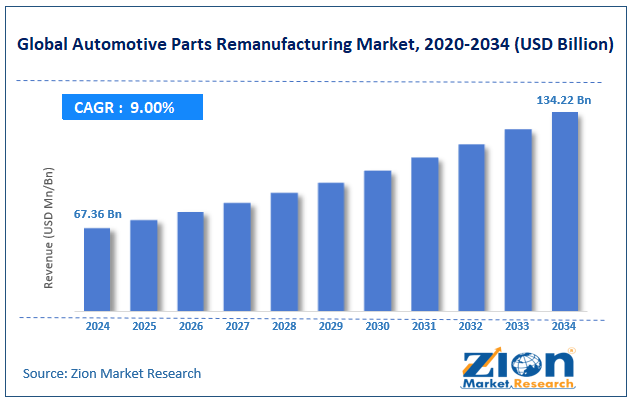
The global automotive parts remanufacturing market size was around USD 67.36 billion in 2024 and is projected to reach USD 134.22 billion by 2034, with a compound annual growth rate (CAGR) of roughly 9% between 2025 and 2034.
Key Insights:
- As per the analysis shared by our research analyst, the global automotive parts remanufacturing market is estimated to grow annually at a CAGR of around 9% over the forecast period (2025-2034)
- In terms of revenue, the global automotive parts remanufacturing market size was valued at around USD 67.36 billion in 2024 and is projected to reach USD 134.22 billion by 2034.
- The automotive parts remanufacturing market is projected to grow significantly, driven by rising demand for cost-effective replacement parts, stringent environmental regulations and emission norms, and advancements in remanufacturing technologies.
- Based on product type, the engine & related parts segment is expected to lead the market, while the transmission & others segment is expected to grow considerably.
- Based on application, the Passenger Cars segment is the dominating segment, while the LCVs and HCVs segments together are projected to witness sizeable revenue over the forecast period.
- Based on end-user, the automotive repair shops segment is expected to lead the market compared to the DIY consumers segment.
- By region, North America is projected to dominate the global market during the forecast period, followed by Europe.
Automotive Parts Remanufacturing Market: Overview
Automotive parts remanufacturing refers to the process of restoring used vehicle components to like-new condition by cleaning, repairing, disassembling, and replacing worn components. It emphasizes extending product life cycles without compromising original equipment standards for safety and performance. This ultimately offers a cost-effective, environmentally sustainable alternative to manufacturing new parts. The global automotive parts remanufacturing market is poised to expand rapidly, driven by the growing aging vehicle parc, environmental sustainability, the circular economy, and the benefits of resource conservation. The rising average age of vehicles worldwide is driving demand for maintenance solutions and replacement parts. Older vehicles need frequent component replacement, driving the adoption of remanufactured parts. This trend is majorly prevalent in mature automotive markets and developing economies.
Moreover, remanufacturing reduces energy use, waste, and the consumption of raw materials compared to new production. Corporations and governments are increasingly promoting circular economy practices. This sustainability benefit strongly supports industry growth. Furthermore, the reuse of plastics, metals, and components conserves natural resources and lowers reliance on mining. This contributes to low environmental impact and production costs. Industries worldwide are supporting resource-efficient manufacturing models.
Despite growth, the global market is constrained by factors such as negative consumer perception and inconsistent core availability. Many consumers perceive remanufactured parts as inferior in durability and quality. This misconception hampers adoption, mainly in premium vehicle segments. Continuous education and warranties are needed to outshine this barrier. Similarly, remanufacturing relies on used components (cores), which are often in short supply. Poor return systems and damaged cores disturb production cycles. This creates supply chain instability.
Nonetheless, the global automotive parts remanufacturing industry stands to benefit from several key opportunities, including the growing demand from the aging vehicle fleet and the remanufacturing of electrification and EV components. A large proportion of vehicles worldwide are over 5 years old and need frequent repairs. This creates sustained demand for cost-efficient remanufactured components. The opportunity is remarkably strong in aftermarket services. The transition to electric vehicles creates opportunities in electric drivetrains and remanufacturing batteries. New business models are developing around EV component reuse. This presents a high-growth future segment.
Impact of the USA-Israel war on Iran on the Automotive Parts Remanufacturing Market
Geopolitical tensions between the United States, Israel, and Iran can significantly disrupt global automotive supply chains, adversely affecting component availability and raw material sourcing. This disturbance fuels reliance on remanufactured components as cost-efficient, quickly deployable alternatives, particularly for aftermarket services and fleet operators. Simultaneously, growing energy costs, logistical uncertainties, and trade restrictions may limit investment and production, creating a mixed impact on the total growth of the automotive parts remanufacturing market.
Automotive Parts Remanufacturing Market: Dynamics
Growth Drivers
How are environmental sustainability and the circular economy pushing the automotive parts remanufacturing market?
Tighter environmental regulations and sustainability initiatives are driving the automotive industry toward circular-economy principles, where remanufacturing plays a crucial role by reducing raw-material extraction, waste generation, and energy use. Governments and corporations are focusing on material reuse and recovery, augmenting the adoption of remanufactured parts as an eco-friendly alternative to new production. This trend supports emissions-reduction goals and corporate ESG strategies, driving long-term growth of the automotive parts remanufacturing market. Sustainability mandates also motivate OEMs to implement take-back and remanufacturing programs.
How is the automotive parts remanufacturing market driven by technological improvements that enhance product quality?
Emerging technologies such as AI-assisted inspection, 3D printing, IoT tracking, and precision cleaning methods are significantly enhancing the quality and reliability of remanufactured parts. This makes them more competitive with new components. These advancements shorten turnaround times, raise consistency standards, and enable complex assemblies, such as electronic modules, to be economically remanufactured. Quality control and improved digital diagnostics elevate confidence among end consumers and workshops. Improvements also reveal new product segments, such as EV-related components.
Restraints
High capital & technology investment requirements adversely impact the market progress
Remanufacturing modern components, particularly hybrid powertrains and electronic parts, requires advanced diagnostic tools, skilled labor, and specialized machinery. Smaller players face high entry barriers due to the capital costs of precision cleaning, automated inspection, and testing equipment. Ongoing investment to keep pace with the evolution of vehicle tech strains financial resources. This may hamper participation in larger companies.
Opportunities
How is the expansion of circular economy initiatives presenting favorable prospects for the development of the automotive parts remanufacturing market?
Worldwide sustainability goals are driving governments and OEMs to adopt circular-economy models, directly benefiting remanufacturing. There is strong potential to integrate remanufactured parts into green supply chains as companies aim to reduce energy use, waste, and carbon emissions. Growing policy support and environmental mandates make remanufacturing more strategic. Standardized environmental credentials may help mainstream adoption, thereby positively impacting the worldwide automotive parts remanufacturing industry.
Challenges
Supply chain volatility & logistics bottlenecks restrict the market growth
Perverse supply chains for cores are inherently complex and reliant on several dispersed stakeholders from salvage yards to repair shops. Disturbances such as regional imbalances and transport delays in core availability may extend lead times and disrupt production schedules. This volatility complicates cost management and inventory planning. Enhancing collaboration in the chain is a strategic challenge.
Automotive Parts Remanufacturing Market: Report Scope
| Report Attributes | Report Details |
|---|---|
| Report Name | Automotive Parts Remanufacturing Market |
| Market Size in 2024 | USD 67.36 Billion |
| Market Forecast in 2034 | USD 134.22 Bllion |
| Growth Rate | CAGR of 9% |
| Number of Pages | 230 |
| Key Companies Covered | Robert Bosch GmbH, ZF Friedrichshafen AG, Valeo SA, BorgWarner Inc., Cardone Industries Inc., Meritor Inc., Genuine Parts Company, Denso Corporation, Cummins Inc., Delphi Technologies PLC, Motorcar Parts of America Inc., Caterpillar Inc., Mitsubishi Electric Corporation, ATC Drivetrain, Jasper Engines & Transmissions, and others. |
| Segments Covered | By Product Type, By Application, By End-User, and By Region |
| Regions Covered | North America, Europe, Asia Pacific (APAC), Latin America, Middle East, and Africa (MEA) |
| Base Year | 2024 |
| Historical Year | 2019 to 2023 |
| Forecast Year | 2025 - 2034 |
| Customization Scope | Avail customized purchase options to meet your exact research needs. Request For Customization |
Automotive Parts Remanufacturing Market: Segmentation
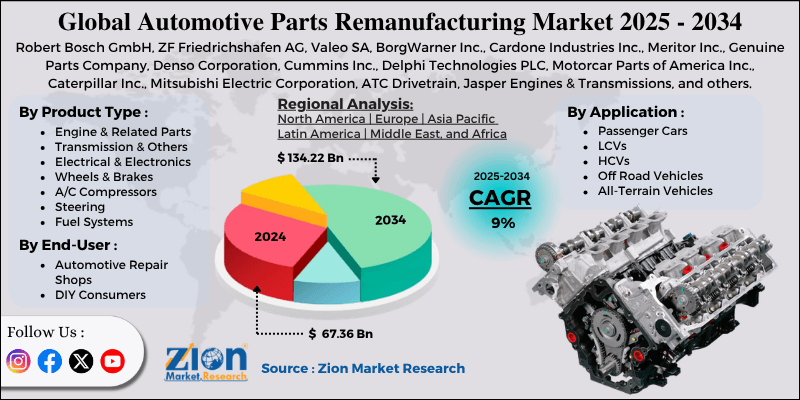
The global automotive parts remanufacturing market is segmented based on product type, application, end-user, and region.
Why is the Engine & Related Parts segment projected to dominate the automotive parts remanufacturing market?
Based on product type, the global automotive parts remanufacturing industry is divided into engine & related parts, transmission & others, electrical & electronics, wheels & brakes, A/C compressors, steering, fuel systems, and others. The engine & related parts segment registered a notable market share in the past few years, with nearly 40%. This is fueled by frequent replacement cycles and major cost savings over new engines for commercial and passenger vehicles. This strong rank indicates high demand for cylinder heads, remanufactured engines, and related components, which are financially challenging to procure.
Conversely, the transmission & others segment held a second-leading market share of 38%, driven by costly, complex new transmissions that make remanufactured alternatives more appealing. Together, these two segments dominate remanufacturing activity, with other classes such as electronics and electrical, fuel systems, and wheels & brakes accounting for smaller shares of the market.
What factors help the Passenger Cars segment lead the automotive parts remanufacturing market?
Based on application, the global automotive parts remanufacturing market is segmented into passenger cars, LCVs, HCVs, off road vehicles, and all-terrain vehicles. The passenger cars segment held leadership in the market with 58% of the total share. This is fueled by the vast global fleet of private vehicles that need cost-effective part replacements and frequent maintenance.
Nonetheless, the LCVs and HCVs segments together rank second after the passenger cars segment, accounting for 38% of the total market. Logistics companies and fleet operators actively choose remanufactured components in order to reduce maintenance costs and downtime. Other segments, like all-terrain and off-road vehicles segments hold a smaller share.
What are the key reasons for the leadership of the Automotive Repair Shops segment in the automotive parts remanufacturing market?
Based on end-user, the global market is segmented into automotive repair shops and DIY consumers. The automotive repair shops capture over 50% of the total market as independent service centers and mechanics depend largely on remanufactured components to offer cost-efficient maintenance and repairs in vehicle types. Repair shops prioritize component availability, warranty support, and price efficiency, making them the primary demand for remanufactured parts.
However, the DIY consumer segment holds second place, as vehicle owners increasingly choose to maintain aging cars themselves using affordable remanufactured components. This DIY trend is backed by growing parts awareness, cost pressures, and online access to parts due to higher new-part prices.
Automotive Parts Remanufacturing Market: Regional Analysis
Why is North America outperforming other regions in the global Automotive Parts Remanufacturing market?
North America is anticipated to retain its leading role in the global automotive parts remanufacturing market, with a 4-6% CAGR, driven by a large and aging vehicle fleet, advanced remanufacturing technology, and a supportive regulatory environment. North America’s vehicle population is aging, with many trucks and cars requiring part replacements and frequent maintenance. This fuels strong demand for cost-effective remanufactured components. Both commercial and passenger fleets contribute significantly to this sustained industry growth.
Moreover, the region uses advanced technologies such as automated diagnostics, quality testing, and precision machining to produce remanufactured parts that meet or exceed OEM standards. These advancements improve customer confidence and reliability. High-class production capabilities make remanufactured components more extensively adopted. Furthermore, North American governments promote environmental sustainability through incentives and regulations that support recycling and circular-economy practices. These policies encourage the use of remanufactured parts over new components. Compliance with environmental standards strengthens the industry’s long-term appeal and growth.
Why does Europe rank second in the global Automotive Parts Remanufacturing Market?
Europe ranks as the second-largest region in the global automotive parts remanufacturing industry, with a 4-5.5% CAGR, driven by high vehicle ownership and aging fleet, established aftermarket infrastructure, and advanced technology adoption. A large number of older commercial and passenger cars require parts replacement and frequent maintenance. This creates steady demand for cost-effective remanufactured components. The aging fleet promises prolonged market stability. The region also has a mature network of repair shops, remanufacturing facilities, and distributors. This infrastructure allows efficient collection, distribution, and remanufacturing of parts. It supports timely, high-quality aftermarket services.
Additionally, European remanufacturers use precision machining, strict quality control systems, and automated testing. These technologies promise remanufactured parts that meet near-OEM standards. Reliable performance raises market adoption and customer trust.
Automotive Parts Remanufacturing Market: Competitive Analysis
The leading players in the global automotive parts remanufacturing market are:
- Robert Bosch GmbH
- ZF Friedrichshafen AG
- Valeo SA
- BorgWarner Inc.
- Cardone Industries Inc.
- Meritor Inc.
- Genuine Parts Company
- Denso Corporation
- Cummins Inc.
- Delphi Technologies PLC
- Motorcar Parts of America Inc.
- Caterpillar Inc.
- Mitsubishi Electric Corporation
- ATC Drivetrain
- Jasper Engines & Transmissions
What are the key trends in the global Automotive Parts Remanufacturing Market?
Expansion of reverse logistics systems:
Improved collection networks and incentives for returning used cores are solidifying remanufacturing supply chains. Improved reverse logistics help ensure a quality, stable supply of cores, reducing reliance on waste and scrap. This trend supports operational efficiency, enhances production planning, and lowers costs.
Integration of Industry 4.0 technologies:
Remanufacturers are increasingly adopting digital tools such as AI-driven diagnostics, automated machining, and IoT sensors to enhance production precision and core assessment. These technologies improve quality, consistency, and reduce turnaround times. Hence, remanufactured parts are achieving near-OEM performance, driving industry confidence.
The global automotive parts remanufacturing market is segmented as follows:
By Product Type
- Engine & Related Parts
- Transmission & Others
- Electrical & Electronics
- Wheels & Brakes
- A/C Compressors
- Steering
- Fuel Systems
- Others
By Application
- Passenger Cars
- LCVs
- HCVs
- Off Road Vehicles
- All-Terrain Vehicles
By End-User
- Automotive Repair Shops
- DIY Consumers
By Region
- North America
- The U.S.
- Canada
- Mexico
- Europe
- France
- The UK
- Spain
- Germany
- Italy
- Rest of Europe
- Asia Pacific
- China
- Japan
- India
- Australia
- South Korea
- Rest of Asia Pacific
- The Middle East & Africa
- Saudi Arabia
- UAE
- Egypt
- Kuwait
- South Africa
- Rest of the Middle East & Africa
- Latin America
- Brazil
- Argentina
- Rest of Latin America
Table Of Content
Methodology
FrequentlyAsked Questions
Automotive parts remanufacturing refers to the process of restoring used vehicle components to like-new condition by cleaning, repairing, disassembling, and replacing worn components. It emphasizes extending product life cycles without compromising original equipment standards for safety and performance. This ultimately offers a cost-effective, environmentally sustainable alternative to manufacturing new parts.
The global automotive parts remanufacturing market is projected to grow due to increasing vehicle parc and aging fleet, OEM participation in remanufacturing programs, and supply chain disruptions, boosting the reuse of parts.
According to study, the global automotive parts remanufacturing market size was around USD 67.36 billion in 2024 and is expected to grow to around USD 134.22 billion by 2034.
The CAGR value of the automotive parts remanufacturing market is expected to be around 9% during 2025-2034.
Technological advancements are enhancing precision, efficiency, and quality in remanufacturing, enabling parts to meet near-OEM performance standards.
The passenger car segment is expected to dominate the automotive parts remanufacturing market by 2034, driven by higher vehicle volumes and maintenance demand.
North America is expected to lead the global automotive parts remanufacturing market during the forecast period.
The key players profiled in the global automotive parts remanufacturing market include Robert Bosch GmbH, ZF Friedrichshafen AG, Valeo SA, BorgWarner Inc., Cardone Industries, Inc., Meritor, Inc., Genuine Parts Company, Denso Corporation, Cummins Inc., Delphi Technologies PLC, Motorcar Parts of America, Inc., Caterpillar Inc., Mitsubishi Electric Corporation, ATC Drivetrain, and Jasper Engines & Transmissions.
Leading players are adopting strategies such as mergers & acquisitions, OEM collaborations, expansion of global distribution, and technological upgrades to strengthen their market presence.
The report examines key aspects of the automotive parts remanufacturing market, including a detailed analysis of current growth factors and restraints, as well as future growth opportunities and challenges that will affect the market.

HappyClients

