
Intelligent Vehicle Inspection Market Size, Share, Trends, Growth and Forecast 2034

Intelligent Vehicle Inspection Market By Technology (Automated Inspection Systems, On-Board Diagnostics (OBD), Machine Vision Systems, and Artificial Intelligence (AI) and Machine Learning), By Application (Pre-Purchase Inspections, Fleet Management, Insurance Assessments, Regulatory Compliance, and Routine Maintenance), By Vehicle Type (Passenger Cars, Electric Vehicles (EVs), Commercial Vehicles, and Two-Wheelers), and By Region - Global and Regional Industry Overview, Market Intelligence, Comprehensive Analysis, Historical Data, and Forecasts 2025 - 2034
| Market Size in 2024 | Market Forecast in 2034 | CAGR (in %) | Base Year |
|---|---|---|---|
| USD 16.2 Billion | USD 36.6 Billion | 8.5% | 2024 |
Intelligent Vehicle Inspection Industry Perspective:
What will be the size of the global intelligent vehicle inspection market during the forecast period?
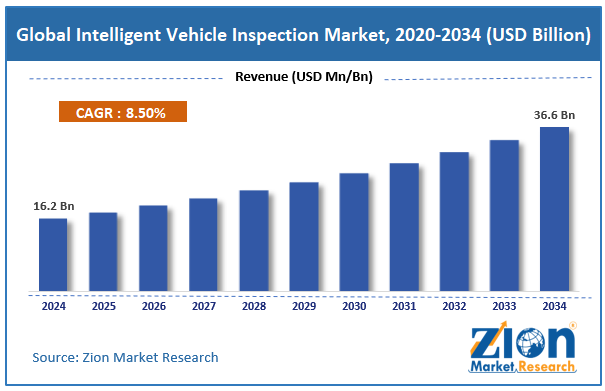
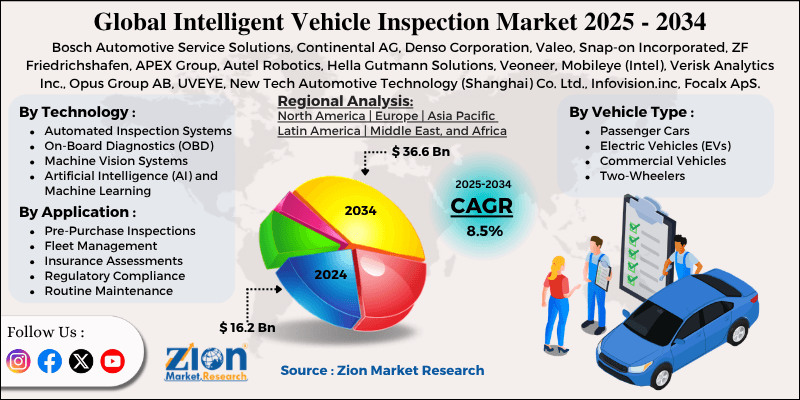
The global intelligent vehicle inspection market size was worth around USD 16.2 billion in 2024 and is predicted to grow to around USD 36.6 billion by 2034, with a compound annual growth rate (CAGR) of roughly 8.5% between 2025 and 2034.
Key Insights
- As per the analysis shared by our research analyst, the global intelligent vehicle inspection market is estimated to grow annually at a CAGR of around 8.5% over the forecast period (2025-2034).
- In terms of revenue, the global intelligent vehicle inspection market size was valued at around USD 16.2 billion in 2024 and is projected to reach USD 36.6 billion by 2034.
- Increasing vehicle ownership and traffic volumes are expected to propel the intelligent vehicle inspection market over the projected period.
- Based on the technology, the automated inspection systems segment dominated the market in 2024.
- Based on the application, the pre-purchase inspections segment is expected to capture the largest market share over the analysis period.
- Based on the vehicle type, the passenger cars segment is growing at a substantial rate during the projected period.
- Based on region, North America dominates the market.
Intelligent Vehicle Inspection Market: Overview
Intelligent Vehicle Inspection is an innovative technique for evaluating the condition, safety, and performance of vehicles. It is a technology-based automated system driven by computer algorithms powered by artificial intelligence (AI), machine learning, computer vision & sensor-based technology. Intelligent Vehicle Inspection is a sophisticated tool, as opposed to manual inspection, that uses scanners, cameras & data analysis to inspect vehicles on the road and recognize damage, structural flaws, emissions & mechanical faults with remarkably high accuracy, efficiency, and effectiveness. The growth of the intelligent vehicle inspection market is driven by rising safety standards and government regulations worldwide that require vehicles to meet specific safety, environmental, and emission norms, pushing organizations to adopt automated, precise vehicle inspection systems.
The growth is also fueled by the introduction and adaptation of technologies such as Artificial Intelligence (AI), machine learning, computer vision, and the Internet of Things (IoT), which are making vehicle inspections more accurate, affordable, and 25 to 50 times faster than manual inspections. The growing adoption of automation across automotive manufacturing, fleet management, and the insurance industry is also driving market growth. However, the high initial investment might be hampering the industry expansion.
Intelligent Vehicle Inspection Market: Dynamics
Growth Drivers
How does the growing adoption of AI, machine learning, and IoT drive the intelligent vehicle inspection market?
The proliferation and increasing use of AI, machine learning, and IoT are the key growth drivers for the intelligent vehicle inspection market. These technologies enable automated, accurate inspection processes that run much faster than traditional manual processes, lowering operational costs. In particular, the AI-powered computer vision systems used in inspection have been shown to outperform humans in detecting cosmetic damage such as scratches and dents, paint color and texture inconsistencies, and assembly errors, reducing quality liability issues.
By using machine learning models, inspection processes can learn the types of damage present and continuously improve, while futuristic IoT-enabled sensors, combined with connected platforms, enable data to be transmitted and monitored remotely and in real time, enabling predictive maintenance to avoid problems before they occur. A good instance is the AI-powered vehicle inspection system used by Amazon, which scans the entire vehicle using cameras and machine learning, in a matter of seconds, automatically detecting and classifying defects and transmitting instant reports to aid maintenance decisions. Similarly, Toyota has installed deep learning-based vision systems to automate vehicle inspections within its manufacturing plants, and commercial vehicle insurer Tractable has developed an AI solution using computer vision to enable faster, more accurate damage assessment.
Restraints
The lack of skilled professionals poses a significant restraint on the intelligent vehicle inspection market
The shortfall of skilled professionals in the field is a major limitation to the adoption of the intelligent vehicle inspection market. The reason is that intelligent system integration and its operation require technical skills in applying machine learning, computer vision, AI, and IoT, as well as in system management. Many organizations are unwilling to apply such techniques due to the unavailability of trained personnel who can operate, calibrate, and maintain the inspection systems, as well as interpret the data into logical insights. This situation poses operational risks and increases regular operational costs for any organization, especially for small and medium enterprises (SMEs).
Opportunities
Do the increasing number of product launches present an opportunity for the intelligent vehicle inspection market?
Frequent product launches present a good opportunity for the intelligent vehicle inspection market, as newer products enhance overall quality, ease of use, and technology availability. With the launch of newer, more advanced inspection products and systems, features are quickening in terms of scan speed, accuracy, and ease of use. This enables companies such as car manufacturers, service providers, and insurers to adopt the systems more quickly. New products and systems are also increasingly launched at lower cost or price to ease installation and use, thereby enabling companies such as automotive manufacturers and repair centers to adopt these solutions at a smaller scale. An increase in the number of product launches will also lead to greater comfort with human-machine interfaces, thereby increasing competition among product providers to become more innovative, resulting in customer satisfaction and wider adoption of such systems.
For instance, in August 2025, UVeye, the world leader in AI-powered vehicle inspections, announced that it will deploy automated inspection systems in partnership with JLR (Jaguar Land Rover) North America at its three largest US seaports: Brunswick, Georgia; Baltimore, Maryland; and Port Hueneme, California. This will make JLR the first auto manufacturer in the US to have UVeye's automated inspections included in the Customer Acceptance Line (CAL), which ensures that all autos arriving overseas are inspected by AI before being sold to retailers, ensuring the standards of the luxury vehicle are met. This breakthrough is part of a broader surge in automation and digitalization in US Ports. The program is designed to facilitate extremely rapid inbound vehicle flows, significantly reduce manual errors, and enable more comprehensive inspections, all with visibility from ship to showroom.
Challenges
How does limited adoption in developing regions pose a significant challenge to the intelligent vehicle inspection market?
A low adoption rate in developing countries is expected to pose a severe challenge to the intelligent vehicle inspection market, as it limits the product's reach and delays global technological innovation. The factors that affect the adoption of intelligent equipment in developing nations include the absence of infrastructure, the high cost of advanced inspection systems, and a lack of financial resources among SMBs and government organizations.
With the dominance of manual inspection techniques, the lack of technical familiarity with such systems, and the high initial investment requirements hamper advanced intelligent inspections have not yet achieved economic feasibility. For these reasons, the adoption of AI, IoT, and GPS-enabled inspection systems is slow in the developing world, despite the high demand for such systems in the current context.
Intelligent Vehicle Inspection Market: Report Scope
| Report Attributes | Report Details |
|---|---|
| Report Name | Intelligent Vehicle Inspection Market |
| Market Size in 2024 | USD 16.2 Billion |
| Market Forecast in 2034 | USD 36.6 Bllion |
| Growth Rate | CAGR of 8.5% |
| Number of Pages | 227 |
| Key Companies Covered | Bosch Automotive Service Solutions, Continental AG, Denso Corporation, Valeo, Snap-on Incorporated, ZF Friedrichshafen, APEX Group, Autel Robotics, Hella Gutmann Solutions, Veoneer, Mobileye (Intel), Verisk Analytics Inc., Opus Group AB, UVEYE, New Tech Automotive Technology (Shanghai) Co. Ltd., Infovision.inc, Focalx ApS, and others. |
| Segments Covered | By Technology, By Application, By Vehicle Type, and By Region |
| Regions Covered | North America, Europe, Asia Pacific (APAC), Latin America, Middle East, and Africa (MEA) |
| Base Year | 2024 |
| Historical Year | 2019 to 2023 |
| Forecast Year | 2025 - 2034 |
| Customization Scope | Avail customized purchase options to meet your exact research needs. Request For Customization |
Intelligent Vehicle Inspection Market: Segmentation
Technology Insights
Why do the automated inspection systems hold a dominant position in the intelligent vehicle inspection market?
The automated inspection systems segment dominated the market in 2024. Automated inspection systems are driving a large share of the intelligent vehicle inspection market because they greatly outperform manual inspection in terms of speed, accuracy, and efficiency. First, automatic inspection systems employ technologies such as AI and computer vision to rapidly and reliably inspect vehicles, often in seconds and significantly outperforming manual inspections, which are relatively time-consuming. This is particularly valuable for high-volume settings such as manufacturing facilities, toll stations, and fleets.
Second, they provide high accuracy and reliability by eliminating errors introduced by human inspection and by identifying even small, hard-to-detect defects. This provides granular information on vehicle safety and quality, along with affordability, by eliminating inefficient manual labor. Industrial automation and real-time data collection via automated vehicle inspection systems are major technological developments that result in lower labor costs, faster abnormality detection, faster prevention and correction, automated reporting, and greater transparency, which benefit the insurance industry and fleets alike.
Application Insights
Are pre-purchase inspections growing at the highest rate in the intelligent vehicle inspection market?
The pre-purchase inspections segment is expected to capture the largest market share over the analysis period. The growth is primarily driven by the fast-growing pre-owned automobile market and an equal increase in demand for transparency in vehicle transactions. Purchasers are now more prudent in their decisions and seek more detailed, data-supported inspection reports before buying a vehicle (online or outstation). AI-enabled intelligent inspection solutions (computer vision-enabled) are expected to provide quick, reliable, and remote assessments, thereby boosting shopper confidence and preventing deception or defect-related issues.
The rising adoption of online car marketplaces, leasing companies, and dealer aggregators also indicates increased demand for established standards and efficient inspection solutions. Though not the fastest-growing segment, pre-purchase inspections will eventually be adopted on a widespread basis due to their contribution to higher trust, lower conflict risk, and fairer valuation.
Vehicle Type Insights
Do passenger cars account for a substantial share of the intelligent vehicle inspection market?
The passenger cars segment is growing at a substantial rate during the projected period. The passenger cars segment is experiencing growth due to the increase in global ownership of personal vehicles and increasing demand for frequent safety, maintenance, and compliance inspections. As passenger vehicles make up the largest volume of vehicles on the road, there is an intensive existing demand for frequent inspections across use cases for servicing, insurance claims, resale, and regulatory testing. Increasing adoption of remotely operated and AI-powered inspection systems at dealerships, servicing centers, and fleet operations is further boosting revenue in this segment, providing faster, more accurate, and more affordable inspections for a broader range of vehicles. The increase of electric and connected vehicles in this segment is also creating new inspection requirements for electric battery health, diagnostics, and software. As used-vehicle sales and digital marketplaces proliferate, demand for reliable inspection reports is still increasing among users, boosting revenue for passenger vehicles.
Regional Insights
Why does North America lead the intelligent vehicle inspection market?
North America dominates the intelligent vehicle inspection market. The region is also witnessing growth, driven by early adoption of high-end technologies and a mature automotive ecosystem. The presence of leading automotive manufacturers, technology providers, and start-ups in the US and Canada has led to the early commercialization of AI/automated inspection solutions. The stringent government legislation pertaining to vehicle safety, emissions, and roadworthiness has fueled demand for intelligent inspection solutions.
Further, the region boasts a high level of digitization and IoT penetration, which facilitates the collection of data for real-time analysis and remote vehicle inspection. The increasing demand from insurance companies, fleet operators, used-car marketplaces, and others to enable quick, accurate, and transparent inspections is also driving growth in this region.
Intelligent Vehicle Inspection Market: Competitive Analysis
The global intelligent vehicle inspection market is dominated by players like:
- Bosch Automotive Service Solutions
- Continental AG
- Denso Corporation
- Valeo
- Snap-on Incorporated
- ZF Friedrichshafen
- APEX Group
- Autel Robotics
- Hella Gutmann Solutions
- Veoneer
- Mobileye (Intel)
- Verisk Analytics Inc.
- Opus Group AB
- UVEYE
- New Tech Automotive Technology (Shanghai) Co. Ltd.
- Infovision.inc
- Focalx ApS
The global intelligent vehicle inspection market is segmented as follows:
By Technology
- Automated Inspection Systems
- On-Board Diagnostics (OBD)
- Machine Vision Systems
- Artificial Intelligence (AI) and Machine Learning
By Application
- Pre-Purchase Inspections
- Fleet Management
- Insurance Assessments
- Regulatory Compliance
- Routine Maintenance
By Vehicle Type
- Passenger Cars
- Electric Vehicles (EVs)
- Commercial Vehicles
- Two-Wheelers
By Region
- North America
- The U.S.
- Canada
- Mexico
- Europe
- France
- The UK
- Spain
- Germany
- Italy
- Rest of Europe
- Asia Pacific
- China
- Japan
- India
- Australia
- South Korea
- Rest of Asia Pacific
- The Middle East & Africa
- Saudi Arabia
- UAE
- Egypt
- Kuwait
- South Africa
- Rest of the Middle East & Africa
- Latin America
- Brazil
- Argentina
- Rest of Latin America
Table Of Content
Methodology
FrequentlyAsked Questions

HappyClients

