
Accelerometer Medical Sensors Market Size, Growth, Global Trends, Forecast 2034

Accelerometer Medical Sensors Market By Technology (Piezoelectric Accelerometer Sensors, Capacitive Accelerometer Sensors, MEMS Based Accelerometer Sensors, Piezo resistive Accelerometer Sensors), By Application (Patient Motion and Fall Detection, Cardiac Rhythm and Activity Monitoring, Wearable Fitness and Rehabilitation Devices, Surgical and Diagnostic Equipment), By End-User (Hospitals and Clinical Diagnostic Centers, Home Healthcare and Remote Monitoring, Medical Device Manufacturers, Rehabilitation and Sports Medicine Centers), By Product Type (Implantable Sensor Modules, Wearable Sensor Patches and Bands, Standalone Diagnostic Sensor Units, Sensor Integrated Circuit Boards), and By Region - Global and Regional Industry Overview, Market Intelligence, Comprehensive Analysis, Historical Data, and Forecasts 2026 - 2034
| Market Size in 2025 | Market Forecast in 2034 | CAGR (in %) | Base Year |
|---|---|---|---|
| USD 486.38 Million | USD 1,068.27 Million | 8.99% | 2025 |
Accelerometer Medical Sensors Industry Perspective:
What will be the size of the accelerometer medical sensors market during the forecast period?
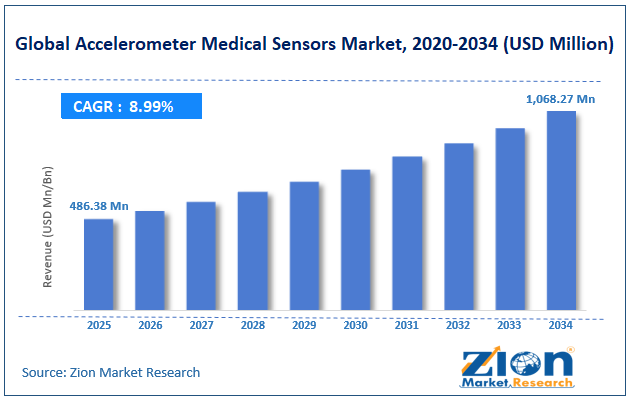
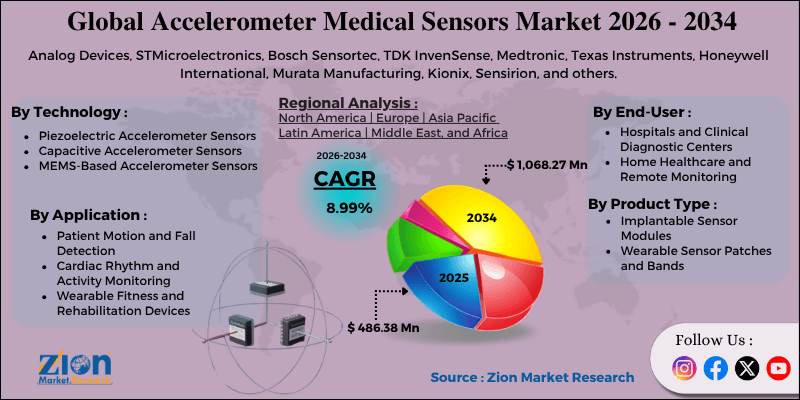
The global accelerometer medical sensors market size was worth approximately USD 486.38 million in 2025 and is projected to grow to around USD 1,068.27 million by 2034, with a compound annual growth rate of roughly 8.99% between 2026 and 2034.
 Request Free SampleRequest Free SampleRequest Free Sample
Key Insights
- As per the analysis shared by our research analyst, the global accelerometer medical sensors market is estimated to grow annually at a compound annual growth rate of around 8.99% over the forecast period from 2026 to 2034.
- In terms of revenue, the global accelerometer medical sensors market size was valued at approximately USD 486.38 million in 2025 and is projected to reach USD 1,068.27 million by 2034.
- The accelerometer medical sensors market is expected to grow steadily, driven by an aging population requiring fall-detection support, growing adoption of wearable health devices, expanding remote patient monitoring programs, rising cases of cardiac disease, and continuous improvements in sensor accuracy and battery life.
- Based on technology, MEMS-based accelerometer sensors are expected to lead the market, while piezoelectric accelerometer sensors are anticipated to grow steadily as demand rises for highly sensitive vibration and motion detection in medical devices.
- Based on application, patient motion and fall detection is expected to lead the accelerometer medical sensors market, while cardiac rhythm and activity monitoring is anticipated to grow rapidly, driven by rising cases of heart-related conditions worldwide.
- Based on end-user, hospitals and clinical diagnostic centers form the largest current end-user group, while home healthcare and remote monitoring are expected to grow rapidly during the forecast period as more patients choose to recover and manage conditions at home.
- Based on product type, wearable sensor patches and bands are expected to lead the market, while implantable sensor modules are anticipated to grow steadily as demand increases for continuous internal health monitoring.
- Based on region, North America is projected to dominate the global accelerometer medical sensors market during the estimated period, followed by Europe.
Accelerometer Medical Sensors Market: Overview
Accelerometer medical sensors are small electronic devices that detect body movement, vibration, and changes in motion, helping doctors monitor a patient's health, physical activity, and recovery more accurately. These sensors are used in many medical devices, including wearable fitness trackers, smartwatches, implantable heart devices, hospital monitoring systems, and rehabilitation equipment. They measure how a person moves, walks, sleeps, or exercises and provide valuable information to doctors and caregivers. This data helps detect falls, monitor recovery after surgery, track heart-related conditions, and identify unusual movement patterns that may indicate health problems. Most modern accelerometer medical sensors are built using advanced MEMS technology, making them very small, lightweight, accurate, and energy-efficient.
As more healthcare services move beyond hospitals, these sensors are becoming essential for remote patient monitoring and home healthcare. They allow doctors to track patients without frequent hospital visits, improving convenience and enabling earlier disease detection. The growing popularity of wearable health devices, the increasing elderly population needing fall detection, and the rising demand for personalized healthcare are driving growth in the accelerometer medical sensors market across hospitals, clinics, and home healthcare settings worldwide.
The accelerometer medical sensors industry is growing due to rising demand for remote patient monitoring, an aging global population, and continuous advancements in sensor miniaturization technology.
Impact of the USA-Israel War on Iran on the Accelerometer Medical Sensors Market
Tensions among the United States, Israel, and Iran could create short-term challenges for the medical sensor supply chain, particularly for semiconductor components and raw materials that transit affected trade regions. Some medical device manufacturers may experience temporary delays in sourcing certain electronic components, which could slow near-term production timelines. However, steady demand from hospitals, home healthcare providers, and wearable technology companies is expected to keep the accelerometer medical sensors market on a stable growth path despite short-term regional disruptions.
Accelerometer Medical Sensors Market: Technology Roadmap 2025–2034
What is the projected development roadmap for the accelerometer medical sensors market over the forecast period?
The accelerometer medical sensors market is progressing through smaller and more energy-efficient sensor designs, artificial intelligence-powered movement analysis, wireless data connectivity, and longer-lasting implantable sensor batteries. The market is expected to grow at a compound annual growth rate of around 8.99% over the forecast period, supported by rising global demand for remote health monitoring and wearable medical technology.
The following roadmap outlines key development phases expected through 2034.
2025–2027: Sensor Miniaturization and Wireless Connectivity Phase
- Manufacturers are expected to develop smaller, lighter accelerometer sensors that can be comfortably worn for extended periods without disturbing patients.
- Wireless data transmission between sensors and hospital monitoring systems is expected to expand, allowing doctors to track patient activity in real time from a distance.
- Improved battery efficiency is expected to extend the working life of wearable and implantable sensors, reducing the need for frequent recharging or replacement.
2028–2031: Artificial Intelligence and Predictive Health Monitoring Phase
- Companies are expected to combine accelerometer data with artificial intelligence software to detect early warning signs of falls, irregular heartbeats, or abnormal movement patterns before serious problems occur.
- Integration between accelerometer sensors and electronic health record systems is expected to grow, giving doctors a more complete picture of patient activity over time.
- Cloud-based platforms are expected to help hospitals and remote monitoring services manage sensor data from thousands of patients simultaneously, improving response times for at-risk individuals.
2032–2034: Fully Connected Smart Health Monitoring Phase
- Accelerometer sensors are expected to become part of larger connected health ecosystems that combine motion data with other vital signs for complete patient monitoring.
- Self-calibrating sensors are expected to reduce the need for manual adjustments, making long-term monitoring more reliable and less dependent on technician support.
- Fully automated alert systems are expected to notify caregivers and medical staff instantly when a fall, abnormal movement, or health concern is detected, thereby improving patient safety in both home and hospital settings.
Accelerometer Medical Sensors Market: Dynamics
Growth Drivers
Remote healthcare expansion is driving growth in the accelerometer medical sensors market.
The accelerometer medical sensors market is growing as more healthcare providers adopt remote patient monitoring and home healthcare services. These sensors help doctors and caregivers track a patient's movement, recovery, and overall health without requiring frequent hospital visits. The growing elderly population is driving demand for fall detection devices that can quickly alert family members or healthcare professionals during emergencies. Doctors are also using accelerometer-based devices to monitor heart conditions, physical activity, and recovery after surgery or injury. Hospitals and clinics are adopting these sensors to improve patient care while reducing the workload of healthcare staff.
At the same time, wearable devices such as fitness bands and smartwatches are becoming increasingly popular, encouraging people to monitor their health daily. Many governments are also expanding support for home healthcare programs, making motion-sensing medical devices more accessible. These trends are increasing demand for reliable, affordable, and easy-to-use accelerometer medical sensors across hospitals, clinics, and home healthcare settings worldwide.
How are rising investments in wearable health technology and rehabilitation programs driving the accelerometer medical sensors market?
The accelerometer medical sensors industry is growing as more healthcare providers invest in wearable health devices and improved rehabilitation programs. Hospitals, sports medicine centers, and home healthcare services are using these sensors to track patient movement and monitor recovery more accurately. Physical therapists use motion-tracking devices to measure a patient's progress after surgery, injury, or illness, helping them create more effective treatment plans.
As a result, the demand for accurate and reliable accelerometer medical sensors continues to increase. Medical device companies are developing smaller, lighter, and more comfortable sensors that patients can wear throughout the day without affecting their daily activities. Many hospitals are also adopting connected monitoring systems that combine movement data with other health information, giving doctors a more complete picture of a patient's condition and recovery. Sports medicine centers are using these sensors to monitor athletes, improve performance, and detect movement patterns that may lead to injuries. As wearable technology becomes more common and healthcare providers focus on personalized treatment and continuous patient monitoring, the use of accelerometer medical sensors is expected to grow steadily across hospitals, clinics, rehabilitation centers, and home healthcare settings worldwide.
Restraints
High development costs and concerns about data accuracy are key challenges in the accelerometer medical sensors market.
The accelerometer medical sensors market faces several challenges that may slow its growth. One of the biggest issues is the high cost of developing sensors that are accurate, reliable, and capable of detecting movement in everyday situations. For example, the sensors must distinguish a real fall from normal actions like sitting down or bending, which requires advanced technology and extensive testing. Many small hospitals and home healthcare providers, especially in developing countries, find it difficult to afford these advanced monitoring systems. Battery life is another concern, as wearable and implantable sensors need regular charging or replacement, which can be inconvenient for patients. Protecting patient data is also important because these sensors often transmit health information wirelessly to hospitals, necessitating robust cybersecurity systems. In addition, limited healthcare budgets in some regions make it harder for hospitals and clinics to invest in newer sensor technology. These challenges continue to slow the wider adoption of accelerometer medical sensors despite their many healthcare benefits.
Opportunities
Aging populations and wearable technology trends are driving growth in the accelerometer medical sensors market.
The accelerometer medical sensors market offers strong growth opportunities as the global elderly population increases and more people adopt wearable health devices. Many countries across the Asia-Pacific, Latin America, and the Middle East are seeing increased demand for fall detection and activity-monitoring solutions, creating new opportunities for sensor manufacturers. The growing popularity of smartwatches and fitness bands is also encouraging companies to develop advanced accelerometer sensors for both personal wellness and medical use. More families are choosing home monitoring devices to help keep elderly relatives safe by detecting falls and tracking daily activity.
At the same time, the expansion of telehealth services is increasing the need for sensors that support remote patient monitoring and virtual healthcare. Advances in MEMS technology are making these sensors smaller, more affordable, and easier to use, allowing more hospitals, clinics, and patients to access them. These trends are expected to drive long-term growth in the accelerometer medical sensors market while helping improve patient safety, support independent living, and make healthcare more accessible worldwide.
Challenges
What challenges does the accelerometer medical sensors market face in data reliability and workforce readiness amid rising competition?
The accelerometer medical sensors market faces several challenges that may affect its growth. One major challenge is ensuring that sensors accurately detect real health problems without confusing them with normal daily movements. Incorrect readings can lead to false alarms or missed warnings, reducing their effectiveness. Developing sensors that work well for people of different ages, body types, and activity levels requires advanced research, testing, and investment. Another challenge is the shortage of skilled professionals who can design, maintain, and improve these medical sensor systems.
As these devices become integrated with artificial intelligence and cloud-based healthcare platforms, the need for experts with both healthcare and technology expertise continues to grow. The market is also becoming more competitive as established medical device companies and new technology firms introduce advanced products at competitive prices. These factors can slow the adoption of new accelerometer medical sensors, especially for healthcare providers with limited technical resources or budgets.
 Request Free SampleRequest Free SampleRequest Free Sample
Accelerometer Medical Sensors Market: Report Scope
| Report Attributes | Report Details |
|---|---|
| Report Name | Accelerometer Medical Sensors Market |
| Market Size in 2025 | USD 486.38 Million |
| Market Forecast in 2034 | USD 1,068.27 Million |
| Growth Rate | CAGR of 8.99% |
| Number of Pages | 228 |
| Key Companies Covered | Analog Devices, STMicroelectronics, Bosch Sensortec, TDK InvenSense, Medtronic, Texas Instruments, Honeywell International, Murata Manufacturing, Kionix, Sensirion, and others. |
| Segments Covered | By Technology, By Application, By End-User, By Product Type, and By Region |
| Regions Covered | North America, Europe, Asia Pacific (APAC), Latin America, Middle East, and Africa (MEA) |
| Base Year | 2025 |
| Historical Year | 2020 - 2024 |
| Forecast Year | 2026 - 2034 |
| Customization Scope | Avail customized purchase options to meet your exact research needs. Request For Customization |
Accelerometer Medical Sensors Market: Segmentation
The global accelerometer medical sensors market is segmented by technology, application, end-user, product type, and region.
What makes MEMS-based accelerometer sensors the expected leader in the accelerometer medical sensors market?
Based on technology, the global accelerometer medical sensors market is segregated into piezoelectric, capacitive, MEMS-based, and piezo-resistive accelerometer sensors. MEMS-based accelerometer sensors hold about 43% of the market share, leading due to their compact size, low power consumption, and suitability for both wearable and implantable medical devices. Piezoelectric accelerometer sensors hold around 23% of the market share. It is one of the fastest-growing segments, driven by increasing demand for highly sensitive vibration detection in specialized diagnostic equipment.
How does the patient motion and fall detection application segment maintain its leading position in the accelerometer medical sensors market?
Based on application, the accelerometer medical sensors industry is categorized into patient motion and fall detection, cardiac rhythm and activity monitoring, wearable fitness and rehabilitation devices, and surgical and diagnostic equipment. The patient motion and fall detection segment accounts for about 34% of the global accelerometer medical sensors market, driven by an aging population and rising demand for home-based safety monitoring. The cardiac rhythm and activity monitoring segment holds around 28% of the market share. It is one of the fastest-growing segments, driven by rising cases of heart-related conditions and the growing adoption of implantable cardiac monitoring devices.
What makes hospitals and clinical diagnostic centers the leading end-users of accelerometer medical sensors?
Based on end-user, the market is classified into hospitals and clinical diagnostic centers, home healthcare and remote monitoring, medical device manufacturers, and rehabilitation and sports medicine centers. Hospitals and clinical diagnostic centers lead with about a 38% share, driven by their need for accurate patient-monitoring tools across various departments. Home healthcare and remote monitoring hold around 27% of the market share. It is growing rapidly as more patients choose to manage chronic conditions and recovery from the comfort of their own homes.
How do wearable sensor patches and bands dominate the product-type landscape in the accelerometer medical sensors market?
Based on product type, the accelerometer medical sensors market is divided into implantable sensor modules, wearable sensor patches and bands, standalone diagnostic sensor units, and sensor integrated circuit boards. Wearable sensor patches and bands account for about 40% of the market, due to their comfort, ease of use, and growing acceptance among both patients and healthcare providers. Implantable sensor modules hold around 22% share. They are growing steadily as demand for continuous, long-term internal health monitoring rises, particularly among cardiac patients.
Accelerometer Medical Sensors Market: Regional Analysis
What is driving North America's leadership in the accelerometer medical sensors market?
North America accounts for around 38% of the global accelerometer medical sensors market, making it the largest regional market. The region leads because of its advanced healthcare system, widespread use of wearable health devices, and growing demand for remote patient monitoring. The United States holds the largest share due to its large elderly population, high healthcare spending, and strong adoption of modern medical technologies. Hospitals, clinics, and home healthcare providers are increasingly using accelerometer medical sensors to monitor patient movement, detect falls, and support recovery after surgery or illness. The growing popularity of smartwatches, fitness bands, and other wearable devices is also increasing demand for these sensors. Canada is contributing to market growth by investing in home healthcare services, telehealth programs, and digital health technologies that allow doctors to monitor patients remotely.
Healthcare providers across the region are focusing on early disease detection, patient safety, and reducing hospital readmissions through continuous monitoring. Strong partnerships between medical device companies, technology firms, and healthcare organizations are driving innovation and improving sensor performance. These factors, along with the expansion of digital healthcare infrastructure and increasing awareness of preventive healthcare, continue to strengthen North America's position in the accelerometer medical sensors market.
What factors are supporting the expansion of the accelerometer medical sensors market across Europe?
Europe accounts for around 29% of the global accelerometer medical sensors market, making it the second-largest regional market. The region is growing because of its aging population, well-developed public healthcare systems, and increasing use of remote patient monitoring. Germany is the leading market due to its strong medical device industry, advanced healthcare facilities, and continuous investment in healthcare innovation. The United Kingdom is also seeing steady growth as more hospitals and healthcare providers use wearable devices and home monitoring systems to improve elderly care. France, Italy, the Nordic countries, and the Benelux region are expanding the use of accelerometer medical sensors in rehabilitation programs, chronic disease management, and patient monitoring.
Governments across Europe are investing in digital healthcare, telemedicine, and home-based care to improve patient outcomes and reduce healthcare costs. Medical device manufacturers are working closely with hospitals and research organizations to develop more accurate, comfortable, and reliable sensors. Rising awareness of preventive healthcare, increasing demand for wearable medical devices, and continuous improvements in healthcare technology are expected to support the long-term growth of the accelerometer medical sensors market across Europe.
Recent Market Developments
- In January 2026, Empatica received CE MDR certification for Parkinson's disease monitoring by integrating PKG movement algorithms with its wearable motion-sensing platform, strengthening its remote patient monitoring capabilities.
Accelerometer Medical Sensors Market: Competitive Analysis
The leading players in the global accelerometer medical sensors market are:
- Analog Devices
- STMicroelectronics
- Bosch Sensortec
- TDK InvenSense
- Medtronic
- Texas Instruments
- Honeywell International
- Murata Manufacturing
- Kionix
- Sensirion
The global accelerometer medical sensors market is segmented as follows:
By Technology
- Piezoelectric Accelerometer Sensors
- Capacitive Accelerometer Sensors
- MEMS-Based Accelerometer Sensors
- Piezo-resistive Accelerometer Sensors
By Application
- Patient Motion and Fall Detection
- Cardiac Rhythm and Activity Monitoring
- Wearable Fitness and Rehabilitation Devices
- Surgical and Diagnostic Equipment
By End-User
- Hospitals and Clinical Diagnostic Centers
- Home Healthcare and Remote Monitoring
- Medical Device Manufacturers
- Rehabilitation and Sports Medicine Centers
By Product Type
- Implantable Sensor Modules
- Wearable Sensor Patches and Bands
- Standalone Diagnostic Sensor Units
- Sensor Integrated Circuit Boards
By Region
- North America
- The U.S.
- Canada
- Mexico
- Europe
- France
- The UK
- Spain
- Germany
- Italy
- Rest of Europe
- Asia Pacific
- China
- Japan
- India
- Australia
- South Korea
- Rest of Asia Pacific
- The Middle East & Africa
- Saudi Arabia
- UAE
- Egypt
- Kuwait
- South Africa
- Rest of the Middle East & Africa
- Latin America
- Brazil
- Argentina
- Rest of Latin America
Table Of Content
Methodology
FrequentlyAsked Questions
Accelerometer medical sensors are small electronic devices that detect body movement, vibration, and changes in motion, helping doctors monitor a patient's health, physical activity, and recovery more accurately.
The global accelerometer medical sensors market is expected to grow, driven by an aging population requiring fall-detection support, growing adoption of wearable health devices, expanding remote patient monitoring services, rising cases of cardiac disease, and continuous improvements in sensor accuracy and battery performance.
According to research, the global accelerometer medical sensors market size was worth around USD 486.38 million in 2025 and is predicted to grow to around USD 1,068.27 million by 2034.
The compound annual growth rate value of the accelerometer medical sensors market is expected to be around 8.99% during 2026 to 2034.
North America is expected to lead the global accelerometer medical sensors market during the forecast period, driven by a rapidly aging population, strong adoption of wearable health technology, and significant investment in remote monitoring infrastructure.
The major players in the global accelerometer medical sensors market include Analog Devices, STMicroelectronics, Bosch Sensortec, TDK InvenSense, Medtronic, Texas Instruments, Honeywell International, Murata Manufacturing, Kionix, and Sensirion.
The report examines key aspects of the accelerometer medical sensors market, including growth drivers, restraints, emerging opportunities, challenges, a competitive landscape analysis, regional breakdowns, and a detailed future outlook across all major technologies, applications, end users, and geographies.
How are market trends and consumer preferences evolving in the accelerometer medical sensors market?
The accelerometer medical sensors market is shifting toward smaller, smarter, and more connected sensor designs, with growing preference for real-time health monitoring, artificial intelligence-powered movement analysis, and wearable devices that fit comfortably into daily life.
The accelerometer medical sensors market is advancing through artificial intelligence-powered fall prediction, smaller, more energy-efficient sensor designs, wireless, connected monitoring systems, and self-calibrating sensors, helping to improve accuracy, reliability, and patient safety across hospital and home care settings.
The accelerometer medical sensors market will grow in elderly fall detection, cardiac activity monitoring, rehabilitation progress tracking, and sports injury prevention, driven by aging populations, rising heart disease cases, and growing global interest in wearable health technology.

HappyClients

