
Global Wearable Fitness Tracker Market Size, Share, And Forecast 2032

Wearable Fitness Tracker Market By product type (smartwatches, activity monitors, and smart clothing), By wearing type (headwear, handwear, and legwear), By application (heart rate tracking, sleep measurement tracking, sport, running, cycling tracking, and glucose measurement tracking), By end-user (hospital and diagnostic centers, sport, and others) And By Region: - Global And Regional Industry Overview, Market Intelligence, Comprehensive Analysis, Historical Data, And Forecasts, 2024-2032
| Market Size in 2023 | Market Forecast in 2032 | CAGR (in %) | Base Year |
|---|---|---|---|
| USD 52.97 Billion | USD 371.24 Billion | 21.5% | 2023 |
Description
What is the Market size of the Wearable Fitness Tracker Industry?
According to the report published by Zion Market Research, the global Wearable Fitness Tracker Market size was valued at USD 52.97 Billion in 2023 and is predicted to reach USD 371.24 Billion by the end of 2032. The market is expected to grow with a CAGR of 21.5% during the forecast period. The report analyzes the global Wearable Fitness Tracker Market's growth drivers, restraints, and impact on demand during the forecast period. It will also help navigate and explore the arising opportunities in the Wearable Fitness Tracker industry.
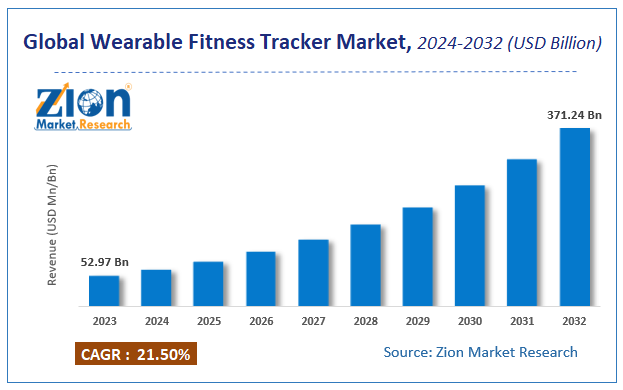
North America Wearable Fitness Tracker Market Sales and Revenue: The North America led the market with USD 17,740.69 million in 2023 and is expected to reach USD 100,715.51 million by 2032, growing at a CAGR of 21.31%. Growth is driven by high consumer awareness, strong presence of leading wearable technology companies, and early adoption of advanced fitness tracking devices.
Europe Wearable Fitness Tracker Market Sales and Revenue: The Europe accounted for USD 15,506.27 million in 2023 and is projected to reach USD 83,920.87 million by 2032, at a CAGR of 20.63%. Increasing health consciousness, expanding digital health ecosystems, and supportive regulatory frameworks are driving market expansion.
Asia Pacific Wearable Fitness Tracker Market Sales and Revenue: The Asia Pacific is the fastest-growing region, valued at USD 15,057.46 million in 2023 and forecast to reach USD 96,348.18 million by 2032, registering a CAGR of 22.96%. Rapid urbanization, a large tech-savvy population, and rising disposable incomes in countries like China and India are key growth drivers.
Latin America Wearable Fitness Tracker Market Sales and Revenue: The Latin America recorded USD 2,534.28 million in 2023 and is expected to reach USD 12,094.84 million by 2032, growing at a CAGR of 18.66%. Increasing awareness of fitness and improving access to wearable devices are supporting market growth.
Middle East Wearable Fitness Tracker Market Sales and Revenue: The Middle East market stood at USD 1,174.63 million in 2023 and is projected to reach USD 5,753.37 million by 2032, at a CAGR of 19.61%. Growth is driven by rising health awareness and increasing adoption of digital health solutions.
Africa Wearable Fitness Tracker Market Sales and Revenue: The Africa accounted for USD 957.40 million in 2023 and is expected to reach USD 4,559.18 million by 2032, growing at a CAGR of 17.87%. The market is gradually expanding with improving smartphone penetration and growing interest in fitness tracking technologies.
Global Wearable Fitness Tracker Market: Overview
A wearable fitness tracker is a device that is worn by the user to keep track of several body parameters throughout the day. The user needs to input physiological details including their height, weight, and gender to enable the tracker to use the collected data in a better sense. Such personalization helps to process the data that is been generated by the tracker. Several sensors can be added to the wearable fitness tracker but usually motion sensors are widely used to determine movements of the body.
Key Insights
- As per the analysis shared by our research analyst, the global Wearable Fitness Tracker Market is estimated to grow annually at a CAGR of around 21.5% over the forecast period (2024-2032).
- In terms of revenue, the global Wearable Fitness Tracker Market size was valued at around USD 52.97 Billion in 2023 and is projected to reach USD 371.24 Billion by 2032.
- Based on the product type, the smartwatches segment is the leading category in the wearable fitness tracker market. This dominance is driven by the increasing integration of advanced health monitoring features and the growing consumer preference for multifunctional devices that combine fitness tracking with communication and entertainment.
- Based on the wearing type, handwear (which includes smartwatches and wristbands) holds the largest market share. The convenience of wearing these devices on the wrist, combined with their ability to provide real-time data accessibility, makes them the preferred choice for consumers globally.
- Based on the application, heart rate tracking and running are among the most significant segments. The rising prevalence of lifestyle-related diseases and a growing emphasis on cardiovascular health have led to an increased demand for trackers that offer precise heart rate monitoring and activity-specific data for sports like cycling and running.
- Based on the end-user, the sport and hospital and diagnostic centers segments are major contributors to market growth. While fitness enthusiasts utilize these trackers for performance monitoring, healthcare providers are increasingly adopting them for remote patient monitoring and chronic disease management.
- Based on the region, North America leads the global wearable fitness tracker market, primarily due to its well-established healthcare infrastructure, high per capita income, and the early adoption of advanced medical fitness technologies. The presence of key market players and a tech-savvy population further solidify its leading position in the industry.
Global Wearable Fitness Tracker Market: Growth Factors
The global wearable fitness tracker market is growing at a rapid pace. Factors such as a change in lifestyle, increase in disposable income, and growing concerns of lifestyle-related diseases are augmenting the growth of the global wearable fitness tracker market. The use of wearable technology has enabled the user to live a healthier and fitter life owing to its ability to track fitness levels. It collects the data and converts it into metrics including sleep quality, steps count, general activity, calories burned, and much more. The wearable fitness tracker benefits the user by enabling to keep track of the progress, helps in setting achievable goals, monitor health, user-friendly interface, helps to stay motivated, and provides workout ideas that are been personalized to cater current fitness level of the user.
In addition to this, there is a rise in the prevalence of lifestyle-related diseases including obesity, heart diseases, stroke, and much more. To overcome such diseases, most people across the world are mainly focusing on their health and well-being with the prime preference being self-care. Thus, the broad spectrum of benefits offered by the wearable fitness tracker, rise in prevalence of the diseases, and consumer preference towards healthy lifestyle are the factors that are combinedly contributing to the growth of the global market. Furthermore, continuous development in wearable technology to offer the user advanced features will lead to several opportunities for the growth of the global wearable fitness tracker market over the forecast period. However, questionable accuracy, battery run-time, and high cost are some of the issues associated with wearable fitness trackers which may limit the growth of the global wearable fitness tracker market.
With the growing importance of a healthy lifestyle in the COVID-19 pandemic situation, the demand for wearable fitness devices is observed escalating. The COVID-19 infections affected almost all the regions around the world which show the importance of health to conquer such infections. this has resulted in high investment in wearable fitness devices. The growth of the market has seen more in developing countries where strong online shopping options are available.
Global Wearable Fitness Tracker Market: Segmentation
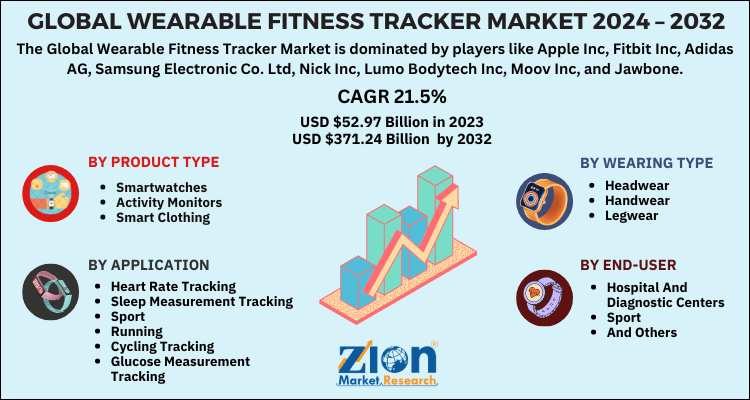
The global wearable fitness tracker market is bifurcated into product type, wearing type, application, end-user, and region.
Based on the product type, the segment is divided into smartwatches, activity monitors, and smart clothing.
Based on the wearing type, the global wearable fitness tracker market is split into headwear, handwear, and legwear.
The application segment is comprised of heart rate tracking, sleep measurement tracking, sport, running, cycling tracking, and glucose measurement tracking.
The end-user segment is bifurcated into the hospital and diagnostic centers, sport, and others.
Recent Developments:
- In September 2024, Masimo partnered with Qualcomm Technologies, Inc. to develop a next-generation smartwatch for OEMs producing Wear OS by Google devices, advancing wearable health technology.
- In July 2024, KORE, a Georgia-based IoT company, partnered with mCare Digital to launch the mCareWatch 241, a smartwatch for virtual patient monitoring. The device features emergency assistance, GPS tracking, call functionality, heart rate monitoring, reminders, fall detection, speed dialing, geofence alerts, a pedometer, and motion-detection alerts.
Wearable Fitness Tracker Market: Report Scope
| Report Attributes | Report Details |
|---|---|
| Report Name | Wearable Fitness Tracker Market |
| Market Size in 2023 | USD 52.97 Billion |
| Market Forecast in 2032 | USD 371.24 Billion |
| Growth Rate | CAGR of 21.5% |
| Number of Pages | 220 |
| Key Companies Covered | Apple Inc, Fitbit Inc, Adidas AG, Samsung Electronic Co. Ltd, Nick Inc, Lumo Bodytech Inc, Moov Inc, and Jawbone |
| Segments Covered | By Product Type, By Wearing Type, By Application, By End-User And By Region |
| Regions Covered | North America, Europe, Asia Pacific (APAC), Latin America, Middle East, and Africa (MEA) |
| Base Year | 2023 |
| Historical Year | 2018 - 2022 |
| Forecast Year | 2024 - 2032 |
| Customization Scope | Avail customized purchase options to meet your exact research needs. Request For Customization |
Global Wearable Fitness Tracker Market: Regional Analysis
Considering the geographical market positioning, North America is expected to dominate the global wearable fitness tracker market in terms of revenue. Factors such as well-established healthcare infrastructure, high adoption of wearable fitness devices owing to awareness regarding advanced medical fitness tools, high per capita income, presence of key market players, and high buying power of customers contributing to the large revenue in the market. Europe is expected to stay in the second position in the global wearable fitness tracker market. However, the rapid growth of the market is expected in Asia Pacific over the forecast period. Factors such as growing disposable income, growing awareness about healthy lifestyle, and availability of low-cost fitness devices in the region is expected to contribute to rapid revenue generation in this region.
Global Wearable Fitness Tracker Market: Competitive Players
The nature of the global wearable fitness tracker market is highly competitive, due to large growth opportunities in this market, key players are focusing to grab untouched market to increase the revenue. Major players operating in this market include:
- Apple Inc
- Fitbit Inc
- Adidas AG
- Samsung Electronic Co. Ltd
- Nick Inc
- Lumo Bodytech Inc
- Moov Inc
- Jawbone.
The Global Wearable Fitness Tracker Market is segmented as follows:
By Product Type
- Smartwatches
- Activity Monitors
- Smart Clothing
By Wearing Type
- Headwear
- Handwear
- Legwear
By Application
- Heart Rate Tracking
- Sleep Measurement Tracking
- Sport
- Running
- Cycling Tracking
- Glucose Measurement Tracking
By End-User
- Hospital And Diagnostic Centers
- Sport
- And Others
By Region
- North America
- The U.S.
- Canada
- Mexico
- Europe
- France
- The UK
- Spain
- Germany
- Italy
- Rest of Europe
- Asia Pacific
- China
- Japan
- India
- Australia
- South Korea
- Rest of Asia Pacific
- The Middle East & Africa
- Saudi Arabia
- UAE
- Egypt
- Kuwait
- South Africa
- Rest of the Middle East & Africa
- Latin America
- Brazil
- Argentina
- Rest of Latin America
What Reports Provides
- Full in-depth analysis of the parent market
- Important changes in market dynamics
- Segmentation details of the market
- Former, on-going, and projected market analysis in terms of volume and value
- Assessment of niche industry developments
- Market share analysis
- Key strategies of major players
- Emerging segments and regional markets
- Testimonials to companies in order to fortify their foothold in the market.
Table Of Content

FrequentlyAsked Questions
A wearable fitness tracker is a smart device worn on the body to monitor physical activity and health metrics. It tracks steps, heart rate, and sleep.
The global Wearable Fitness Tracker market is expected to be driven by the Growth is fueled by rising health awareness, increasing fitness adoption, and growing integration with smartphones and health apps. Demand for remote health monitoring supports expansion.
According to study, the global Wearable Fitness Tracker market size was worth around USD 52.97 Billion in 2023 and is predicted to grow to around USD 371.24 Billion By 2032.
The global Wearable Fitness Tracker market is expected to grow at a Compound Annual Growth Rate (CAGR) of around CAGR 21.5% during the forecast period from 2024-2032.
The global Wearable Fitness Tracker industry is projected to be challenged by Data privacy concerns; device commoditization; high competition and price pressure.
The Rising health awareness and preventive care focus; integration with healthcare ecosystems; growth in AI-based health analytics will offer significant growth opportunities in the Wearable Fitness Tracker market.
More advanced sensors (SpO2, skin temp, HRV) and AI coaching; improved battery life with efficient chipsets; medical-grade partnerships and regulated features for chronic condition monitoring are the emerging trends and innovations impacting the Wearable Fitness Tracker market.
The global Wearable Fitness Tracker market is expected to be led by APAC during the forecast period.
Some of the prominent players operating in the global Wearable Fitness Tracker market are; Apple Inc, Fitbit Inc, Adidas AG, Samsung Electronic Co. Ltd, Nick Inc, Lumo Bodytech Inc, Moov Inc, and Jawbone and others.
The report explores crucial aspects of the Wearable Fitness Tracker market, including a detailed discussion of existing growth factors and restraints, while also browsing future growth opportunities and challenges that impact the market.
HappyClients

