
Wrist Dive Computer Market Size, Share, Trends, Growth & Forecast 2034

Wrist Dive Computer Market By Display Type (AMOLED, MIP, E-ink and Hybrid (Dual-layer)), By Connectivity (Stand-alone (No Wireless), Bluetooth/Smartphone-synced and Air-integrated (Wireless Transmitter)), By End-User (Recreational/Civilian, Commercial and Military and Technical/Professional), By Distribution Channel (Online and Offline (Specialty Dive Shops and Mass Retail)), and By Region - Global and Regional Industry Overview, Market Intelligence, Comprehensive Analysis, Historical Data, and Forecasts 2025 - 2034
| Market Size in 2024 | Market Forecast in 2034 | CAGR (in %) | Base Year |
|---|---|---|---|
| USD 302 Million | USD 551 Million | 6.2% | 2024 |
Wrist Dive Computer Industry Perspective
What will be the size of the global wrist dive computer market during the forecast period?
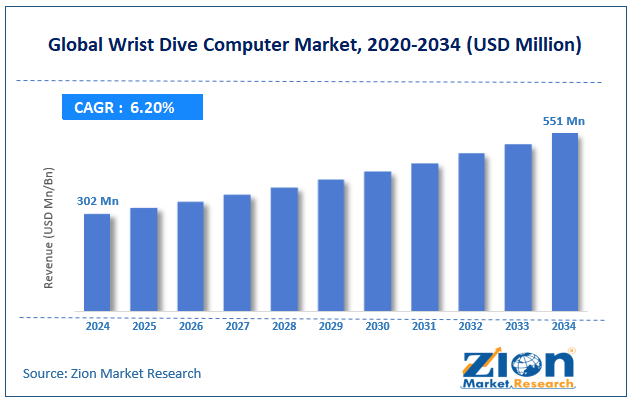
The global wrist dive computer market size was worth around USD 302 million in 2024 and is predicted to grow to around USD 551 million by 2034, with a compound annual growth rate (CAGR) of roughly 6.2% between 2025 and 2034.
Key Insights
- As per the analysis shared by our research analyst, the global wrist dive computer market is estimated to grow annually at a CAGR of around 6.2% over the forecast period (2025-2034).
- In terms of revenue, the global wrist dive computer market size was valued at around USD 302 million in 2024 and is projected to reach USD 551 million by 2034.
- Growth of online retail and direct-to-consumer channels is expected to drive the wrist dive computer market.
- Based on the display type, the AMOLED display type captures the largest revenue share of more than 40% in 2024.
- Based on the connectivity, the Bluetooth/smartphone-synced dominates the market in 2024, with over 42% revenue share.
- Based on the end-user, the recreational/civilian captures a significant market share in 2024, over 60%.
- Based on the distribution channel, the offline segment captures the largest revenue share of over 50% in 2024.
- Based on region, North America is expected to lead the wrist dive computer market over the projected period.
Wrist Dive Computer Market: Overview
A wrist dive computer is a diving instrument worn on the wrist that enables a diver to monitor and control key diving parameters on a single underwater device. The system displays essential navigational information to divers by displaying their current depth, dive time, ascent rate, decompression status, and surface interval duration. These instruments have found widespread use in recreational scuba diving, technical and free diving, and commercial underwater tasks. The wrist dive computer market experiences growth because of various factors, which include the rising numbers of people who participate in recreational diving and diving tourism activities, together with the continuous development of technological innovations, the increasing safety standards and regulatory requirements, the expansion of online retail and direct-to-consumer distribution channels, and the rising spending power of consumers who want to experience new things. However, limited awareness and technical complexity pose a significant challenge to market growth.
Wrist Dive Computer Market: Dynamics
Growth Drivers
Does the rising participation in recreational diving & diving tourism drive the wrist dive computer industry expansion?
The wrist dive computer market is growing as more people are interested in recreational diving and dive tourism. As more individuals are certified as divers and go on underwater adventures, the need for essential safety gear, especially personal dive computers, increases. More and more recreational divers are buying their own wrist dive computers instead of renting them. This is because they are worried about safety, cleanliness, and the retention of their own dive records. The growth and recovery of marine tourism, liveaboard diving vacations, and travel to tropical destinations all drive greater equipment sales.
Additionally, diving training organizations strongly recommend or require the use of dive computers during certification courses, thereby encouraging new divers to purchase them sooner. As more people get involved in new areas like Asia-Pacific and Latin America, the target consumer base grows, driving long-term revenue growth.
According to the Outdoor Industry Association, in 2021, 164.2 M Americans ages 6 and over participated in outdoor recreation at least once, the highest number on record.
Restraints
High initial cost/affordability barrier poses a significant restraint to the market growth
High start-up costs and affordability constraints are two major problems keeping the wrist dive computer business from growing. Advanced wrist dive computers that can connect to air, support many gases, track location with GPS, feature color displays, and connect wirelessly are often more expensive. This large initial investment may turn off new and infrequent divers, especially in markets where price is important. Many recreational divers may choose to rent gear from dive operators or use basic depth gauges and dive tables rather than buy their own. When disposable income and spending on recreational equipment are still low in developing countries, the cost problem is considerably more limited.
Additionally, continuous updates and enhancements to products could increase the total cost of ownership, making it more difficult for current customers to replace their products. Because of this, price sensitivity, especially in the entry-level market, remains a significant barrier to wider adoption and market entry.
Opportunities
Will the innovative product launch offer a development opportunity for the wrist dive computer market?
New and creative product launches are an excellent opportunity for the wrist dive computer market to flourish. The addition of AI-based dive algorithms, improved decompression modeling, longer battery life, solar charging, AMOLED displays, wireless air integration, GPS surface tracking, and smartphone connectivity are examples of continuous innovation that significantly enhance a product's value and user experience. These new features are interesting to both professional and technical divers, as well as to tech-savvy recreational customers who want wearable gear that can do a lot. The fact that dive computers can also serve as wristwatches (for fitness tracking, notifications, and multisport modes) makes them appealing to more than just conventional divers.
In a competitive market, producers can set their products by making them lighter for freediving, tougher for the military, and using eco-friendly materials. New product launches shorten the time between upgrades, increase average selling prices (ASPs), and create high-end market niches. Consequently, ongoing product innovation is a significant economic opportunity, as it makes products more appealing to customers, safer, and strengthens the brand's global position.
For instance, in November 2025, Suunto, a Finnish company that makes accurate equipment and diving technology, announced two new series of dive computers: the Suunto Nautic and the Suunto Nautic S. These new devices represent a big step forward in Suunto's dive history. They combine current technology with robust reliability to meet the needs of divers of all skill levels.
Challenges
Why do limited awareness and technical complexity hamper the wrist dive computer industry's growth?
Limited knowledge and technical complexity hinder growth in the wrist dive computer market due to several interconnected factors: First, many novice or casual divers in new diving areas don't know how useful a personal wrist dive computer can be. Some people think that rental gear, analog depth gauges, or old dive tables are all they need for recreational diving. This lack of knowledge about the product directly lowers the number of first-time buyers. Second, modern wrist dive computers are becoming increasingly complex.
For people new to this, features such as multi-gas settings, decompression algorithms, air-integration coupling, customizable safety stops, firmware upgrades, and Bluetooth log synchronization can be hard to understand. If users find the device difficult to set up or understand, they may postpone purchasing it or seek easier, cheaper alternatives.
Also, if the setup is wrong due to a lack of technical knowledge, it could lead to incorrect dive profiles, which could make inexperienced divers nervous because they don't trust using contemporary electronics below. Dive instructors may need to spend more time training, which can make it harder for students to learn.
Wrist Dive Computer Market: Report Scope
| Report Attributes | Report Details |
|---|---|
| Report Name | Wrist Dive Computer Market |
| Market Size in 2024 | USD 302 Million |
| Market Forecast in 2034 | USD 551 Million |
| Growth Rate | CAGR of 6.2% |
| Number of Pages | 218 |
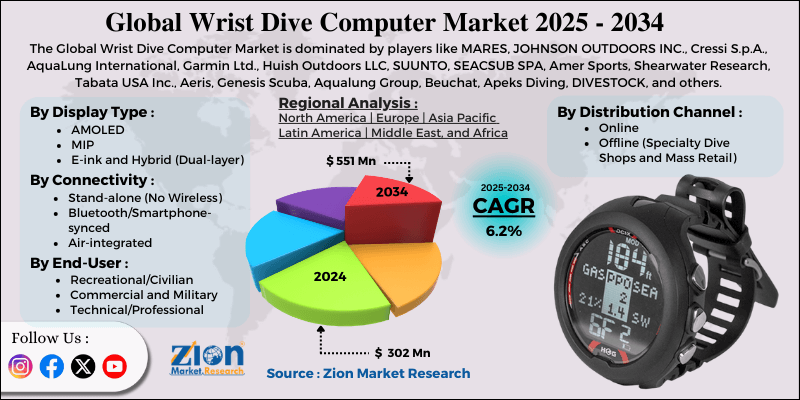
| Key Companies Covered | MARES, JOHNSON OUTDOORS INC., Cressi S.p.A., AquaLung International, Garmin Ltd., Huish Outdoors LLC, SUUNTO, SEACSUB SPA, Amer Sports, Shearwater Research, Tabata USA Inc., Aeris, Genesis Scuba, Aqualung Group, Beuchat, Apeks Diving, DIVESTOCK, and others. |
| Segments Covered | By Display Type, By Connectivity, By End-User, By Distribution Channel, and By Region |
| Regions Covered | North America, Europe, Asia Pacific (APAC), Latin America, Middle East, and Africa (MEA) |
| Base Year | 2024 |
| Historical Year | 2019 - 2023 |
| Forecast Year | 2025 - 2034 |
| Customization Scope | Avail customized purchase options to meet your exact research needs. Request For Customization |
Wrist Dive Computer Market: Segmentation
Display Type Insights
What factors make the AMOLED display type dominant in the wrist dive computer market over the projected period?
The AMOLED display type captures the largest revenue share of more than 40% in 2024. AMOLED displays are superior to conventional LCD or backlit displays in contrast, vibrant colors, deeper blacks, and readability under varying underwater lighting conditions. This is essential for divers who need to quickly and clearly view depth, time, and decompression data.
Also, more product launches are projected to help the market grow. Garmin released the Descent™ G2 diving computer in February 2025. It helps divers explore both underwater and above-water surroundings. The newest dive computer is ready for the next adventure. It supports many dive modes, from technical diving to freediving, and features popular features such as a dive readiness score and Garmin's health, fitness, and connected features. It also boasts an eco-friendly design, with parts made from recycled plastics that would have ended up in the water. In smartwatch mode, the battery can last up to 10 days, so the adventure can keep going. The Descent G2 has a 1.2" AMOLED display that lets one see more information at once, even when one's diving. The watch's case, bezel, and buttons are made of recycled polymers that would otherwise have ended up in the ocean, which is beneficial for the environment.
Connectivity Insights
What factor causes Bluetooth/smartphone-synced to be a dominant segment in the wrist dive computer market?
The Bluetooth/smartphone-synced dominates the market in 2024 with over 42% revenue share. Dive computers with Bluetooth can easily transfer dive logs, depth profiles, and safety information to cellphones and cloud platforms. This makes it easy for divers to view, evaluate, exchange, and store dive information without typing it or using other tools. This connection also enables it download new software and change the device's settings through apps. This encourages users to continue using it and makes it feel more useful.
End-User Insights
Why does the recreational/civilian segment dominate the wrist dive computer industry?
The recreational/civilian captures a significant market share in 2024, over 60%. Instead of renting gear or using simple gauges, more customers are opting for wrist-mounted dive computers to track depth, bottom time, and safety settings. Also, a number of individuals are taking vacations that include diving and other water sports. People are increasingly conscious of safety, want personalized dive records, and prefer wearable gear that integrates with mobile phones and online diving clubs. Many people who dive for enjoyment start with simple models and then move on to more advanced ones. This is beneficial for the market as a whole because it results in higher unit sales and stable revenue.
Distribution Channel Insights
Does the offline segment dominate the wrist dive computer market?
The offline segment captures the largest revenue share of over 50% in 2024. Diver equipment purchasing needs require current testing because technical dive equipment must be tested to help users determine proper fit, operational performance, and system effectiveness. Customers at dive shops, sporting goods stores, and specialty marine stores receive professional guidance on different products and assistance after purchase through installation support and warranty service.
People who use both physical stores and online shopping experience better purchasing outcomes, whereas store visitors make larger purchases than customers who shop exclusively online. First-time divers can access personal dive equipment through dive training centers and resort-based retailers that offer dive computers, certification courses, and rental packages. Manufacturers and retailers expand market access through the distribution of wrist dive computers via established offline networks, thereby enabling them to charge higher prices and generate sustained revenue growth
Regional Insights
Why does North America hold the largest share in the wrist dive computer market?
North America is expected to dominate the industry growth. The area has a long history of recreational diving, and many divers use advanced diving gear, which keeps demand for feature-rich gear high. Real-time dive safety, advanced sensors, Bluetooth/smartphone connectivity, and reliable decompression algorithms are very important to North American divers, especially in the US and Canada. This makes them want to buy high-end wrist dive computers. The presence of well-known stores, dive schools, and high disposable incomes makes it easy to purchase and update dive gear frequently.
A well-developed adventure tourism infrastructure also ensures that recreational and technical diving remain popular activities. These factors work together to make North America one of the top places in the world for wrist dive computer sales.
Wrist Dive Computer Market: Competitive Analysis
The global wrist dive computer market is dominated by players like:
- MARES
- JOHNSON OUTDOORS INC.
- Cressi S.p.A.
- AquaLung International
- Garmin Ltd.
- Huish Outdoors LLC
- SUUNTO
- SEACSUB SPA
- Amer Sports
- Shearwater Research
- Tabata USA Inc.
- Aeris
- Genesis Scuba
- Aqualung Group
- Beuchat
- Apeks Diving
- DIVESTOCK
The global wrist dive computer market is segmented as follows:
By Display Type
- AMOLED
- MIP
- E-ink and Hybrid (Dual-layer)
By Connectivity
- Stand-alone (No Wireless)
- Bluetooth/Smartphone-synced
- Air-integrated (Wireless Transmitter)
By End-User
- Recreational/Civilian
- Commercial and Military
- Technical/Professional
By Distribution Channel
- Online
- Offline (Specialty Dive Shops and Mass Retail)
By Region
- North America
- The U.S.
- Canada
- Mexico
- Europe
- France
- The UK
- Spain
- Germany
- Italy
- Rest of Europe
- Asia Pacific
- China
- Japan
- India
- Australia
- South Korea
- Rest of Asia Pacific
- The Middle East & Africa
- Saudi Arabia
- UAE
- Egypt
- Kuwait
- South Africa
- Rest of the Middle East & Africa
- Latin America
- Brazil
- Argentina
- Rest of Latin America
Table Of Content
Methodology
FrequentlyAsked Questions
A wrist dive computer is a type of diving tool worn on the wrist that allows a diver to monitor and control important diving parameters on a single underwater device. The system provides essential navigational information to divers, including their current depth, dive time, ascent rate, decompression status, and surface interval duration.
The wrist dive computer market experiences growth because of various factors, which include the rising numbers of people who participate in recreational diving and diving tourism activities, together with the continuous development of technological innovations, the increasing safety standards and regulatory requirements, the expansion of online retail and direct-to-consumer distribution channels, and the rising spending power of consumers who want to experience new things.
Limited awareness and technical complexity pose a significant challenge to market growth.
Based on the display type, the AMOLED segment is expected to dominate the Wrist Dive Computer market growth during the projected period.
Adoption of high-resolution AMOLED, OLED, and sunlight-readable screens enhances underwater readability and overall user experience, making devices more intuitive and premium-positioned.
According to the report, the global wrist dive computer market size was worth around USD 302 million in 2024 and is predicted to grow to around USD 551 million by 2034.
The global wrist dive computer market is expected to grow at a CAGR of 6.2% during the forecast period.
The global wrist dive computer industry growth is expected to be led by North America over the forecast period.
The global wrist dive computer market is dominated by players like MARES, JOHNSON OUTDOORS INC., Cressi S.p.A., AquaLung International, Garmin Ltd., Huish Outdoors, LLC, SUUNTO, SEACSUB SPA, Amer Sports, Shearwater Research, Tabata USA, Inc., Aeris, Genesis Scuba, Aqualung Group, Beuchat, Apeks Diving, and DIVESTOCK, among others.
The wrist dive computer market report covers the geographical market along with a comprehensive competitive landscape analysis. It also includes cash flow analysis, profit ratio analysis, market basket analysis, market attractiveness analysis, sentiment analysis, PESTLE analysis, trend analysis, SWOT analysis, trade area analysis, demand & supply analysis, Porter’s five forces analysis, and value chain analysis.

HappyClients

