
U.S. Regenerative Medicine Market Size, Analysis, Trends, Growth, Forecasts, 2032

U.S. Regenerative Medicine Market By Product (Cell-Based Immunotherapies and Gene Therapies), By Therapeutic Category (Oncology and Cardiovascular), and By Region - Industry Overview, Market Intelligence, Comprehensive Analysis, Historical Data, and Forecasts 2024 - 2032
| Market Size in 2023 | Market Forecast in 2032 | CAGR (in %) | Base Year |
|---|---|---|---|
| USD 17 Billion | USD 28 Billion | 16% | 2023 |
U.S. Regenerative Medicine Industry Perspective
What will be the U.S. regenerative medicine market size during the forecast period?
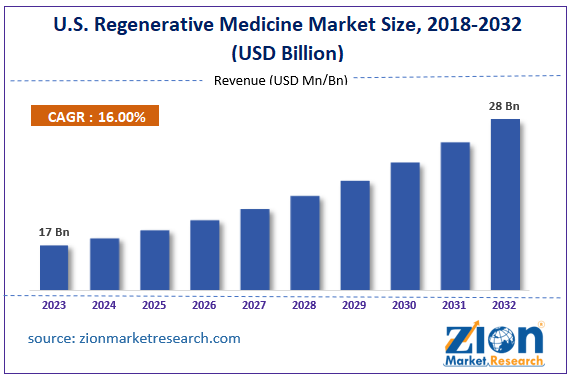
The U.S. regenerative medicine market size was evaluated at $17 billion in 2023 and is slated to hit $28 billion by the end of 2032 with a CAGR of nearly 16% between 2024 and 2032.
This report provides a comprehensive analysis of the growth drivers, restraints, and challenges shaping demand across the U.S. regenerative medicine market throughout the forecast period, while highlighting high-potential emerging opportunities within the industry.
Key Insights
- As per the analysis shared by our research analyst, the U.S. regenerative medicine market is projected to expand at an annual growth rate of around 16% over the forecast period (2024-2032)
- In terms of revenue, the U.S. regenerative medicine market size was evaluated at nearly $17 billion in 2023 and is expected to reach $28 billion by 2032.
- The U.S. regenerative medicine market is anticipated to grow rapidly over the forecast timeline owing to huge investments in the field of regenerative medicine and the setting up of new regenerative medicine units.
- In terms of product, the cell-based immunotherapies segment gained about 70% of the U.S. market proceeds in 2023 and is expected to register the highest gains due to its role as a key approach in regenerative medicine and its exceptional stem cell features for modulating the immune system
- Based on therapeutic category, the oncology segment accrued about 60% of the industry revenue in 2023 and is set to make major contributions toward industry share
- Region-wise, the northeastern region of the U.S., which accounted for half of the U.S. regenerative medicine market share in 2023, is expected to establish a leading position due to escalating demand from an aging populace prone to heart ailments and neurodegenerative diseases, strong healthcare infrastructure, and the launching of new medical therapies.
U.S. Regenerative Medicine Market: Overview
Regenerative medicine is a cutting-edge domain of science aiming to repair and replace damaged organs & issues. It can bring a paradigm shift in healthcare by providing key solutions to a wide spectrum of diseases. For the record, it helps restore organs and tissues damaged or altered due to old age, trauma, and disorders. Furthermore, the key approaches to regenerative medicine include cellular treatments, tissue engineering, and artificial organ use. Moreover, the U.S. FDA has already provided a green signal to the use of regenerative medicine in treating orthopedic injuries and wounds of dermatitis.
U.S. Regenerative Medicine Market: Growth Factors
Huge allocation of funds for producing new regenerative medicines to prompt market growth in the U.S.
Huge investments in the field of regenerative medicine and the setting up of new regenerative medicine units are expected to spur the growth of the U.S. regenerative medicine market. Apart from this, breakthroughs in tissue engineering, gene treatment, and cell therapies will expand the scope of growth of the market in the U.S. Moreover, a surge in the occurrence of chronic disorders and a rise in clinical trials testing new kinds of regenerative medicines will increase the size of the market in the U.S.
In addition to this, these regenerative medicines can minimize the burden of chronic ailments and deliver favorable outcomes. This, in turn, can optimize the growth of the market in the U.S. The need for treating burn injuries, heart disorders, neurological ailments, and diabetes has paved the way for exponential growth of the market in the U.S.
U.S. Regenerative Medicine Market: Restraints
Stringent legislation implemented by regulatory authorities to restrict the growth of the industry in the U.S.
Strict laws enforced by the U.S. FDA over approval of regenerative medicine products and uncertainty about the firms investing in the research activities related to product development can restrict the expansion of the U.S. regenerative medicine industry. Huge costs of regenerative treatments, along with a lack of insurance coverage for patients treated with regenerative medicine, can hamper the industry growth in the U.S.
U.S. Regenerative Medicine Market: Opportunities
The escalating demand for the product in the healthcare sector to open new avenues of growth for the U.S. market
Growing use of regenerative medicine for treating age-related disorders & injuries is anticipated to open new panoramas of growth for the U.S. regenerative medicine industry. Furthermore, breakthroughs in the field of genetic editing systems such as CRISPR can help the market explore new growth opportunities in the near future. Focus on healthcare reforms in various states of the U.S. and the development of value-based care models will help the market in the U.S. reach new heights of growth in the upcoming years.
U.S. Regenerative Medicine Market: Challenges
Growing topographical discrepancies can challenge the growth of the industry in the country
Ethical challenges regarding stem cell research activities and the non-availability of strong healthcare infrastructure amenities in some of the states of the U.S. can pose a big challenge to the expansion of the U.S. regenerative medicine industry. A surge in the geographic disparities in various states of the country can plummet the growth of the industry in the U.S.
U.S. Regenerative Medicine Market: Report Scope
| Report Attributes | Report Details |
|---|---|
| Report Name | U.S. Regenerative Medicine Market |
| Market Size in 2023 | USD 17 Billion |
| Market Forecast in 2032 | USD 28 Billion |
| Growth Rate | CAGR of 16% |
| Number of Pages | 255 |
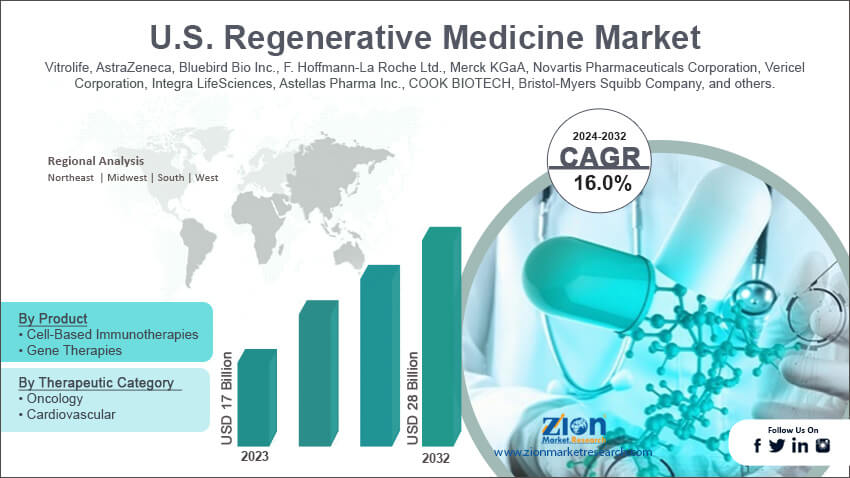
| Key Companies Covered | Vitrolife, AstraZeneca, Bluebird Bio Inc., F. Hoffmann-La Roche Ltd., Merck KGaA, Novartis Pharmaceuticals Corporation, Vericel Corporation, Integra LifeSciences, Astellas Pharma Inc., COOK BIOTECH, Bristol-Myers Squibb Company, and others. |
| Segments Covered | By Product, By Therapeutic Category, and By Region |
| Regions Covered in U.S. | Northeast, Midwest, South, and West |
| Base Year | 2023 |
| Historical Year | 2018 - 2022 |
| Forecast Year | 2024 - 2032 |
| Customization Scope | Avail customized purchase options to meet your exact research needs. Request For Customization |
U.S. Regenerative Medicine Market: Segmentation
The U.S. regenerative medicine market is divided into product, therapeutic category, and region. All the segments of the U.S. regenerative medicine market have been analyzed based on present and future trends and the market is estimated from 2024 to 2032.
In terms of product, the U.S. regenerative medicine market across the globe is bifurcated into cell-based immunotherapies and gene therapies segments. Additionally, the cell-based immunotherapies segment, which gained about 70% of the U.S. market proceeds in 2023, is expected to register the highest gains during the time interval from 2024 to 2032, subject to cell-based immunotherapy being a key approach in regenerative medicine and demonstrating exceptional stem cell features for modulating the immune system and promoting regeneration & tissue repair.
Based on the therapeutic category, the U.S. regenerative medicine industry is divided into oncology and cardiovascular segments. Additionally, the oncology segment, which accrued about 60% of the industry revenue in 2023, is set to make major contributions towards the industry share in the U.S. during the forecast timeframe owing to the surging occurrence of cancer along with conventional approaches by using stem cells.
U.S. Regenerative Medicine Market: Regional Insights
Why will the Northeastern region continue to dominate the U.S. market during the projection period?
Northeastern region, which accounted for half of the U.S. regenerative medicine market share in 2023, is expected to establish a leading position in the U.S. market in the ensuing years. In addition to this, the regional market surge in the forecast timeline can be a result of escalating demand for the product owing to an increase in the aging populace prone to heart ailments, neurodegenerative diseases, and heart ailments. The presence of a strong healthcare infrastructure and the launch of new medical therapies prop up the growth of the market in the region.
The southern regenerative medicine industry in the U.S. is predicted to register the highest growth rate annually in the next few years. The growth of the industry in the region can be due to the growing acceptance of regenerative medicine in the southern part of the U.S. Furthermore, an increase in the allocation of funds to the healthcare sector for improving healthcare infrastructure such as research institutes, hospitals, and clinics will prompt the growth of the industry in the region.
The Midwest and West regions contribute through expanding research activity, clinical trial participation, and gradual strengthening of healthcare infrastructure that supports broader access to regenerative therapies over the forecast period.
Key Developments
- In May 2024, Bioz Inc., a key AI-based software firm, entered into a strategic partnership with WiCell, a key player in cell line characterization & stem cell banking. Such strategic moves are likely to embellish the expansion of the regenerative medicine market in the U.S.
- In October 2023, Bayer AG opened a cell therapy & gene therapy production unit of about 1 00,000 square feet in California, the U.S.
U.S. Regenerative Medicine Market: Competitive Landscape
The U.S. regenerative medicine market profiles key players such as:
- Vitrolife
- AstraZeneca
- Bluebird Bio Inc.
- F. Hoffmann-La Roche Ltd.
- Merck KGaA
- Novartis Pharmaceuticals Corporation
- Vericel Corporation
- Integra LifeSciences
- Astellas Pharma Inc.
- COOK BIOTECH
- Bristol-Myers Squibb Company
Segments Covered
The U.S. regenerative medicine market is segmented as follows:
By Product
- Cell-Based Immunotherapies
- Gene Therapies
By Therapeutic Category
- Oncology
- Cardiovascular
The U.S.
- Northeast
- Midwest
- South
- West
Table Of Content
Methodology
FrequentlyAsked Questions
Regenerative medicine is a cutting-edge domain of science aiming to repair and replace damaged organs and tissues. It can bring a paradigm shift in healthcare by providing key solutions to a wide spectrum of diseases and helps restore organs and tissues damaged or altered due to old age, trauma, and disorders.
Key growth drivers include humungous investments in regenerative medicine, the setting up of new regenerative medicine units, breakthroughs in tissue engineering, gene treatment, and cell therapies, a surge in the occurrence of chronic disorders, and a rise in clinical trials testing new regenerative medicines.
According to a study, the U.S. regenerative medicine industry size was $17 billion in 2023 and is projected to reach $28 billion by the end of 2032.
The U.S. regenerative medicine market is anticipated to record a CAGR of nearly 16% from 2024 to 2032.
The northeastern region is expected to dominate the U.S. regenerative medicine market, having accounted for half of the market share in 2023, while the southern region is projected to register the fastest CAGR.
The U.S. regenerative medicine market is led by players such as Vitrolife, AstraZeneca, Bluebird Bio, Inc., F. Hoffmann-La Roche Ltd., Merck KGaA, Novartis Pharmaceuticals Corporation, Vericel Corporation, Integra LifeSciences, Astellas Pharma Inc., COOK BIOTECH, and Bristol-Myers Squibb Company.
The U.S regenerative medicine market report covers the geographical market along with a comprehensive competitive landscape analysis. It also includes cash flow analysis, profit ratio analysis, market basket analysis, market attractiveness analysis, sentiment analysis, PESTEL analysis, trend analysis, SWOT analysis, trade area analysis, demand & supply analysis, Porter’s five force analysis, and value chain analysis.

HappyClients

