
Global Stem Cells Market Size, Share, Growth Trends, And Forecasts 2032

Stem Cells Market: By Product Type (Pluripotent Cells, Human Embryonic Stem Cells, Adult Stem Cells, and Others), By Source (Allogeneic, and Autologous), By Application (Development & Drug Discovery, and Regenerative Medicine), and By End User (Tissue & Cell Banks, Therapeutic Companies, Service Companies, and Reagent & Tools Companies): Global Industry Perspective, Comprehensive Analysis and Forecast, 2024 - 2032
| Market Size in 2023 | Market Forecast in 2032 | CAGR (in %) | Base Year |
|---|---|---|---|
| USD 374.28 Million | USD 878.21 Million | 9.94% | 2023 |
How big is the Stem Cells Market?
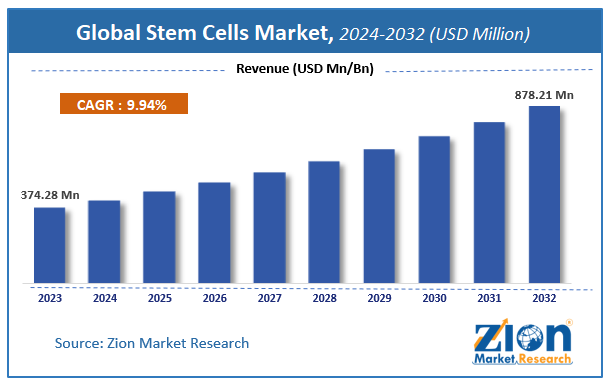
According to a report from Zion Market Research, the global Stem Cells Market was valued at USD 374.28 Million in 2023 and is projected to hit USD 878.21 Million by 2032, with a compound annual growth rate (CAGR) of 9.94% during the forecast period 2024-2032. This report explores market strengths, weakness, opportunities, and threats. It also provides valuable insights into the market's growth drivers, challenges, and the future prospects that may emerge in the Stem Cells industry over the next decade.
Stem Cells Market: Overview
The stem cell is one of the master cells of the human body; it has the capability to develop into anyone’s body with more than 200 plus cell types. Stem cells are undifferentiated cells that typically belong to the same family category (lineage). They preserve the capability to divide all through life and give augment to cells that can turn out to be extremely specialized and take the place of cells that doesn’t grow. Stem cells add to the body's ability to repair and renew its tissues and generate new cells of any tissue they belong to.
The market is characterized by intense research and development efforts aimed at harnessing the regenerative capabilities of these cells to restore or replace damaged tissues and organs. This field integrates various scientific disciplines, including genomics, proteomics, and tissue engineering, to create innovative treatment modalities. Beyond clinical applications, the market also includes the use of stem cells in drug toxicity testing and developmental biology research. The ecosystem involves academic institutions, pharmaceutical giants, and specialized biotech firms working in unison to translate laboratory findings into viable clinical solutions for global healthcare challenges.
Key Insights
- As per the analysis shared by our research analyst, the global stem cells market is projected to grow annually at a CAGR of around 9.94% over the forecast period (2024-2032).
- In terms of revenue, the global stem cells market size was valued at around USD 374.28 Million in 2023 and is projected to reach USD 878.21 Million by 2032.
- The market is driven by the rising incidence of chronic ailments such as cancer, diabetes, and cardiovascular diseases, coupled with substantial investments in stem cell research by both government and private entities.
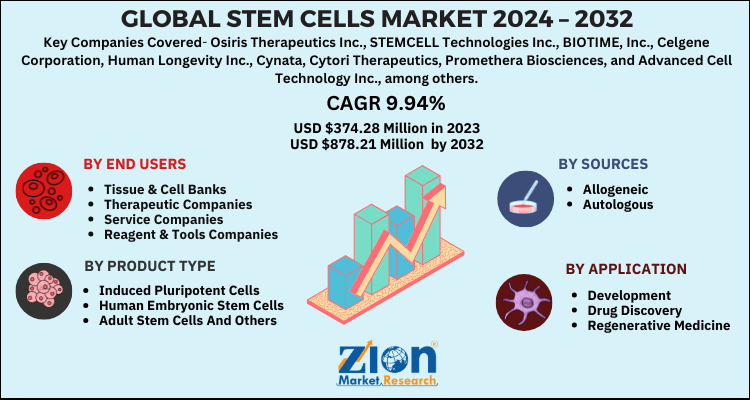
- Based on product type, the stem cell market is categorized into induced pluripotent cells, human embryonic stem cells, adult stem cells, and others.
- Based on sources, the market is bifurcated into allogeneic and autologous.
- Based on application, the stem cells market is classified into development & drug discovery, and regenerative medicine.
- Based on end users the market is divided into tissue & cell banks, therapeutic companies and service companies, and reagent & tools companies.
- North America dominated the global stem cells market with a share of 42% in 2025 owing to a robust healthcare infrastructure, high research expenditure, and a favorable regulatory environment for clinical trials in the United States.
Global Stem Cells Market: Dynamics
Growth Factors
Rising Prevalence of Chronic and Degenerative Diseases
The global increase in chronic conditions such as Parkinson's disease, Alzheimer's, Type 1 diabetes, and various forms of cancer is a primary driver for the stem cells market. As traditional treatments often only manage symptoms, there is a massive clinical pull toward stem cell-based therapies that offer the potential for tissue regeneration and functional recovery. This shift from palliative care to curative medicine is encouraging healthcare providers to adopt cellular therapies.
Furthermore, the aging global population is more susceptible to degenerative bone and joint disorders. Stem cells are increasingly being utilized in orthopedic applications to repair cartilage and bone tissue. This demographic trend ensures a steady and growing demand for advanced regenerative solutions, pushing the boundaries of current medical practice and fueling market expansion.
Restraints
Ethical Concerns and Stringent Regulatory Frameworks
Despite its potential, the stem cells market faces significant restraints due to ethical dilemmas, particularly concerning human embryonic stem cells (hESCs). The destruction of human embryos to harvest cells remains a highly controversial topic in several regions, leading to restrictive legislation and public opposition. These ethical hurdles can slow down research approvals and limit the availability of funding for certain types of stem cell studies.
Additionally, the regulatory pathway for stem cell therapies is exceptionally complex and rigorous. Navigating the requirements for clinical trials, manufacturing standards (GMP), and final market authorization requires immense time and financial resources. The uncertainty regarding long-term safety and the potential for tumor formation (tumorigenicity) in some stem cell types often leads to delayed approvals, hindering the rapid commercialization of new products.
Opportunities
Advancements in Induced Pluripotent Stem Cells (iPSCs) Technology
The emergence of induced pluripotent stem cells represents a massive opportunity for the market. By reprogramming adult cells back into a pluripotent state, scientists can bypass the ethical issues associated with embryonic cells while maintaining the ability to create any cell type in the body. This technology opens doors for personalized medicine, where treatments can be tailored to an individual's genetic makeup, significantly reducing the risk of immune rejection.
Moreover, iPSCs are becoming invaluable tools in the pharmaceutical industry for drug screening and toxicity testing. This "disease-in-a-dish" model allows researchers to observe how specific human cells react to new drugs before moving to clinical trials, potentially saving billions in drug development costs. The commercialization of iPSC-derived products is expected to be a major growth frontier in the coming decade.
Challenges
High Cost of Stem Cell Procedures and Processing
A major challenge facing the industry is the exorbitant cost associated with stem cell harvesting, processing, and therapeutic application. The specialized equipment, cleanroom environments, and highly skilled personnel required for cell culture and expansion make these treatments expensive. Consequently, stem cell therapies remain out of reach for a large portion of the global population, particularly in developing economies.
The lack of standardized protocols for cell characterization and large-scale manufacturing also poses a challenge. Ensuring the consistency, purity, and potency of cell batches across different production runs is difficult. Without cost-effective mass production techniques and better insurance reimbursement policies, the widespread adoption of stem cell therapies in mainstream clinical practice will remain limited.
Stem Cells Market: Report Scope
| Report Attributes | Report Details |
|---|---|
| Report Name | Stem Cells Market |
| Market Size in 2023 | USD 374.28 Million |
| Market Forecast in 2032 | USD 878.21 Million |
| Growth Rate | CAGR of 9.94% |
| Number of Pages | 110 |
| Key Companies Covered | Osiris Therapeutics Inc., STEMCELL Technologies Inc., BIOTIME, Inc., Celgene Corporation, Human Longevity Inc., Cynata, Cytori Therapeutics, Promethera Biosciences, and Advanced Cell Technology Inc., among others |
| Segments Covered | By Sources, By Product Type, By End Users, By Application And By Region |
| Regions Covered | North America, Europe, Asia Pacific (APAC), Latin America, Middle East, and Africa (MEA) |
| Base Year | 2023 |
| Historical Year | 2018 - 2022 |
| Forecast Year | 2024 - 2032 |
| Customization Scope | Avail customized purchase options to meet your exact research needs. Request For Customization |
Global Stem Cells Market: Segmentation
The global stem cell market is classified based on sources, product type, end users, application, and geography. All the segments have been analyzed based on present and future trends and the market is estimated from 2024 to 2032.
Based on product type, the stem cell market is categorized into induced pluripotent cells, human embryonic stem cells, adult stem cells, and others.
Based on sources, the market is bifurcated into allogeneic and autologous.
Based on application, the stem cells market is classified into development & drug discovery, and regenerative medicine.
Based on end users the market is divided into tissue & cell banks, therapeutic companies and service companies, and reagent & tools companies.
Global Stem Cells Market: Regional Analysis
North America to dominate the global market
North America is the leading region in the global stem cells market, a position it maintains due to its highly advanced healthcare infrastructure and significant government funding through agencies like the NIH. The United States is the dominating country in this region, housing the majority of the world's leading biotech companies and research institutions dedicated to cellular therapy. The region benefits from a well-defined regulatory framework that, while strict, provides a clear pathway for the approval of regenerative products. Furthermore, high patient awareness and the presence of a sophisticated insurance system facilitate the adoption of high-cost stem cell treatments, ensuring the region remains at the forefront of the industry.
Europe holds a substantial share of the market, driven by strong research initiatives in countries like Germany, the UK, and France. Germany is the dominating country in Europe, known for its excellence in clinical research and tissue engineering. The European market is characterized by collaborative research programs and a favorable environment for the development of Advanced Therapy Medicinal Products (ATMPs). The region's focus on ethical yet progressive stem cell policies allows for a diverse range of research, particularly in adult and induced pluripotent stem cell segments.
The Asia Pacific region is expected to witness the highest growth rate during the forecast period. China is the dominating country in this region, having invested billions in stem cell research and clinical trial facilities to become a global leader in biotechnology. Other countries like Japan and India are also contributing significantly; Japan, in particular, has pioneered some of the most advanced regulatory pathways for regenerative medicine to fast-track cell therapies. The large patient population and increasing healthcare spending in these emerging economies provide a fertile ground for market expansion and clinical trials.
Global Stem Cells Market: Competitive Players
Some of the major key players in the global stem cells market are
- Osiris Therapeutics Inc
- STEMCELL Technologies Inc
- BIOTIME, Inc
- Celgene Corporation
- Human Longevity Inc
- Cynata
- Cytori Therapeutics
- Promethera Biosciences
- Advanced Cell Technology Inc
The global stem cells market is segmented as follows:
By Product Type
- Pluripotent Cells
- Human Embryonic Stem Cell
- Adult Stem Cells
- Others
By Source
- Allogeneic
- Autologous
By Application
- Development & Drug Discovery
- Regenerative Medicine
By End User
- Tissue & Cell Banks
- Therapeutic Companies
- Service Companies
- Reagent & Tools Companies
By Region
- North America
- The U.S.
- Canada
- Mexico
- Europe
- France
- The UK
- Spain
- Germany
- Italy
- Rest of Europe
- Asia Pacific
- China
- Japan
- India
- Australia
- South Korea
- Rest of Asia Pacific
- The Middle East & Africa
- Saudi Arabia
- UAE
- Egypt
- Kuwait
- South Africa
- Rest of the Middle East & Africa
- Latin America
- Brazil
- Argentina
- Rest of Latin America
Table Of Content
Methodology
FrequentlyAsked Questions
Stem cells are unique human cells that have the ability to develop into many different cell types, from muscle cells to brain cells. They act as a biological repair system and are utilized in medicine to regenerate damaged tissues and treat various diseases through their self-renewing and transformative properties.
The primary drivers include the rising prevalence of chronic and age-related diseases, increasing investments in biotechnology R&D, advancements in induced pluripotent stem cell (iPSC) technology, and a growing global focus on regenerative medicine as a curative alternative to traditional therapies.
The market was valued at USD 374.28 Million in 2023 and is projected to reach a value of USD 878.21 Million by 2032.
The global stem cells market is expected to grow at a Compound Annual Growth Rate (CAGR) of 9.94% during the forecast period of 2024 - 2032.
Key challenges include the high cost of cellular therapies, ethical controversies surrounding embryonic stem cells, complex regulatory approval processes, and technical difficulties in the large-scale manufacturing of consistent and pure cell batches.
Emerging trends include the integration of 3D bioprinting with stem cells to create organoids, the use of CRISPR gene editing to enhance cell therapies, and the shift toward off-the-shelf allogeneic stem cell products that do not require patient-specific harvesting.
The value chain consists of cell sourcing and acquisition, laboratory research and cell line development, large-scale cell expansion and processing, cryopreservation and storage, clinical trial validation, and finally, therapeutic application or integration into drug discovery programs.
North America is expected to remain the largest contributor to market value due to its advanced research ecosystem, while the Asia Pacific region is anticipated to show the fastest growth due to rising healthcare investments and supportive regulations in China and Japan.
Major players include Osiris Therapeutics Inc., STEMCELL Technologies Inc., BIOTIME, Inc., Celgene Corporation, Human Longevity Inc., Cynata, Cytori Therapeutics, Promethera Biosciences, and Advanced Cell Technology Inc., among others, all of whom are investing heavily in cell culture media, processing technologies, and clinical-stage cell therapies.
The report provides a comprehensive analysis of market trends, revenue forecasts, competitive landscapes, and deep dives into segment-specific growth. It offers strategic insights into technological advancements, regulatory shifts, and regional opportunities for stakeholders and investors.

HappyClients

