
Shaving Market Size, Trend, Growth, Industry Analysis 2034

Shaving Market By Product (Beard Moisturizers, Razors & Blades, After-Shave Emulsion, and Pre-Shave Cream), By Distribution Channel (Online Stores and Retail Stores), and By Region - Global and Regional Industry Overview, Market Intelligence, Comprehensive Analysis, Historical Data, and Forecasts 2026 - 2034
| Market Size in 2025 | Market Forecast in 2034 | CAGR (in %) | Base Year |
|---|---|---|---|
| USD 39.71 Billion | USD 54.87 Billion | 3.60% | 2025 |
Shaving Industry Perspective:
What is the anticipated size of the shaving market during the projection period?
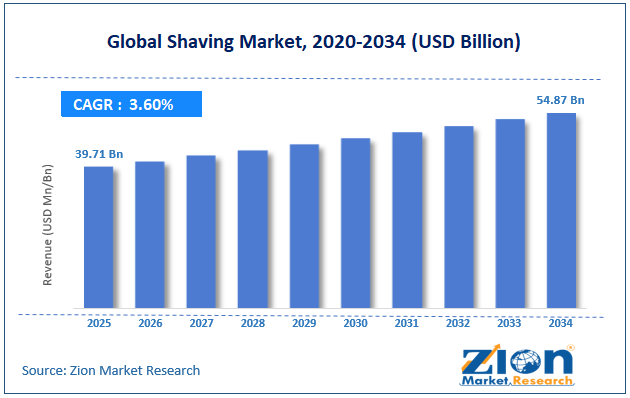
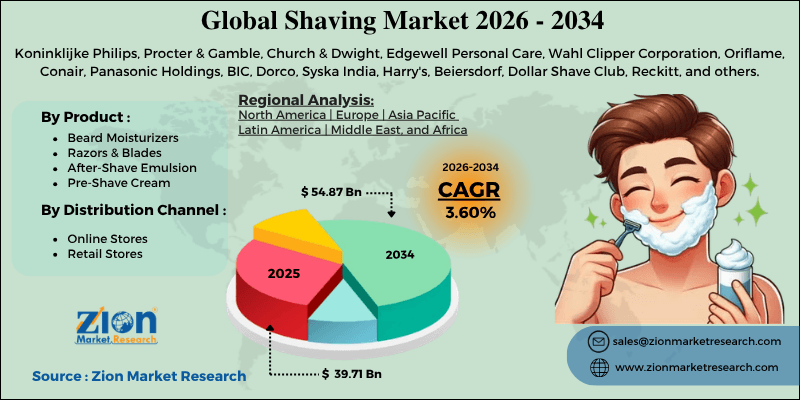
The global shaving market size was worth around USD 39.71 billion in 2025 and is predicted to grow to around USD 54.87 billion by 2034, with a compound annual growth rate (CAGR) of roughly 3.60% between 2026 and 2034.
Key Insights:
- As per the analysis shared by our research analyst, the global shaving market is estimated to grow annually at a CAGR of around 3.60% over the forecast period (2026-2034)
- In terms of revenue, the global shaving market size was valued at around USD 39.71 billion in 2025 and is projected to reach USD 54.87 billion by 2034.
- The shaving market is projected to grow at a significant rate due to the growing population and disposable income.
- Based on the product, the razors & blades segment is growing at a high rate and will continue to dominate the global market as per industry projections.
- Based on the distribution channel, the retail stores segment is anticipated to command the largest market share.
- Based on region, Asia-Pacific is projected to dominate the global market during the forecast period.
Shaving Market: Overview
The shaving market deals with the production, marketing, and distribution of cosmetic products specially designed for shaving applications. These products are used by men and women for desired shaving. According to market analysis, most shaving products are available as gel or aerosol foam, allowing effective removal of unwanted hair and grooming. The shaving sector deals with a range of hair removal products, including pre-shaving kits, razors, creams, and post-shaving products. During the forecast period, the global shaving market is anticipated to be driven by the growing population, heightened public awareness, product innovation, and the impact of quick commerce on the commercial ecosystem.
In addition, organic or chemical-free shaving items and companies with sustainable business practices are likely to witness accelerated growth. However, tough competition, lower brand loyalty, safety concerns, and the environmental impact of overconsumption may impact market revenue in the long run.
Shaving Market: Dynamics
Growth Drivers
How will the growing population and disposable income influence the shaving market growth?
The global shaving market is projected to be driven by the growing population and rising disposable income. The increase in job opportunities and the evolving lifestyles of the general population have accelerated demand for personal care products, such as shaving items. According to official reports, the average household disposable income per capita is over USD 10,500. Although the number varies from region to region, the consensus indicates a steady increase in disposable income.
Heightened awareness about hygiene and personal grooming to aid market expansion
Shaving products are an essential part of an everyday personal grooming kit. They are essential for maintaining an individual’s hygiene as shaving products remove unwanted hair from different body parts. Regular shaving promotes skin health by removing dead cells. In addition, shaving prevents bacterial infection as facial hair harbors bacteria. A study published by the Journal of Hospital Infection concluded that healthcare officials without facial hair were less likely to carry methicillin-resistant Staphylococcus aureus (MRSA). Regular shaving is also associated with mental, psychological, and social benefits, driving industry revenue.
Restraints
Which factors will emerge as leading growth limitations for the shaving market?
The global shaving market is projected to be restricted due to high competition from similar products and electric variants. The market is filled with several brands and sub-brands targeting the same set of audience. An excessive number of options in the market can be overwhelming for consumers. In addition, electric shaving kits have longer replacement cycles, limiting market revenue. Electric shavers can last over a decade if maintained well. As more consumers shift toward electric variants, brands offering gel-based or conventional razors may face growth barriers.
Opportunities
Natural, chemical-free, and skin-friendly shaving solutions to open new doors for growth
The global shaving industry is projected to see growth opportunities in the form of growing demand for chemical-free, organic, and skin-friendly products. Conventional shaving gels, creams, and razors can lead to skin irritation, especially for customers with highly sensitive skin. Shaving companies are integrating natural elements such as aloe vera, essential oils, and kokum butter as essential components of shaving products.
For instance, popular personal care brand Forest Essentials produces shaving creams made of orange peel and sandalwood. In July 2026, Braun, a leading provider of electric shavers and other grooming products, launched Braun NEVO. It is a new generation of premium electric shavers equipped with AeroTouch™ technology. It delivers precise results with less friction, thus ensuring a smooth shaving experience.
What will be the role of e-commerce and quick commerce sectors in the shaving market?
E-commerce and quick commerce industries have fueled growth in the global shaving market. These sectors offer access to a wider range of options, including at-home delivery. Investments in Artificial Intelligence (AI) and Machine Learning (ML) to track consumer buying behavior and enhance customer service have expanded the number of consumers buying products online. As per industry analysis, more than 28.5% of personal hygiene and grooming products are bought through online sales channels.
Challenges
Low-quality and counterfeit products to challenge industry growth trajectory
The global shaving industry is anticipated to be challenged by the rising distribution of low-quality and counterfeit products. Official investigations conclude that over 66.9% of beauty products across digital third-party portals are fake items. The European Union Intellectual Property Office estimates that the region loses over 4.8% of total sales due to the distribution of counterfeit products.
Shaving Market: Report Scope
| Report Attributes | Report Details |
|---|---|
| Report Name | Shaving Market |
| Market Size in 2025 | USD 39.71 Billion |
| Market Forecast in 2034 | USD 54.87 Billion |
| Growth Rate | CAGR of 3.60% |
| Number of Pages | 227 |
| Key Companies Covered | Koninklijke Philips, Procter & Gamble, Church & Dwight, Edgewell Personal Care, Wahl Clipper Corporation, Oriflame, Conair, Panasonic Holdings, BIC, Dorco, Syska India, Harry's, Beiersdorf, Dollar Shave Club, Reckitt, and others. |
| Segments Covered | By Product, By Distribution Channel, and By Region |
| Regions Covered | North America, Europe, Asia Pacific (APAC), Latin America, Middle East, and Africa (MEA) |
| Base Year | 2025 |
| Historical Year | 2020 - 2024 |
| Forecast Year | 2026 - 2034 |
| Customization Scope | Avail customized purchase options to meet your exact research needs. Request For Customization |
Shaving Market: Segmentation
The global shaving market is segmented based on product, distribution channel, and region.
Why will the razors & blades segment lead the shaving industry revenue during the forecast period?
Based on product, the global market segments are beard moisturizers, razors & blades, after-shave emulsion, and pre-shave cream. In 2025, the highest growth was listed in the razor & blades segment. It accounted for over 71% of the global revenue. During the forecast period, the razor & blades segment will continue leading the market with a CAGR of 5.1%. Product innovation, higher consumer preference, and cost-effectiveness are major segmental growth propellers.
Which will be the fastest-growing distribution channel during the forecast period in the shaving market?
Based on distribution channel, the global market divisions are online stores and retail stores. In 2025, the market was dominated by the retail stores segment, accounting for 81% of global returns. During the forecast period, online stores may emerge as the fastest-growing segment with a CAGR of 7.52%. Personal care companies are actively opting for online sales either through company-owned websites and applications or by collaborating with existing third-party channels, especially personal care-related portals.
Shaving Market: Regional Analysis
Why will North America lead the shaving market in the coming years?
The global shaving market is currently led by North America. In 2025, it accounted for 40.5% of global revenue and is projected to grow at a CAGR of 4.31% during the forecast period. Consumers across the North American market spend more on premium personal grooming items. In addition, the region reports overconsumption in the personal care industry, fueling demand for shaving products. The presence of prominent, globally operating shaving companies across the US and Canada will further aid regional dominance.
Why will Asia-Pacific generate the fastest CAGR in the shaving market during the forecast period?
Asia-Pacific is expected to emerge as the fastest-growing region in the shaving market with a CAGR of 6.52% during the forecast period. In 2025, it accounted for 28% of the global revenue. A growing consumer base, rising disposable income, and increased awareness of personal hygiene will propel regional growth. Furthermore, the steady expansion of online retailers and a greater focus on natural or organic shaving creams will open new avenues for regional market growth.
Shaving Market: Competitive Analysis
The global shaving market is led by players like:
- Koninklijke Philips
- Procter & Gamble
- Church & Dwight
- Edgewell Personal Care
- Wahl Clipper Corporation
- Oriflame
- Conair
- Panasonic Holdings
- BIC
- Dorco
- Syska India
- Harry's
- Beiersdorf
- Dollar Shave Club
- Reckitt
What are the latest key trends in the shaving market?
Reduced packaging
Companies offering shaving products are working to reduce packaging to appeal to eco-conscious consumer groups. This will help reduce packaging waste and promote brand value in the long run.
Expansion of women-oriented products
Rising demand for skin-sensitive razors and other shaving products designed for women consumers has increased industry revenue in recent years. Increasing female workforce and the use of shaving products in the entertainment industry are prominent market growth drivers.
The global shaving market is segmented as follows:
By Product
- Beard Moisturizers
- Razors & Blades
- After-Shave Emulsion
- Pre-Shave Cream
By Distribution Channel
- Online Stores
- Retail Stores
By Region
- North America
- The U.S.
- Canada
- Mexico
- Europe
- France
- The UK
- Spain
- Germany
- Italy
- Rest of Europe
- Asia Pacific
- China
- Japan
- India
- Australia
- South Korea
- Rest of Asia Pacific
- The Middle East & Africa
- Saudi Arabia
- UAE
- Egypt
- Kuwait
- South Africa
- Rest of the Middle East & Africa
- Latin America
- Brazil
- Argentina
- Rest of Latin America
Table Of Content
Methodology
FrequentlyAsked Questions
The shaving market deals with the production, marketing, and distribution of cosmetic products specially designed for shaving applications.
The global shaving market is projected to be driven by the growing population and disposable income.
According to study, the global shaving market size was worth around USD 39.71 billion in 2025 and is predicted to grow to around USD 54.87 billion by 2034.
The CAGR value of the shaving market is expected to be around 3.60% during 2026-2034.
The global shaving industry is anticipated to be challenged by the rising distribution of low-quality and counterfeit products.
Reduced packaging and expansion of women-oriented products are the emerging trends and innovations impacting the shaving market.
The global shaving market has performed well so far and will offer similar trends in the coming years.
Asia-Pacific will contribute notably towards the shaving market value.
The global shaving market is led by players like Koninklijke Philips, Procter & Gamble, Church & Dwight, Edgewell Personal Care, Wahl Clipper Corporation, Oriflame, Conair, Panasonic Holdings, BIC, Dorco, Syska India, Harry's, Beiersdorf, Dollar Shave Club, and Reckitt.
The report explores crucial aspects of the shaving market, including a detailed discussion of existing growth factors and restraints, while also browsing future growth opportunities and challenges that impact the market.

HappyClients

